

Manager mental health training teaches leaders to spot early warning signs, hold supportive, non-clinical conversations, and connect struggling staff with the right help. It builds real capability across a team, not just tick-box awareness. The next step is straightforward: pick an accredited, interactive manager-focused course, or run a short pilot with one team before rolling it out further.
TL;DR:
- Accredited, interactive courses with scenario practice and clear referrals improve managers' ability to spot signs of distress and hold supportive conversations.
- Online, blended, or multi-day qualifications with proper accreditation and follow-up sessions offer better long-term behavior change than one-off workshops.
- Formal training combined with senior leadership sponsorship and peer coaching significantly increases the likelihood of lasting cultural change.
- Effectiveness metrics should include training completion, manager confidence, and sickness absence trends over six to twelve months, rather than clinical outcomes.
- Post-training, tools like therapy navigation platforms help managers guide staff toward professional support, ensuring referrals lead to appropriate care.
Table of Contents
- What types of manager mental health training exist?
- What will managers actually learn on a good course?
- Does manager mental health training actually work?
- How do you choose and roll out training across a business?
- What does successful implementation actually look like?
- What goes wrong when rolling out training, and how do you fix it?
- Publisher perspective: lessons from watching rollouts succeed and fail
- What happens after a manager makes a referral?
- Sources
What types of manager mental health training exist?
Not all manager mental health training courses UK-based leaders find online do the same job, and picking the wrong type wastes both budget and goodwill. Broadly, you're choosing between awareness training, prevention-focused manager training, and formally accredited qualifications.
Awareness courses, the kind popularised by Mental Health First Aid (MHFA) England, give managers a grounding in recognising distress and reducing stigma. They're a solid starting point for organisations new to the topic. Prevention-focused manager training goes further. It builds specific skills for line managers, things like structuring a return-to-work conversation or adjusting workload without singling someone out, and tends to suit organisations who already have basic awareness embedded and want practical follow-through.
Mind's "Managing mental health at work" course sits closer to this second category, aimed squarely at people-management responsibilities rather than general staff awareness. Red Cross and St John Ambulance also run manager-oriented sessions, often blending first-aid principles with psychological support basics.
Delivery formats vary widely:
- eLearning modules — self-paced, typically 1 to 3 hours, good for baseline knowledge across large teams.
- Half-day or one-day workshops — interactive, scenario-based, better for building conversational confidence.
- Blended programmes — eLearning plus live facilitation, often spread over several weeks.
- Multi-day accredited courses — Level 3 qualifications, such as those offered through the Wellbeing Lead Academy using OCN-C4L accreditation, running across multiple sessions with assessed outcomes.
Accreditation matters more than most buyers realise. Check who issued the certificate, whether it carries CPD (Continuing Professional Development) approval, and whether it has an expiry or renewal requirement. A course with no named accrediting body is not necessarily poor, but it makes verifying quality much harder.
What will managers actually learn on a good course?
A strong course builds specific, repeatable skills rather than general sensitivity. Managers should come away able to do the following:
- Spot early signs — changes in attendance, performance, or behaviour that suggest someone is struggling.
- Open a supportive conversation — using non-judgemental, open-ended questions rather than leading ones.
- Hold boundaries — knowing where support ends and professional treatment begins.
- Make an appropriate referral — to an employee assistance programme, occupational health, or external services.
- Agree reasonable adjustments — practical changes to workload, hours, or duties.
- Follow up consistently — checking in without becoming intrusive.
The strongest programmes are explicit about the line between observation and diagnosis. Managers are trained to notice and act, never to label or assess a clinical condition. Harvard Business Review's guidance on manager support for employee mental health frames this well: the highest-impact actions are behavioural, not clinical, things like modelling openness, checking in regularly, and signposting clearly.
Look for scenario practice in any course you're evaluating, for instance, role-playing a conversation with someone who's been withdrawn for weeks, or rehearsing how to raise a performance dip without assuming the cause.
Pro Tip: Ask the provider for a sample scenario script before booking. If they can't show you one, the course is likely theory-heavy and light on practical rehearsal.
Does manager mental health training actually work?
The evidence points in a genuinely encouraging direction, though it comes with caveats worth understanding before you commit budget.
Company-level data analysed in PLOS ONE's study on line manager training and organisational outcomes found that employers offering this training reported better staff recruitment, improved retention, and reduced long-term sickness absence. That's a meaningful signal for anyone trying to build a business case, because it ties training directly to costs HR and finance teams already track.
Training cascaded from senior leadership, paired with ongoing reinforcement, tends to outperform a single standalone session. A one-off workshop can raise awareness, but it rarely changes behaviour on its own.
A pilot randomised controlled trial reported in JMIR Mental Health's Managing Minds at Work study found that web-based interactive manager training produced measurable improvements in managers' confidence, mental health knowledge, and workplace competencies at three-month follow-up. That's a genuinely useful data point: it's one of the few controlled trials in this space, and it supports digital and blended formats specifically, not just in-person workshops.
The Thriving at Work review reinforces the policy case, recommending executive and managerial involvement as a core plank of workplace mental health strategy.
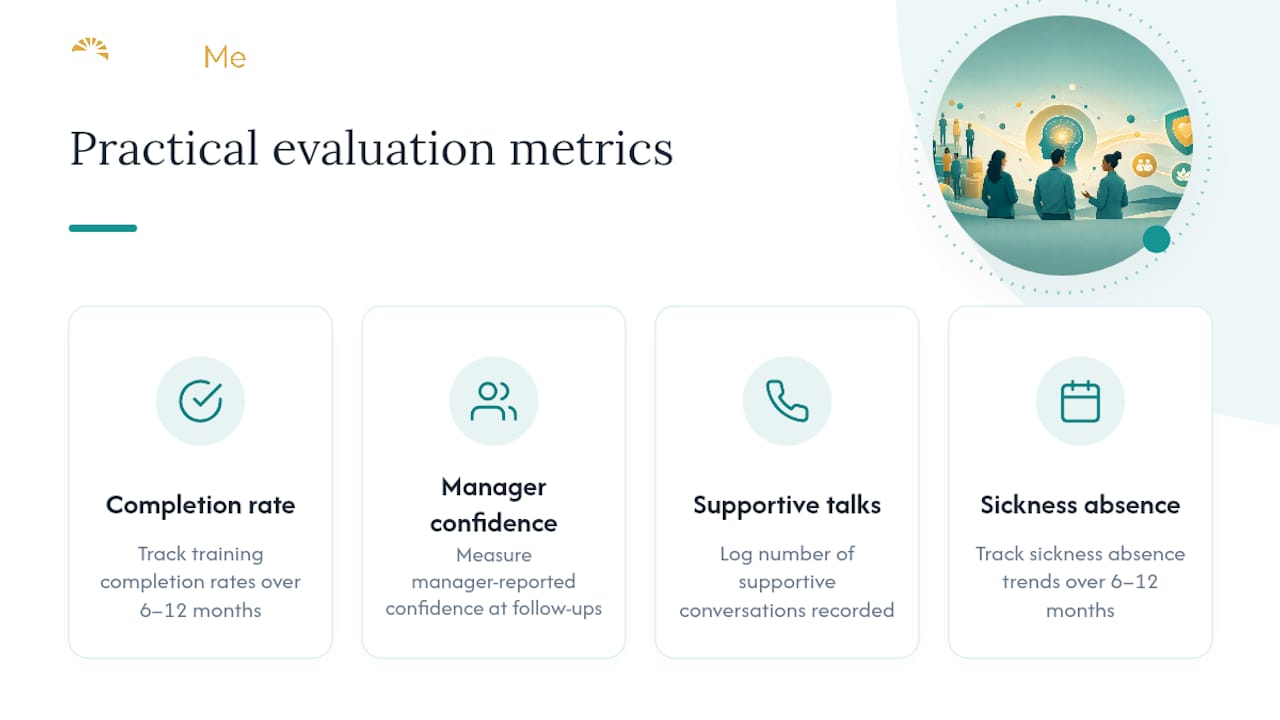
What the evidence doesn't yet firmly establish is a direct causal chain from training to downstream clinical outcomes for employees, that link needs more longitudinal study. Practically, this means you should track proxy metrics you can actually measure: training completion rates, manager-reported confidence, number of supportive conversations logged, and sickness absence trends over 6 to 12 months.
How do you choose and roll out training across a business?
Selecting a provider is easier once you know which questions actually separate a strong course from a polished marketing page. Work through this checklist before you sign anything:
- Is the content interactive, with scenario practice, not just slides or video?
- Does it focus on prevention and early intervention, not only crisis response?
- Can the provider customise content to your organisation's policies and referral routes?
- Is it accredited, and by whom? Ask for the certifying body's name directly.
- Does it include a refresher or follow-up session, ideally within 6 to 12 months?
- What's the cost model, per head, per cohort, or a flat licence fee?
- Can they share anonymised outcome data from previous cohorts?
When you speak to a shortlisted provider, ask directly: what evaluation data do you have from past deliveries? Can we see sample materials before committing? What's your capacity for larger cohorts, and how do you handle accessibility needs? These questions reveal far more than a glossy brochure.
A sensible rollout follows a simple sequence:
- Pilot with one team or department — ideally 15 to 30 managers, over 4 to 8 weeks.
- Measure early signals — completion rate, confidence surveys, qualitative feedback.
- Adjust content or delivery based on pilot feedback.
- Scale to the wider organisation, staggering cohorts to avoid overloading HR support.
- Schedule refresher training at 6 to 12 month intervals, not as a one-off.
Budget and duration vary considerably: eLearning-only options can run from a few pounds per head, while accredited Level 3 multi-day courses cost substantially more per person but include assessed outcomes and formal certification. Our implementation guide for organisational mental health programmes walks through pilot planning and evaluation templates in more depth.
What does successful implementation actually look like?
Context changes everything about how manager training lands. A 40-person creative agency and a 4,000-employee logistics firm need very different rollout shapes, even when the underlying course content is similar.
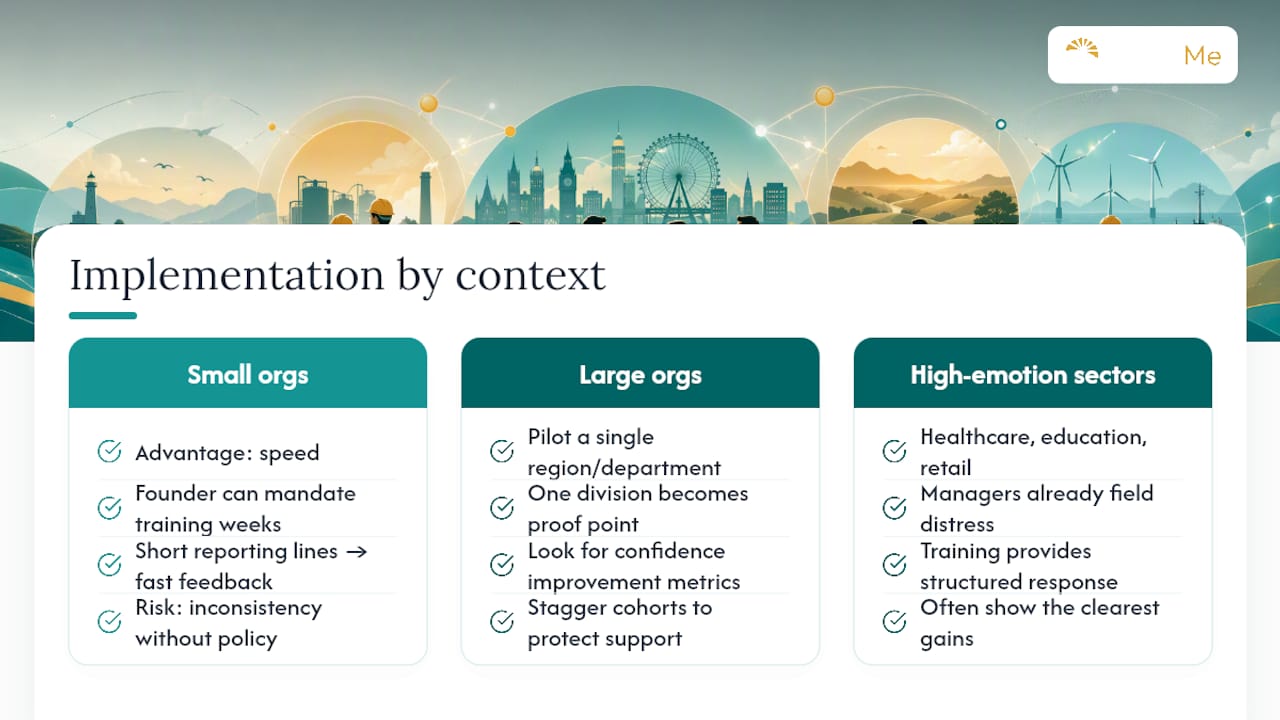
In smaller organisations, the advantage is speed. A founder or operations lead can mandate training for every manager within weeks, and because reporting lines are short, feedback travels fast. The risk is inconsistency, without a formal policy behind it, training can become optional in practice even when it's compulsory on paper.
Larger, multi-site organisations tend to succeed by piloting with a single region or department first, exactly the approach the evidence base supports. One division becomes the proof point: measurable improvements in manager confidence and a drop in unplanned absence give HR the internal case to secure budget for a full rollout. Staggering cohorts also means support resources, like signposting to counselling or occupational health, aren't overwhelmed all at once.
Sectors with high emotional load, healthcare, education, and customer-facing retail, often see the clearest gains because managers there are already fielding distress regularly; training simply gives them a structured way to respond instead of improvising. Our guide on employee counselling for HR teams covers how these referral pathways typically work once a manager has flagged a concern.
The common thread across contexts is sponsorship. Training that a senior leader visibly champions sticks; training quietly delegated to HR alone tends to fade within a quarter.
What goes wrong when rolling out training, and how do you fix it?
The most common failure point isn't the course content, it's what happens after the session ends. Managers attend, feel briefly more confident, and then slip back into old habits within weeks because nothing in their day-to-day routine reinforces the new behaviour.
A second recurring problem is inconsistent manager buy-in. If senior leadership treats the training as a compliance exercise rather than a genuine priority, managers pick up on that instantly and disengage. The fix is straightforward, though not always easy politically: get a senior sponsor to introduce the training personally, and reference it in subsequent team meetings.
Time pressure is the third obstacle. Busy managers deprioritise anything that isn't urgent, and a full-day workshop can feel impossible to schedule across a large team. Blended or digital formats, like the web-based model tested in the Managing Minds at Work trial, address this directly by letting managers complete core content at their own pace, then attend a shorter live session for practice.
Finally, many organisations skip measurement entirely, so nobody can tell if the training worked. Track a small number of practical indicators. Completion rate, manager-reported confidence, and sickness absence trends over the following two quarters, rather than trying to prove clinical outcomes you don't have the data to measure.
Publisher perspective: lessons from watching rollouts succeed and fail
The single biggest predictor of whether manager mental health training sticks isn't the course itself, it's whether a senior leader visibly backs it. Training delivered top-down, with a director attending the same session as their managers, changes culture. Training quietly outsourced to an HR portal rarely does.
Peer coaching after the formal session matters more than most providers admit. Pairing managers to debrief real conversations, without breaching confidentiality, builds the confidence that a single workshop can't. Our piece on therapy support for managers explores this reinforcement gap in more detail.
— Yetty
What happens after a manager makes a referral?
Training equips managers to notice, ask, and refer, but it stops there deliberately. Managers aren't therapists, and good courses are explicit that the next step belongs to a professional support pathway, not the line manager.
That's where Guidemetherapy fits. It's a therapy navigation platform that helps employees who've been signposted by a manager actually find the right therapist, rather than facing a directory of names and no clear starting point. It runs an in-depth screening, builds a personalised therapy plan, and matches people with a therapist using both AI-assisted tools and human oversight, so the process feels guided rather than overwhelming at a moment when someone is already finding things hard.
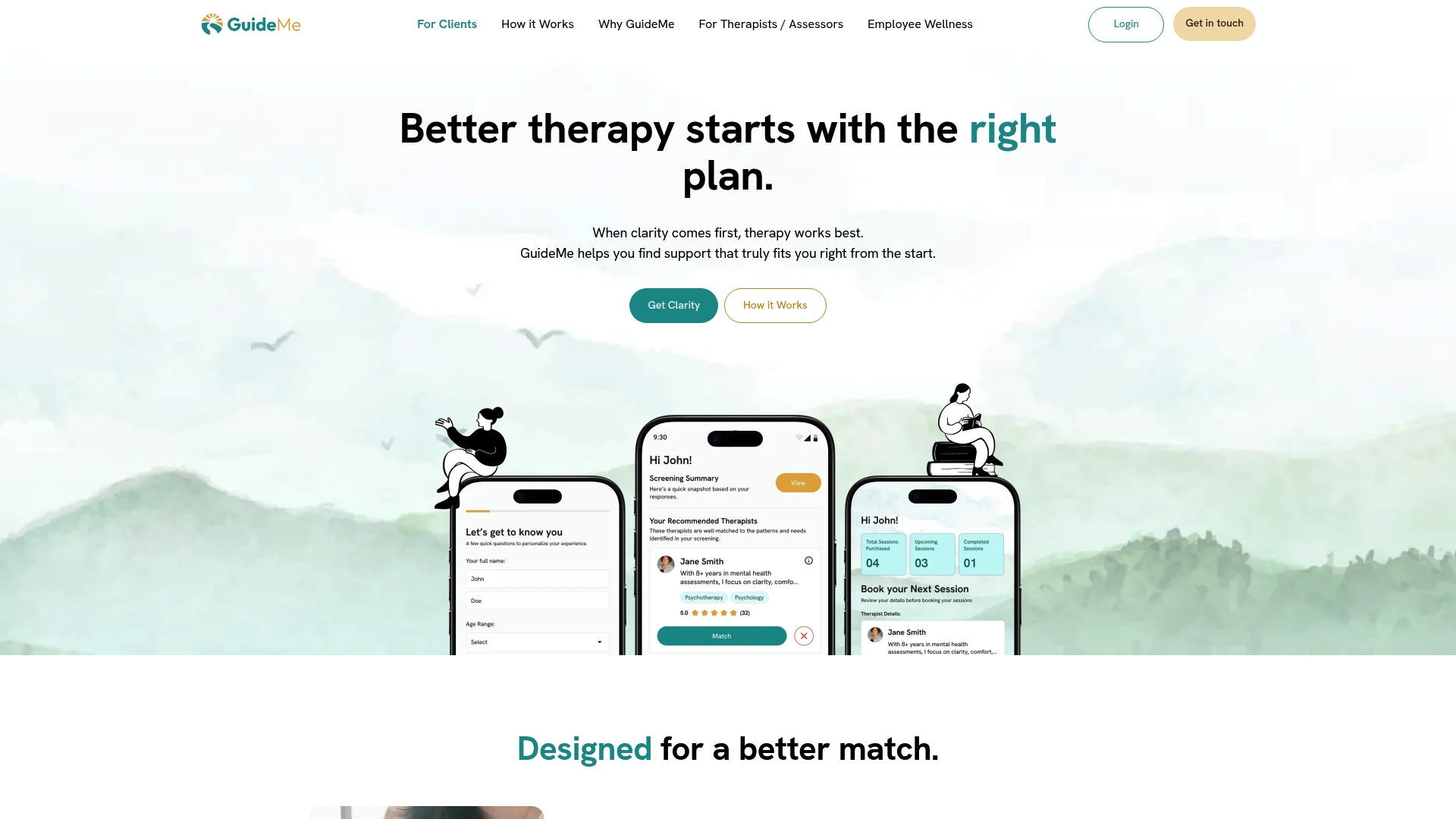
For managers, this means the referral conversation ends somewhere concrete. Instead of saying "you should probably talk to someone," you can point staff towards a structured, private route that takes the guesswork out of finding support, and for organisations exploring a fuller employee support solution, Guidemetherapy also offers corporate partnership options worth reviewing on the Guidemetherapy site.
Sources
- PLOS ONE — The relationship between line manager training in mental health and organisational outcomes
- JMIR Mental Health — Managing Minds at Work trial
- Gov
- Harvard Business Review — 8 ways managers can support employees’ mental health
This article is general information, not a substitute for advice from a qualified doctor. Consult a qualified healthcare professional about your own circumstances before acting on anything here.