

TL;DR:
- Implementing a sustainable mental health programme requires a rights-based approach, stakeholder co-production, and early governance integration.
- A structured, phased process—including exploration, design, pilot, evaluation, and scale—is essential to prevent common failures and ensure long-term success.
Implement an integrated, rights-based mental health programme by selecting an efficient delivery model, co-producing with people with lived experience, and embedding governance, training, and continuous quality improvement from day one. This is the approach endorsed by WHO 2024–25 guidance, NICE, NHS England, and Mind, and it is the foundation every sustainable programme in the UK is built on.
Start this week:
- Secure written leadership sign-off and name an implementation lead
- Complete an organisational readiness assessment (staff capacity, existing pathways, cultural readiness)
- Identify your delivery model (task sharing, collaborative care, or stepped care)
- Map stakeholders and identify at least two people with lived experience to involve from the outset
- Review NICE guidelines and NHS England frameworks relevant to your setting
Timeline highlights:
- Early readiness assessment completed; governance structure agreed; lived-experience representatives recruited
- Delivery model selected; pilot design finalised; training plan drafted; KPIs pre-specified early
- Pilot evaluated; scale-up decision made; programme embedded in HR policy and budget cycle
Key authorities to reference throughout: WHO 2024–25 guidance, NICE, NHS England, Mind, and Guidemetherapy for therapy navigation and organisational support.
Table of Contents
- What does a mental health programme implementation guide actually cover?
- How do you choose the right delivery model for your setting?
- How do you engage stakeholders and co-produce with lived experience?
- What workforce, governance, and regulatory steps do you need in place?
- How do you monitor, evaluate, and sustain your programme?
- What are the most common barriers and how do you fix them?
- How does therapy navigation support organisational programmes?
- Key takeaways
- Why the exploration phase is the most undervalued step in implementation
- Guidemetherapy supports your organisation's mental health programme
- Useful sources and recommended reading
What does a mental health programme implementation guide actually cover?
A well-structured implementation plan moves through five phases: explore, design, pilot, evaluate, and scale. Each phase has a decision gate. Skipping one, particularly exploration, is the most common reason programmes stall or fail within 18 months.
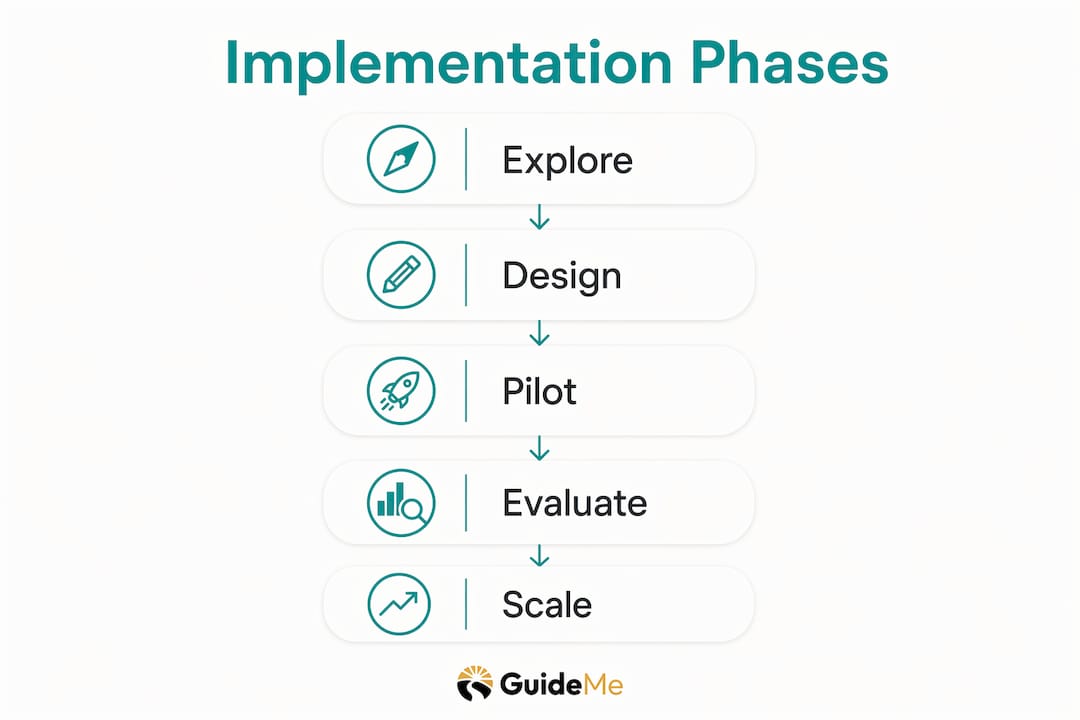
| Phase | Key deliverable | Decision gate |
|---|---|---|
| Exploration | Readiness report; leadership commitment letter | Go/no-go: sufficient capacity and mandate? |
| Design | Intervention selected; adaptation documented; roles assigned | Go/no-go: fidelity plan and budget confirmed? |
| Pilot | Pilot running; KPIs being collected | Go/no-go: reach, fidelity and outcome data adequate? |
| Evaluation | Pilot evaluation report; CQI recommendations | Go/no-go: evidence supports scale-up? |
| Scale and sustain | Programme embedded in policy, budget and governance | Annual review cycle |
Roles and responsibilities:
| Role | Responsibilities |
|---|---|
| Implementation lead | Day-to-day coordination, fidelity monitoring, stakeholder liaison |
| Clinical lead | Intervention quality, supervision oversight, safeguarding escalation |
| Lived-experience representative | Co-production input, accessibility review, evaluation feedback |
| Data lead | KPI collection, data protection compliance, reporting |

Implementation science frameworks such as RE-AIM and PRISM map directly onto these phases, giving teams a shared language for progress reviews.
How do you choose the right delivery model for your setting?
Three models dominate evidence-based mental health delivery in the UK: task sharing, collaborative care, and stepped care. Choosing between them depends on your workforce, population, and budget.
Decision criteria checklist:
- Population need (severity range, age, language, digital access)
- Available workforce (specialist vs. non-specialist ratio)
- Budget for supervision and training
- Integration point (GP surgery, school, workplace)
- Equity and reach goals
| Model | Best fit | Key advantage | Main risk |
|---|---|---|---|
| Task sharing | Low-resource settings; schools; community organisations | Extends reach without specialist headcount | Quality depends on supervision quality |
| Collaborative care | Primary care; GP-embedded programmes | Specialist oversight with non-specialist delivery | Requires clear referral and communication protocols |
| Stepped care | Workplace EAPs; NHS IAPT-aligned services | Matches intensity to need; cost-efficient | Risk of under-stepping for complex presentations |
Manualised interventions delivered by non-specialists can be integrated into health, education, or social services when supervision is built in from the start. Remote delivery is likely as effective as face-to-face for many presentations, but digital exclusion risks must be addressed through blended options.
Operational checklist for your chosen model:
- Referral pathway documented and tested with frontline staff
- Supervision schedule agreed (frequency, format, escalation route)
- Escalation protocol for safeguarding and crisis presentations
- Data sharing agreement in place between partners
For workplace settings, understanding therapy's role in workplace culture helps frame the model choice to senior leaders. Care model design considerations for stepped and collaborative pathways are also well covered in care model innovation guidance for healthcare teams.
How do you engage stakeholders and co-produce with lived experience?
Meaningful involvement of people with lived experience is both a rights requirement and a practical success factor. Programmes designed without it routinely miss access barriers that only become visible once uptake data arrives.
| Stakeholder group | How to involve | When |
|---|---|---|
| Senior leadership | Briefings, business case, governance sign-off | Exploration and design |
| Frontline staff | Co-design workshops, feedback loops | Design and pilot |
| People with lived experience | Co-production panels, paid advisory roles | All phases |
| Community and voluntary sector | Partnership mapping, referral agreements | Design and scale |
Co-production checklist:
- Recruit lived-experience representatives through trusted community routes, not internal HR lists
- Compensate fairly (sessional fee or equivalent) and cover travel and access costs
- Provide accessible formats for all materials (plain English, translation, BSL where needed)
- Define decision rights clearly: what can lived-experience input change?
- Review adaptation decisions against lived-experience feedback before finalising
Pro Tip: Avoid tokenism by giving lived-experience representatives a named role in the evaluation phase, not just the design phase. Their input on whether outcomes actually matter to the people the programme serves is often more useful than the clinical KPI data alone.
What workforce, governance, and regulatory steps do you need in place?
Workforce readiness and regulatory compliance are not background tasks. They are the conditions under which everything else works.
Training plan principles:
- Single-session training does not produce sustained practice change. Post-training coaching and supervision must be budgeted from the outset.
- Training should be role-specific: referrers need different content from non-specialist deliverers.
- Supervision should be scheduled, documented, and linked to performance review.
Regulatory checklist for UK settings:
- ICO / Data Protection Act 2018: Register data processing activities; obtain valid consent; complete a Data Protection Impact Assessment for any digital tool or platform
- CQC: Confirm whether your programme triggers CQC registration requirements (particularly for services providing treatment or diagnosis)
- Safeguarding: Appoint a named safeguarding lead; ensure all staff complete appropriate-level safeguarding training; document escalation routes
- Consent: Use accessible, written consent processes; document capacity assessments where relevant
- Record keeping: Agree retention periods and access controls in line with NHS Records Management Code of Practice
For role definitions and workforce planning, a guide to types of mental health professionals helps clarify which roles require registration and which can be filled by trained non-specialists.
How do you monitor, evaluate, and sustain your programme?
Pre-specifying your KPIs before the pilot begins is non-negotiable. Retrospective outcome selection introduces bias and weakens your business case for scale-up.
Suggested KPI set:
- Reach: Number of people accessing the programme with demographic breakdown
- Fidelity: Sessions delivered adhering to protocol and supervision attendance
- Clinical outcomes: Use of validated measures at baseline and follow-up
- User experience: Satisfaction levels and dropout reasons
- Equity: Analysis of access across demographic and social factors
- Cost: Evaluation of programme cost in relation to outcomes
Continuous quality improvement processes that track fidelity reduce effectiveness loss over time. Build CQI into routine governance rather than treating it as a temporary project review.
Funding models to consider:
- Internal organisational budget (HR or occupational health line)
- NHS partnership or integrated care board commissioning
- Employer-funded employee assistance programme
- Grants (NHS Charities Together, Mind grants, local authority public health funding)
What are the most common barriers and how do you fix them?
Barriers and mitigations:
- Low organisational readiness: Invest in the exploration phase before committing to delivery. A readiness assessment prevents wasted training spend.
- Staff turnover: Embed the programme in job descriptions and induction, not in individual champions.
- Funding gaps: Build a costed business case early. Therapy's role in employee retention provides ROI evidence useful for board-level conversations.
- Implementation drift: Schedule quarterly fidelity reviews; use supervision data as an early warning system.
- Digital exclusion: Offer blended delivery (in-person plus remote) as standard, not as an afterthought.
- Cultural and linguistic barriers: Co-produce materials in community languages; involve cultural brokers in adaptation.
Pro Tip: A one-page business case for senior leaders should include: the population need (local prevalence data), the proposed model and cost, three pilot KPIs with targets, and the risk of inaction (absenteeism cost, staff turnover rate). Keep it to one side of A4.
How does therapy navigation support organisational programmes?
A therapy navigation approach addresses one of the most common failure points in organisational mental health programmes: the gap between a person recognising they need support and actually accessing the right therapist.
Illustrative scenario: An NHS-linked workplace programme identifies 40 employees through a PHQ-9 screening. Without a navigation layer, referral to an appropriate therapist takes several weeks and involves multiple handoffs. With a therapy navigation service integrated into the programme, each person completes an in-depth screening, receives a personalised therapy plan, and is matched to a therapist suited to their presentation and preferences.
Benefits of integrating therapy navigation:
- Reduces time from referral to first session
- Improves therapist-client match quality, which supports engagement and completion
- Generates structured outcome data to feed back into programme KPIs
- Reduces clinical lead burden by handling matching and triage administratively
Questions to ask any therapy navigation partner:
- How is matching personalised to clinical presentation and individual preferences?
- What data and outcome reports are available to the commissioning organisation?
- How does the platform handle safeguarding escalation?
- Is the service compliant with ICO requirements and GDPR?
Key takeaways
A sustainable mental health programme requires an integrated, rights-based approach with governance, co-production, and fidelity monitoring built in from the start.
| Point | Details |
|---|---|
| Start with exploration | Complete a readiness assessment before training begins to avoid wasted spend and staff burnout. |
| Choose an efficient model | Task sharing, collaborative care, or stepped care extends reach without requiring specialist headcount for every session. |
| Co-produce from day one | Lived-experience involvement at all phases improves uptake, equity, and the relevance of your KPIs. |
| Monitor fidelity, not just activity | CQI processes that track fidelity metrics reduce effectiveness loss over time and protect your investment. |
| Guidemetherapy as a partner | Guidemetherapy's therapy navigation platform supports organisational programmes by handling matching, triage, and outcome reporting. |
Why the exploration phase is the most undervalued step in implementation
Organisations consistently underinvest in the exploration phase because it produces no visible output. There is no training delivered, no service launched, no metric to report upward. That invisibility is precisely why it gets cut when timelines tighten.
The evidence is clear: organisational culture and a formal readiness assessment are among the strongest predictors of whether a programme survives its first year. Skipping this phase does not save time. It borrows time from the scale-up phase, when problems that could have been identified in week two become crises in month ten.
Co-production and governance are not optional additions to a programme that is otherwise well-designed. They are the conditions that make the design trustworthy. A programme built without lived-experience input will miss access barriers. A programme without a named clinical governance lead will drift from its evidence base within months. Neither failure is recoverable cheaply.
Guidemetherapy supports your organisation's mental health programme
Organisations that have done the hard work of designing a programme still face a practical problem: connecting the people they have identified as needing support with the right therapist, quickly and without adding administrative burden to clinical staff.
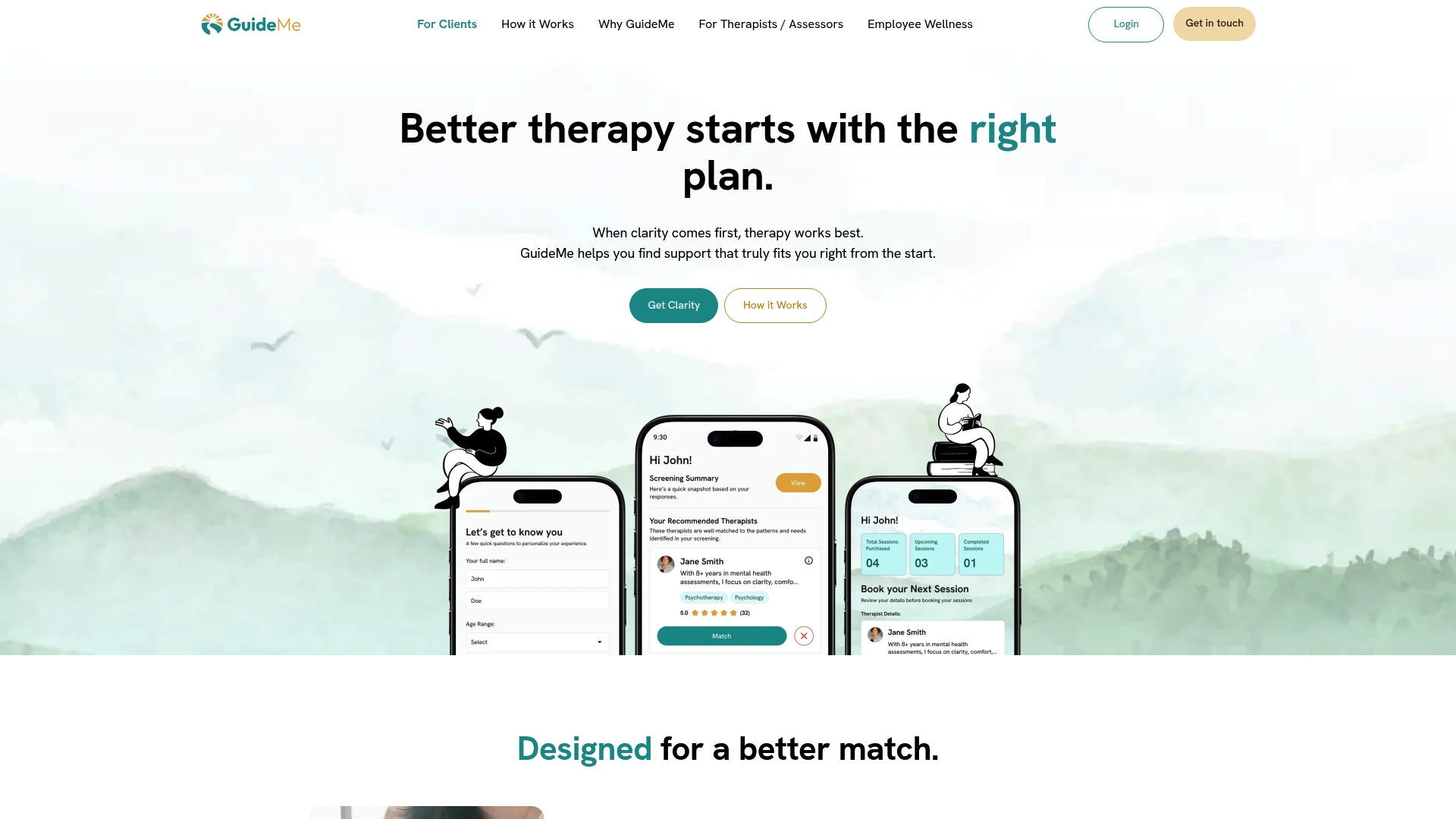
Guidemetherapy's therapy navigation platform addresses this directly. It combines AI-assisted matching with human-led clinical screening to produce a personalised therapy plan for each person, then matches them to a therapist suited to their specific presentation and preferences. For organisations, this means structured outcome data, reduced time from referral to first session, and a compliance-ready platform built to ICO and GDPR standards.
Whether you are running a workplace employee assistance programme, a school-based mental health initiative, or an NHS-partnered community service, Guidemetherapy's enterprise solutions are designed to integrate with your existing governance and reporting structures. Visit Guidemetherapy to speak with the team about how therapy navigation can support your programme's KPIs and access goals.
Useful sources and recommended reading
Primary guidance:
- WHO Guidance on mental health policy and strategic action plans: Module 3 — process for developing, implementing, and evaluating mental health plans
- WHO Guidance on policy and strategic actions for mental health and the health sector — integration into primary care and health systems
- WHO Psychological interventions implementation manual (ISSUP) — delivery models, task sharing, and non-specialist delivery
- WHO mhGAP implementation guide — job aid for non-specialist health professionals
UK-specific resources:
- NHS England mental health implementation frameworks (search NHS England website for current IAPT and community mental health transformation guidance)
- NICE guidelines for depression, anxiety, and common mental health disorders (nice.org.uk)
- Mind practical resources for organisations (mind.org.uk)
Implementation science:
- CCBHC EBP Resource Guide — RE-AIM, PRISM, and stages of implementation
- Practical guide for EBP implementation in public mental health (University of Washington) — organisational readiness and CQI
This article provides general implementation guidance and does not constitute clinical, legal, or regulatory advice. Confirm current requirements with NICE, NHS England, the ICO, and the CQC for your specific setting and programme type.