

What is a step-by-step team support plan?
A team support plan is a structured, written framework that sets out how a manager will identify, address, and monitor the wellbeing and performance needs of their team. It is not a vague policy document. It is a living tool with clear objectives, defined roles, documented processes, and measurable outcomes.
Done well, a support plan does three things at once: it gives team members clarity about what help is available, it gives managers a consistent process to follow, and it gives organisations evidence of good practice. In UK workplaces, support plans also carry procedural weight. Employers have a legal duty of care under the Health and Safety at Work Act 1974, and a documented support framework helps demonstrate that duty is being met.
Every effective team support plan contains the following core elements:
- Clear objectives aligned to both team and organisational goals
- Defined roles and responsibilities for everyone involved
- Wellbeing and mental health measures appropriate to the team's context
- Communication protocols and structured feedback loops
- Escalation processes with named contacts and timelines
- Measurable KPIs to track progress and flag problems early
This guide walks UK managers through each stage of building and sustaining a practical support plan, from deciding when to start, through to measuring whether it is working.
When should you develop a team support plan?
The right time to build a support plan is before a problem becomes a crisis. Most managers wait until something goes wrong: a resignation, a grievance, a period of prolonged sickness absence. By then, the cost in time, morale, and productivity is already accumulating.
Several situations make a structured support plan particularly urgent:
- New teams or restructured departments, where roles and expectations are unclear
- Performance gaps, where individuals or the group are consistently missing targets
- Wellbeing concerns, including visible signs of stress, burnout, or disengagement
- High turnover, which often signals unmet support needs rather than poor recruitment
- Significant organisational change, such as a merger, leadership shift, or new ways of working
The benefits of acting early are concrete. A well-designed support plan clarifies role expectations, reduces ambiguity, and gives team members a clear route to raise concerns before they escalate. It also protects managers: documented support activity is evidence of reasonable management practice under UK employment law.
A note on mental health: The NHS estimates that one in four people in England will experience a mental health problem each year. For managers, that figure means the question is not whether someone on the team will need support, but when and how prepared you are to provide it.
Aligning the support plan with broader organisational goals, such as reducing absence rates, improving engagement scores, or meeting diversity and inclusion commitments, also makes it easier to secure buy-in from senior leadership and HR.
Who should be involved in support planning?
A support plan built by one person in isolation rarely works. The process needs input from the people who will live with it, and oversight from those responsible for compliance and resources.
The core group typically includes:
- The line manager or team leader, who drives the process and owns day-to-day implementation
- Team members themselves, whose input on their own needs and preferences is not optional but foundational
- HR, for compliance guidance, policy alignment, and access to formal support resources
- Wellbeing officers or occupational health advisers, where available, particularly for teams with known health pressures
- Senior leadership, to confirm that the plan aligns with organisational strategy and has the backing it needs
For teams dealing with complex mental health needs, external partners can add real value. Therapy navigation platforms, for example, can help managers connect team members with appropriate professional support without the manager needing to act as a clinician. Understanding the types of organisational support available is a useful starting point before convening the planning group.
The planning process itself should feel collaborative, not top-down. When team members contribute to the plan, they are more likely to trust it and use it.
What must an effective team support plan contain?
The components of a support plan are not interchangeable. Each one serves a specific function, and a gap in any area weakens the whole structure.
| Component | Description | Why it matters |
|---|---|---|
| Support vision | A single, plain-language statement of what good support looks like for this team | Anchors every other decision in the plan |
| Objectives | Specific, measurable goals tied to team and organisational priorities | Prevents the plan from becoming vague or unmeasurable |
| Roles and responsibilities | Named individuals with clear accountabilities | Removes ambiguity about who does what |
| Wellbeing measures | Mental health resources, flexible working options, peer support structures | Addresses the human dimension of team performance |
| Communication protocols | Agreed channels, frequency, and format for team and one-to-one conversations | Keeps information flowing and problems visible |
| Escalation pathways | Step-by-step process for raising concerns, with named contacts at each level | Protects both team members and managers |
| KPIs and review schedule | Defined metrics and regular review dates | Makes the plan a living document, not a filed one |
The support vision deserves particular attention. It should be a practical description, not a corporate slogan. Something like: "Every team member knows where to go for help, gets a response within 48 hours, and never has to repeat their concern to more than one person." That sentence becomes the benchmark against which every other element of the plan is measured.
Wellbeing measures should go beyond signposting an Employee Assistance Programme. Consider structured check-ins, peer support pairings, and clear guidance on how to access mental health support. For managers who want to understand how therapy fits into a workplace wellbeing strategy, the role of therapy in workplace culture is worth exploring before finalising this section.
How to create a team support plan: a step-by-step process
The sequence here matters. Each step creates the foundation for the next, and skipping ahead, particularly to tools and technology, before the process is defined is one of the most common mistakes managers make. Process design must precede tool selection; tools should automate existing workflows, not create them.
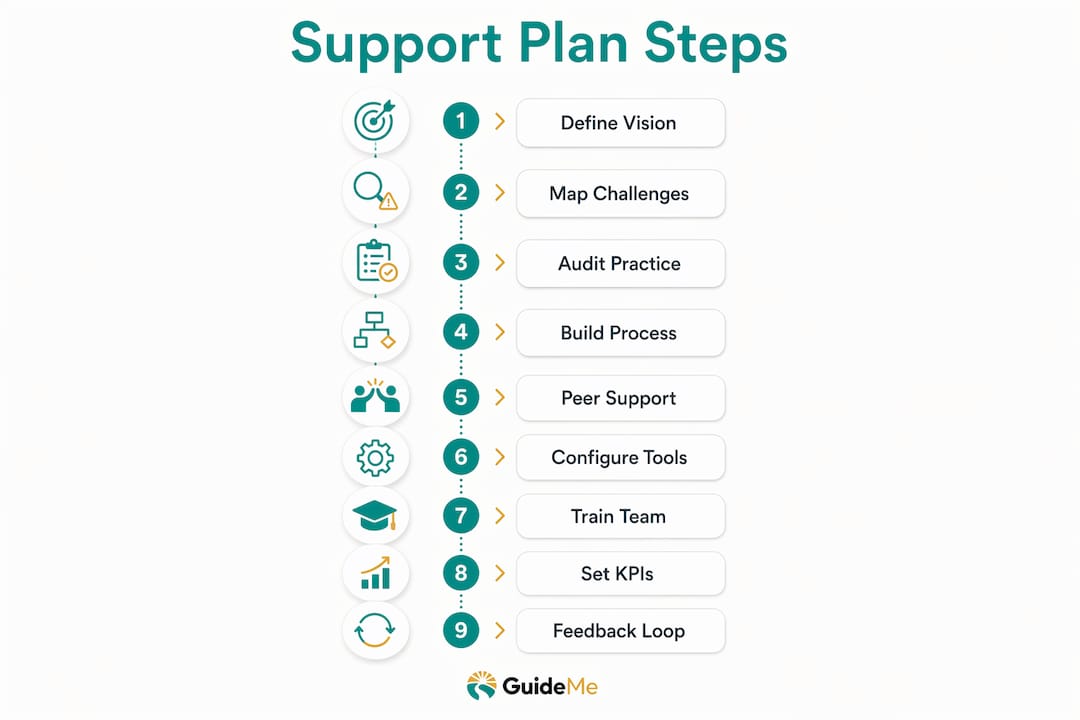
Step 1: Define your support vision
Write one clear sentence describing what excellent support looks like for your specific team. Keep it concrete and measurable. Avoid abstract language. This sentence will guide every decision that follows.
Step 2: Map team interactions and challenges
Identify every point at which team members might need support, from onboarding and role transitions through to periods of high workload, personal difficulty, or organisational change. This mapping exercise typically reveals gaps that were never visible from inside the day-to-day routine.

Step 3: Audit current practice
Pull together what you already know: absence data, engagement survey results, one-to-one notes, and any formal feedback. Identify the top five recurring issues. Benchmarking against broader UK workplace wellbeing data helps you understand where your team sits relative to norms.
Step 4: Build the process layer
Document the handling path for every common support scenario. Define response timelines. Create an escalation matrix that specifies who handles what level of complexity. Write clear guidance for the highest-volume situations. This is what separates a support plan from a support intention.
Step 5: Establish peer and self-service support
A well-maintained knowledge base or peer support structure reduces the volume of issues that need to reach the manager. Focus initial content on the top recurring issues and expand from there. Keeping the scope tight, rather than trying to document everything at once, improves both usability and adoption.
Step 6: Choose and configure tools
With the process defined, you now know what your tools need to do. Configure communication platforms, wellbeing tracking tools, or ticketing systems to mirror your triage logic. Set up any automation for routine tasks such as check-in reminders or escalation alerts. For teams managing health-related support needs, understanding how to communicate care needs to external providers is a practical skill worth building into the plan.
Step 7: Train and onboard the team
Effective onboarding starts with culture and philosophy before moving to systems and workflows. Introduce the support plan's purpose and values first. Then walk team members through the processes. Then cover the tools. Reversing this order creates cognitive overload and reduces retention.
Step 8: Set KPIs and schedule reviews
Lock in two or three high-impact metrics, such as response time to support requests, escalation frequency, and team wellbeing scores, and review them on a regular cadence. Monthly reviews of core KPIs allow you to spot trends before they become problems.
Step 9: Establish a feedback loop
The plan is not complete when it is written. It becomes functional when it has a mechanism for continuous improvement. Schedule regular reviews, route insights back to the planning group, and treat every spike in support requests as a signal worth investigating.
Pro Tip: Balance process rigour with flexibility. A plan that feels bureaucratic will be avoided. Build in explicit permission for team members to raise concerns informally, and make clear that the formal process exists to help, not to monitor.
What tools and templates help with support planning?
The right tools make a support plan easier to maintain and harder to ignore. The wrong ones create administrative burden without adding value.
Template types worth using
- Support playbooks: document the handling path for each common scenario, written in plain language so any team member can follow them
- Check-in checklists: structured prompts for one-to-one conversations that cover wellbeing, workload, and development without making the meeting feel like an audit
- Escalation flowcharts: visual guides showing who to contact at each stage, with contact details and expected response times
- Review templates: standardised formats for recording KPI data and team feedback at each review cycle
Comparing tool categories
| Tool category | Strengths | Limitations |
|---|---|---|
| Wellbeing platforms | Structured check-ins, mood tracking, anonymised reporting | Can feel intrusive if not introduced carefully |
| Communication tools (e.g. Microsoft Teams, Slack) | Familiar, low friction, easy to integrate with existing workflows | Require clear protocols to avoid message overload |
| HR information systems | Centralised records, policy links, absence tracking | Often lack the flexibility for bespoke team-level plans |
| Knowledge bases (e.g. Notion, Confluence) | Accessible, searchable, easy to update | Require ongoing maintenance to stay relevant |
| Ticketing systems | Structured, trackable, good for escalation management | Can feel impersonal for wellbeing-related support |
The most common mistake is selecting tools before the process is defined. A ticketing system configured around a poorly designed escalation process will simply make the wrong process faster. Define the workflow first, then choose the tool that fits it.
For managers building a support plan that includes a therapy or mental health component, a structured therapy onboarding guide can help both managers and team members understand what professional support involves and how to access it without unnecessary delay.
Feedback systems deserve particular attention. The most useful feedback is collected at the point of experience, not weeks later in an annual survey. Build short, specific feedback prompts into existing workflows: after a one-to-one, after a support request is resolved, after a team meeting. Keep them brief. Two or three questions, answered in under two minutes, will generate far more usable data than a lengthy quarterly form.
What are the five pillars of an effective team support strategy?
A structured team support strategy rests on five interconnected pillars: people, process, channels, tools, and metrics. Each pillar needs to function independently, but a gap in anyone weakens the overall structure.
The five pillars:
- People: the right individuals in the right roles, with clear accountabilities and the skills to deliver on them
- Process: documented workflows for every common support scenario, including escalation and feedback
- Channels: the specific routes through which team members can access support, whether that is a one-to-one conversation, a shared inbox, a wellbeing platform, or an external referral pathway
- Tools: the technology and templates that make the process easier to follow consistently
- Metrics: the KPIs that tell you whether the plan is working and where it needs adjustment
The planning sequence that makes these pillars work together follows a clear order: define the support vision, map team interactions, audit current performance, build the process layer, establish self-service or peer support, configure tools, train the team, and set up a feedback loop. The sequence matters because each step depends on the one before it.
Choosing the right KPIs
Effective managers focus on 2–3 high-impact KPIs rather than tracking every available metric. For a team support plan, the most useful indicators tend to be:
- Wellbeing or satisfaction scores: collected through regular check-ins or brief pulse surveys
- Response time to support requests: how quickly team members receive a substantive reply when they raise a concern
- Escalation frequency: how often issues move beyond the first point of contact
Escalation volume in particular carries diagnostic value. A sustained rise in escalations usually signals a gap in documentation, training, or the process itself, not simply a need for more staff. Treat it as a prompt to investigate root causes, not just to increase capacity.
KPIs should be shared with the team openly. When team members understand what is being measured and why, the metrics become a shared tool for improvement rather than a management surveillance mechanism.
Examples of what effective team support plans look like in practice
Abstract frameworks become clearer when you can see what they look like in a real context. The following examples draw on established good practice in UK workplace settings.
A small team navigating high workload
A team of eight in a NHS-adjacent organisation was experiencing rising sickness absence and visible signs of stress during a period of service redesign. The manager convened a planning meeting with HR and two team representatives. Together, they identified three recurring pressure points: unclear priorities during busy periods, insufficient handover processes when colleagues were absent, and no clear route for raising concerns without fear of judgement.
The resulting support plan introduced fortnightly structured check-ins using a simple two-question format, a shared priority board updated each Monday, and a named wellbeing contact outside the immediate line management chain. Escalation rates dropped within two review cycles, and the team reported clearer expectations in the next engagement survey.
A remote team with communication gaps
A distributed team working across three time zones had no consistent communication protocol. Support requests were sent to different channels depending on who was online, and response times varied widely. The manager audited three months of communication data and identified the top recurring issues: unclear ownership of tasks, delayed responses to urgent queries, and no shared understanding of after-hours expectations.
The support plan established a single channel for support requests, defined response time targets by urgency level, and introduced a weekly asynchronous check-in. The manager also built a brief knowledge base covering the ten most common queries, which reduced repeat requests within the first month.
A team recovering from leadership change
Following an unexpected management transition, a team of twelve experienced a period of low morale and uncertainty. The incoming manager prioritised the support plan as the first visible act of leadership. Rather than presenting a finished document, the manager ran two structured listening sessions to gather input before drafting the plan. The resulting framework included a clear statement of values, explicit commitments on feedback frequency, and a direct link to external mental health support through a therapy navigation service.
The listening-first approach built trust quickly. Team members reported feeling heard before the plan was even finalised, which increased their willingness to engage with the formal processes it introduced.
How to align your support plan with organisational goals and policies
A support plan that exists in isolation from the wider organisation tends to lose momentum. Connecting it to organisational strategy gives it authority, resources, and longevity.
Linking to organisational priorities
Start by identifying which organisational goals your support plan directly serves. Common connections include:
- Reducing absence rates, where the plan's wellbeing measures and early intervention processes contribute directly
- Improving engagement scores, where structured check-ins and transparent communication protocols make a measurable difference
- Meeting legal obligations, where documented support activity demonstrates compliance with the Health and Safety at Work Act 1974 and the Equality Act 2010
- Supporting diversity and inclusion commitments, where the plan's accessibility and flexibility provisions show up in practice
Frame the support plan in the language of these priorities when presenting it to senior leadership. A plan described as "a wellbeing initiative" is easier to deprioritise than one described as "a mechanism for reducing absence costs and meeting our duty of care obligations."
Aligning with HR policy
Every support plan should cross-reference the organisation's existing HR policies: capability procedures, absence management frameworks, flexible working policies, and any Employee Assistance Programme provision. This alignment prevents the plan from contradicting formal policy and ensures that managers know when to escalate from the support plan into a formal HR process.
The good practice guidance developed for supported housing settings in the UK makes a useful point that applies across sectors: a support plan used as a tool of genuine participation, rather than a compliance document, becomes the most effective evidence of user involvement and quality practice. The same principle applies in workplace settings. When team members see the plan as something built with them, not imposed on them, it functions as intended.
Reviewing and updating the plan
A support plan reviewed annually and updated only when something goes wrong is not a living document. Build in semi-annual reviews as a minimum, with a brief monthly check against your core KPIs. When organisational priorities shift, update the plan to reflect them. When a team member's circumstances change significantly, review the relevant sections promptly rather than waiting for the next scheduled cycle.
Managers who want to develop their own capacity to lead through these processes, particularly around coaching and supporting team members with mental health needs, may find that therapy support for managers is a practical investment alongside the structural work of building the plan itself.
Key takeaways
A step-by-step team support plan works when it is built collaboratively, grounded in real team data, and reviewed regularly against a small set of meaningful KPIs.
| Point | Details |
|---|---|
| Start with a clear vision | Write one plain-language sentence describing what good support looks like before building anything else. |
| Involve the right people | Include team members, HR, and wellbeing specialists from the start, not after the plan is drafted. |
| Process before tools | Define workflows and escalation paths before selecting or configuring any technology. |
| Focus on 2–3 KPIs | Track wellbeing scores, response times, and escalation frequency rather than every available metric. |
| Align with organisational goals | Frame the plan in terms of absence reduction, legal compliance, and engagement to secure leadership support. |
Supporting your team's mental health goes further with Guidemetherapy
Building a support plan is a strong start. But when team members need professional mental health support, having the right referral pathway matters as much as having the right internal process.
Guidemetherapy is a therapy navigation platform that helps individuals understand their mental health needs and get matched with the right therapist from the beginning. It is human-led and AI-powered, which means the matching process is both personalised and efficient. For managers, it offers a credible, accessible route to professional support that sits alongside, rather than replacing, the internal plan you have built.
If you are developing a support plan that includes a mental health component, Guidemetherapy can help your team members take the next step with clarity and confidence.