

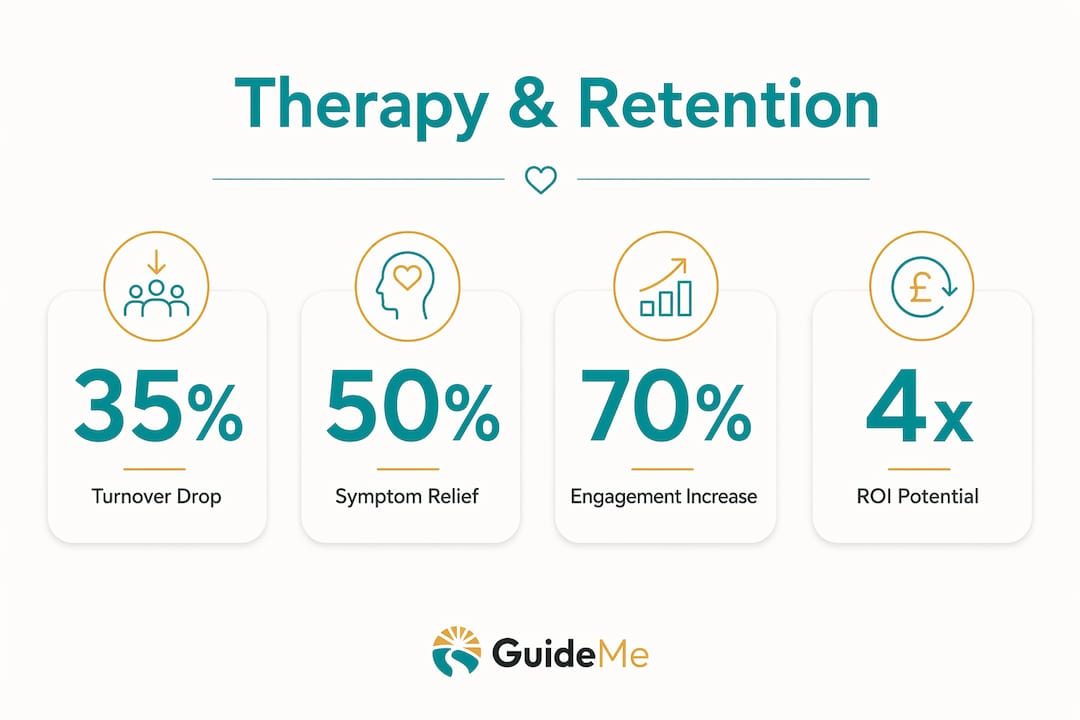
Therapy plays a direct and measurable role in employee retention. Employees who access evidence-based mental health support are significantly less likely to leave their organisation within 12 months: Therapy users left at 11% over 12 months, compared to 22% of non-users in a large-scale study of employees across multiple companies. That gap does not happen by accident. Therapy addresses the underlying causes of disengagement, from unmanaged anxiety and burnout to poor interpersonal communication, before they become resignation letters. For HR and organisational leaders, understanding this connection is the starting point for building a workforce that stays.
Key mechanisms through which therapy supports retention:
- Reduced turnover risk: Employees with an anxiety diagnosis who used evidence-based care showed a 27% lower risk of leaving compared to those receiving standard care.
- Improved job satisfaction: Therapy builds stress management skills and emotional resilience, which translate directly into greater engagement at work.
- Lower absenteeism: Psychotherapeutic consultation produces lasting reductions in depressive and anxiety symptoms, reducing unplanned absences over time.
- Common therapy types offered: Cognitive Behavioural Therapy (CBT), counselling, and Rational Emotive Behaviour Therapy (REBT) are the most widely used in workplace programmes.
- Confidentiality as a prerequisite: Employees will not engage with therapy unless they trust that their conversations remain private. Organisations that communicate clear confidentiality policies consistently see higher uptake.
What are the real benefits of therapy and mental health awareness for retention?
The business case for workplace mental health support is grounded in outcomes, not goodwill. Therapy reduces the conditions that push employees out: burnout, chronic stress, poor team communication, and a sense of not being valued. When those conditions improve, people stay.
- Reduced absenteeism and presenteeism: Therapy coaching improves interpersonal skills and engagement, cutting absenteeism and the hidden cost of employees who are physically present but mentally checked out.
- Stronger workplace culture: Mental health awareness programmes normalise help-seeking, which reduces stigma and creates an environment where people feel safe raising concerns before they escalate.
- Enhanced leadership capability: Managers who receive therapy support develop better emotional intelligence and communication skills, making them more effective at spotting distress early and responding with care rather than performance management.
- Lower recruitment and training costs: Organisations that invest in therapy-driven retention spend less on replacing staff, with measurable savings on recruitment advertising, onboarding time, and productivity loss during transitions.
- Improved engagement scores: Employees who feel psychologically supported report higher commitment to their organisation's goals, which shows up in engagement surveys and output quality.
| Benefit | Impact on retention |
|---|---|
| Reduced anxiety and depression symptoms | Lower voluntary turnover, particularly among high-risk groups |
| Improved stress management skills | Fewer burnout-related resignations |
| Stronger manager-employee relationships | Earlier intervention before disengagement becomes departure |
| Lower absenteeism | Reduced disruption and improved team stability |
| Normalised help-seeking culture | Higher therapy uptake and sustained wellbeing improvements |
Mental health awareness without access to actual therapy is incomplete. Awareness campaigns raise knowledge and reduce stigma, but they do not treat the underlying conditions driving turnover. The two work together: awareness opens the door, and therapy provides the support that changes outcomes.
How to implement mental health and therapy programmes that employees actually use
The most common failure in workplace therapy programmes is low uptake. Organisations invest in Employee Assistance Programmes (EAPs) or counselling services, then find that employees do not use them. The reasons are predictable: stigma, distrust around confidentiality, and a lack of visible leadership support. Each of these is solvable.
- Appoint Mental Well-being Champions: Peer support roles within teams destigmatise therapy and encourage early help-seeking before performance declines. Champions do not replace professional support; they create a psychologically safe culture around accessing it.
- Communicate confidentiality clearly and repeatedly: Employees need to know, in plain language, that their conversations with therapists or EAP counsellors will not be shared with their employer. Organisations that make this explicit see higher participation rates.
- Train managers to recognise and respond to distress: The World Health Organization recommends manager training that builds open communication, active listening, and an understanding of how job stressors affect mental health. A manager who responds with empathy rather than a performance review changes the trajectory of an at-risk employee.
- Integrate therapy with flexible working policies: The US Surgeon General's framework for workplace wellbeing pairs therapy access with structural changes such as flexible scheduling and equitable workloads. Therapy works better when the conditions causing stress are also addressed.
- Select evidence-based therapy models: CBT and REBT have the strongest evidence base for workplace settings. Choosing accredited providers and evidence-based approaches gives employees confidence that the support on offer is clinically credible.
- Make access genuinely easy: Offer a mix of on-site, remote, and after-hours options. Telehealth removes the logistical barriers that prevent employees from attending sessions during working hours.
- Monitor participation without surveillance: Track uptake rates and aggregate wellbeing data to understand whether the programme is reaching the people who need it, without breaching individual confidentiality.
Pro Tip: When launching a new therapy programme, brief line managers before announcing it to the wider workforce. Managers who understand and visibly endorse the programme are the single most effective driver of employee uptake.
The types of organisational support that sustain engagement over time combine professional therapy access with peer networks and leadership modelling. No single element works in isolation.

How do you measure the impact of therapy programmes on retention and business outcomes?
Measuring the return on mental health investment is one of the areas HR leaders find most challenging. The connection between therapy and retention is real, but the data pathways require deliberate design from the outset.
| Metric | What it measures | Data source |
|---|---|---|
| 12-month turnover rate | Whether therapy users leave at lower rates than non-users | HR records, segmented by programme participation |
| Absenteeism rate | Frequency and duration of unplanned absences | Payroll and attendance data |
| Employee engagement score | Commitment, motivation, and sense of belonging | Annual or pulse surveys |
| Wellbeing index | Self-reported mental health status over time | Validated tools such as the GHQ-12 |
| EAP utilisation rate | Proportion of eligible employees accessing support | EAP provider reports |
The most useful measurement approach compares therapy users against a matched group of non-users within the same organisation, which is the methodology used in the 184,715-employee study cited earlier. Without that comparison, it is difficult to separate the effect of therapy from other variables such as management changes or pay increases.
Statistic to note: Among employees with an anxiety diagnosis, evidence-based psychotherapy reduced the relative risk of leaving by 27% compared to standard care, with a statistically significant result (p=0.03).
Surveys alone are not sufficient. Pair self-reported wellbeing data with hard HR metrics: turnover rates, absenteeism figures, and time-to-fill for vacancies. When these move in the same direction as wellbeing scores, the case for continued investment becomes straightforward to make to senior leadership.
Challenges in measurement are real. Employees may not disclose therapy use, participation data can be incomplete, and the benefits of therapy often take months to appear in retention figures. Building a 12-month measurement window into the programme design from the start addresses most of these issues. The CDC's Total Worker Health framework recommends using validated survey tools alongside HR analytics to build a complete picture of programme effectiveness.
What does the research say about therapy's specific role in keeping employees?
The evidence base for psychological support in the workplace has grown considerably, and the findings are consistent: therapy access reduces turnover, particularly when the organisational environment supports it.

The most striking quantitative finding comes from a study of 184,715 employees across 14 companies. Among those who used an evidence-based mental health benefit, 11% left within 12 months compared to 22% of non-users. That is not a marginal difference. For a company of 500 people, it translates to a meaningful reduction in the number of departures, with corresponding savings on recruitment and lost productivity.
CBT has a particularly well-documented role at a critical decision point: the exit interview. A study applying CBT during exit interviews with 20 machine operators who had decided to resign found that six of the eight employees who received CBT counselling chose to stay. That finding challenges the assumption that an exit interview is simply a data-collection exercise. With the right therapeutic intervention, it can become a retention tool.
"EAPs could engender a more significant impact by also assisting organisations to improve their psychosocial safety climate, in combination with individual interventions." — PMC research on EAP effectiveness
Psychosocial safety climate (PSC) is the term researchers use to describe employees' perception that management genuinely prioritises psychological health. Studies show that EAP effectiveness increases in organisations with high PSC. In practical terms, this means therapy programmes deliver stronger retention outcomes when leadership actively models and communicates a commitment to mental health, not just when they fund an EAP and leave employees to find it themselves.
Therapy also produces lasting symptom relief. Psychotherapeutic consultation at work led to significant reductions in depressive and anxiety symptoms at both nine and 15 months post-intervention, according to research published in BMC Public Health. That longevity matters for retention because the benefits compound over time rather than fading after a few sessions.
For HR leaders looking to connect employees with the right support from the start, Guidemetherapy's therapy navigation platform offers a structured approach to matching individuals with therapists suited to their specific needs, reducing the friction that often prevents employees from accessing care at all. The platform combines human guidance with AI-powered matching, which means employees spend less time feeling lost and more time in therapy that actually fits.
Managers are a critical but often overlooked part of the retention picture. Therapy support for managers improves their capacity to recognise distress in their teams and respond with the kind of empathy that keeps people engaged rather than pushing them towards the door. The WHO's guidelines on mental health at work explicitly recommend manager training as one of the three core organisational interventions for improving workforce wellbeing.
How Guidemetherapy can support your organisation's retention goals
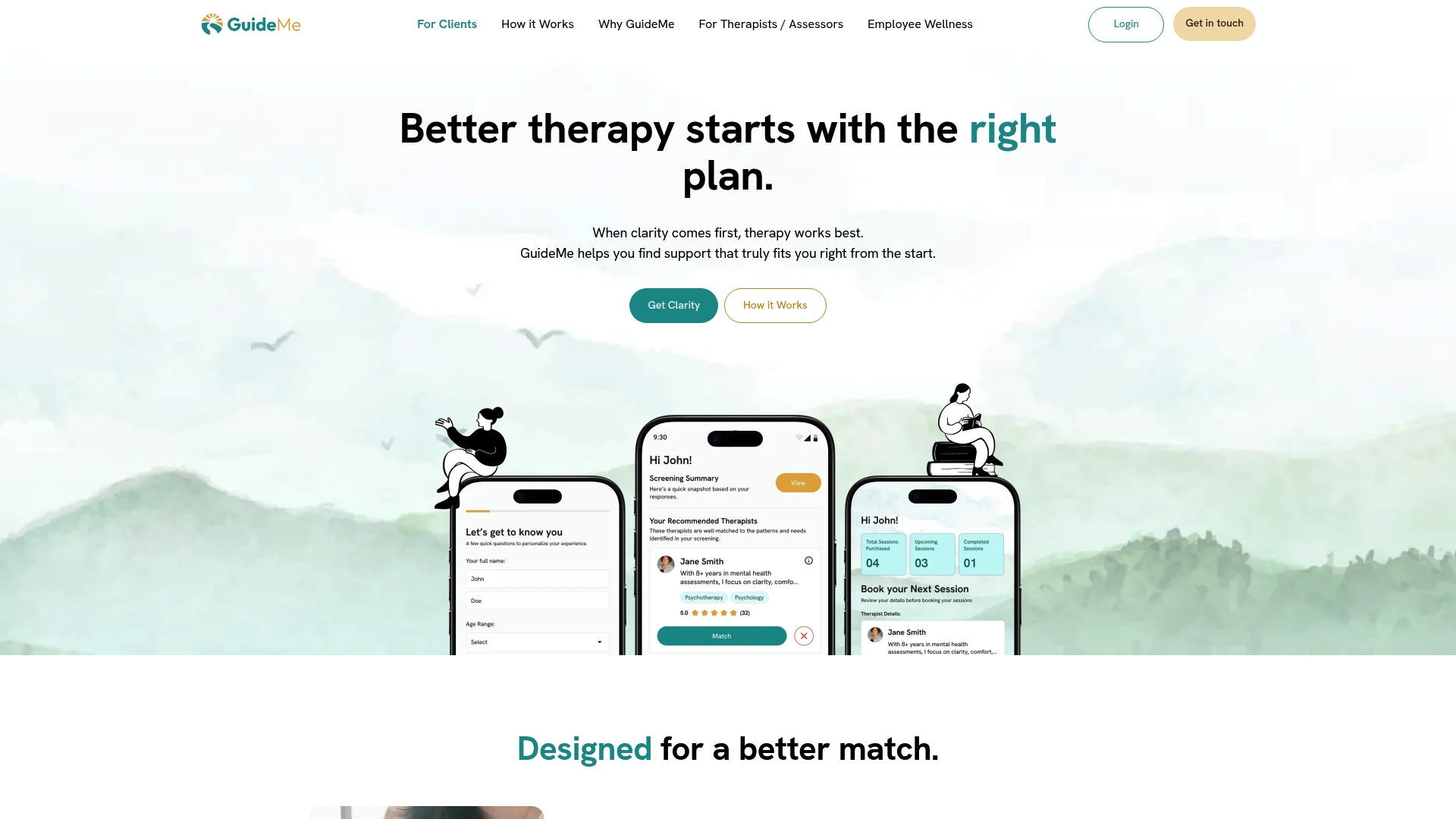
Finding the right therapist is one of the biggest barriers employees face when trying to access mental health support. Guidemetherapy removes that barrier. The platform creates an in-depth therapy plan for each individual, then matches them with a therapist whose approach, specialism, and availability fit their specific situation. It is human-led and AI-powered, which means the matching process is both clinically informed and genuinely personal.
For HR and organisational leaders, Guidemetherapy offers a way to provide employees with meaningful mental health support without the guesswork. Employees who feel guided and cared for from the first step are far more likely to engage with therapy and stay engaged with their organisation.
Start supporting your team with therapy navigation that works from the beginning.
Key takeaways
Therapy access directly reduces employee turnover, with evidence-based programmes significantly lowering 12-month departure rates compared to no support, and delivering a notably lower turnover risk among employees with anxiety diagnoses.
| Point | Details |
|---|---|
| Therapy halves turnover rates | Employees using evidence-based mental health benefits left at 11% over 12 months, compared to 22% of non-users. |
| CBT works even at exit interviews | Six of the eight employees who received CBT counselling during exit interviews chose to remain with their organisation. |
| Psychosocial safety climate amplifies results | EAP effectiveness increases when leadership actively prioritises psychological health at an organisational level. |
| Confidentiality drives uptake | Employees engage with therapy programmes only when clear, credible confidentiality policies are in place and communicated. |
| Measurement requires a 12-month window | Turnover, absenteeism, and engagement data should be tracked over at least 12 months to capture therapy's full retention impact. |