

TL;DR:
- Mental health encompasses a person's overall well-being, enabling stress coping, potential realization, and meaningful community engagement.
- Early recognition of common conditions like anxiety and depression is crucial, as they impact daily life and carry serious risks if untreated.
- Adopting small, consistent strategies—including physical, psychological, and social actions—effectively promotes mental wellness and resilience.
Mental health is defined as a state of mental well-being that enables you to cope with stress, realise your potential, and contribute meaningfully to your life and community. According to the World Health Organization, mental disorders account for 1 in every 6 years lived with a disability globally. That figure makes psychological well-being one of the most significant health challenges of our time. Conditions such as anxiety and depression affect millions of people, yet many go without support. Understanding what mental health actually means, and what shapes it, is the first step towards doing something about it.
What are the most common mental health conditions?
Mental health conditions range from anxiety and depression to stress-related disorders, post-traumatic stress, and obsessive-compulsive disorder. Each condition sits on a spectrum of severity, from mild and temporary to persistent and life-limiting. The impact on daily life is real: relationships suffer, work performance drops, and physical health deteriorates alongside psychological distress.
Depression is one of the most prevalent conditions worldwide. Depressive illness affects approximately 17% of populations in some developed regions at some point in their lives, with women diagnosed twice as often as men and peak incidence occurring in the 40s. That prevalence means depression is not a rare or niche concern. It is a condition that touches most families in some form.
The risks associated with untreated conditions are serious. The annual suicide rate for individuals with diagnosed depression is 3 to 4 times higher than for other psychiatric disorders. Early recognition and support are not optional extras. They are protective.
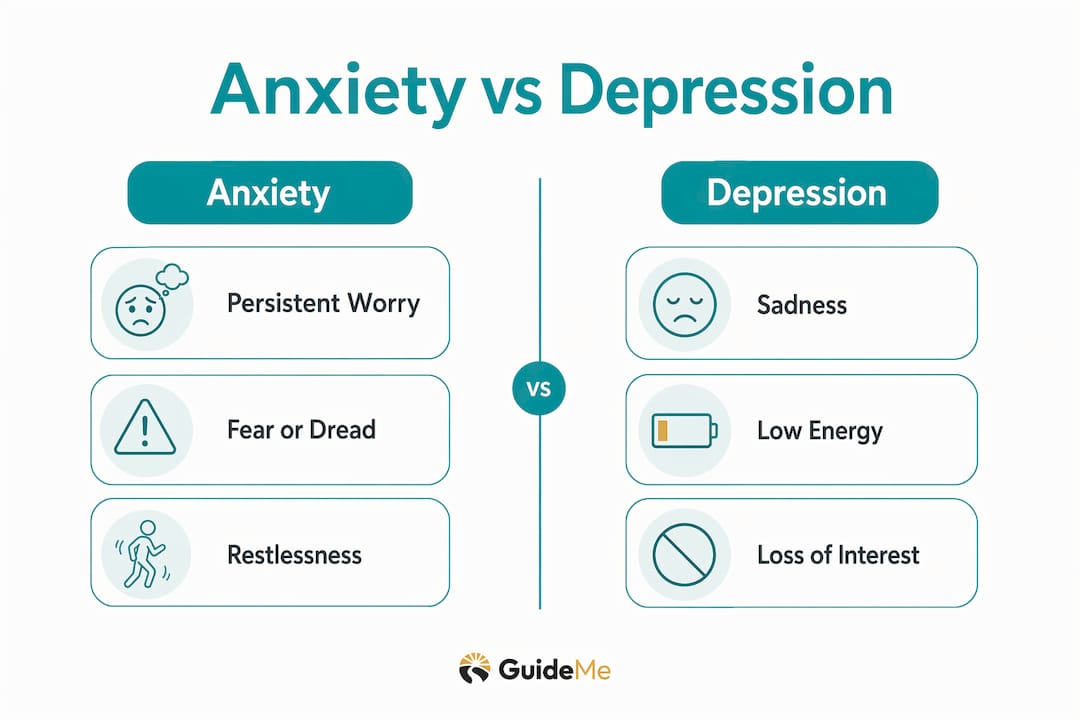
Comparing common symptoms of anxiety and depression:
| Symptom area | Anxiety | Depression |
|---|---|---|
| Mood | Persistent worry, fear, or dread | Persistent sadness, emptiness, or hopelessness |
| Physical | Rapid heartbeat, muscle tension, sweating | Fatigue, changes in appetite, sleep disruption |
| Thinking | Racing thoughts, difficulty concentrating | Negative self-talk, poor memory, indecision |
| Behaviour | Avoidance of situations, restlessness | Withdrawal from activities and relationships |
Recognising these signs of mental distress early matters. Anxiety and depression share some features but require different approaches to treatment, which is why accurate identification is the foundation of effective care.
Pro Tip: Keep a simple mood diary for two weeks. Tracking patterns in your energy, sleep, and emotions gives you concrete information to share with a GP or therapist, making your first appointment far more productive.
Is mental health the same as not having a mental illness?
Mental health and mental illness are related but distinct concepts. The absence of a diagnosed condition does not automatically mean good mental health, and a person living with a mental illness can still experience genuine well-being. This distinction matters because it shifts the goal from simply avoiding illness to actively building a life that feels meaningful and manageable.
Research published in PMC confirms that mental health exists on a continuum, and that positive mental well-being, which includes happiness, a sense of purpose, and strong cognitive functioning, is a separate dimension from the presence or absence of illness. This is known as the dual continua model. It means you can score well on one dimension and poorly on the other at the same time.
Positive mental well-being involves more than feeling good on a given day. It includes your ability to form relationships, find meaning in work or creativity, manage difficult emotions without being overwhelmed, and maintain a sense of identity under pressure. These qualities are worth cultivating regardless of whether you have a diagnosis.
Emphasising positive well-being also reduces stigma by broadening the conversation beyond illness. When mental wellness is understood as something everyone can work on, rather than a label reserved for those in crisis, more people feel comfortable seeking support earlier.
Pro Tip: Ask yourself not just "Am I coping?" but "Am I thriving?" The second question points you towards growth rather than just survival.
Activities that support positive mental well-being include:
- Regular physical movement, even short walks
- Engaging in creative or purposeful work
- Practising gratitude or reflective journalling
- Spending time in nature
- Maintaining social connections, even brief ones
- Mindfulness practices that build present-moment awareness
How to improve mental health: practical strategies that work
Improving mental health does not require a single dramatic change. It requires consistent, small actions across several areas of life. The evidence points to a combination of physical, psychological, and social strategies working together.

Physical approaches
Stress triggers the release of adrenaline and cortisol, and prolonged exposure to these hormones elevates the risk of headaches, heart disease, and disrupted sleep. Physical interventions that signal safety to the nervous system, such as slow diaphragmatic breathing, cold exposure, or progressive muscle relaxation, directly reduce these physiological effects. Regular aerobic exercise, including running, swimming, or cycling, lowers baseline cortisol and improves mood through endorphin release.
Sleep and nutrition are equally important. Poor sleep amplifies emotional reactivity and impairs decision-making. A consistent sleep schedule, limiting screen exposure before bed, and reducing caffeine after midday are straightforward adjustments with measurable effects. Nutrition research consistently links diets rich in whole foods, omega-3 fatty acids, and fermented foods to better mood regulation.
Psychological strategies
Cognitive reframing, the practice of identifying and questioning unhelpful thought patterns, is one of the most transferable skills from formal therapy into daily life. You do not need a therapist present to notice when you are catastrophising and ask yourself what the evidence actually supports. Problem-solving frameworks, where you break a stressor into its component parts and address each one, reduce the sense of being overwhelmed.
Therapy helps manage stress by building these skills in a structured, supported environment. Cognitive behavioural therapy (CBT) in particular teaches you to interrupt unhelpful cycles of thought and behaviour, and its effects are well-documented across anxiety, depression, and stress-related conditions.
Social connection
Social support buffers the negative effects of stress and correlates with reduced anxiety and improved quality of life. This does not mean you need a large social network. Even one or two trusted relationships where you feel genuinely heard provide significant protection against psychological distress. Actively investing in those connections, through regular contact, honest conversation, and reciprocal care, is a mental health strategy in its own right.
Pro Tip: Write a personal mental wellness action plan. List three activities that reliably improve your mood, two people you can contact when you are struggling, and one professional resource you would use if things escalated. Having it written down removes the decision-making burden when you most need support.
How to access quality mental health resources and support
Finding the right support is one of the most practical steps you can take, yet many people delay it due to stigma, uncertainty about where to start, or past experiences of poor-quality care. Mental health care quality is often poor globally, with wide treatment gaps and persistent stigma. Knowing what good care looks like helps you advocate for yourself.
Evidence-based therapy is the standard you should expect. CBT and other structured approaches consistently outperform generic or unstructured support, and therapy often leads to better long-term outcomes than medication alone for many conditions. A good therapist will work collaboratively with you, set clear goals, and adjust the approach based on your progress.
In the UK, your options include:
- NHS Talking Therapies (formerly IAPT): free, self-referral access to CBT and counselling for anxiety and depression
- Charities such as Mind, Samaritans, and Rethink Mental Illness, which offer helplines, peer support, and local services
- Private therapy platforms that match you with vetted, qualified therapists based on your specific needs
- Your GP: a first point of contact for assessment, referral, and medication where appropriate
Counselling approaches vary considerably in method and focus. Person-centred therapy, psychodynamic therapy, and CBT each suit different presentations and personal preferences. Understanding the differences helps you make a more informed choice rather than accepting whatever is available.
Pro Tip: Before your first therapy session, write down the three things you most want to change or understand about yourself. This gives the therapist a clear starting point and helps you assess whether the approach is working after a few sessions.
Key takeaways
Mental health is a dynamic state that requires active attention, not just the absence of a diagnosed condition. Combining physical self-care, psychological skills, social connection, and professional support produces the most durable improvements.
| Point | Details |
|---|---|
| Mental health is a spectrum | Positive well-being and mental illness are distinct dimensions; you can work on both simultaneously. |
| Common conditions are widespread | Depression affects around 17% of people in some developed regions; early recognition reduces serious risk. |
| Stress has physical consequences | Prolonged cortisol exposure raises the risk of heart disease and sleep disruption; physical interventions help. |
| Social connection is protective | Even one or two trusted relationships significantly buffer the negative effects of stress. |
| Evidence-based therapy works | CBT and structured approaches consistently outperform generic support and often exceed medication alone long-term. |
What I have learned about mental health that most articles miss
I have spent a long time thinking about mental health, both professionally and personally, and the thing that strikes me most is how rarely people talk about the non-linear nature of it. Most content presents mental health improvement as a steady upward climb. In reality, it moves in cycles. You can feel genuinely well for months and then find yourself struggling again, not because you failed, but because life is variable and so are you.
The dual continua model changed how I think about this. Knowing that you can have a diagnosable condition and still experience real well-being, or conversely feel empty and purposeless without any clinical label, removes a lot of unnecessary shame. It also makes the goal clearer. You are not trying to reach a fixed destination. You are building a set of skills and relationships that help you recover faster when things get hard.
What I have found genuinely useful, beyond any single technique, is the combination of honest self-awareness and consistent small actions. The breathing exercises, the sleep routine, the one friend you call when things feel heavy. None of these are dramatic. All of them compound over time. And when those are not enough, getting professional support early, before things reach a crisis point, makes an enormous difference to how quickly and fully you recover.
Be kind to yourself in the process. Progress in mental health rarely looks the way you expect it to.
— Yetty
Find the right therapist with Guidemetherapy
If you are ready to take the next step, Guidemetherapy makes it straightforward to find qualified, vetted therapists who use evidence-based approaches tailored to your needs.
Guidemetherapy is a human-led, AI-powered therapy navigation platform. It starts with an in-depth therapy plan that helps you understand your mental health clearly, then matches you with the right therapist from the beginning. No guesswork, no wasted sessions with the wrong fit. Whether you are managing anxiety, depression, or stress, start your therapy plan today and take a step towards the support you deserve.
FAQ
What is mental health, exactly?
Mental health is a state of well-being in which a person can cope with normal life stresses, work productively, and contribute to their community. The World Health Organization defines it as a core component of overall health, not simply the absence of illness.
What are the early signs of mental distress?
Common early signs include persistent low mood, increased anxiety or worry, disrupted sleep, withdrawal from relationships, and difficulty concentrating. Noticing these patterns early and seeking support promptly significantly improves outcomes.
How does stress affect mental health?
Prolonged stress triggers sustained release of cortisol and adrenaline, which raises the risk of anxiety, depression, sleep problems, and physical health conditions including heart disease. Managing the physiological response to stress is central to protecting mental wellness.
What is the difference between mental health and mental illness?
Mental health refers to overall psychological well-being, including positive emotions, purpose, and functioning. Mental illness refers to diagnosable conditions such as depression or anxiety. Research confirms these are related but distinct dimensions; a person can have a mental illness and still experience meaningful well-being.
When should I seek professional mental illness support?
Seek professional support when distress persists for more than two weeks, significantly affects your daily functioning, or involves thoughts of self-harm. Evidence-based therapies such as CBT are effective for a wide range of conditions and are available through the NHS, charities, and private platforms.