

Navigating therapy means finding the right therapeutic match and treating the process as active and collaborative, not something you passively receive. The single best next step is to make a short list of two or three therapists and book intro consultations with each. Fit matters more than which modality you pick, and progress in early sessions rarely moves in a straight line.
TL;DR:
- Building a strong therapeutic alliance is more crucial than the specific therapy approach, with early setbacks common and not necessarily indicating failure.
- Typically, six or more sessions are needed to properly assess whether a therapist is a good fit, especially since progress can be uneven and gradual.
- Choosing a therapist should prioritize your problem, budget, and preferences, with thorough initial consultations to evaluate rapport and approach.
- Private therapy costs range from £40 to £150 per session in the UK, and NHS or employer programs can offer free or subsidized options, but waiting times vary.
- Structured navigation services, like GuideMe, improve engagement by streamlining matching, scheduling, and follow-up, especially for people who have struggled to start therapy before.
Table of Contents
- What does navigating therapy actually involve?
- Which type of therapy suits your situation?
- How do you find and choose the right therapist?
- What happens in the first few sessions?
- How do you get the most out of each session?
- When is therapy not working, and what should you do?
- Does professional navigation actually improve outcomes?
- How do you prepare mentally before your first session?
- What does therapy cost, and how does insurance factor in?
- Why does stigma still shape how people approach therapy?
- A short note on trying again
- Ready to find your match through GuideMe?
- Sources
What does navigating therapy actually involve?
Therapy works because of two things happening together: a trusting relationship and specific techniques applied inside it. Research from Wampold and Imel's meta-analytic work found that relationship factors explain more of the variation in outcomes than the particular modality a therapist practises. That's not a small detail. It means the "best" therapy type on paper can still fail if you and the therapist don't click, and a less fashionable approach can work brilliantly with the right person delivering it.
The therapeutic alliance, the working bond between you and your therapist, is widely regarded as the strongest single predictor of whether therapy helps. Annie Wright's clinical guide to how therapy works describes this alliance as something built through consistent, empathic response and mutual agreement on the work ahead, not something that simply appears because someone has the right letters after their name.
Progress tends to be uneven. You might feel worse before you feel better, particularly if therapy is surfacing something you've avoided for years. That's normal, and it's exactly why judging effectiveness after one or two sessions is a mistake.
- The alliance predicts outcome more reliably than technique choice alone
- Change happens through a mix of insight, relationship, and structured practice
- Setbacks in early weeks don't necessarily mean the approach is wrong
- Comfort discussing difficult topics tends to build gradually, not instantly
Pro Tip: Commit to a minimum of six sessions before deciding whether a therapist is right for you. Clinical guidance consistently points to this as the threshold needed to see whether the alliance is forming, rather than judging on a first impression.
Which type of therapy suits your situation?
Different modalities suit different problems, though the differences matter less than most people assume. Here's a plain-language rundown of what you'll encounter when researching options.
- Cognitive behavioural therapy (CBT): structured, present-focused, good for anxiety, phobias, and specific behavioural patterns you want to change quickly.
- EMDR (Eye Movement Desensitisation and Reprocessing): designed for trauma processing, often used when a specific traumatic memory keeps intruding on daily life.
- Psychodynamic or relational therapy: slower and more exploratory, useful for long-standing relationship patterns or when you want to understand "why" as much as "how to stop."
- Internal Family Systems (IFS): works with different "parts" of yourself, often chosen by people who feel internally conflicted or stuck in self-criticism.
- Couples therapy: focused on communication patterns and shared goals between partners, usually most effective when both people genuinely want to attend.
- Group therapy: offers peer support and a lower cost per session, particularly effective for shared experiences like grief or addiction recovery.
None of these approaches guarantees results by name alone. A skilled CBT therapist with poor rapport will likely underperform a warm, attentive psychodynamic therapist even on a CBT-appropriate problem. Use modality as a starting filter for your search, not the final decision. If your problem is trauma related, lean toward EMDR or trauma-informed psychodynamic work. If you want practical tools for a specific issue on a tighter timeline, CBT is a reasonable first search term. Beyond that, prioritise the person over the label.
How do you find and choose the right therapist?
Start by getting clear on three things before you search anything: what problem you want to address, your budget or insurance situation, and whether you want online or in-person sessions. Identity preferences, such as wanting a therapist who shares your cultural background or LGBTQ+ experience, are also worth deciding upfront rather than discovering mid search.
Several channels can get you there. Professional directories let you filter by specialism and location but leave the vetting work to you. Your GP can refer you into NHS talking therapies, though waiting lists vary widely by area. Employer benefits sometimes include a set number of free sessions through an employee assistance programme. Platforms like GuideMe combine AI-assisted screening with human oversight to shortlist therapists suited to your specific situation, which cuts down the trial-and-error considerably.
Once you have two or three names, book intro consultations with each. The British Association for Counselling and Psychotherapy recommends checking a therapist's qualifications directly and asking specific questions during that first call rather than assuming credentials from a directory listing.
- Ask what their typical approach looks like for your specific problem.
- Ask how they measure progress and how often they'll check in on the relationship itself.
- Ask about availability, cancellation policy, and whether sessions are weekly or flexible.
- Ask what happens if the approach isn't working after a few sessions.
- Compare your gut reaction across all consultations before committing to one.
Pro Tip: Treat comparison shopping as legitimate self-advocacy rather than an awkward inconvenience. Psychology Today's clinical commentary frames trying several therapists before choosing as a sensible, common practice, not a sign you're being difficult.
Reading full profiles and checking specialisms before you book also improves your odds, according to practical guidance from Psychology on structuring your search.
What happens in the first few sessions?
Expect the first session, often called an intake, to focus on gathering information rather than diving into deep work. You'll typically be asked about your history, current symptoms, medications, and what brought you to therapy now rather than six months ago. Paperwork usually covers confidentiality terms, fees, and consent for treatment, and a reasonable therapist will explain the limits of confidentiality clearly, including the rare circumstances where they're legally obliged to break it.
Bring a rough idea of what you want from therapy, even if it's vague. "I want to stop dreading Sunday nights" is a perfectly good starting goal. Some people find it useful to jot down a few recent examples of the problem in action, since specific incidents give a therapist far more to work with than general descriptions.
- Confirm fees and cancellation policy before session two, not after a missed payment
- Ask directly how confidentiality works and what the exceptions are
- Flag any accessibility needs (hearing, mobility, timing) at the booking stage
- Note practical logistics: is it in-person, phone, or video, and does that suit you long term
Scheduling and payment logistics sound mundane, but they're a common reason people quietly drop out of therapy within the first month. Sort them out early so they don't become the obstacle.
How do you get the most out of each session?
Therapy that stays contained to the fifty minutes in the room tends to move slowly. The work that happens between sessions, small experiments, noticing patterns, trying a different response to an old trigger, is often where the actual change gets tested against real life.
Mind's practical guidance on getting the most from therapy and counselling recommends giving direct feedback to your therapist about what's working and what isn't, rather than assuming they'll intuit it. Therapists generally welcome this. Wright's guide describes the work as inherently collaborative, meaning you're expected to shape the process, not sit back and receive a fixed programme.
- Try one small behavioural experiment between sessions and report back on what happened
- Keep a brief mood or symptom log if your goal involves anxiety, sleep, or low mood
- Say plainly if a technique isn't landing, rather than nodding along for weeks
- Revisit your original goal every few sessions to check you're still working toward it
Pro Tip: If you notice yourself editing what you say to avoid an awkward reaction from your therapist, raise that directly. It's usually the single fastest way to repair a stalling alliance.
When is therapy not working, and what should you do?
Some friction is normal. Persistent problems are not. Watch for signs that go beyond ordinary discomfort with hard material.
- Ethical or boundary issues, such as a therapist sharing excessive personal information, blurring professional lines, or dismissing your concerns outright, warrant an immediate stop, not patience.
- Persistent mismatch after six sessions, where you still feel unheard or the sessions feel aimless, is a signal to raise it directly with your therapist first.
- Worsening symptoms over many weeks with no acknowledgment or adjustment from your therapist should prompt a second opinion, either from another therapist or your GP.
- No engagement with your feedback, where raised concerns simply get brushed aside repeatedly, is grounds to switch.
If raising the issue doesn't shift anything within a session or two, it's reasonable to seek a second opinion or move on entirely. Formal complaints about ethical breaches can go through the BACP's complaints procedure or the therapist's registering body. Switching therapists isn't a failure on your part. It's often the correction that makes the next attempt work.
Does professional navigation actually improve outcomes?
Evidence for structured navigation is stronger than most people expect. A nationwide cohort study published in PLOS One found that people using a remote care navigation service had much higher odds of actually starting therapy, attended substantially more sessions than those without navigation, and showed modest additional symptom improvement among those with more severe baseline symptoms.
Navigation doesn't just point people toward a therapist. It handles the scheduling, the follow-up, and the administrative friction that quietly causes people to give up before their first session even happens.
This matters most for people who've struggled to get started before, including younger adults navigating care transitions, where continuity and personal follow-up make a measurable difference to whether they stay engaged.
- Screening that clarifies your actual needs before matching begins
- AI-assisted shortlisting paired with human oversight, not an algorithm alone
- Scheduling support that removes the usual booking friction
- Ongoing check-ins between sessions to catch a poor fit early
How do you prepare mentally before your first session?
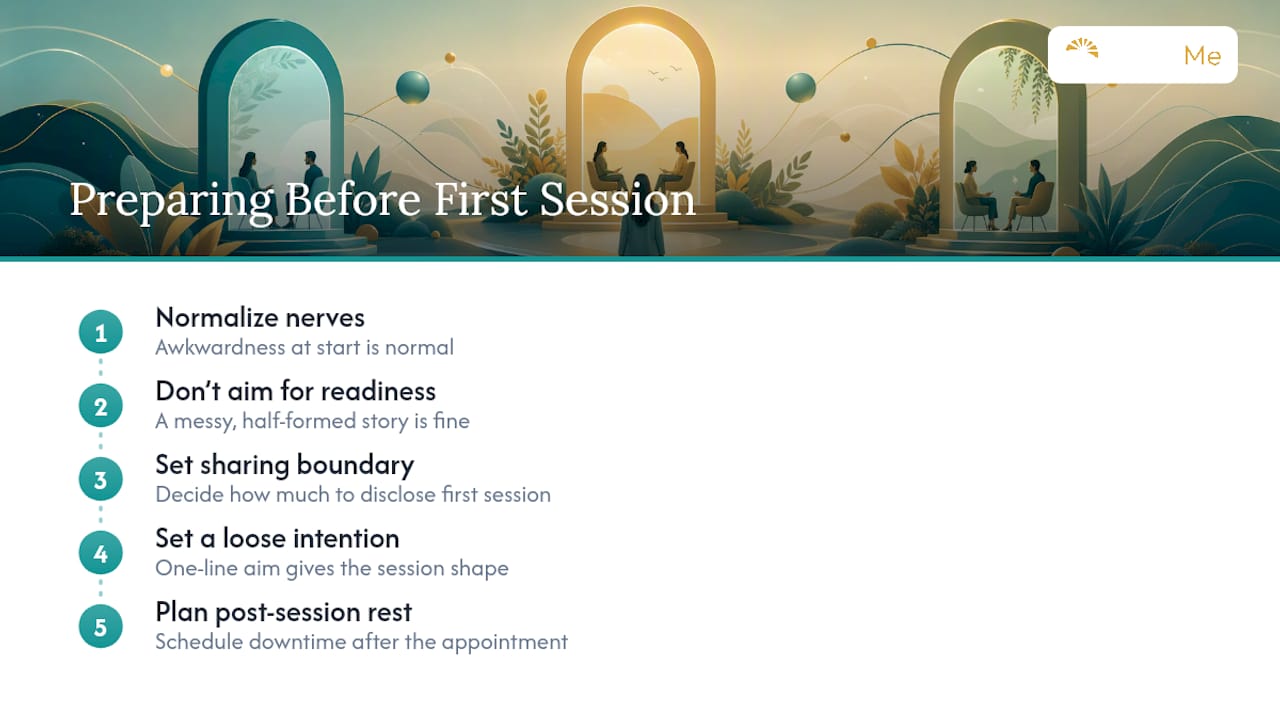
Nerves before a first session are near universal, even among people who've had therapy before. Expect some awkwardness in the opening minutes. You're meeting a stranger and disclosing personal material, and that discomfort is a normal part of the process rather than evidence something is wrong with you or the fit.
It helps to lower the pressure on yourself to arrive "ready." You don't need a polished narrative of your problem. Therapists are trained to ask questions that draw the relevant material out gradually, so arriving with a messy, half-formed sense of what's bothering you is perfectly workable.
It's also worth deciding in advance how much you're willing to share in the first session and accepting that you can hold things back until trust builds. Nobody is obliged to disclose everything on day one. Setting a loose intention, such as "I want to talk about why I keep avoiding this decision," gives the session a shape without forcing you to script it.
Finally, expect some emotional residue after the session ends, particularly if you touched on something significant. Give yourself space afterward rather than scheduling something demanding immediately after your appointment, at least for the first few sessions while you're still learning how you personally respond to the work.
What does therapy cost, and how does insurance factor in?
Costs vary considerably depending on route. NHS talking therapies are free but often involve waiting lists that stretch from weeks to several months depending on your area and the type of therapy requested. Private therapy sessions typically range from around £40 to £150 per session in the UK, with costs influenced by the therapist's experience, location, and whether they're a psychologist, counsellor, or psychotherapist.
Private health insurance sometimes covers a set number of sessions per year, though policies differ enormously in what they'll pre-authorise and which providers count as in-network. It's worth calling your insurer directly and asking specifically what mental health cover you have before booking, rather than assuming standard cover includes talking therapy.
Employer assistance programmes are another underused route, often providing a fixed number of free sessions with no GP referral required. If cost is the main barrier, ask directly whether a therapist offers a sliding scale. Many independent practitioners reserve a portion of their caseload for reduced fees, though availability shifts throughout the year.
Why does stigma still shape how people approach therapy?
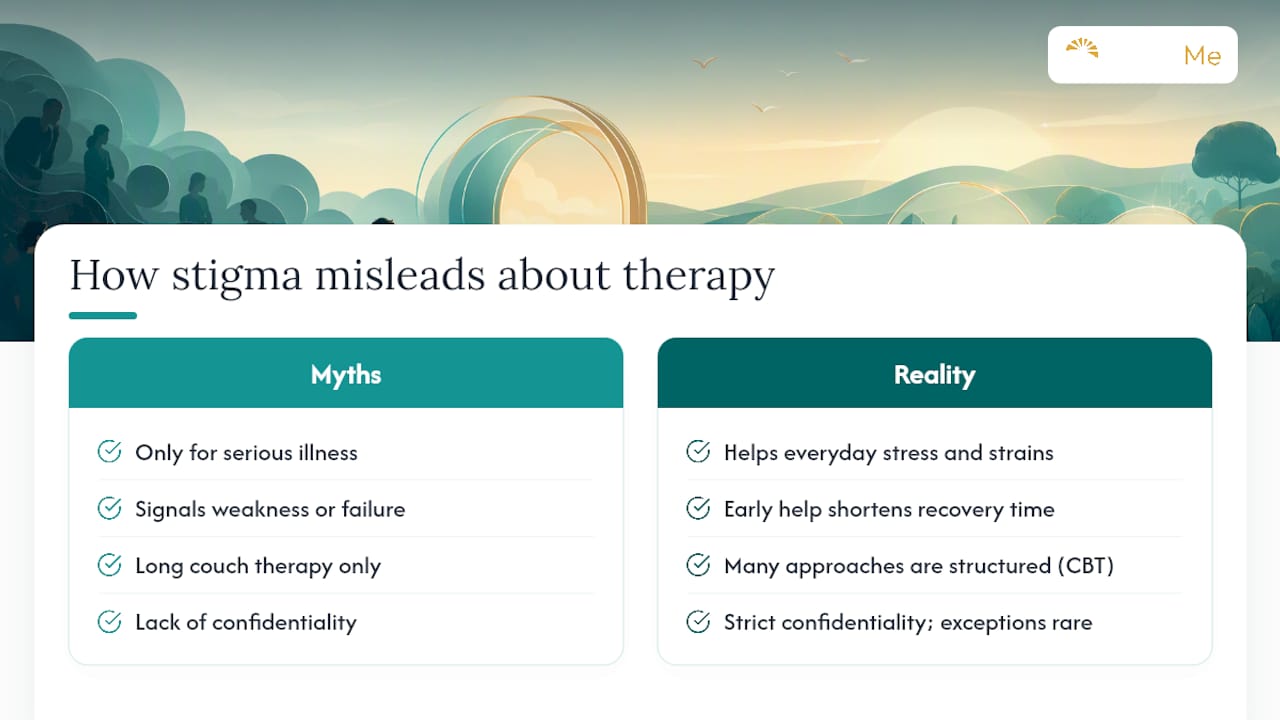
Stigma around therapy has softened over the past decade, but old misconceptions still shape decisions in quiet ways. The idea that therapy is only for "serious" mental illness keeps plenty of people from seeking help for ordinary stress, relationship strain, or low-grade unhappiness that would respond well to a few months of structured support.
Another persistent myth is that needing therapy signals weakness or an inability to cope alone. In practice, seeking support earlier tends to shorten the time needed to see improvement, precisely because problems haven't had years to become entrenched.
There's also a common assumption that therapy means lying on a couch talking about childhood for years with no clear direction. Modern practice, particularly structured approaches like CBT, often looks much more like problem-solving with a skilled collaborator than open-ended reflection.
Confidentiality concerns keep some people away too, worried that seeking help will somehow reach an employer or family member. Therapists operate under strict confidentiality rules, with narrow legal exceptions around risk of serious harm, and any competent therapist will explain those boundaries clearly in your first session. Talking to someone who's already used therapy, even briefly, often does more to dismantle the stigma than any statistic ever could.
A short note on trying again
I've watched people give up on therapy entirely after one bad match, convinced the whole thing "doesn't work for them." It usually wasn't therapy that failed. It was one therapist, one approach, one Tuesday afternoon that didn't click. A friend of mine switched after three flat sessions, booked two intro calls with different therapists, and found someone within a fortnight who actually fit. The searching is part of the process, not a detour from it.
— Yetty
Ready to find your match through GuideMe?
Guidemetherapy is the alternative to endless directory scrolling and cold-calling practices one by one. Instead of guessing from a bio photo and a list of specialisms, you get an in-depth screening that builds a personalised therapy plan before you're matched, with AI-assisted shortlisting checked by a human, not left to an algorithm alone.
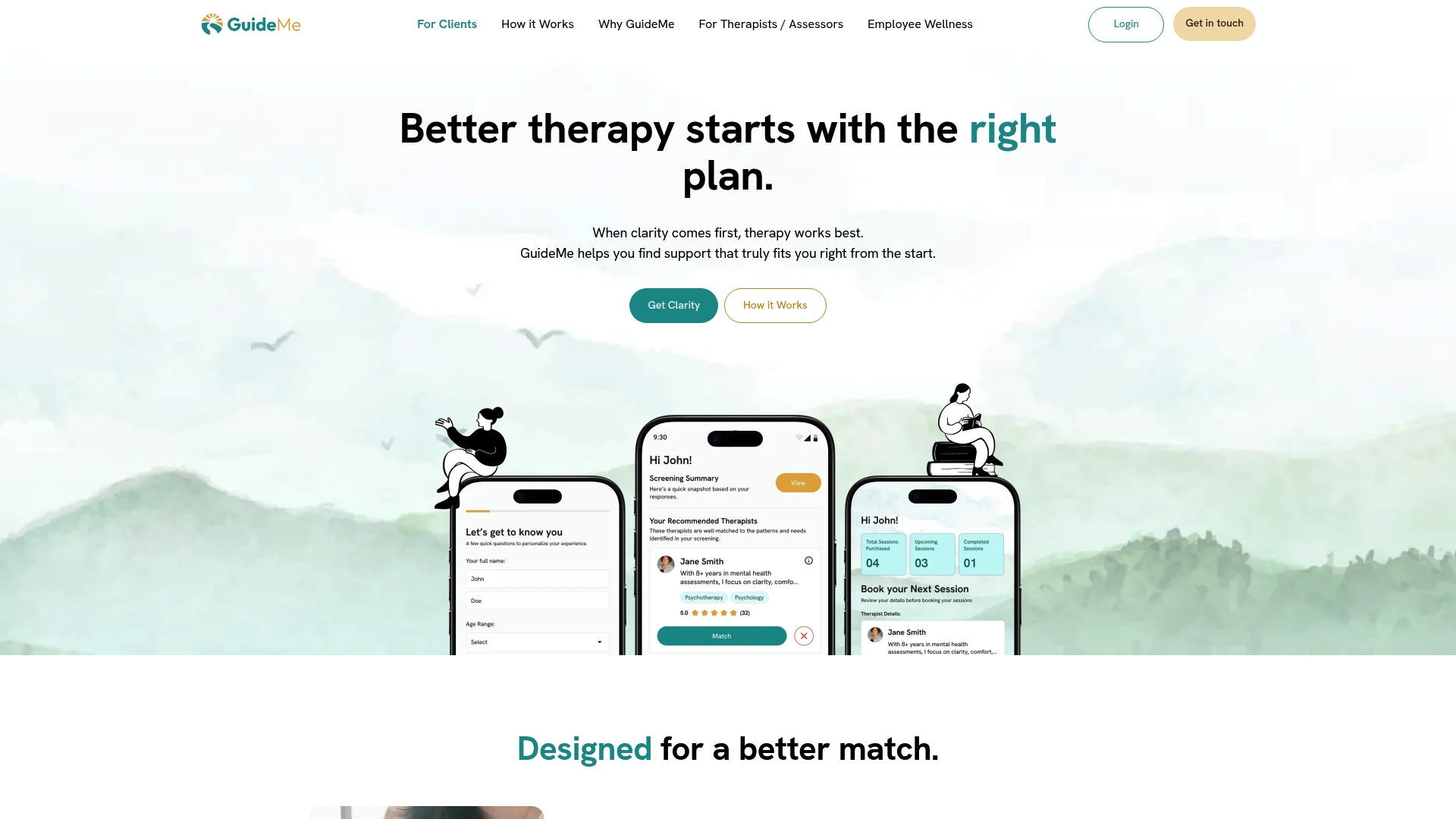
That means less time spent on consultations that go nowhere and more time with someone actually suited to your situation from the start. Guidemetherapy also keeps you supported between sessions, with check-ins that catch a poor fit early rather than months in. For a fuller sense of the matching process, the step-by-step guide to choosing the right therapist walks through what to expect. If you're ready to stop searching alone, start your match with GuideMe and get your first consultation booked.
Sources
- A remote care navigation solution associated with improved utilisation and outcomes of mental healthcare: A nationwide cohort study (PLOS One)
- How therapy works: a therapist's complete guide (Annie Wright)
This article is general information, not a substitute for advice from a qualified doctor. Consult a qualified healthcare professional about your own circumstances before acting on anything here.