

The latest national figure, 88.7% of referrals were seen within 6 weeks in January 2026, according to NHS Digital, comfortably above target. Specialist and community mental health services, though, have no single national wait standard, so your own experience may look very different.
TL;DR:
- Over 88.7% of NHS referrals for talking therapies accessed treatment within six weeks in January 2026, surpassing the 75% target set by NHS England.
- Waiting time standards apply only to NHS Talking Therapies for mild to moderate anxiety and depression, not to specialist or community mental health services.
- Local waiting times vary greatly depending on clinical complexity, staffing levels, referral pathways, and reporting practices, often resulting in longer waits for specialist care.
- Self-referral is usually faster and available for most talking therapies, and individuals can check local data and request alternative providers if waits are too long.
- During wait times, support options include urgent crisis help, interim NHS contacts, or private and low-cost therapies, which can often start within days.
Table of Contents
- What NHS therapy wait times UK standards actually mean
- Why does NHS therapy waiting differ so much by service?
- How do you check local NHS therapy waiting times and self-refer?
- What can you do while you wait for NHS therapy?
- What are the limits of NHS mental health waiting-time data?
- GuideMe's perspective on navigating NHS therapy waits
- Get matched with a therapist while your NHS referral is pending
- Sources
What NHS therapy wait times UK standards actually mean
The 6 week and 18 week clocks both start on the date your referral is received, not the date you first contact anyone about it. The clock stops at your first attended treatment appointment, the actual therapy session, not an initial assessment call or a screening chat with a duty worker. That distinction catches a lot of people out, because a "first appointment" in everyday conversation and a "first appointment" in NHS reporting terms aren't always the same thing.
NHS England sets the formal targets at 75% of people seen within 6 weeks and 95% within 18 weeks, specifically for NHS Talking Therapies, the service formerly known as IAPT.
Latest figure: 88.7% of referrals accessed treatment within 6 weeks in January 2026, well clear of the 75% standard, per NHS Digital.
A few things worth knowing about the scope of this standard:
- It applies to NHS Talking Therapies, aimed at adults with mild to moderate anxiety and depression, including treatments such as CBT and guided self-help.
- It does not cover specialist mental health services, such as community mental health teams for severe and enduring conditions.
- Some measures count referrals that finished treatment within the reporting month, which is a slightly different lens than "everyone currently waiting."
If your referral fits the Talking Therapies remit, the national data gives you a genuinely useful benchmark. If you're waiting for something more specialist, the picture is murkier, and that's where most of the frustration people describe tends to sit.
Why does NHS therapy waiting differ so much by service?
Talking Therapies runs on a standardised national pathway with published targets and monthly public reporting. Specialist and community mental health services don't have that same structure, and NHS England's own guidance confirms that not every service carries a formal waiting-time standard. That gap explains most of the confusion people feel when comparing their own wait to a headline statistic.
Several factors drive the variation you'll see between services and areas:
- Clinical complexity: mild to moderate cases move through a structured, time-boxed pathway; complex or high-risk cases go through fuller assessment before any wait clock even starts.
- Local staffing levels: two neighbouring boroughs can report very different median waits purely because one has more trained therapists per head.
- Referral pathways: self-referral routes tend to move faster than GP-mediated routes for the same service, simply because there's one less step.
- Reporting differences: not all providers submit data in the same format or on the same schedule, which can distort area-to-area comparisons.
Practitioners often describe a two-tier reality: mild-to-moderate presentations flow through Talking Therapies with a transparent, publicly reportable wait, while people referred on to secondary or specialist care face waits that are longer and far less predictable, according to NHS Digital's own performance commentary. Charities working in the sector have gone further. Rethink Mental Illness's analysis of NHS data found some people wait many months, occasionally over a year, for specialist community treatment. That's a very different world from the 6 week Talking Therapies figure.
How do you check local NHS therapy waiting times and self-refer?
You don't need to wait passively for a letter to find out where you stand or to get things moving. Most people can act on this within a day.
- Search NHS.uk's talking therapies pages for your area to find local service details and referral routes.
- Try self-referral first. Most Talking Therapies services accept self-referral, meaning you don't need to see a GP before you're added to the list.
- Ask your GP for a referral if your needs seem more complex, or if you're unsure which service fits, since GPs can direct you to the right pathway rather than the wrong one.
- Check NHS Digital's subnational data tables if you want to see how your local service compares to the national average, using the Improving Access to Psychological Therapies data set.
- Know your choice rights. For most first outpatient appointments, you can ask to be referred to an alternative provider if your local wait looks unusually long.
Before you self-refer, have a rough idea ready of how long you've been struggling, whether you're currently taking any medication, and whether risk (to yourself or anyone else) is a factor, since the service will ask about all three during triage.
Pro Tip: Self-referral forms often ask you to describe your difficulties in your own words. Write a few sentences in advance rather than composing them under pressure on the form itself. Clearer answers tend to get triaged faster.
What can you do while you wait for NHS therapy?
Waiting is genuinely hard, and it's fair to feel frustrated by it; seeking emotional and psychological support can help during this difficult time. But there are real options in the meantime, some free, some paid, all worth knowing about.
If things become urgent or unsafe:
- Call 999 or go to A&E if there's immediate risk to life.
- Call NHS 111 and select the mental health option for urgent, non-life-threatening support.
- Contact your local NHS mental health crisis team, which operates independently of the standard referral queue.
- Samaritans (116 123) is free, confidential, and available around the clock.
Interim NHS support while your appointment is pending:
You're not stuck doing nothing between referral and treatment. Ask your GP about a medication review if you're already on something, or about interim contact with a community mental health team if your situation changes while you wait. Services will sometimes escalate a case if new information suggests the original wait band no longer fits.
Private and low-cost alternatives:
- Private therapy typically starts sessions within days rather than weeks. Private CBT sessions in the UK often start from around £40, with structured courses ranging roughly £240 to £1,200 depending on length and therapist experience.
- Employer Assistance Programmes and some charities offer short-term, low-cost or free counselling. It's worth checking with HR or a relevant charity before assuming private is your only fast route.
- If cost is the main barrier, comparing an NHS versus private therapy route side by side can help you decide whether a blended approach, private now, NHS later, makes sense for your budget.
If you'd rather not sort through directories alone, a navigation platform can help you shortlist a suitable private therapist quickly, based on what you're actually dealing with rather than guesswork.
What are the limits of NHS mental health waiting-time data?
NHS waiting-time figures aren't a perfect live snapshot. Some published measures count referrals that finished treatment within the reporting month, rather than everyone currently sitting in the queue, so headline percentages can shift for reasons that have nothing to do with your own local service getting faster or slower.
There's also a known data-quality issue worth flagging. NHS Digital's Mental Health Services monthly statistics for April 2026 note that a CYPED-related data issue means counts of people still waiting may run around 2% higher than the true figure, with corrections scheduled during year-end processing.
Two practical takeaways follow from this:
- Treat small month-to-month percentage swings with caution rather than reading too much into them.
- Contact your local service directly for the most current position. Published national data lags behind what's happening on the ground by weeks.
GuideMe's perspective on navigating NHS therapy waits
We built GuideMe because "just find a therapist" is rarely simple when you're already exhausted by waiting. Our screening looks at what you're actually experiencing, then our human-led, AI-assisted matching narrows down therapists who genuinely fit that picture, rather than leaving you to scroll through directory listings hoping for the best.
Most people who use GuideMe alongside an NHS referral do both at once: they stay on the NHS list while using GuideMe to find a private therapist who can start sooner, or to feel more confident about what to expect once their NHS appointment arrives. It's a practical way to feel less stuck while the wait plays out, not a replacement for the NHS route.
— Yetty
Get matched with a therapist while your NHS referral is pending
A navigation platform can be a practical middle step between "I've been referred" and "I'm finally being seen." Instead of searching directories or guessing which private therapist suits your situation, screening can build a picture of what you need first, then human-led, AI-assisted matching can help narrow the field to therapists who actually fit.
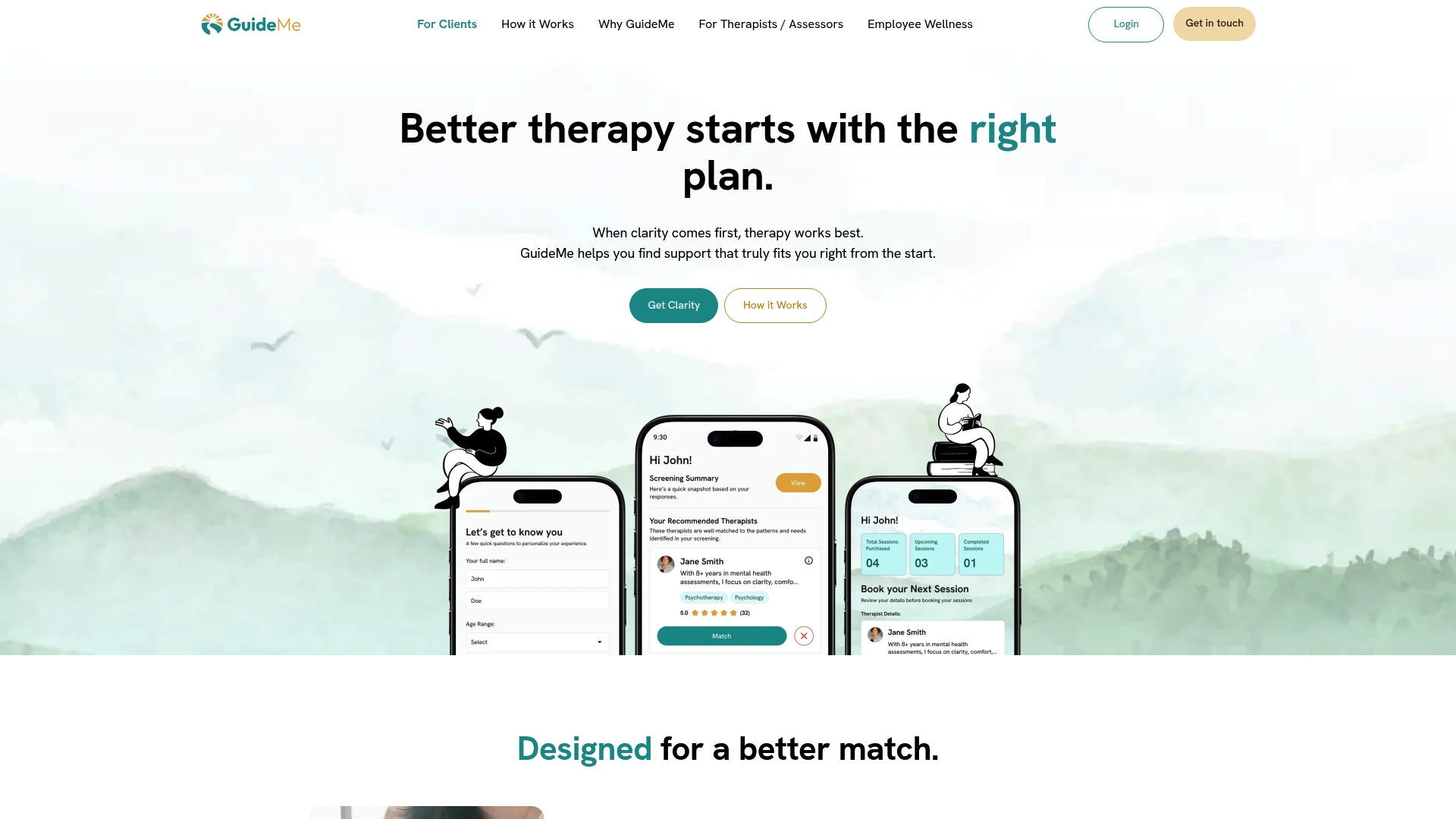
This works alongside your NHS Talking Therapies referral, not instead of it. Keep your place on the NHS list, and use GuideMe if you want a faster private option, a second opinion on fit, or simply somewhere to start while you wait. If you're weighing up directories versus a matching service, our guide to online therapist directories is worth a look too. When you're ready, visit GuideMe to begin your screening and see who you're matched with.
This article is general information, not a substitute for advice from a qualified doctor. Consult a qualified healthcare professional about your own circumstances before acting on anything here.
Sources
- NHS Talking Therapies monthly statistics — waiting times (January 2026)
- Mental health access and waiting time standards — NHS England
- Talking therapies — NHS
- Improving Access to Psychological Therapies data set — NHS Digital