

If cost is your main worry, or you're dealing with mild-to-moderate anxiety or depression, the NHS is usually the right first call, and NHS Talking Therapies is free at the point of use. If you need to be seen urgently, want a specific specialism, or value privacy and choice of therapist, private therapy tends to serve you better. Private sessions typically run from around £40 to £180+, and plenty of people use both routes at once.
TL;DR:
- Private therapy costs vary widely, from £20 for trainees to up to £180+ for specialists, with long-term courses costing several thousand pounds.
- NHS waiting times often exceed six weeks, with some areas experiencing waits over 12 to 30 weeks, especially if stepping up from low- to high-intensity support.
- Choice of private therapists allows for specific modalities and confidentiality, whereas NHS provides evidence-based treatments with limited modality options.
- Combining NHS support with private sessions can bridge waiting gaps or access niche therapies that NHS does not offer.
- Using a therapy matching platform can help prioritize urgent needs, fit budgets, and find therapists with the right specialization, avoiding random directory searches.
Table of Contents
- Private therapy vs NHS: comparing cost, wait time and choice
- Costs: private fees, total-course examples and cheaper alternatives
- NHS waiting times vs private access: what to actually expect
- Which therapy type suits which route?
- How to choose between NHS and private therapy
- Getting started: NHS self-referral and booking privately
- GuideMe: matching you to the right route, not just a therapist
- Why the "NHS or private" framing misses the point
- Compare your options and get matched with Guidemetherapy
- Sources
Private therapy vs NHS: comparing cost, wait time and choice
The two routes trade off against each other in fairly predictable ways. Here's how they stack up:
- Cost: NHS Talking Therapies is free at the point of use; private sessions generally cost £40–£180+ depending on the therapist's qualifications.
- Typical wait: NHS England targets 75% of patients starting treatment within six weeks, though your postcode matters enormously; private therapists often see you within days to a few weeks.
- Therapist choice: the NHS assigns the next available clinician; private practice lets you pick by gender, specialism and approach.
- Specialisms available: the NHS focuses on NICE-recommended, evidence-based treatments; private practitioners more often offer niche modalities.
- Session flexibility: NHS courses follow a fixed structure; private arrangements flex around your diary and pace.
- Confidentiality: NHS records sit within your wider medical file; private pay keeps sessions off that record in most cases.
A lot of people don't pick one lane. They stay on an NHS waiting list while using a handful of private sessions to bridge the gap, then step back to whichever route suits them once treatment starts.
Costs: private fees, total-course examples and cheaper alternatives
Private therapy in the UK isn't priced on a single scale. It shifts depending on who you see and where you live.
- Trainee counsellor: £20–£35 per session
- Qualified counsellor: £40–£70 outside London, £60–£90 in London or other major cities
- CBT therapist or psychotherapist: £70–£120
- Clinical psychologist or specialist: £100–£180+
A short 8-session course of private CBT usually costs several hundred pounds, while six months of weekly sessions can exceed a couple thousand once you factor in typical mid-range fees, according to NHS guidance on accessing mental health services. That's the number people forget when they budget only for the first month. A detailed breakdown of CBT pricing shows how quickly per-session costs compound into a full course.
If that stretches your budget, several lower-cost routes exist:
- Charity counselling services, often £10–£40 per session
- Trainee clinics attached to training institutions
- Employer Assistance Programmes (EAPs), which frequently cover 6–8 free sessions
- University counselling services for students
- NHS digital therapy options, delivered remotely at no cost
NHS waiting times vs private access: what to actually expect
The NHS's own standard is that 75% of people should start treatment within six weeks of referral. In practice, many areas report waits of 12, 18, or even 30-plus weeks, and your postcode can matter more than your diagnosis.
- NHS target: 75% seen within six weeks (national aim, not a guarantee for your area)
- Real-world NHS waits: commonly 12 to 30+ weeks depending on region and service demand
- Private consultations: often available within days to a few weeks, subject to therapist availability
One detail catches people out: if you're stepped up from low-intensity NHS support (guided self-help, for example) to high-intensity therapy, that step-up can reset your position in the queue, adding weeks or months you hadn't planned for. It's still worth self-referring early regardless, since the clock only starts once you're on the list, and you can always cancel or switch later.
Which therapy type suits which route?
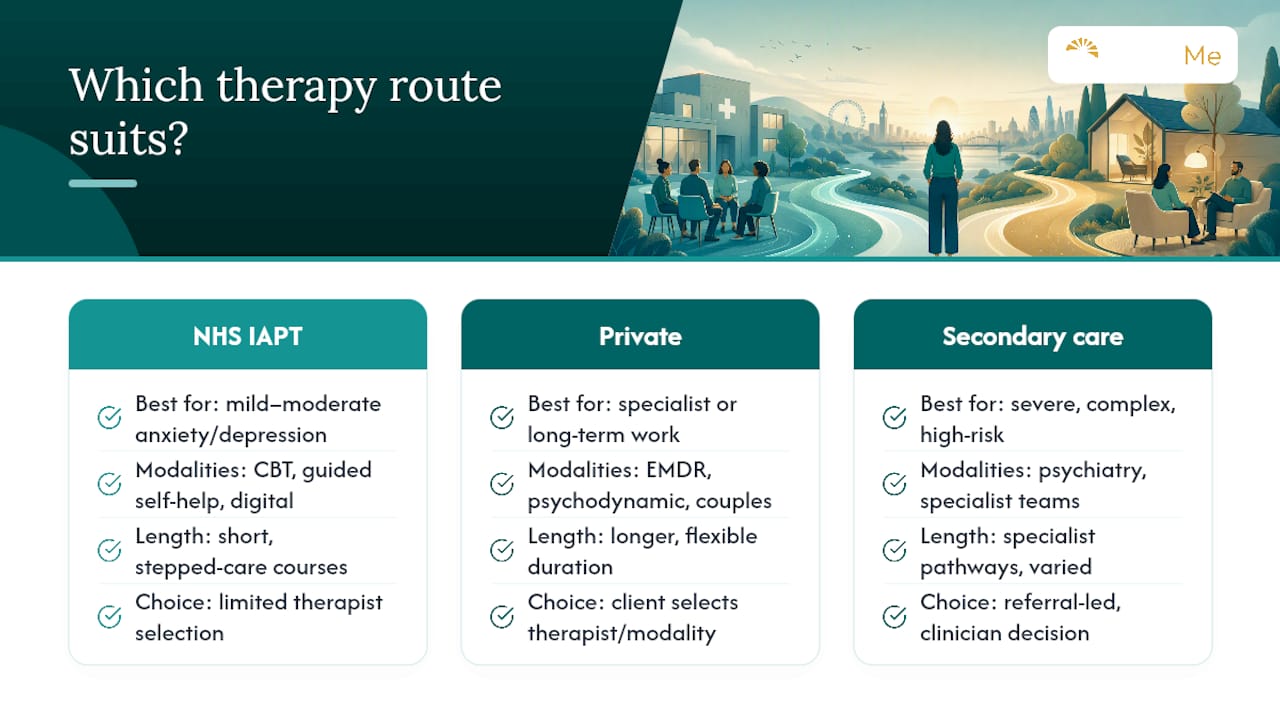
NHS Talking Therapies, still widely known by its former name IAPT, is built around NICE-recommended interventions: CBT, guided self-help, and digital programmes delivered face-to-face or remotely. It's designed for mild-to-moderate anxiety and depression, and for a large slice of the population, that's exactly the level of support needed.
Private practice tends to hold the specialist and longer-term work: EMDR for trauma, psychodynamic therapy stretching over a year or more, and couples therapy, which the NHS rarely offers outside specific relationship-focused services. Choice of modality and therapist tends to sit with the private sector, partly because private practitioners aren't bound to the same stepped-care protocols.
If your symptoms are severe, complex, or involve risk (psychosis, significant self-harm, bipolar disorder), secondary NHS mental health services or a psychiatrist are the appropriate route, not general counselling of either kind. Working out whether you need a psychiatrist or a therapist is worth doing before you book anything.
How to choose between NHS and private therapy
Run through this before you commit to either route:
- How urgent is this? If you need support within days, private is realistically your only fast option.
- What's your budget? Be honest about whether you can sustain months of private fees, not just the first session.
- Do you need a specific modality? EMDR, psychodynamic work and couples therapy point towards private.
- How complex is the presenting problem? Severe or layered conditions may need NHS secondary care, not either standard route.
- Does confidentiality matter to you? Private pay generally keeps sessions off your central medical record.
- Do you have employer or insurance cover? Check EAP entitlement before paying out of pocket.
If you're contacting a private therapist directly, ask:
- What are your qualifications and which professional body are you registered with?
- Are you accredited through a PSA-accredited register?
- Do you receive regular clinical supervision?
- How long is each session, and how many will I likely need?
- What's your cancellation policy and fee?
- How do you track whether therapy is working?
Watch for red flags: no verifiable registration, pressure to book a long block of sessions upfront, or vague cancellation terms.
Pro Tip: Treat the first session as a two-way interview. A good therapist expects questions about their approach and won't be defensive when you ask them.
Getting started: NHS self-referral and booking privately
For the NHS, search "NHS Talking Therapies" plus your postcode, or ask your GP for a referral. The initial assessment call typically covers your symptoms, history and what you're hoping to get from treatment, then places you on the appropriate pathway.
For private therapy, safety checks matter more than speed:
- Search registers held by BACP, UKCP or HCPC before booking anyone
- Consider trainee clinics or EAP-provided sessions if cost is tight
- Ask upfront about record-keeping, sliding-scale fees, and cancellation windows
- Nothing stops you running NHS and private support in parallel
A step-by-step guide to booking therapy in the UK covers what to expect at each stage of both processes.
GuideMe: matching you to the right route, not just a therapist
Working out whether you need NHS support, private therapy, or both isn't always obvious from the outside, especially when you're already feeling low on energy to research it. A therapy navigation platform can provide an in-depth screening, create a personalised therapy plan, and combine AI-assisted matching with human oversight to connect you with a therapist suited to your specific situation.
That's genuinely useful in a few common scenarios: bridging an NHS wait with short-term private sessions, finding a specialist modality the NHS doesn't offer locally, or simply verifying a private therapist's credentials before you commit any money...
Why the "NHS or private" framing misses the point
Most guidance on this topic treats NHS and private therapy as a fork in the road, pick one and stick with it. That's not how people actually use mental health support, and it's not the smartest way to think about it either.
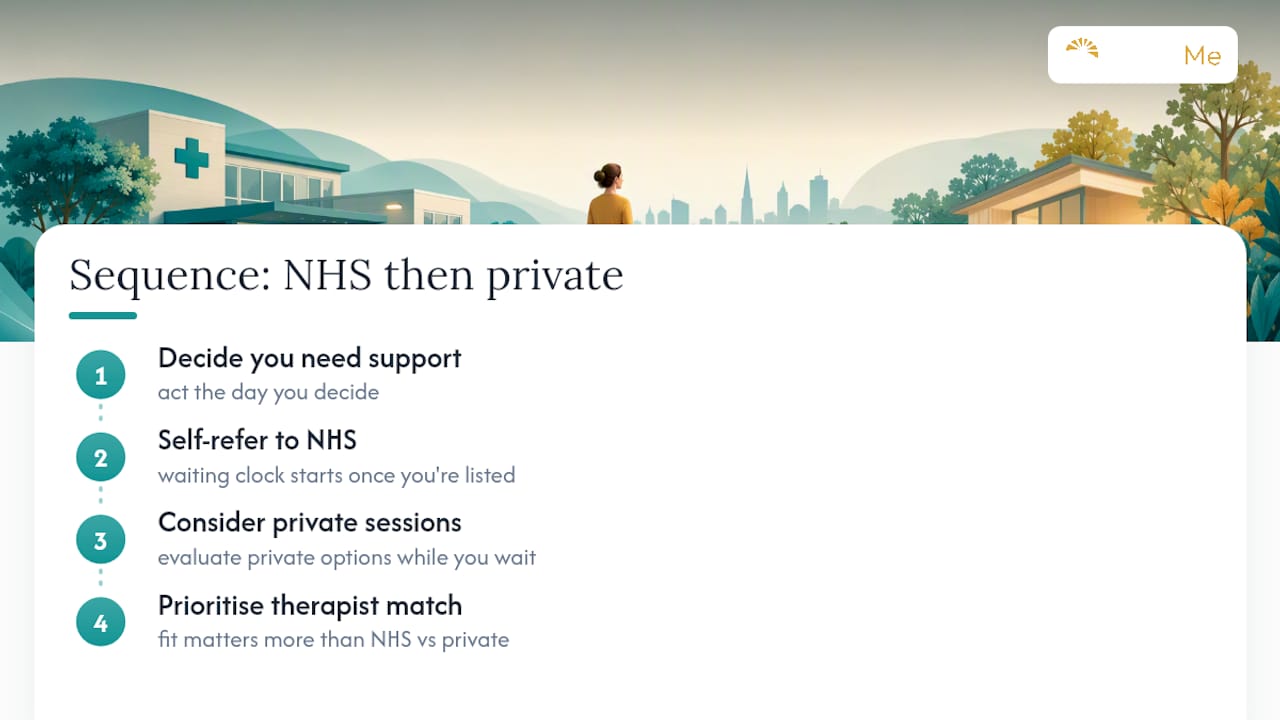
The more useful framing is sequencing. Self-refer to NHS Talking Therapies the day you decide you need support, because the waiting clock only starts once you're on a list, then decide separately whether private sessions make sense while you wait. These aren't competing philosophies of care. NHS Talking Therapies exists because stepped, evidence-based CBT works for a genuinely large share of anxiety and depression cases, and private practice exists because some problems, and some people's schedules, need more flexibility than a public service running at capacity can offer.
Where I'd push back on conventional advice is the assumption that private always means "better" or "faster fix." It means more choice and often faster access, not automatically stronger outcomes. A well-matched NHS CBT therapist frequently outperforms a poorly matched private one, purely because the fit between person and therapist affects results more than which sector delivered it. That's the real argument for tools that focus on matching rather than just listing therapists by postcode and price.
— Yetty
Compare your options and get matched with Guidemetherapy
Working out whether you need NHS Talking Therapies, a private therapist, or a combination of both shouldn't rest on guesswork about waiting lists and fee bands. A therapy navigation platform can give you a clearer starting point: a proper screening, a personalised plan, and matching that accounts for your budget, urgency and the specific issue you're dealing with, rather than a generic directory search.
If you're weighing up cost against speed, or trying to find a private therapist whose specialism actually matches your situation, start with a screening on Guidemetherapy and get matched with a therapist suited to what you actually need.
This article is general information, not a substitute for advice from a qualified doctor. Consult a qualified healthcare professional about your own circumstances before acting on anything here.
Sources
- How to access mental health services — NHS
- Access and waiting time standard — NHS England
- PMC article discussing stepped-care and wait impacts