

Start with the two PSA-accredited registers: the BACP Register and UKCP Find a Therapist. Both verify training, enforce ethical standards, and provide a formal complaints route. For broader searching, Counselling Directory holds the PIF TICK quality mark, an independently-assessed standard for online health information. These three are your safest starting points.
- BACP Register: PSA-accredited; a large number of listed therapists; limits listings to registered or accredited members.
- UKCP Find a Therapist: PSA-accredited national register; therapists meet UKCP training and ethical standards.
- Counselling Directory: over 20,000 listings; PIF TICK certified; includes editorial resources to help first-time searchers.
- Key trust signals to check: PSA accreditation, membership status (e.g. Registered MBACP), published complaints procedure, evidence of CPD and supervision.
- Quick next step: search within a register, filter for online sessions, then confirm membership status and ask for the complaints procedure before booking.
Key takeaways
PSA-accredited registers (BACP and UKCP) are the safest starting point for finding a therapist in the UK, because they verify training, enforce ethical standards, and provide a formal complaints route.
| Point | Details |
|---|---|
| Start with accredited registers | Use the BACP Register or UKCP Find a Therapist first; both are PSA-accredited with verified membership standards. |
| Check PIF TICK for directories | Counselling Directory holds the PIF TICK quality mark, signalling independently assessed quality for its listings. |
| Verify registration independently | Search the therapist's name directly on the BACP or UKCP register before booking, not just on the directory listing. |
| Know the crisis services | For urgent support, use Samaritans (116 123), Shout (text 85258), or NHS 111; directories are for private practitioners, not crises. |
| Guidemetherapy for guided matching | Guidemetherapy combines human-led screening and AI-assisted matching with upfront registration checks for a supported search. |
Table of Contents
- Which online therapist directories should you use in the UK?
- What do directory listings actually show you?
- How do you use a directory to find and contact a therapist?
- How do you check a therapist's registration and complaints procedure?
- What are the red flags in listings and first communications?
- Where can you get free or urgent mental health support in the UK?
- Can ChatGPT or an AI tool replace a therapist?
- When should you use a register, a directory, or a matching service?
- Why accredited registers should always come first
- Guidemetherapy: guided matching when you want more than a search bar
- Sources
Which online therapist directories should you use in the UK?
The UK has no single statutory regulator for counsellors and psychotherapists. Therapy in the UK is not universally regulated by law; the protection you get comes from membership of an accredited professional body, not from a government licence. That makes choosing the right directory more important than it might seem.
PSA-accredited registers are the gold standard. The Professional Standards Authority independently assesses them for governance, complaints handling, and standard-setting. The Department of Health promotes them as the first place the public should look for practitioners.
- BACP Register: The BACP Register of Counsellors and Psychotherapists is PSA-accredited and sets membership standards, CPD requirements, and a professional complaints procedure. Becoming a Registered MBACP requires accredited training or a Certificate of Proficiency, plus supervised practice.
- UKCP Find a Therapist: UKCP maintains a national register listing only therapists who meet its training and ethical standards. It is also PSA-accredited, and its register page explains how data quality and trainee listings are managed separately from fully registered members.
- Counselling Directory: Lists more than 20,000 counsellors and psychotherapists and combines searchable listings with editorial content about therapy types. It holds the PIF TICK certification, independently assessed by the Patient Information Forum as a quality mark for trusted health information online.
Pro Tip: The PIF TICK mark signals that a directory's health information has been independently assessed for quality and accuracy. If a directory does not hold it, check its editorial standards carefully before relying on its content.
The BACP Therapist Directory lists a large number of private therapists and restricts advertising to registered or accredited members, which means everyone you find there has met a defined standard for training, experience, and ethical practice.
What do directory listings actually show you?
Most listings across the major UK directories share a common set of fields. Knowing which ones to prioritise saves time and reduces the risk of booking someone who is not the right fit.
Fields that matter most:
- Registration and membership status: Look for "Registered MBACP" or "UKCP Registered." These confirm the therapist is on an accredited register with a complaints route.
- Qualifications and training: A named, accredited qualification (not just "trained in CBT") is a positive signal. Vague statements like "studied various approaches" warrant a follow-up question.
- Therapy approach: CBT, person-centred, psychodynamic, EMDR, and others suit different needs. Knowing what evidence-based therapy means helps you read these descriptions critically.
- Session types: Confirm whether online, telephone, or in-person sessions are available. Not all therapists offer all formats.
- Fees and availability: Clear fee information and stated availability are practical necessities. A listing with no fees listed is not necessarily a red flag, but you should ask before the first session.
- Languages spoken: Relevant if English is not your first language or you want therapy in another language.
Fields to treat cautiously:
- Promises of guaranteed outcomes or rapid cures.
- Vague training statements with no named institution or qualification.
- Long lists of specialisms with no depth or explanation.
Pro Tip: Profiles vary in quality because many therapists do not fully optimise their listings. If a search returns few results, broaden your keywords or check multiple registers rather than assuming no suitable therapists exist in your area.
How do you use a directory to find and contact a therapist?
A structured approach gets you to a first appointment faster and with more confidence.
- Choose your starting register or directory. Begin with the BACP Register or UKCP Find a Therapist for the strongest accreditation assurance. Use Counselling Directory for broader coverage or if you want editorial guidance alongside your search.
- Set your filters. Select "online" or "telephone" under session type if you want virtual sessions. Add your location for in-person options. Filter by therapy type if you already know what you need.
- Shortlist three profiles. Read each one for membership status, qualifications, therapy approach, and fees. Three gives you comparison options without being overwhelming.
- Verify registration independently. Do not rely solely on the listing. Check the therapist's name directly on the BACP or UKCP register to confirm current membership status.
- Send a short first message. Keep it brief: your main concern in one sentence, your preferred session format, and a question about availability. Ask about the platform used for online sessions, the cancellation policy, and how confidentiality is handled.
- Book an initial consultation. Many therapists offer a short introductory call. Use it to assess whether you feel comfortable, not just whether they are qualified.
From first contact to a confirmed first appointment, most people find the process takes one to two weeks, depending on therapist availability and how quickly you respond to messages.
Pro Tip: Keep a simple note of the three therapists you contact: their name, register, fee, and your impression of their profile. It makes comparison much easier if you receive multiple responses at once.
For more practical guidance on finding a therapist efficiently, including what to ask and what to expect, a structured approach consistently produces better results than open-ended browsing.
How do you check a therapist's registration and complaints procedure?
Checking registration takes less than five minutes and is worth doing before every booking.
- Go to the BACP Register search at bacp.co.uk and enter the therapist's name. A current listing confirms active membership.
- Do the same on the UKCP website. Note whether the therapist appears on the main register or a trainee list; UKCP lists trainees separately from fully registered members.
- Confirm the membership category. "Registered MBACP" is the standard entry-level status. "MBACP (Accred)" requires at least three years of supervised clinical practice beyond initial registration.
- Ask the therapist directly for their registration number. A confident, immediate answer is a positive sign.
CPD and supervision matter because they indicate ongoing professional development, not just initial training. A therapist in active practice should be able to confirm they receive regular supervision.
Pro Tip: Every PSA-accredited register publishes its complaints procedure publicly. If you cannot find it within two clicks on the register's website, call them directly. Knowing the route before you need it is sensible, not pessimistic.
If concerns arise:
- Raise them with the therapist first if it is safe to do so.
- Contact the relevant register (BACP or UKCP) to make a formal complaint.
- Report serious concerns to the Professional Standards Authority, which oversees all accredited registers.
What are the red flags in listings and first communications?
Some signals in a profile or early exchange should prompt you to pause and check further.
- No verifiable registration: If a therapist cannot be found on the BACP or UKCP register, ask why. "I'm not a member of any professional body" is not an acceptable answer for a practitioner offering clinical services.
- Vague or missing qualifications: A listing that mentions "extensive training" with no named institution or qualification is incomplete at best.
- Guaranteed outcomes: No ethical therapist promises a cure or a specific result. Outcome guarantees are a clear warning sign.
- Pressure to commit quickly: A therapist who pushes for immediate payment or a long block booking before an introductory session is not following standard practice.
- Evasive answers about supervision: A practising therapist should be in regular supervision. Reluctance to confirm this is a concern.
- No clear privacy answer for online sessions: If a therapist cannot tell you which platform they use or how your data is protected, that is a gap in their professional practice.
- No complaints route provided: Every registered therapist should be able to direct you to their professional body's complaints procedure without hesitation.
If a therapist cannot confirm their registration, explain their complaints procedure, or answer basic questions about online session security, those are grounds to walk away. Report concerns to the relevant register or to the Professional Standards Authority. Protecting yourself is not an overreaction; it is exactly what these systems are designed to support.
Pro Tip: Use the therapist fit assessment framework to structure your introductory call. It turns a potentially awkward conversation into a straightforward checklist.
Where can you get free or urgent mental health support in the UK?
Directories are for finding paid or private practitioners. They are not crisis services. If you or someone you know needs immediate support, go directly to these:
Crisis and urgent support:
- Samaritans: Call 116 123, free, 24 hours a day, every day. For anyone in distress or at risk.
- Shout: Text SHOUT to 85258 for free, confidential text-based crisis support, 24/7.
- NHS 111 / 111 online: For urgent mental health concerns that are not an emergency. Available 24 hours.
- Mind: mind.org.uk provides signposting to local services and information on a wide range of mental health topics.
Free or lower-cost ongoing support:
- Many charities offer free counselling sessions or low-cost referrals. Mind, Rethink Mental Illness, and local IAPT services (now NHS Talking Therapies) are starting points.
- Counselling Directory allows you to filter by fee range. Searching for student or trainee therapists (who work under supervision) can reduce costs significantly while still providing accredited-standard care.
- Some therapists offer sliding-scale fees. Ask directly; many do not advertise this but will consider it.
Paid therapy through a directory is still the right route for ongoing, structured support. Crisis lines are not a substitute for regular therapy, and regular therapy is not a substitute for crisis support. The two serve different needs.
Can ChatGPT or an AI tool replace a therapist?
No. AI chat tools cannot replace a trained therapist for clinical care. That answer does not change with newer models or more sophisticated interfaces.
What AI cannot do:
- Provide a clinical assessment or diagnosis.
- Offer a regulated duty of care.
- Maintain confidentiality under a professional framework.
- Provide a complaints route if something goes wrong.
- Manage a mental health crisis safely.
Privacy risks are real. Conversations with AI tools are processed by third-party servers. Depending on the platform's terms, your data may be used for training or stored in ways you cannot control. There is no equivalent of a therapist's professional confidentiality obligation.
Where AI can help:
- Finding information about therapy types and what to expect.
- Preparing questions to ask a therapist before a first session.
- Mood-tracking prompts or journalling frameworks between sessions.
- Signposting to directories and registers.
Pro Tip: Use an AI tool to prepare for therapy, not instead of it. Writing down your main concerns before a first session, with or without AI assistance, helps you use that time well.
When should you use a register, a directory, or a matching service?
The right route depends on what you need most.
| Your priority | Best route | Why |
|---|---|---|
| Highest accreditation assurance | BACP Register or UKCP Find a Therapist | PSA-accredited; formal complaints route; verified training standards |
| Broad search with editorial support | Counselling Directory | 20,000+ listings; PIF TICK quality mark; therapy-type guides for first-time searchers |
| Guided matching with less effort | Matching/navigation service (e.g. Guidemetherapy) | Human-led screening; upfront registration checks; personalised therapy plan |
Most people benefit from using more than one route. Start with a PSA-accredited register to confirm a therapist's credentials, then use a broader directory to compare options, and consider a matching service if you want someone to do the vetting work with you.
- Use the BACP or UKCP register when accreditation and a formal complaints route are your primary concern.
- Use Counselling Directory when you want a large pool of options and accessible editorial guidance alongside listings.
- Use a matching service when you are time-poor, unsure where to start, or want a structured therapy plan before you begin searching.
For a detailed comparison of directory alternatives for UK users, including how matching services differ from self-directed searches, the differences in approach are worth understanding before you commit.
Why accredited registers should always come first
There is a tendency in online mental health content to treat all directories as roughly equivalent, distinguished mainly by design and search features. That framing misses the point. The gap between a PSA-accredited register and an unverified listing site is not cosmetic; it is the difference between a practitioner who is accountable to a professional body and one who is not.
The UK's lack of universal statutory regulation for therapists means that accountability depends entirely on voluntary membership of accredited bodies, highlighting the importance of licensing and accreditation in trusted health services. A therapist who is not on the BACP or UKCP register may be skilled and ethical. But if something goes wrong, you have no formal complaints route, no professional conduct procedure, and no independent body to escalate to. That is a meaningful risk, not a theoretical one.
Guidemetherapy's approach of combining human-led matching with upfront registration checks reflects this same priority: accreditation first, then fit. The two are not in tension. A therapist who meets professional standards and suits your specific needs is the goal; the register confirms the first part, and the matching process addresses the second.
Guidemetherapy: guided matching when you want more than a search bar
Searching directories yourself is a solid starting point. But for many people, the process of reading profiles, cross-checking registers, and shortlisting three candidates still feels like a lot to manage alongside everything else.
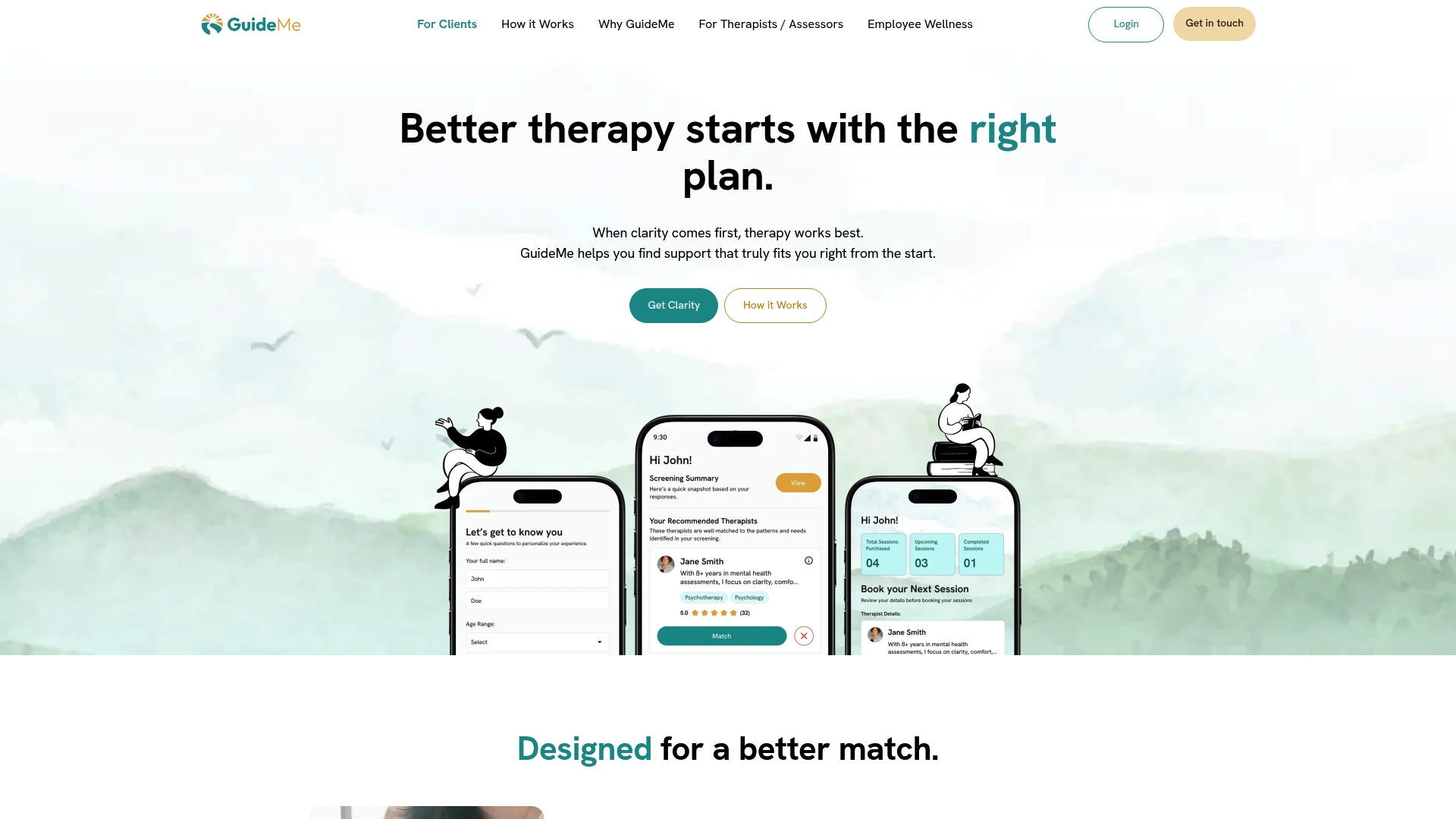
Guidemetherapy is a therapy navigation platform that does the vetting work with you. It combines an in-depth screening process with a personalised therapy plan, then matches you with a therapist whose registration, approach, and availability have already been checked. The matching is human led and AI assisted, which means you get both the efficiency of a structured search and the reassurance of a real person reviewing your needs.
For individuals who want to find the right therapist without spending hours on directories, Guidemetherapy offers a clear, supported route from first screening to confirmed booking. Visit guidemetherapy.com to start your therapy plan today.
Sources
The sources below cover registration checks, complaints procedures, and urgent support. Each serves a distinct purpose.
- How to find a therapist: BACP Therapist Directory
- BACP Register of Counsellors and Psychotherapists
- Counselling Directory
- Our register | UKCP
- Statutory regulation summary briefing | UKCP