

Short answer: yes. Private medical insurance, many employers and the NHS can all pay for talking therapy in the UK, but each route comes with its own limits and rules. Private policies usually cap outpatient sessions or spend, workplace schemes vary by employer, and the NHS offers free treatment with waiting times that shift by region. Knowing which door to knock on first saves weeks of confusion.
TL;DR:
- Private mental health coverage typically includes outpatient therapy sessions with session caps varying by insurer and policy tier, usually detailed in policy documents.
- Employer benefits like Employee Assistance Programs offer limited free or subsidized sessions, often with confidentiality maintained if the provider is used correctly.
- NHS talking therapies are free with waiting times that differ regionally, and self-referral can speed access outside the GP referral process.
- Common policy exclusions include pre-existing conditions, addiction treatment, and certain assessments, so verifying allowances and red flags before claiming is essential.
- If a claim is denied, challenging the reason through written documentation and internal appeals can often lead to coverage even after initial rejection.
Table of Contents
- Private medical insurance for therapy: what's covered and what isn't
- How do employer benefits and EAPs cover counselling?
- What does the NHS actually offer for talking therapy?
- What exclusions and limits should you check before assuming you're covered?
- What if insurance won't cover it or you've used your allowance?
- Checklist: how do you confirm cover and book your first session?
- How do mental health parity rules affect therapy cover in the UK?
- What can you do if your therapy claim gets denied?
- GuideMe's perspective on making cover work for you
- Guideme: your next step in getting matched
- Sources
Private medical insurance for therapy: what's covered and what isn't
Most comprehensive private medical insurance (PMI) policies in the UK now build in some mental health cover, but the outpatient allowance is where the real detail sits. Cognitive behavioural therapy (CBT), counselling and psychotherapy are commonly included; chronic conditions, developmental diagnoses and addiction treatment are usually excluded or handled separately.
Typical outpatient limits sit at a moderate to generous level per year, corresponding to a standard number of sessions common in UK private medical insurance policies, depending on the insurer and tier, according to NHS guidance on talking therapies and analysis from Forbes Advisor UK.
Inpatient psychiatric cover, where offered, sits on a separate part of the policy entirely and rarely applies to routine counselling. A few things worth checking before you assume you're covered:
- Whether mental health cover is standard or an optional add-on
- The exact outpatient allowance in pounds and in session count
- Whether a higher policy tier removes or raises the cap
- Any pre-existing condition exclusions tied to previous mental health claims
As policies increasingly treat mental health as standard rather than exceptional, the outpatient allowance and the pre-existing condition wording have become the two things that actually separate a good policy from a mediocre one.
How do employer benefits and EAPs cover counselling?
Employee Assistance Programmes (EAPs) are one of the most widely offered workplace wellbeing benefits in the UK, and for good reason: they're cheap for employers and genuinely useful for staff. An EAP typically bundles short-term counselling with a limited number of sessions, a 24-hour helpline, and signposting to further support.
CIPD's 2025 wellbeing research shows counselling services and EAPs rank among employers' most common benefits, alongside occupational sick pay. Access is usually simpler than people expect. If your employer offers one, here's how to use it:
- Ask HR or check your staff handbook for the EAP provider's name and phone number
- Call the helpline directly. You don't normally need manager sign-off
- Ask explicitly how many sessions are included and whether extensions are possible
- Confirm that session content stays confidential and isn't reported back to HR
That confidentiality point matters. Most EAPs report only anonymised usage statistics to employers, not individual details, which is worth confirming if you're anxious about workplace stigma. Our guide on what employee counselling covers breaks this down further for anyone navigating a new scheme.
What does the NHS actually offer for talking therapy?
NHS talking therapies remain free at the point of use and, in England, adults can self-refer directly without seeing a GP first. In Scotland, Wales and Northern Ireland, a GP referral is typically still the route in.
Sessions usually run 50 to 60 minutes, with most courses lasting between 8 and 16 sessions depending on the treatment approach and how you respond. CBT tends to follow a structured, time-limited format; longer-term counselling can extend further where clinically justified.
- Self-referral is available online or by phone in most English areas
- Waiting times vary significantly by region, sometimes weeks, sometimes longer
- The NHS "right to choose" lets some patients select a different provider if local waits are long, which is worth asking about when referred
- NHS therapy suits people without insurance or with straightforward, moderate presentations; private routes suit those wanting faster access or specific therapist choice
If you're weighing NHS against private cover, the honest comparison usually comes down to speed versus cost. Our piece on booking an NHS therapy appointment covers what to expect at each stage.
What exclusions and limits should you check before assuming you're covered?
Policy wording is where good intentions go to die. Common exclusions across UK insurers and employer schemes include pre-existing mental health conditions, ADHD or autism assessments, addiction treatment, and work-related stress claims without a formal diagnosis attached.
Many insurers now offer a "direct access" or clinical assessment pathway, letting members skip the GP and go straight to an assessment call with the insurer's own clinical team. This genuinely speeds things up, according to GoingPrivateUK's breakdown of Vitality's direct-access route, and it's worth asking your insurer if they offer something similar.
To check where you stand:
- Pull up your policy document and search for "mental health," "outpatient," and "psychiatric"
- Call your insurer's claims team directly rather than relying on the general helpline
- Ask HR for the EAP provider's name if you're unsure whether one exists
- Watch for vague outpatient definitions, unusually long exclusion lists, or an unclear authorisation process. Those are red flags that cover is thinner than it looks
Pro Tip: Ask your insurer for the outpatient allowance in writing, not just verbally. Session caps quoted over the phone sometimes differ from what's actually written into your policy schedule.
For help decoding dense policy language, our guide to reading therapy cover terms walks through the wording insurers use most often.
What if insurance won't cover it or you've used your allowance?
Running out of sessions doesn't mean running out of options. NHS talking therapies remain free once you're through the referral process, and several UK charities fill the gap for people who need more support than their policy allows.
- Local Mind centres offer subsidised or free counselling in many areas
- Cruse Bereavement Support helps with grief-related therapy at low or no cost
- Rape Crisis and Anxiety UK provide specialist, often free, services
- University counselling services are open to current students regardless of insurance
- Some private therapists offer sliding-scale fees for people on lower incomes
Whichever route you choose, check the therapist's accreditation through BACP or UKCP registers before booking. Community organisations such as From Love With Care's loneliness support services also offer a useful bridge for people who need connection alongside formal therapy.
Checklist: how do you confirm cover and book your first session?
Work through these steps in order, and have your policy number, GP details and a brief description of what you're struggling with ready before you call anyone.
- Check NHS self-referral availability in your area first. It's free and often the fastest baseline option
- Find your policy number and outpatient allowance in your PMI documents
- Call your insurer's claims team and ask about direct-access assessment routes
- Contact HR to ask about EAP access and session limits
- Verify any therapist's BACP or UKCP accreditation before booking
- Book an initial assessment call or session
Insurer authorisation for outpatient therapy often turns around within a few working days, while NHS waits vary by area, sometimes considerably longer.
Our therapist finder guide covers what to look for once you've confirmed which route is paying.
How do mental health parity rules affect therapy cover in the UK?
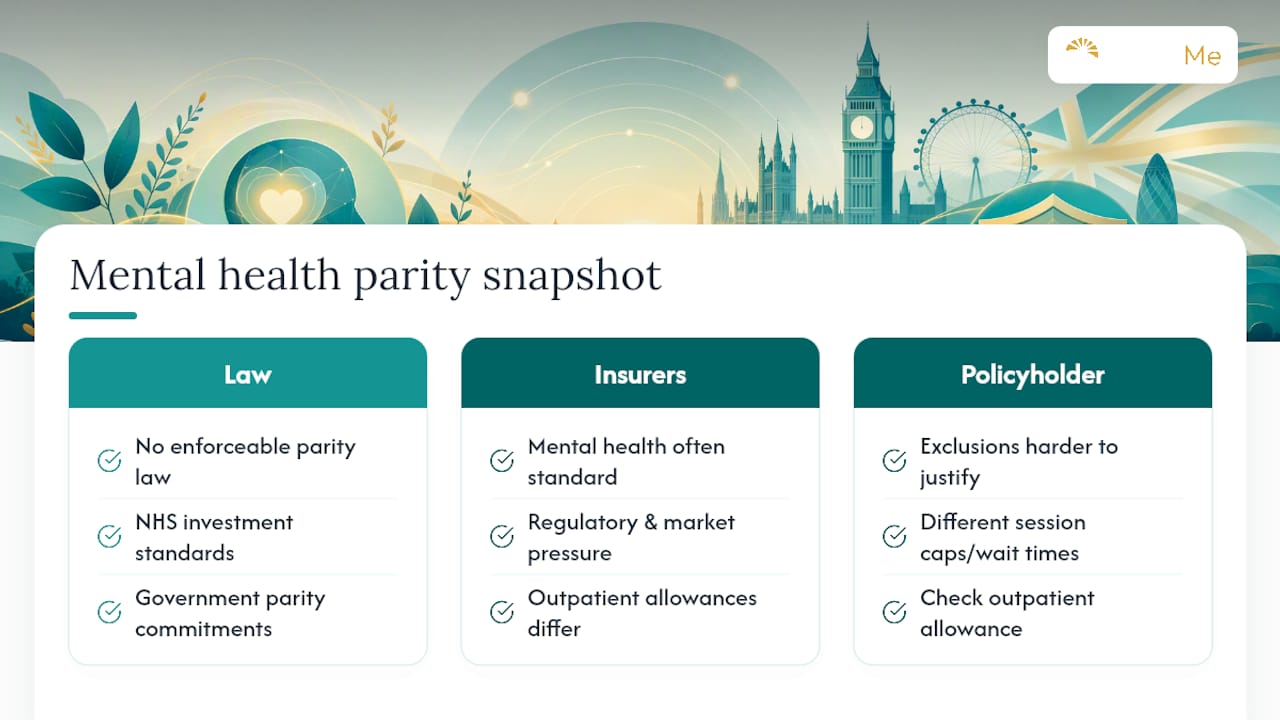
The UK doesn't have a single, enforceable "parity law" in the way some other countries do, requiring insurers to cover mental health identically to physical health. What exists instead is a policy direction, set out through NHS mental health investment standards and broader government commitments, pushing mental health funding and access closer to parity with physical health services over time.
For private insurance, this shows up indirectly. Regulatory and market pressure has nudged insurers toward including mental health cover as standard rather than as a costly add-on, which is part of why outpatient allowances have become the real differentiator between policies rather than whether mental health is covered at all. Employers have followed a similar path, partly driven by workplace wellbeing reporting expectations that make counselling provision a visible, comparable benefit.
The practical effect for you as a policyholder is limited but real: mental health exclusions are harder for insurers to justify wholesale than they once were, and cover that treats a panic disorder differently from a physical injury claim is increasingly the exception rather than the rule. That said, parity in principle doesn't mean parity in session caps or waiting times. Always check the specific outpatient allowance rather than assuming broad policy language guarantees equal treatment.
What can you do if your therapy claim gets denied?
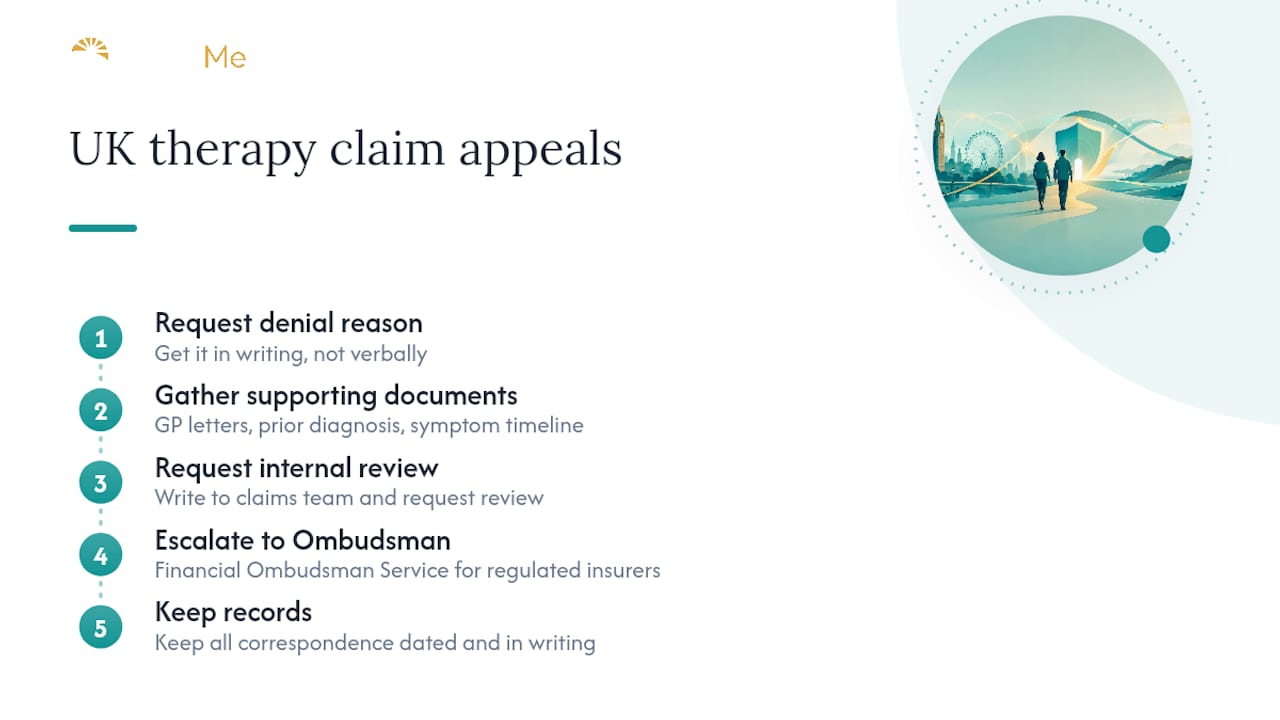
A denied claim for talking therapy is rarely the final word. Insurers reject claims for identifiable reasons, and most are challengeable if you know what to ask.
Start by requesting the denial reason in writing rather than accepting a verbal explanation. Common grounds include the condition being classed as pre-existing, the treatment falling outside the outpatient definition in your policy, or a missing referral step such as a GP letter or clinical assessment call.
Once you have the written reason, gather supporting documentation: GP letters, any prior diagnosis, and a clear timeline of when symptoms began relative to your policy start date. This matters most for pre-existing condition disputes, where the exact date of first symptoms versus policy inception decides the outcome.
Every UK insurer runs a formal internal appeals process, usually accessed by writing to the claims team and requesting a review. If that fails, the Financial Ombudsman Service can investigate disputes with regulated insurers free of charge, and it's a route worth using rather than giving up after one rejection. Keep every piece of correspondence dated and in writing throughout. Verbal assurances from a call centre are hard to enforce later, but a documented paper trail gives you something concrete to appeal against if the first answer is no.
GuideMe's perspective on making cover work for you
Confirming what your policy, employer or the NHS will actually pay for is often the hardest part of getting help. GuideMe combines an in-depth screening process with AI-assisted matching and human support, so you're not left guessing whether a therapist's approach or accreditation fits your situation.
Practically, that means help checking what your policy documentation actually requires, and being matched with a BACP or UKCP-accredited therapist suited to your needs from the start. GuideMe doesn't replace the NHS, your insurer or your employer's EAP. It sits alongside them, helping you work out which route makes sense and cutting the admin that usually slows people down.
— Yetty
Guideme: your next step in getting matched
Working out which route pays for your therapy shouldn't take longer than the therapy itself. Guidemetherapy pairs in-depth screening with AI-assisted, human-led matching, so instead of trawling through policy PDFs or guessing which therapist fits your needs, you get a personalised plan and a matched, accredited therapist from the outset.
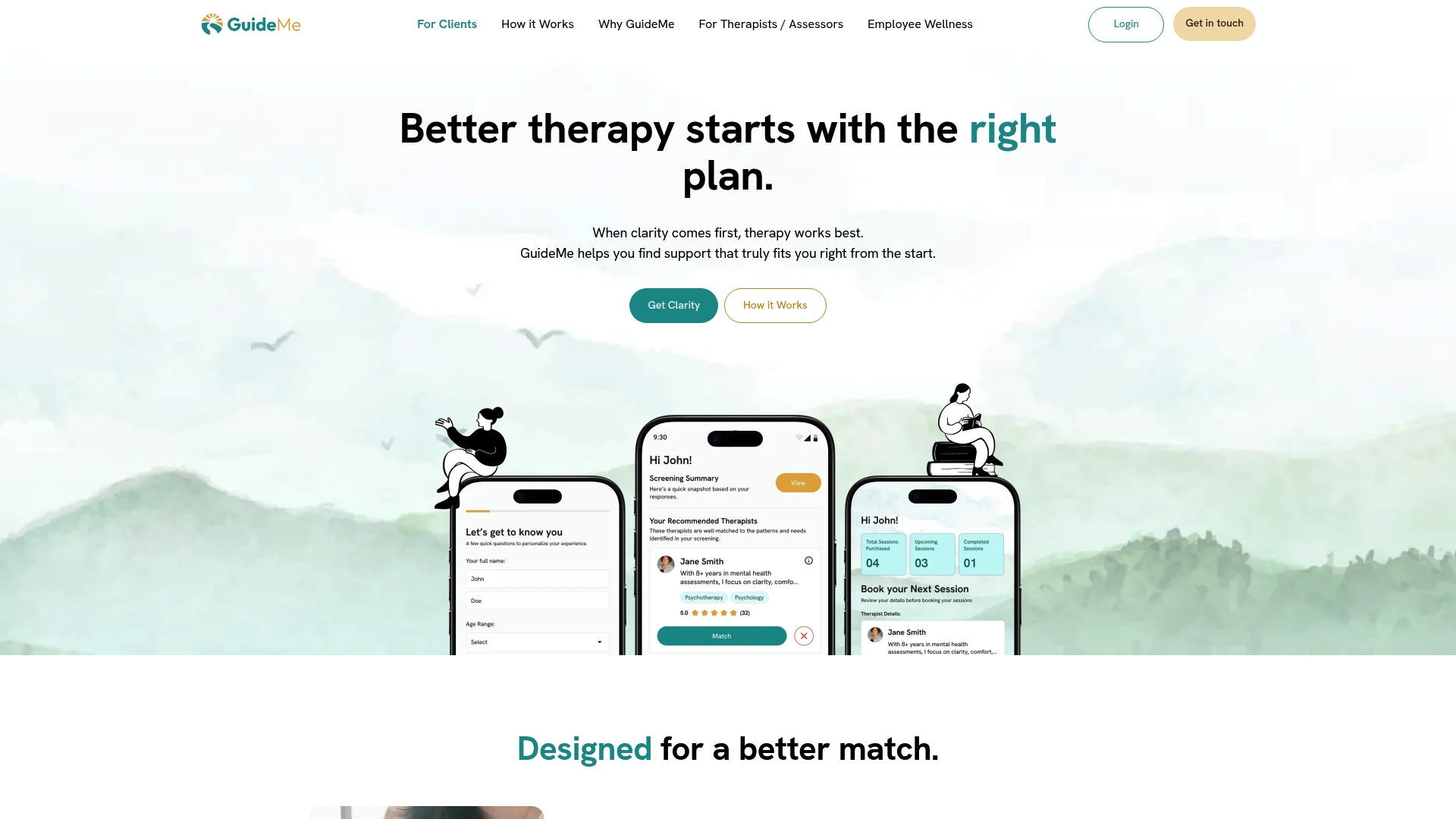
Whether you're covered through PMI, an employer scheme, or planning to pay privately after using your NHS or insurance allowance, GuideMe helps you build a clear therapy plan and connects you with the right professional without the back-and-forth. If you're ready to stop guessing and start with a plan tailored to your situation, visit GuideMe's platform to begin your screening and get matched with a therapist today.
This article is general information, not a substitute for advice from a qualified doctor. Consult a qualified healthcare professional about your own circumstances before acting on anything here.
Sources
- NHS England — NHS talking therapies for adults
- CIPD — Health and wellbeing at work 2025
- Forbes Advisor UK — Does private health insurance cover mental health?