

A psychiatrist is a medical doctor who can diagnose mental illness and prescribe medication. A therapist treats emotional and psychological difficulties through talking, without prescribing anything. If you're dealing with severe symptoms, a suspected chemical imbalance, or safety risk, start with a psychiatrist. If your struggle is relationship-based, situational, or emotional, a therapist is usually the right first call. Many people end up seeing both.
TL;DR:
- A psychiatrist can diagnose severe mental illnesses, prescribe medication, and rule out physical causes behind psychological symptoms, making them essential for crisis situations.
- Psychologists are non-medical experts in psychological assessment and therapy, while psychotherapists and counsellors vary widely in training and legal registration, requiring careful qualification checks.
- Shared care between psychiatrists and therapists is common, with psychiatrists managing medication and diagnosis, and therapists focusing on emotional skills and behavioural patterns.
- For acute risks or severe symptoms, immediate psychiatric attention is necessary, whereas less urgent issues like anxiety or relationship problems are suitable for therapy starting points.
- Costs vary, with psychiatric assessments being more expensive upfront and follow-up appointments spaced out, while therapy sessions are more frequent but generally less costly per session.
Table of Contents
- Psychiatrist vs therapist: what a psychiatrist actually does
- Psychiatrist vs psychologist vs psychotherapist: who does what
- How to check a practitioner's UK qualifications and registration
- Why psychiatrists and therapists often work together
- How to choose: a decision framework and the questions to ask first
- NHS or private: how access and first appointments actually work
- GuideMe's take on finding the right fit, not just the right title
- What seeing a psychiatrist costs compared to a therapist
- How often you'll see a psychiatrist versus a therapist
- Does medication or therapy actually work better?
- Why the "just pick one" advice misses the point
- Want help finding the right match without the guesswork?
- Sources
Psychiatrist vs therapist: what a psychiatrist actually does
A psychiatrist is a fully qualified doctor first. In the UK, that means completing medical school, two years of foundation training, then a minimum of four further years specialising in psychiatry before becoming a consultant. This medical grounding is what separates a psychiatrist from every other professional in this article. They're the only ones who can prescribe antidepressants, antipsychotics, or mood stabilisers, and the only ones trained to rule out physical causes behind psychological symptoms, such as thyroid problems mimicking depression.
Psychiatrists work under General Medical Council regulation and are typically affiliated with the Royal College of Psychiatrists, which sets training standards and ongoing professional requirements. Their scope centres on diagnosis, medication management, and higher-risk or complex presentations.
Where psychiatric input is usually needed:
- Suspected psychosis, bipolar disorder, or severe depression
- Symptoms with a possible physical or neurological cause
- Situations involving risk to yourself or others
- When previous therapy hasn't resolved persistent symptoms
Pro Tip: If you're already on medication and it isn't working, don't just push through more talking therapy. Book a psychiatric review first, since dosage or diagnosis may need reassessing.
Psychiatrist vs psychologist vs psychotherapist: who does what
This is where most confusion sets in, because none of these job titles mean quite what people assume. A clinical or counselling psychologist completes an undergraduate psychology degree followed by a doctoral-level qualification, typically three further years. They're not medical doctors and cannot prescribe, but they're highly trained in psychological assessment, formulation, and evidence-based therapy models such as CBT.
A psychotherapist or counsellor, by contrast, has a training path that varies enormously. Some hold a two-year diploma; others complete a four-year master's. Crucially, the title psychotherapist isn't legally protected in the UK, so anyone can technically call themselves one.
What to check before booking with any therapist:
- Which therapy model they use (CBT, psychodynamic, integrative) and whether it suits your issue
- Whether they've worked specifically with your concern before, not just "generally"
- Their professional body registration, not just a website claim
Most people seeking support for anxiety, low mood, relationship strain, or life transitions are well suited to talking therapy. The goal usually isn't a diagnosis, it's understanding patterns and building coping tools.
How to check a practitioner's UK qualifications and registration
Training length tells you part of the story, but registration tells you whether standards are actually enforced. Clinical and counselling psychologists must register with the Health and Care Professions Council (HCPC), and titles like "Clinical Psychologist" are legally protected. Psychiatrists must hold GMC registration.
Psychotherapists and counsellors sit in murkier territory. Because their title carries no legal protection, voluntary registration with bodies such as the British Association for Counselling and Psychotherapy (BACP) or the United Kingdom Council for Psychotherapy (UKCP) becomes the real signal of quality, not the job title itself.
A quick five-step check before you commit:
- Search the practitioner's name on the GMC, HCPC, BACP, or UKCP register directly.
- Confirm their training programme was accredited, not just "completed."
- Ask whether they receive ongoing clinical supervision.
- Check they log continuing professional development (CPD) hours.
- Look for any disciplinary history on the regulator's public record.
Skipping this step is common, and it's the single easiest way to end up with unsuitable support.
Why psychiatrists and therapists often work together
Mental health care rarely fits neatly into one lane, highlighting how companionship services differ from therapy. Someone with treatment-resistant depression might see a psychiatrist for medication while working with a therapist weekly on thought patterns and behaviour. This is normal, not a sign that one professional failed.
How shared care typically works:
- The psychiatrist manages diagnosis, prescribing, and risk monitoring.
- The therapist focuses on skills, insight, and emotional processing.
- Both may contribute to a shared care plan, particularly in NHS community mental health teams.
- Private practitioners often communicate directly with a client's consent, especially for complex cases.
Multidisciplinary teams exist precisely because no single title covers everything a person might need.
How to choose: a decision framework and the questions to ask first
Start with severity and risk, not preference. If there's any suicidal thinking, psychosis, or rapid decline, go to your GP or psychiatric services first; medication and safety come before talking therapy in that scenario. If the core issue is anxiety, low mood, grief, or relationship strain without acute risk, a therapist with relevant experience is usually the sensible starting point.
Run through this before booking anyone:
- How severe are my symptoms, and is there any safety risk right now?
- Have I tried therapy or medication before, and did it help?
- Is this affecting my ability to work, sleep, or function day to day?
- Do I want a medical review, talking support, or both?
Once you've answered those, contact the practitioner directly and ask specific questions rather than relying on a bio page.
Questions worth asking at first contact:
- What's your registration number, and with which body?
- Have you worked with this specific issue before?
- What's your therapeutic approach, and how many sessions does it usually take?
- What are your fees, and is there a waiting list?
Pro Tip: A good practitioner will answer registration and experience questions without hesitation. Vagueness here is itself useful information.
Watch for red flags too. Anyone who can't produce registration details, refuses to explain their supervision arrangements, or pressures you into a long prepaid package with guaranteed results deserves a hard pass. Genuine practitioners don't need to sell certainty they can't offer.
NHS or private: how access and first appointments actually work
Through the NHS, access usually starts with your GP, who refers you either to psychological therapy services or a community mental health team, depending on severity. Waiting times vary considerably by region and by how urgent your case is assessed to be.
Private access skips the referral queue. You can self-refer directly to a private psychiatrist or therapist, though private psychiatric consultations tend to cost considerably more than a private therapy session, reflecting the extra years of medical training involved.
What differs between a first appointment with each:
- A first psychiatric assessment covers medical history, current medication, symptom timeline, and a risk assessment.
- A first therapy session usually involves discussing what's brought you there, agreeing goals, and beginning to build a shared understanding of the problem.
- Both should explain confidentiality limits and how your records are stored before you share anything sensitive.
Ask about follow-up arrangements at the end of that first meeting, whatever route you've taken.
GuideMe's take on finding the right fit, not just the right title
Titles matter less than most people assume. What actually determines whether therapy helps is whether the practitioner has real experience with your specific issue, uses a modality suited to it, and is properly supervised. GuideMe was built around that principle: an in-depth screening process and personalised therapy plan come before any match is suggested, so the pairing isn't based on availability alone.
Checking specialism, modality, and supervision manually takes real effort, which is exactly the gap a structured navigation approach closes. Getting this right the first time also matters more than most guides admit; a poor match doesn't just waste money, it can put someone off seeking help again entirely.
What seeing a psychiatrist costs compared to a therapist
Private psychiatric consultations sit at the higher end of mental health spending, largely because you're paying for a doctor's specialist medical training rather than a therapy hour. An initial private psychiatric assessment typically runs longer and costs more than a standard therapy session, with follow-up medication reviews usually shorter and cheaper than the first appointment.
Private therapy costs vary by modality, location, and the practitioner's experience level, but a single session generally costs less than a psychiatric consultation. Longer-term therapy, however, often means weekly sessions over months, so the total spend can rival or exceed a course of psychiatric treatment depending on how many sessions you need.
NHS access removes the direct cost for both routes, but the trade-off is waiting time rather than money. Community mental health teams and NHS-funded talking therapies (often accessed through NHS Talking Therapies services) carry no consultation fee, though demand means waits can stretch, particularly for non-urgent cases.
If cost is a genuine barrier, it's worth asking directly about sliding-scale fees when contacting a private therapist; many independent practitioners offer reduced rates for certain circumstances, even if it isn't advertised upfront. Psychiatrists, being medically regulated specialists, have less flexibility on fee structure, since their costs reflect years of additional training rather than discretionary pricing.
How often you'll see a psychiatrist versus a therapist
Session frequency differs sharply between the two, and it catches a lot of people off guard. A psychiatrist typically sees you for a longer initial assessment, then follow-up appointments are spaced weeks or months apart, often for medication review rather than ongoing conversation. Once a treatment plan stabilises, some patients see their psychiatrist only every few months.
Therapy runs on a different rhythm entirely. Most talking therapy happens weekly or fortnightly, with sessions lasting around fifty minutes. This isn't arbitrary; different therapy models carry different rhythms and goals by design. CBT, for instance, tends to run in a defined course of sessions, often somewhere between six and twenty, aimed at specific symptom change. Psychodynamic therapy, focused on deeper relational patterns, often runs longer with no fixed endpoint, since the work is exploratory rather than symptom-targeted.
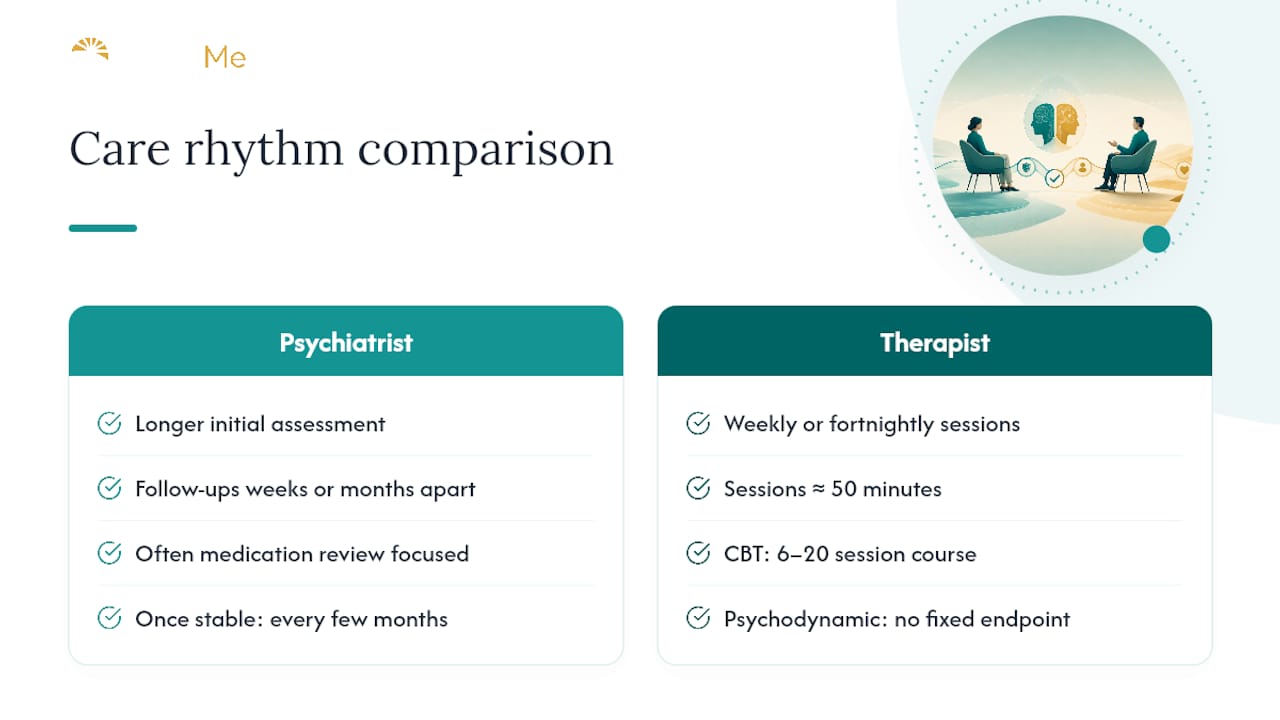
The practical upshot: if you're choosing between the two based on time commitment alone, therapy demands far more regular attendance, while psychiatric care demands less frequent but higher-stakes appointments. Neither is inherently "more work"; they simply ask different things of your schedule. Someone managing medication with occasional check-ins might find psychiatric care fits around a busy life more easily than committing to weekly therapy, while someone processing a specific pattern of thinking may need that weekly consistency to make real progress.
Does medication or therapy actually work better?
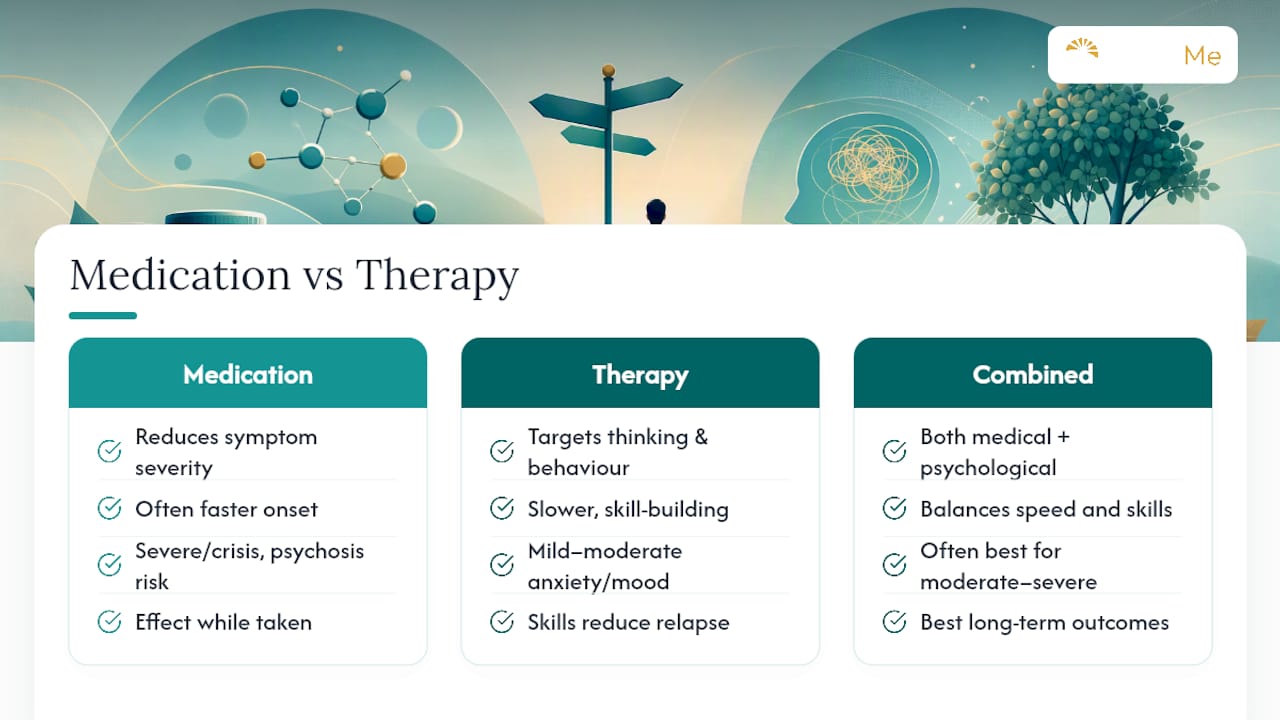
Neither medication nor therapy wins outright, because they're built to do different jobs. Medication tends to address symptom severity directly, often faster than therapy for conditions like moderate to severe depression or anxiety, by working on brain chemistry. Therapy addresses the thinking patterns, behaviours, and relational habits underneath those symptoms, which medication alone doesn't touch.
For many conditions, particularly moderate to severe depression, evidence generally supports combining the two over relying on either alone. Psychiatrists and psychologists working in multidisciplinary teams reflect this in practice, combining medical and psychological approaches rather than treating them as competing options.
Where the evidence gets more nuanced is severity. Milder anxiety or low mood often responds well to therapy alone, without needing medication at all. Severe presentations, particularly those involving psychosis or significant risk, usually need medical intervention before talking therapy can do much good, simply because a person in crisis often can't engage meaningfully with reflective work.
There's also a durability argument worth knowing. Some research on CBT suggests the skills learned can outlast the treatment itself, reducing relapse risk after therapy ends, whereas medication's effects on symptoms are usually more closely tied to whether someone stays on it. This doesn't make therapy "better," it makes them differently suited to short-term crisis stabilisation versus long-term skill-building. The honest answer is that the right evidence-based choice depends entirely on your specific diagnosis, severity, and history, which is exactly why a proper assessment matters more than picking a side in advance.
Why the "just pick one" advice misses the point
Most guides on this topic present psychiatrist versus therapist as a fork in the road, as though choosing wrong wastes your time. That framing undersells how often the right answer is genuinely "both, but in sequence." The bigger failure I see in conventional advice is treating job titles as a proxy for competence, when regulation status tells you far more. A psychotherapist with fifteen years of unsupervised private practice and no BACP accreditation is a bigger unknown than a newly qualified, properly registered one.
What gets underrated entirely is the interview stage. People will spend hours comparing therapist bios online, then accept the first available slot without asking a single question about supervision or specialism. That's backwards. The credentials exist publicly precisely so you can check them before, not after, you've committed money and vulnerability to someone.
If there's one priority to take from all this, it's sequencing: assess risk and severity first, match specialism second, and only then weigh personal rapport. Skipping straight to rapport is how people end up in years of pleasant but ineffective sessions.
— Yetty
Want help finding the right match without the guesswork?
Working through registration checks, modality research, and specialism questions on your own takes real time, time that's harder to find when you're already struggling. Guidemetherapy exists as a faster route to the same outcome: a structured therapy plan built from an in-depth screening process, followed by human-led, AI-assisted matching to a therapist whose specialism, modality, and supervision have already been considered on your behalf.

This suits you particularly well if you want to move quickly, if you're unsure how to judge fit for yourself, or if you're specifically looking for private sessions rather than an NHS waiting list. The NHS route remains entirely valid, especially where cost is the deciding factor, and nothing here replaces that option. But if speed and confidence in the match matter to you, visit Guidemetherapy to start your screening and get matched with a therapist suited to your situation.
This article is general information, not a substitute for advice from a qualified doctor. Consult a qualified healthcare professional about your own circumstances before acting on anything here.
Sources
- Job profile: Psychiatrist (National Careers Service)
- Differences between psychology, psychiatry and psychotherapy (Health Careers, NHS)