
NHS Talking Therapies is free at the point of use in England, and most people can self-refer without a GP appointment. Private CBT typically costs £40 to £100 per session), with a short course of six to twelve sessions landing somewhere between £240 and £1,200. If cost or waiting times are a concern, the fastest route depends on your circumstances, and we'll walk through each one below.
TL;DR:
- Private CBT costs range from £40 to £150 per session, with shorter courses typically costing between £240 and £1,200 depending on session frequency and practitioner type.
- NHS Talking Therapies offer free CBT with waiting times that vary by region, averaging 8.6 sessions per course, but delays can extend beyond the national targets.
- The price for private CBT is influenced by practitioner qualifications, location, assessment length, and whether sessions are online or in person, with London practitioners charging the most.
- Employers might reduce costs through workplace mental health programs like EAPs or PMI, but the actual ROI depends heavily on company size, existing absence rates, and intervention costs.
- Alternatives such as charity services, trainee clinics, group programs, and NHS self-referral provide lower-cost or free options before considering private therapy.
Table of Contents
- How much does private CBT cost in the UK?
- NHS Talking Therapies: what it offers and how long you'll wait
- What changes the price you'll pay for CBT
- CBT for employers: EAPs, PMI and the ROI case
- Lower-cost options if private CBT feels out of reach
- Why therapist fit matters more than the cheapest rate
- Getting matched with the right CBT therapist through GuideMe
- Sources
How much does private CBT cost in the UK?
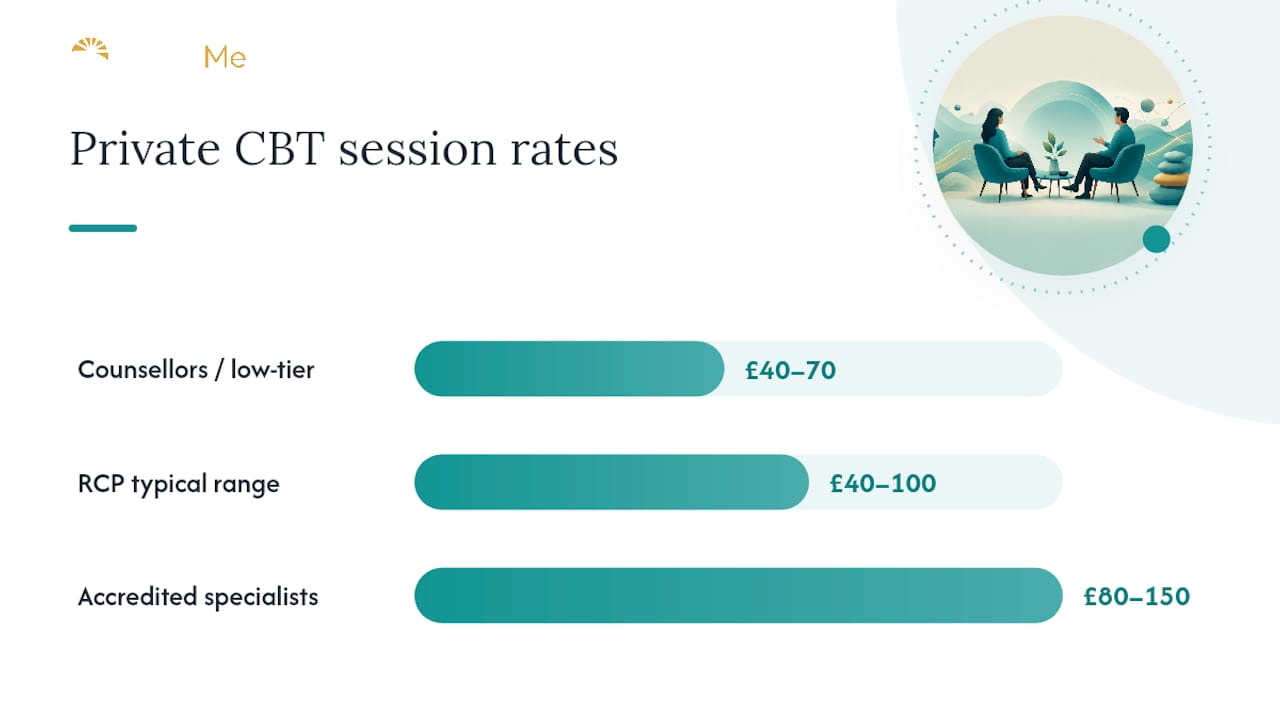
Private CBT in the UK generally falls into two price bands, and which one you land in depends almost entirely on who you see. Counsellors and lower-tier practitioners tend to charge £40 to £70 per session, while accredited clinical psychologists, psychiatrists, and specialists in London often charge £80 to £150 or more. The Royal College of Psychiatrists puts the typical private CBT range at roughly £40 to £100 per 50 minute session, which is a useful midpoint if you're trying to budget before you've picked a therapist.
Most CBT is delivered as a short, structured course rather than open-ended talking therapy, and that's actually one of its strengths: you know roughly what you're signing up for from the start.
- A typical short course runs 6 to 12 sessions
- At £40 to £70 per session, that's a course cost of roughly £240 to £840
- At £80 to £150 per session, expect £480 to £1,800 for the same course length
- More complex presentations (long-standing OCD, trauma) sometimes need 15 to 20 sessions
Pro Tip: Ask upfront how many sessions the therapist typically recommends for your specific issue. A vague "let's see how it goes" answer is a red flag; CBT is meant to be goal-driven and time-limited, and a competent practitioner should be able to give you a rough estimate on day one.
Online CBT sessions are usually priced the same as in-person ones, though some therapists offer a small discount for video work since it saves them room hire. Many private practitioners also offer concessions or a sliding scale for students, those on low incomes, or NHS staff, but you generally have to ask directly, since it's rarely advertised.
NHS Talking Therapies: what it offers and how long you'll wait
NHS Talking Therapies is entirely free and covers CBT for anxiety, depression, and related conditions, with self-referral available in most areas, meaning you don't need to see your GP first. The national target is for 75% of people to start treatment within six weeks of referral, and 95% within 18 weeks.
In numbers: NHS Talking Therapies referrals average 8.6 sessions per course, and recent data shows 48.4% of people who completed a course reliably recovered, out of 57,590 completed courses that month.
That's a solid baseline, but it's worth knowing that:
- Waiting times and session availability vary considerably by NHS trust and region
- Rural areas and some inner-city trusts often report longer local waits than the national average
- The therapy offered is usually low or high-intensity CBT depending on severity, not always your first choice of modality
If NHS provision in your area is stretched, that's often the trigger point where people start looking at private options or booking a therapy appointment through a different route entirely.
What changes the price you'll pay for CBT
Private CBT pricing looks inconsistent from the outside, but it usually breaks down into a handful of predictable factors.
- Practitioner type. Counsellors and lower-intensity CBT practitioners sit at the bottom of the price range. Accredited CBT therapists, clinical psychologists, and psychiatrists charge more, reflecting years of additional training, mandatory supervision, and professional indemnity costs.
- Assessment length. Initial assessments often run 60 to 90 minutes, longer than a standard session, and some practitioners charge a separate, higher one-off fee for this. Always ask whether the quoted rate includes the first assessment or not.
- Location. London and the South East carry a noticeable premium over the rest of the UK, sometimes £20 to £40 more per session than the equivalent practitioner elsewhere.
- Format. Online and in-person sessions are usually priced the same, though this varies by practitioner.
- Concessions. Many private therapists reserve a handful of low-cost or sliding-scale slots, but you typically have to ask rather than expect it to be listed on their profile.
Pro Tip: Before booking, ask two direct questions: "Does this rate include the initial assessment?" and "How many sessions do you typically recommend for my presentation?" Both answers tell you more about total cost than the headline hourly rate ever will.
Working out which factors actually matter for your situation before you commit to a therapist saves both money and wasted sessions further down the line.
CBT for employers: EAPs, PMI and the ROI case
Organisations typically access CBT for staff through two routes: an Employee Assistance Programme (EAP), which usually offers short-term counselling (often four to eight sessions) as a low-cost add-on to existing benefits, or Private Medical Insurance (PMI), which tends to offer a fuller clinical pathway including CBT for diagnosed conditions, at a higher per-employee cost.
Programme costs vary enormously by organisation size, sector, and baseline sickness absence, so there's no single number that applies to every business. What's consistent across the evidence is the scale of the problem being solved.
In numbers: Deloitte estimates poor mental health costs UK employers around £51 billion a year through absenteeism, presenteeism, and staff turnover.
Peer-reviewed economic modelling backs the general direction of that argument, though not unconditionally. A 2026 study in PLOS Mental Health found workplace mental health interventions, including CBT, can be cost-saving in many scenarios, but the outcome depends heavily on the organisation's size, existing absence rates, and how much the intervention itself costs to run.
- Smaller organisations should model their own baseline absence figures rather than relying on a single national average
- Early intervention consistently outperforms reactive support in the modelling reviewed
- Corporate therapy provision that gets staff to the right support faster tends to show stronger ROI than generic, broad-brush EAP contracts
Lower-cost options if private CBT feels out of reach
If the standard private rates aren't workable, there are genuine alternatives worth trying before ruling out therapy altogether.
- Charity and voluntary-sector counselling often charges on a sliding scale, sometimes as low as £10 to £30 per session, though waiting lists can be long
- Supervised trainee clinics, often linked to universities, offer CBT delivered by trainees under qualified supervision at a fraction of standard rates
- Group CBT programmes, sometimes run privately or through the NHS, cost less per person than one-to-one work and suit certain presentations well
- Digital CBT platforms offer structured, self-paced modules at low monthly cost, useful as a supplement rather than a full replacement for milder cases
- NHS self-referral remains free and should always be considered alongside any paid option
It's always worth simply asking a private therapist whether they offer concessions or a payment plan; many do, but rarely advertise it. A step-by-step approach to choosing a therapist helps you weigh these trade-offs properly rather than defaulting to whichever option looks cheapest on paper.
Why therapist fit matters more than the cheapest rate
The instinct to chase the lowest hourly rate is understandable, but it's usually the wrong lever to pull. A mismatched therapist and a vague plan waste far more money than an extra £20 per session ever will, because you end up paying for sessions that don't move you forward.
A clear, time-limited CBT plan with defined goals tends to produce faster progress than an open-ended arrangement, regardless of price. Good navigation and matching reduce the number of false starts people go through, which is where real savings come from. Combine routes where it makes sense: NHS for the free baseline, employer support where it exists, and private CBT when speed or specialism matters most.
— Yetty
Getting matched with the right CBT therapist through GuideMe
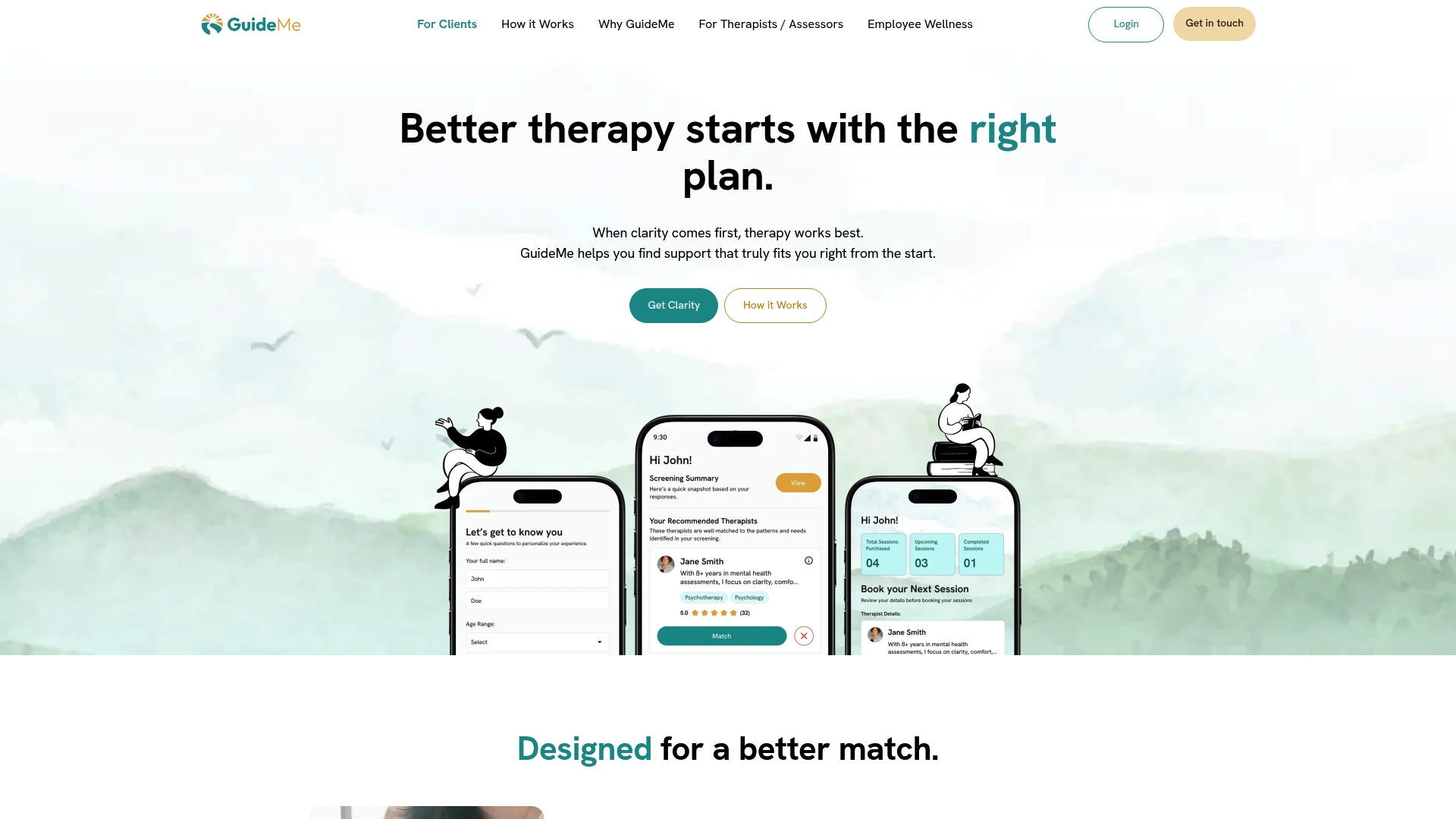
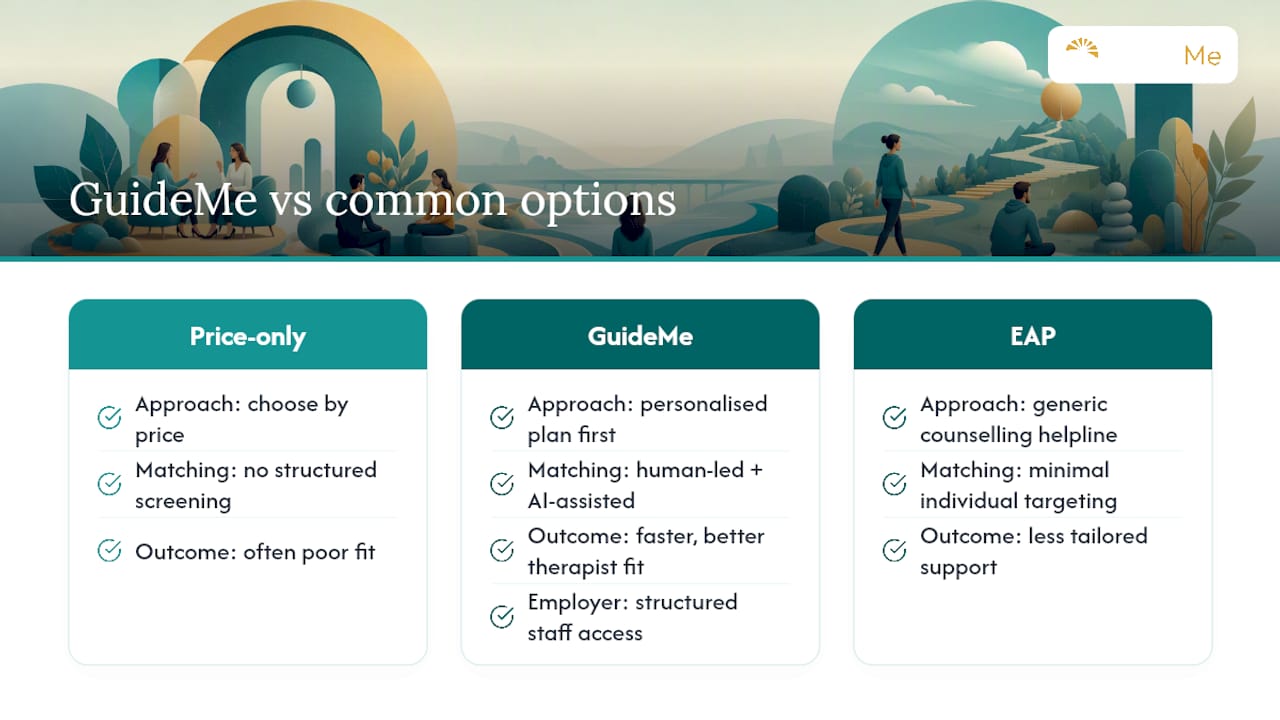
Guidemetherapy exists precisely because picking a therapist on price alone tends to backfire. Its in-depth screening builds a personalised therapy plan first, then uses human-led and AI-assisted matching to connect you with a CBT practitioner suited to your actual presentation, not just whoever has a free slot this week.
For employers, Guidemetherapy's corporate offering gives staff structured access to matched therapists, complementing or replacing a standard EAP pathway with something more targeted to individual need rather than a generic counselling helpline. That matters given the scale of cost poor mental health places on UK employers each year.
If you're weighing NHS waiting times against private cost, or trying to work out what a workplace mental health offering should actually look like, visit the GuideMe platform to check eligibility or start a navigation session. It's a faster way to find the right fit than trawling directories on price alone.
This article is general information, not a substitute for advice from a qualified doctor. Consult a qualified healthcare professional about your own circumstances before acting on anything here.
Sources
- NHS Talking Therapies monthly statistics — waiting times (January 2026)
- Deloitte — poor mental health costs UK employers £51 billion a year
- PLOS Mental Health — economic modelling of workplace mental wellbeing interventions (2026)