

A support network is a group of people and connections that provide emotional, practical, and informational help when you need it most. Research consistently shows that social support yields a robust association with psychological adjustment across mental health, workplace, and educational outcomes. What matters most is not how many people are in your network, but how confident you feel that support is available when you need it. UK undergraduates with higher confidence in available support report less severe depression and anxiety and are more likely to seek help informally.
The role of support networks goes well beyond having someone to call in a crisis. They shape how you process stress, recover from setbacks, and maintain a sense of belonging over time. Emotional support, in particular, is consistently protective against depression across adult life stages, more so than practical or instrumental help.
Core elements and impacts of a support network include:
- Emotional support: feeling heard, valued, and understood by others
- Practical support: help with tasks, logistics, or daily responsibilities
- Informational support: guidance, advice, and access to resources
- Sense of belonging: connection to a community or group with shared values
- Resilience: a buffer against stress, anxiety, and low mood
- Recovery: a foundation for returning to stability after difficult periods
Table of Contents
- What types of support networks can help your mental health?
- How do you build a strong support network from scratch?
- What makes building and maintaining support networks difficult?
- How do you keep your support network strong over time?
- How community resources and professional support expand your network
- Finding the right professional support alongside your network
- Key takeaways
What types of support networks can help your mental health?
Support networks are not one-size-fits-all. They span a range of relationships and settings, each serving a distinct function in your overall well-being. Understanding the different types helps you identify gaps and build more deliberately.
1. Family and close friends
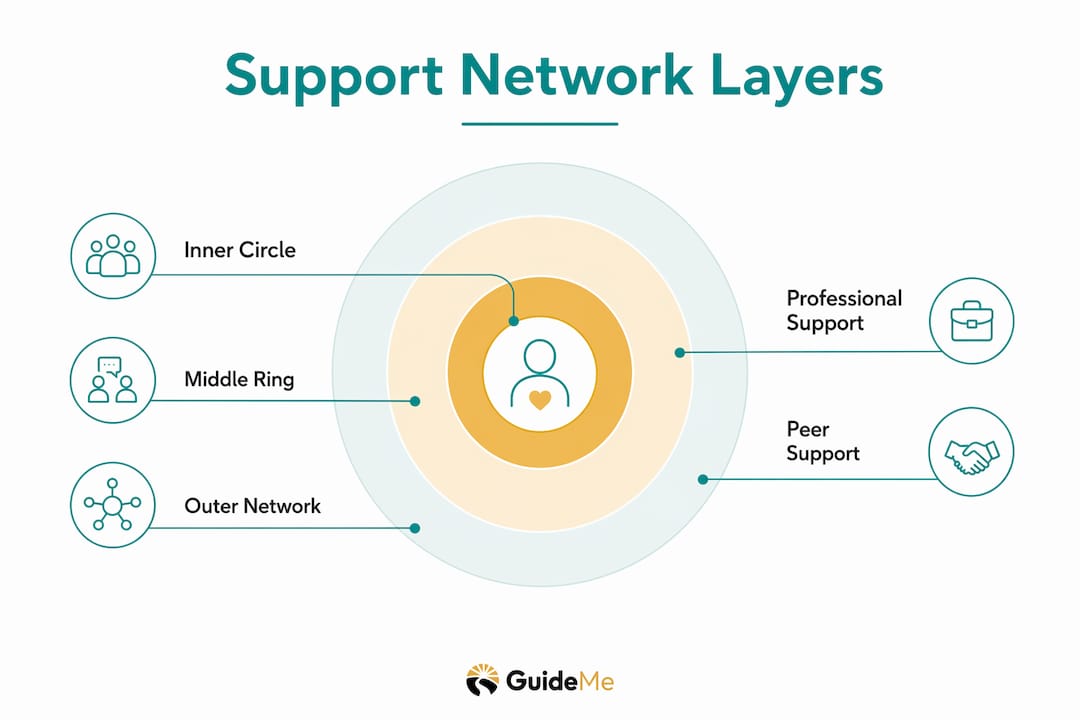
Your inner circle typically provides the deepest emotional support. These are the people you turn to during significant life events, who offer unconditional care and a sense of safety. For adults, spousal and partner relationships are particularly protective, and emotional support from close family consistently reduces the risk of depression.
2. Peers and social acquaintances
Friendships formed through shared interests, workplaces, or local communities occupy a middle ring. They offer reliable companionship and a sense of normalcy. These relationships may feel lighter than close family bonds, but they provide important social continuity and a sense of belonging.

3. Community groups and interest-based networks
Wider community ties, such as sports clubs, faith groups, volunteering organisations, or hobby groups, contribute to what researchers call bridging social capital. These connections link you to people from different backgrounds and life stages, expanding your perspective and resilience. Diverse social networks spanning ages, backgrounds, and contexts promote greater social cohesion than homogeneous ones.
4. Peer support networks
Peer support is a recovery-oriented approach grounded in shared lived experience. Peer support workers in England use their own mental health journeys to build mutuality, shared learning, and hope with others. This non-clinical model complements formal therapy and offers something a professional relationship often cannot: the credibility of someone who genuinely understands from the inside.
5. Professional and formal support
Therapists, counsellors, GPs, and mental health services form a distinct layer of support. These relationships are boundaried and structured, but they fulfil a role that personal networks cannot. A therapist provides clinical expertise; a peer supporter offers lived experience; a close friend offers unconditional care. Each is non-substitutable.

Pro Tip: Think of your support network in concentric rings: an inner circle for emotional depth, a middle ring for reliable friendship, and a wider ring for community belonging. Each layer serves a different purpose, and all three matter.
How do you build a strong support network from scratch?
Building a support network takes time and intention. It rarely happens by accident, particularly in adulthood. UK research on friendship formation shows it takes many hours of repeated contact to move from acquaintance to casual friend, and significantly more time to build a close friendship. That is not discouraging; it is clarifying. Consistent, low-pressure contact over time is what deepens connection.
-
Identify your genuine interests. Shared activity is the most natural foundation for connection. Whether that is a running club, a book group, or a community garden, showing up regularly around people who share your interests creates the repeated contact that builds trust.
-
Start small and stay consistent. You do not need to form deep friendships immediately. Casual, repeated interactions, a familiar face at a weekly class, a colleague you eat lunch with, gradually build the familiarity that relationships grow from.
-
Be willing to be the one who reaches out. Many people wait to be invited. Sending the first message, suggesting a walk, or following up after a conversation is often all it takes to move a connection forward.
-
Diversify your network deliberately. Avoid building a network that is entirely made up of people from one context, such as work or one friendship group. Connections across different settings make your network more resilient when one area of life changes.
-
Reciprocate. Giving support is as important as receiving it. Relationships that feel one-directional tend to fade. Showing up for others, checking in, and offering help sustains the network over time.
-
Use structured opportunities. Volunteering, local interest groups, adult education classes, and community events all provide low-pressure environments to meet new people. These settings remove the awkwardness of cold introductions.
-
Do not rely on a single person. Placing all your emotional needs on one individual, however close, creates fragility. A healthy network distributes support across several relationships.
What makes building and maintaining support networks difficult?
Even with the best intentions, building and sustaining a support network is genuinely hard for many people. Understanding the common barriers makes it easier to address them honestly.
- Social anxiety: Fear of rejection or judgement can make initiating contact feel overwhelming, particularly for those who have had difficult social experiences in the past.
- Time constraints: Work, caring responsibilities, and busy schedules leave little room for the consistent contact that relationships require.
- Life transitions: Moving city, changing jobs, having children, or experiencing bereavement can disrupt existing networks and make rebuilding feel daunting.
- Over-reliance on one person: Leaning heavily on a single friend or partner places unsustainable pressure on that relationship and leaves you vulnerable if it changes.
- Homogeneous networks: A network made up of people who are very similar to you, in age, background, or context, can feel comfortable but is fragile when circumstances shift.
- Stigma: For those managing mental health difficulties, fear of being judged or misunderstood can make it harder to be open with others or to seek peer support.
- Mobility and geography: Living in a rural area, or having limited access to transport or community spaces, reduces opportunities for organic connection.
- Cultural expectations: In some communities, discussing emotional struggles or seeking support outside the family carries stigma, which can limit the diversity of available support.
Recognising these barriers is the first step. Many of them are structural, not personal failings, and they can be addressed with the right resources and a realistic approach.
How do you keep your support network strong over time?
Building a network is one thing; maintaining it requires ongoing effort. Relationships that are not tended to gradually fade, even when the goodwill is mutual. The good news is that small, consistent actions make a significant difference.
- Check in regularly. A brief message, a shared article, or a short phone call keeps connections alive between bigger interactions. You do not need to wait for a significant reason to reach out.
- Be open and vulnerable. Relationships deepen when people share honestly. Allowing others to see when you are struggling, rather than always presenting as fine, invites genuine connection.
- Engage in shared activities. Doing things together, rather than just talking, strengthens bonds. Regular shared experiences, a weekly walk, a monthly dinner, a class you both attend, create a natural rhythm of contact.
- Develop your weaker ties. Acquaintances and looser connections are valuable for resilience and opportunity. Investing a little in these relationships broadens your network without requiring deep emotional commitment.
- Offer support as well as receiving it. Reciprocity sustains long-term network health. People are more likely to show up for you when they feel the relationship flows both ways.
- Adapt as your life changes. Networks need to evolve. A support system that worked well in your twenties may not meet your needs in your forties. Regularly reflecting on who is in your network and what you need from it helps you stay connected to the right people at the right time.
- Include professional support. Personal networks are not a substitute for therapy or clinical care when those are needed. Combining personal relationships with professional mental health support creates a more complete and sustainable foundation.
Understanding why mental health matters is part of recognising why these networks deserve your attention and care.
How community resources and professional support expand your network
Personal relationships are the heart of any support network, but they are not the whole picture. Community-based resources, formal services, and structured programmes extend what a personal network can offer, particularly for people navigating mental health recovery.
- GENIE™ framework: This evidence-based model helps individuals map their existing social connections and link them to local community activities, building meaning and sustained connectedness. Community frameworks like GENIE™ represent a growing approach to mental health recovery that goes beyond clinical treatment.
- Peer support workers: In England, peer support workers use their own lived experience of mental health difficulties to support others in recovery. Their role is distinct from therapy: it is grounded in mutuality, shared learning, and hope rather than clinical expertise.
- Support groups: Structured groups, whether in-person or online, bring together people with shared experiences. The benefits of group therapy extend beyond the clinical setting, offering peer connection and a sense of not being alone.
- Voluntary and community organisations: Charities, mutual aid groups, and local voluntary services provide both practical help and social connection. Many people find that volunteering itself becomes a source of meaningful community.
- Therapists and counsellors: Professional support addresses what personal networks cannot. A therapist offers a boundaried, skilled space for processing difficult experiences without placing that burden on friends or family.
- Hobbies and interest-based activities: Non-clinical, community-based activities, from art classes to walking groups, build social connection as a by-product of doing something enjoyable. These settings are often less intimidating than formal support services.
Peer support roles are also driving systemic change in mental health settings. Research in England finds that peer workers improve not just individual outcomes but the culture of care within services, shifting the focus towards recovery, mutuality, and hope. Exploring self-care in recovery alongside these community connections reinforces the gains made through both personal and professional support.
Finding the right professional support alongside your network
A strong personal network and professional therapy work best together, not as alternatives. If you are unsure where to start with therapy, Guidemetherapy can help. The platform combines human expertise with AI-powered matching to create an in-depth therapy plan and connect you with a therapist who genuinely fits your needs, from the very first step.
Find your therapist with Guidemetherapy and take the first step towards a more supported, stable, and connected life.
Key takeaways
Support networks protect mental health most effectively when they are diverse, reciprocal, and layered across personal, community, and professional relationships.
| Point | Details |
|---|---|
| Perceived support matters most | Confidence that support is available predicts better mental health outcomes more than network size alone. |
| Emotional support is most protective | Emotional support is consistently more protective against depression than practical or instrumental help. |
| Diversity builds resilience | Networks spanning different ages, backgrounds, and contexts are more resilient than homogeneous ones. |
| Reciprocity sustains networks | Giving support is as important as receiving it; one-directional relationships tend to fade over time. |
| Community and professional support complement personal ties | Peer support workers, therapists, and community frameworks each fulfil distinct roles that personal networks cannot replace. |