

TL;DR:
- Confidentiality protects your private therapy information from disclosure without your consent. It is governed by laws like HIPAA in the US and ethical codes in the UK, with specific exceptions such as risk of harm or abuse. Understanding these boundaries enhances trust and encourages openness, which improves therapy outcomes.
Confidentiality in therapy is the professional and legal obligation that prevents your therapist from sharing what you disclose in sessions without your consent. This principle sits at the heart of the therapeutic process, and understanding it before you begin therapy makes a real difference to how openly you engage. The role of confidentiality in therapy extends beyond legal compliance. It creates the conditions in which honest, vulnerable conversation becomes possible. Therapists provide a Notice of Privacy Practices or informed consent document at your first session, setting out exactly what is protected and when disclosure may be required.
What legal and ethical frameworks govern confidentiality in therapy?
Therapist-client confidentiality is governed by a combination of federal law, state regulation, and professional ethical codes. In the United States, the HIPAA Privacy Rule sets the federal baseline, establishing that protected health information cannot be disclosed without patient authorisation except in defined circumstances. In the United Kingdom, the British Association for Counselling and Psychotherapy (BACP) and the UK Council for Psychotherapy (UKCP) both require members to uphold confidentiality as a core ethical duty, with similar exceptions for risk and legal compulsion.
Ethical codes across both countries share a common principle: the therapist's duty to protect client information is not optional. It is a condition of professional registration. Breaching confidentiality without legal justification can result in disciplinary action, loss of licence, and civil liability.
At the start of therapy, your therapist is required to explain confidentiality clearly. HIPAA mandates that this disclosure happens before substantive therapy begins, so you understand the boundaries before you share anything significant. This informed consent process is your first protection.
The minimum necessary disclosure principle also applies. When a therapist is legally required to share information, they must share only what is strictly needed to address the specific risk or legal requirement. They cannot hand over your full file simply because a disclosure is triggered.
- HIPAA Privacy Rule: Sets federal standards for protecting mental health information in the US.
- BACP and UKCP ethical frameworks: Require UK therapists to maintain confidentiality as a professional duty.
- Informed consent documents: Explain confidentiality boundaries and exceptions before therapy begins.
- Minimum necessary disclosure: Limits what a therapist can share even when disclosure is legally required.
- State and regional laws: May add further protections beyond the federal or national baseline.
Pro Tip: Before your first session, ask your therapist for a written copy of their confidentiality policy. Reading it in advance gives you time to ask questions without the pressure of the session itself.
What are the main exceptions and limits to confidentiality in therapy?
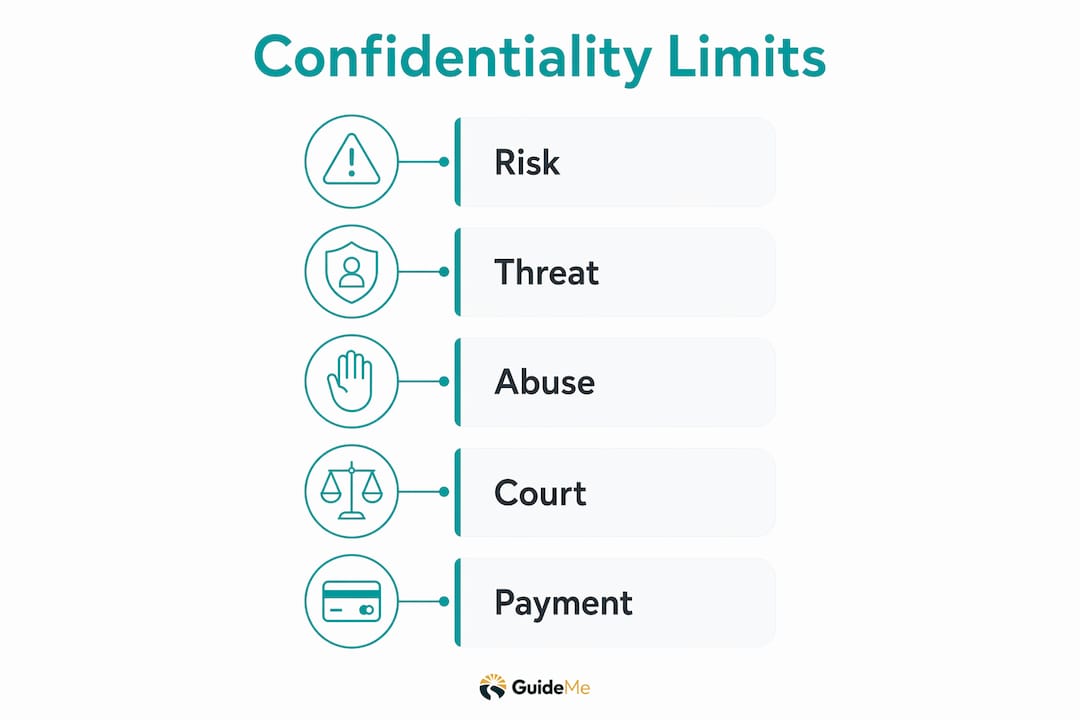
Confidentiality in mental health care is strong, but it is not absolute. Four legally defined categories require therapists to break confidentiality without your consent, and knowing these in advance reduces anxiety rather than increasing it.
- Imminent risk of self-harm. If your therapist believes you are at immediate risk of seriously harming yourself, they are legally and ethically required to act. This may involve contacting emergency services or a named next of kin.
- Credible threat to a third party. If you disclose a specific, credible plan to harm another person, your therapist must take steps to protect that individual. This duty originates from the landmark Tarasoff v. Regents of the University of California case and has been adopted widely across US states and influenced UK practice.
- Child or vulnerable adult abuse. Therapists are mandatory reporters in most jurisdictions. If you disclose that a child or vulnerable adult is being abused, or if your therapist suspects it, they are legally required to report this to the relevant authority.
- Valid court order. A judge can compel a therapist to disclose records or testify. Even here, psychotherapy notes are legally separate from general medical records and require a specific, separate authorisation for release, offering a higher level of protection.
In every one of these scenarios, the minimum necessary information principle applies. Your therapist does not share your full history. They share only what is required to address the specific concern.
One practical point many clients overlook: paying for therapy entirely out-of-pocket allows you to restrict disclosures to insurers, which prevents your insurance company from receiving treatment details. This is a meaningful privacy option if your employer provides your insurance.
Pro Tip: If you are worried about a specific topic before your first session, ask your therapist directly whether discussing it would trigger a mandatory disclosure. Most therapists welcome this question and will answer honestly.
How does confidentiality compare with privacy rights in mental health care?
Confidentiality and privacy are related but distinct concepts. Confidentiality is the therapist's duty not to share your information. Privacy is your right to control access to information about yourself. Both operate in therapy, but they work differently.
| Concept | Who holds the obligation | What it covers | Your rights |
|---|---|---|---|
| Confidentiality | Your therapist | Session content, diagnoses, records | Expect non-disclosure; receive exceptions in writing |
| Privacy | You, protected by law | All personal health information | Access, amend, or restrict your records |
| Psychotherapy notes | Your therapist | Detailed session notes kept separately | Require specific written authorisation for release |
| Routine TPO disclosures | Healthcare system | Treatment, payment, operations | Happen without new authorisation under HIPAA |
Psychotherapy notes deserve particular attention. These are the personal notes a therapist keeps about session content, distinct from your formal clinical record. Under HIPAA, psychotherapy notes require explicit authorisation separate from other medical records. This means a request for your general health records does not automatically include your therapy session notes.
You also have the right to access your own records, request corrections, and in some cases restrict how your information is used. Statements made outside therapy sessions, however, do not carry the same legal protections. Legal privilege applies mainly within the clinical treatment context. A conversation with your therapist at a social event, for instance, is not covered in the same way as a formal session.
Understanding this distinction helps you make informed decisions about what you share and where.
How does confidentiality affect the therapeutic relationship and client outcomes?
Confidentiality is not just a legal formality. It functions as what clinical practitioners describe as a "containing element," a structured boundary that makes it psychologically safe to speak honestly. This matters most for clients who have experienced trauma, neglect, or betrayal, where trust in others has been damaged.

Many clients hesitate entering therapy due to fear of exposure. Therapists are trained to treat this as a normal and understandable response, not a problem to be managed. Early sessions are often used to build trust through clear, transparent communication about what confidentiality means in practice.
The benefits of confidentiality in therapy show up directly in client behaviour. When you trust that your words will not leave the room, you are more likely to:
- Disclose shame-based experiences that are central to your difficulties.
- Explore thoughts or feelings you have never spoken aloud.
- Engage honestly with your therapist rather than presenting a managed version of yourself.
- Return to therapy consistently rather than withdrawing when topics become difficult.
- Build a genuine working relationship that supports real progress.
"Consistent confidentiality reassures clients and supports openness about shame or sensitive topics, making it a clinical necessity rather than simply a legal requirement." Uxbridge Psychology
Understanding the precise limits of confidentiality before therapy starts lessens client anxiety and improves openness. Clients who know exactly what is protected and what is not feel more in control. That sense of control is itself therapeutic, particularly for people whose histories involve powerlessness or unpredictability.
The therapist-client rapport that develops within a confidential relationship is one of the strongest predictors of positive therapy outcomes. Research consistently shows that the quality of the therapeutic alliance matters more than the specific technique a therapist uses. Confidentiality is the foundation on which that alliance is built.
How confidentiality affects therapy is therefore not a peripheral concern. It shapes every session, every disclosure, and every step forward you take in the work.
Key takeaways
Confidentiality in therapy is both a legal obligation and a clinical necessity, and understanding its scope and limits before you begin is the most direct way to enter therapy with confidence.
| Point | Details |
|---|---|
| Confidentiality is legally defined | HIPAA and UK ethical codes require therapists to protect client information from the first session. |
| Four exceptions exist | Imminent self-harm, credible threats to others, abuse reporting, and court orders can require disclosure. |
| Psychotherapy notes have extra protection | These require separate written authorisation for release, distinct from general medical records. |
| Privacy and confidentiality differ | Confidentiality is the therapist's duty; privacy is your legal right to control your own information. |
| Trust depends on confidentiality | Clients who understand their privacy rights engage more openly, which directly improves therapy outcomes. |
Why confidentiality matters more than most clients realise
I have spoken with many people who almost did not start therapy because they were afraid of who might find out. That fear is real, and it is more common than the mental health world tends to acknowledge publicly. What I have observed, again and again, is that the moment a client genuinely understands what confidentiality protects and what it does not, something shifts. The anxiety does not disappear, but it becomes manageable.
What concerns me is how rarely therapists take the time to explain confidentiality in plain language at the outset. Handing someone a dense informed consent form and asking them to sign it is not the same as actually talking them through it. For clients with trauma histories, the clinical value of confidentiality is enormous. It is not background information. It is the thing that makes the work possible.
My honest view is this: if a therapist cannot clearly explain their confidentiality policy in the first session without jargon, that is worth paying attention to. Clarity about therapy boundaries is a sign of a therapist who respects you enough to be transparent. You deserve that transparency before you share anything personal.
Do not let uncertainty about privacy stop you from getting support. Ask the questions. Read the policy. Know your rights. Therapy works best when you walk in feeling informed, not guarded.
— Yetty
Start therapy with a provider who takes your privacy seriously
Feeling uncertain about privacy is one of the most common reasons people delay starting therapy. Guidemetherapy is designed to remove that uncertainty from the beginning.
Guidemetherapy matches you with a therapist who fits your needs, your preferences, and your comfort level, using a combination of human expertise and AI-powered matching. Every therapist on the platform operates within clear confidentiality standards, and the process is built to give you clearer choices from the start. You will know what to expect before your first session, including how your information is protected. If you are ready to take the next step, explore your options at Guidemetherapy and find a therapist you can trust.
FAQ
What does confidentiality mean in therapy?
Confidentiality in therapy is the legal and ethical obligation that prevents your therapist from disclosing what you share in sessions without your consent. It is established through informed consent documents at the start of treatment.
When can a therapist break confidentiality?
A therapist can break confidentiality in four situations: imminent risk of self-harm, a credible threat to another person, suspected child or vulnerable adult abuse, and a valid court order. In each case, only the minimum necessary information is disclosed.
Are my therapy session notes private?
Yes. Psychotherapy notes are legally separate from general medical records under HIPAA and require a specific, separate written authorisation before they can be released to anyone.
Does using insurance affect my therapy confidentiality?
Paying through insurance means your insurer may receive some treatment information. Clients who pay out-of-pocket can restrict disclosures to insurers entirely, which offers a greater degree of privacy.
What questions should I ask my therapist about confidentiality?
Ask your therapist to explain their confidentiality policy in plain language, what would trigger a mandatory disclosure, and how your session notes are stored. You can find a full list of questions to ask your therapist before your first session to help you feel prepared.