

Gender sometimes affects how comfortable you feel in early sessions, but fit and the therapeutic alliance are what actually predict satisfaction and progress. If a therapist's gender matters to you, that preference is valid and worth acting on. Just weigh it alongside specialism, and be ready to test the relationship in a trial session before committing further.
TL;DR:
- Most women prefer female therapists for comfort reasons, but research shows this preference only slightly improves satisfaction and not clinical outcomes.
- Many men have no gender preference at all, and when preferences exist, they are often linked to traditional masculinity, sexuality, or past experiences, but do not determine therapy success.
- Matching a client's gender preference can lead to higher satisfaction and lower drop-out rates, but it has little to no consistent effect on symptom reduction across different therapy approaches.
- Safety concerns, past harm, cultural norms, and readiness to disclose make gender preferences more critical in specific situations like sexual trauma or shared cultural backgrounds.
- Prioritizing therapist approach and specialism, along with building a strong alliance early on, generally outweighs gender considerations in predicting therapy effectiveness.
Table of Contents
- Therapist gender preference: what the research actually shows
- Why people prefer one gender over another
- When therapist gender is worth prioritising
- How to decide: a practical checklist
- How Guidemetherapy applies this to your search
- The evidence versus the instinct: an editorial view
- Find a therapist who fits, not just one who matches on paper
- Sources
- FAQ
Therapist gender preference: what the research actually shows
Most people who express a preference lean towards a therapist of a particular gender for reasons that make emotional sense, but the research on whether that preference changes what actually happens in therapy is far messier than most articles suggest.
Start with how common a preference actually is, because the picture differs sharply between men and women. In one analogue study, women who expressed a preference overwhelmingly wanted a female therapist, with the majority choosing a woman regardless of what problem they were bringing to therapy. That figure held across different presenting issues, which suggests the preference runs deeper than any one topic. It looks like a broad comfort factor rather than a response to a specific concern like sexual trauma or relationship difficulties.
Men tell a different story. A large survey of men found that 60.5% reported no gender preference at all, and among the minority who did have one, preferences were roughly evenly split between male and female therapists. That single statistic reframes a lot of assumptions. The idea that men gravitate towards male therapists as a rule simply doesn't hold up when you look at the numbers.
Among the men who did express a preference, certain patterns emerged. Men were more likely to want a male therapist if they identified strongly with traditional masculine norms, and predictors also included non-heterosexual orientation and, in some samples, lower levels of formal education. None of these factors guarantee a preference. They describe tendencies within a dataset, not rules for any individual sitting in a waiting room.
Does matching that preference actually improve therapy? The honest answer is: a little, and inconsistently. Research on same-gender client-therapist pairings found that getting your preferred gender is linked to greater satisfaction and, in some samples, lower drop-out rates. That's a genuinely useful finding if you're deciding whether to hold out for a specific match. But satisfaction is not the same as clinical improvement, and that's where the evidence gets murkier.
- Symptom reduction and quality-of-life outcomes show a mixed pattern across studies, with some suggesting female-female pairings do slightly better in psychodynamic therapy specifically.
- Effects across cognitive behavioural therapy and other structured approaches show no consistent gender-matching advantage.
- Overall effect sizes, where they exist, tend to be small rather than dramatic.
- Therapy approach itself appears to interact with gender matching, meaning the "does it help" answer shifts depending on what kind of therapy you're in.
Key finding: Meeting a client's stated gender preference is associated with higher satisfaction scores in several studies, but the same research shows this effect on symptom change is inconsistent and typically modest, not the deciding factor in whether therapy works.
That gap between satisfaction and symptom change matters more than it sounds. You could feel more at ease with a therapist who matches your preference and still see roughly the same clinical progress you'd get with someone who doesn't. Therapeutic alliance, the working relationship of trust and collaboration between you and your therapist, consistently predicts outcomes more strongly than gender alone across the wider therapy research base.
The limitations here are worth being upfront about. Several of the studies behind these figures use analogue designs, meaning participants respond to hypothetical scenarios rather than real ongoing therapy, which doesn't always translate to how people behave once they're actually in the room with someone. Samples often skew towards particular cultural contexts, so findings from one country's dataset won't necessarily map onto every reader. And "preference" as measured in a survey isn't the same as a settled, non-negotiable requirement. Someone can tick "prefer female therapist" on a questionnaire and still build a strong working relationship with a male one, given the right approach and enough time.
Why people prefer one gender over another
The reasons behind a gender preference are rarely arbitrary, even when they're hard to put into words at first.
Qualitative research on this describes something researchers call "gendered capital," where patients attribute distinct emotional or relational resources to therapists based on gender. Female therapists were often perceived by patients as bringing particular strengths, described in one thematic study as gendered capital in psychotherapy, shaping why many women in that research leaned towards choosing a woman. Whether or not that perception holds up in every individual case, it clearly shapes decision-making before a single session begins.
Several recurring drivers show up across the research and in the kinds of conversations we hear from people trying to choose a therapist:
- Perceived empathy and communication style. Some clients associate female therapists with warmth and emotional attunement, while male therapists are sometimes read through a different lens, occasionally described in interview studies as a father-like or authority figure rather than a peer.
- Safety around disclosure. Topics involving sexual trauma, body image, or intimate relationship issues can feel safer to raise with a therapist of a specific gender, particularly when the client's difficult experiences involved someone of the other gender.
- Masculinity and cultural norms. Men who strongly identify with traditional masculine expectations sometimes worry that opening up to a woman, or alternatively to another man, will be judged differently, and this shapes who they feel safe choosing.
- Past experience, good or bad. A previous therapist of one gender who helped enormously, or one who didn't, leaves a mark that colours the next decision far more than any statistic could.
- Comfort with specific topics. Gendered attributions around who will "understand" fertility struggles, menopause, or fatherhood transitions push some clients towards a therapist who shares that lived territory.
None of these reasons need to be justified to anyone. A preference rooted in a past negative experience is just as legitimate as one rooted in a considered, researched decision.
Pro Tip: If you're not sure why you have a preference, try naming the specific worry behind it, such as "I'm scared of being judged" or "I don't think a man will get this." That worry, not the gender label itself, is usually what you need a therapist to address.
When therapist gender is worth prioritising
Some situations make gender preference less of a soft comfort factor and more of a practical necessity for actually being able to talk.
-
Sexual trauma and sexual health concerns. If your difficulty involves sexual abuse, assault, or intimate health issues, feeling safe enough to disclose at all often depends heavily on the therapist's gender, particularly when the person who caused harm shares a gender with the therapist you'd be sitting across from.
-
Shared bodily or life experience. Pregnancy loss, menopause, postpartum depression, or the transition into fatherhood are topics where clients frequently want a therapist who has some lived proximity to that experience, even if the therapist hasn't been through it personally.
-
Prior harm involving a specific gender. If a past relationship, workplace situation, or family dynamic involved significant harm from someone of a particular gender, the instinct to avoid that gender in a therapy room isn't squeamishness. It's a boundary that protects your ability to actually engage in the work.
-
Cultural or religious context. In some cultural and religious communities, same-gender therapeutic relationships aren't simply preferred but expected, and stepping outside that expectation can create a barrier to attending therapy at all, regardless of how skilled the therapist on offer might be.
-
Early-stage trust building. If you're new to therapy altogether and unsure whether you'll open up to anyone, removing one variable, the therapist's gender, by choosing what already feels instinctively safer can make the first few sessions considerably less daunting.
Outside these situations, gender tends to matter less than people expect going in. Someone dealing with generalised anxiety, low mood, or work stress often finds that a therapist's approach and warmth outweigh their gender within the first two or three sessions. The scenarios above are different because they involve a specific, identifiable barrier to disclosure, not just general unease.
How to decide: a practical checklist
Treat the decision less like a fixed rule and more like a hypothesis you test in the first few sessions.
Start with what to ask before you even book. Most therapist directories and matching services let you message a potential therapist or read a profile before committing, so use that stage properly:
- Ask directly whether they have experience with your specific issue, not just a general category like "anxiety."
- Ask what therapeutic approach they use and why they think it fits your situation.
- Ask how they handle confidentiality, particularly if you're worried about sensitive disclosures.
- If gender-related comfort is part of your concern, ask whether they've worked with clients who share that concern before.
- Ask about session structure and what progress typically looks like over the first month.
Evaluating the first three or four sessions matters more than any single first impression. A slightly awkward opening session doesn't mean the fit is wrong; it often just means you're both still finding your footing. Watch for these signals instead:
- Do you feel safe enough to raise the topic you actually came in for, even if it takes a session or two to get there?
- Does the therapist's approach feel structured enough to be useful, without feeling rigid or dismissive of what you bring up?
- Are you noticing small shifts, in mood, in how you talk about the problem, in your own self-awareness, by session three or four?
- Does the relationship feel collaborative, or does it feel like you're being managed rather than heard?
If those signals are largely positive, the gender question has probably answered itself, whichever way it went. If they're not, that's the point to consider a change, and gender may or may not be the reason.
A few red flags matter more than gender ever should. Poor communication, a therapist who seems distracted or dismissive, or a mismatch in approach (for example, wanting practical strategies but getting only reflective listening) are reasons to switch regardless of who's sitting across from you. Prioritise specialism over gender when the two conflict. A therapist of your preferred gender with no experience in your specific issue is usually a weaker choice than a well-matched specialist of the other gender, particularly for complex or trauma-related concerns.
Changing therapists is more normal than people assume, and most services expect it. If you decide the fit isn't right, whether because of gender-related discomfort or something else entirely, say so plainly to the service or platform you used rather than just disappearing. A clear reason, "I need someone with more experience in X" or "I'd feel more comfortable with a different gender," helps whoever is matching you get it right the second time.
How Guidemetherapy applies this to your search
Guidemetherapy was built around a simple observation from this research: preference and specialism both matter, and forcing people to choose between them produces worse matches.
The platform combines in-depth screening with human-led and AI-assisted matching, so a stated gender preference is recorded alongside your specific concerns rather than treated as the only variable. That distinction matters because, as the research above shows, gender preference without attention to specialism can lead to a comfortable-sounding match that still doesn't address what you actually came in for.
- Your gender preference is captured during screening and factored into the match, alongside your presenting concern and therapy goals.
- Matching draws on both AI-assisted screening and human oversight, aiming to reflect the 8% improvement in therapy outcomes associated with better-matched therapist selection.
- Guidemetherapy reports a 93% first-try match rate, meaning most people don't need multiple rematches to find someone who fits.
Guidemetherapy doesn't promise that gender-matching alone will resolve every difficulty in therapy, and the research summarised above explains why: alliance and specialism carry more weight than gender on their own. What the platform aims to do is remove the guesswork from balancing all three factors at once, so your first contact with a therapist is closer to the right one than a cold search would typically produce.
The evidence versus the instinct: an editorial view
Fit and safety come first. Gender comes second, except in the specific situations, sexual trauma, shared bodily experience, prior gendered harm, where it effectively becomes part of safety itself.
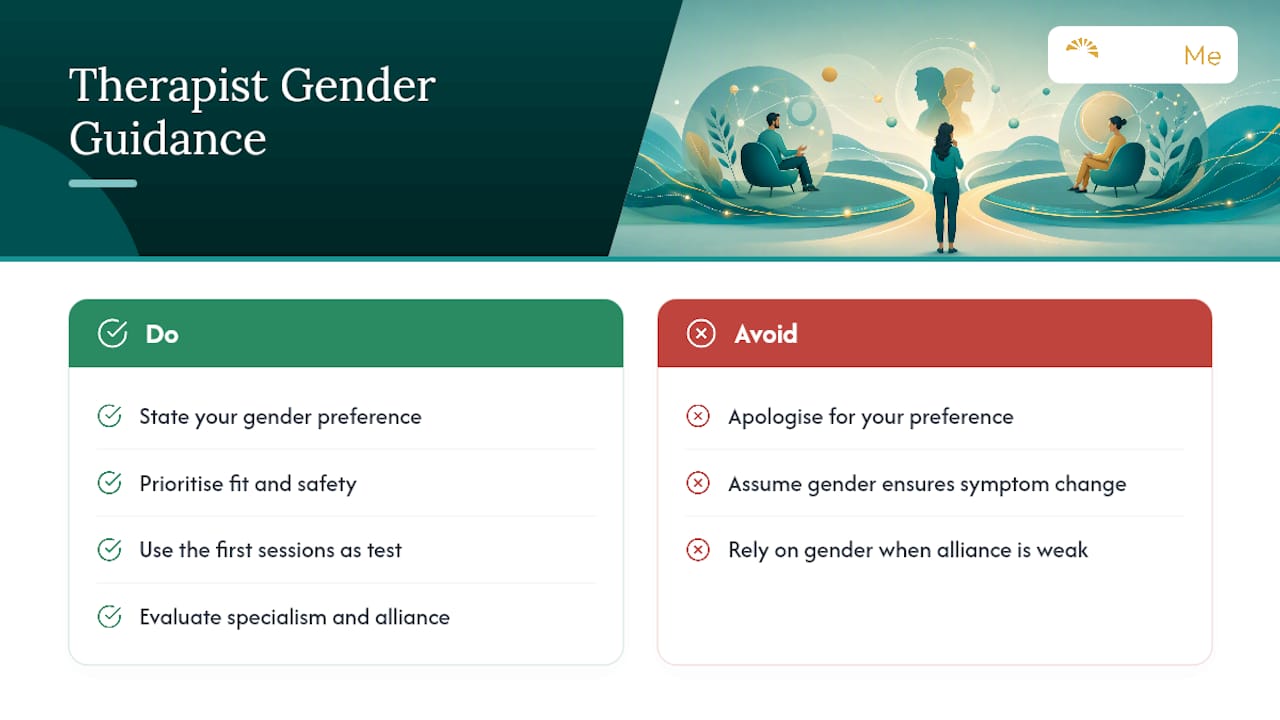
That's not a hedge. The research on outcomes is consistent on one point: gender matching correlates with satisfaction more reliably than it correlates with actual symptom change. People feel better about therapy with their preferred gender. They don't consistently get measurably better outcomes because of it. That's an uncomfortable nuance for an industry that often sells gender-matching as a simple fix, but it's the honest reading of the data.
The practical implication is straightforward. Treat your gender preference as real and worth stating, never as something to apologise for. But treat the first few sessions as the actual test, not the gender label on the therapist's profile. If specialism, approach, and alliance are strong, gender often stops mattering within weeks. If they're weak, no amount of gender-matching will fix it.
— Yetty
Find a therapist who fits, not just one who matches on paper
Working out whether to prioritise gender, specialism, or something else entirely is exactly the kind of decision that's harder to make alone than it should be. Guidemetherapy exists for that gap between wanting the right fit and not knowing how to find it without weeks of trial and error.
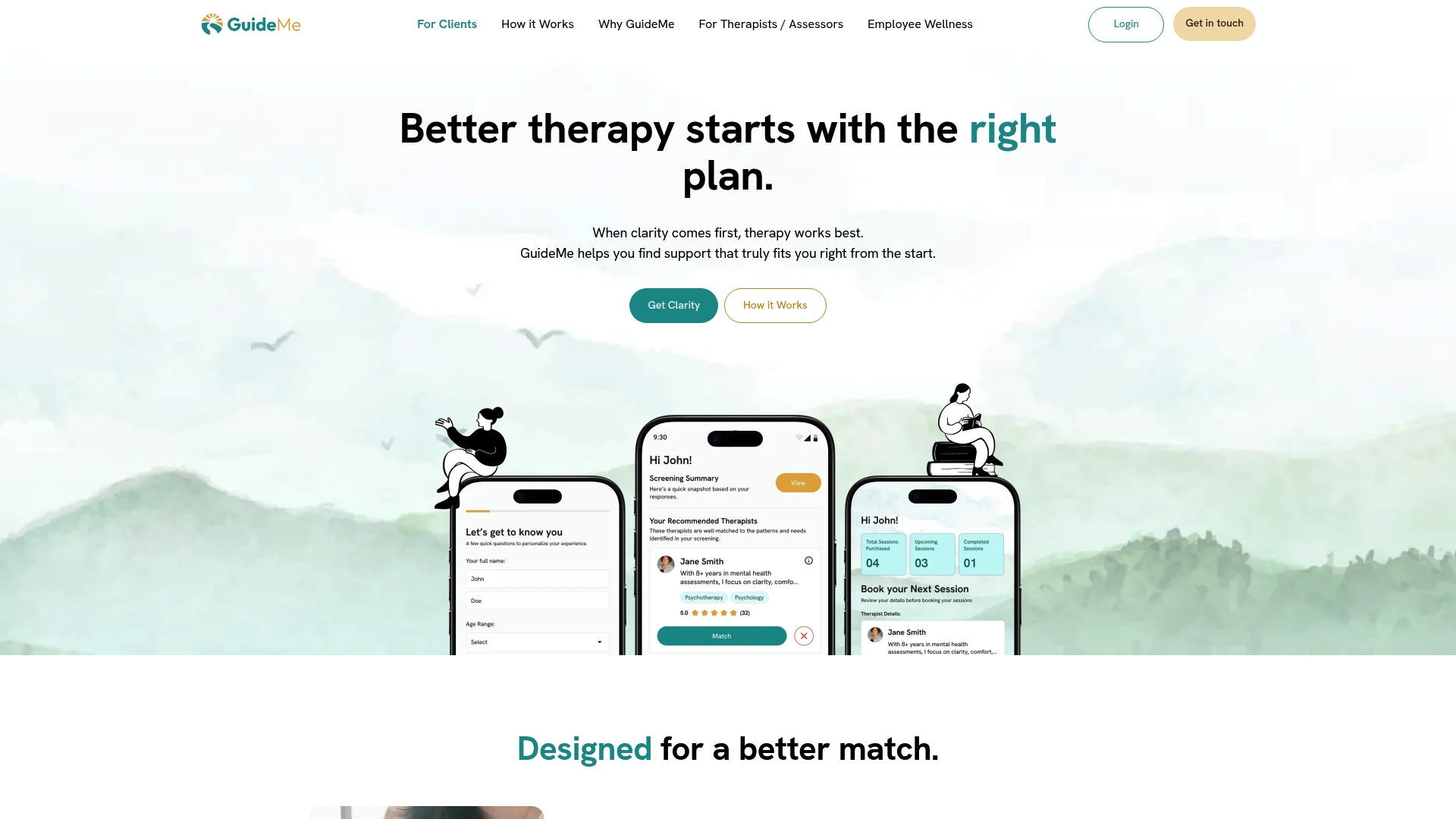
The platform starts with in-depth screening that captures your gender preference alongside your actual concerns, then uses human-led and AI-assisted matching to suggest a therapist suited to both. It's built on the understanding that a comfortable match and a skilled match shouldn't be a trade-off you have to make blind.
If you're ready to stop weighing gender preference against specialism on your own, start your screening with Guidemetherapy and let the matching process do the balancing for you.
This article is general information, not a substitute for advice from a qualified doctor. Consult a qualified healthcare professional about your own circumstances before acting on anything here.
Sources
- Women’s preference of therapist based on sex of therapist and presenting problem: An analogue study
- Men’s preferences for therapist gender: Predictors and impact on satisfaction with therapy
FAQ
Is it better for a man to see a male or female therapist?
Neither is universally better. Most men report no gender preference at all, and among those who do, satisfaction depends more on whether the preference is met than on which gender is chosen.
Which gender is more likely to see a therapist?
Women attend therapy more often than men across most surveyed populations, though this reflects broader help-seeking patterns rather than any rule about who benefits more from treatment.
Does gender matching with a therapist actually improve outcomes?
It reliably improves satisfaction and can reduce drop-out, but its effect on symptom reduction is mixed and typically small, meaning alliance and approach usually matter more.
Can I change therapists if the gender match isn't working?
Yes. Most services expect this and can rematch you if you explain what wasn't working, whether that's gender-related or about approach and specialism.
Which personality type is most likely to become a therapist?
There's no single dominant personality profile among therapists; the profession draws people with varied traits, though empathy and comfort with emotional disclosure are commonly cited as useful strengths.