

Therapy improves decision-making, stress regulation, sleep, and impulse control for people working in high-stakes finance. If you are a finance professional experiencing burnout, anxiety, or persistent stress, the evidence is clear: psychological support is not a luxury. Research from Cambridge shows that problem debt cuts recovery rates to 22% for those with financial difficulty compared with 50% for those without, which signals how deeply financial pressure and mental health are intertwined. Here is where to start:
- Self-refer to NHS Talking Therapies (formerly IAPT) online, without needing a GP referral first.
- Consider private therapy if confidentiality or scheduling flexibility is a priority.
- Use a navigation service such as Guidemetherapy to get matched with a therapist who understands high-pressure finance roles.
Table of Contents
- Why therapy benefits financiers more than most professionals
- What are the real therapy benefits for finance professionals?
- Which therapy approaches work best for finance-related problems?
- Where can you access therapy in the UK as a finance professional?
- How do you choose the right therapist for a high-stakes finance role?
- What should you expect from therapy: timeline and costs in the UK?
- When should you seek urgent or crisis help?
- Key takeaways
- Why finance-specific mental health care deserves more serious attention
- Guidemetherapy: matched to a therapist who understands your world
- Useful sources and further reading
Why therapy benefits financiers more than most professionals
Finance roles turn cognitive and emotional strain into a measurable risk variable. When your mental state directly affects the quality of a trade, a credit decision, or a client recommendation, psychological wellbeing stops being a personal matter and becomes an operational one. Commentators and clinicians increasingly frame mental health as risk management for the finance desk, not a private concern to be managed quietly after hours.
Research finding: A Cambridge study found mental-health recovery rates of 22% for people with problem debt, versus 50% for those without. Financial difficulty does not just cause stress; it actively slows clinical recovery.
The cognitive impacts of unmanaged stress in finance roles include:
- Impaired working memory, reducing the ability to hold and weigh competing data points
- Degraded risk assessment, particularly under time pressure
- Weakened impulse control, increasing the likelihood of reactive decisions
- Decision fatigue that compounds across a trading day or reporting cycle
- Sleep disruption that compounds all of the above
Research on finance workers and performance pressure confirms that anxiety, depression, and suicidal ideation are measurably elevated in this population. Studies on trading and investor populations show that resilience, built partly through clinical intervention, is protective against the most severe outcomes.
What are the real therapy benefits for finance professionals?
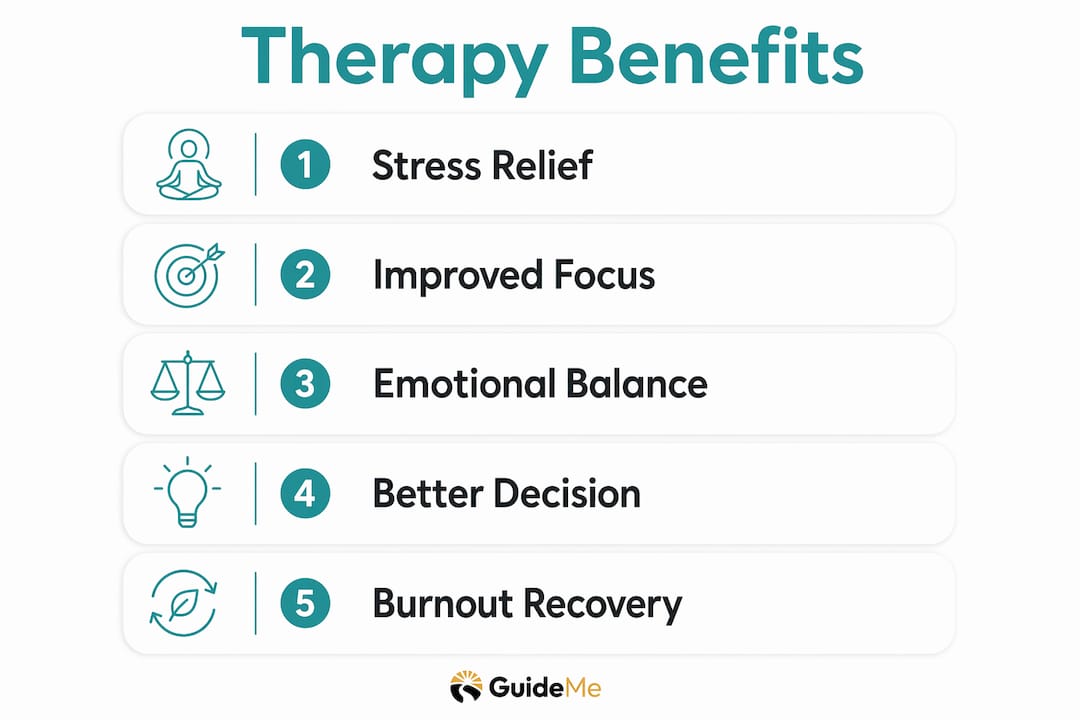
Therapy delivers concrete, measurable gains that show up at the desk, not just at home. The benefits of mental health support in finance careers are well documented, and they map directly onto professional performance.
- Improved decision quality. CBT helps identify cognitive distortions that skew risk assessment. Fewer catastrophising thoughts means clearer analysis under pressure.
- Reduced emotional reactivity. Traders who learn to pause between stimulus and response make fewer impulsive position changes during volatile sessions.
- Better sleep. CBT for Insomnia (CBT-I) addresses the racing-mind pattern common in finance professionals, restoring the deep sleep that supports memory consolidation.
- Burnout reduction. Structured therapy identifies the early warning signs of burnout before they become a performance crisis or a resignation.
- Clearer ethical reasoning. When anxiety is managed, the cognitive bandwidth for weighing ethical trade-offs increases. Pressure-driven ethical shortcuts become less automatic.
- Substance-use management. Alcohol and stimulant misuse are disproportionately common in finance. Therapy addresses the underlying drivers rather than the behaviour alone.
- Restored work-life balance. ACT-based approaches help professionals disentangle their identity from their performance metrics, reducing the all-or-nothing thinking that erodes personal life.
Addressing the emotional roots of financial behaviour, rather than relying on purely financial or budgeting advice, produces more durable change. The Cambridge recovery data reinforces this: when financial difficulty is present, psychological intervention is not optional, it is the mechanism that makes recovery possible.
Which therapy approaches work best for finance-related problems?
The most relevant modalities for financiers are CBT, CBT-I, mindfulness-based stress reduction (MBSR), Acceptance and Commitment Therapy (ACT), and EMDR. Each addresses a different layer of the problem.
- CBT targets the cognitive patterns that distort risk perception and fuel anxiety. It is the most widely evidenced approach for depression and generalised anxiety in working adults.
- CBT-I is the first-line clinical treatment for insomnia. For finance professionals whose sleep is disrupted by market anxiety or pre-meeting rumination, it is often more effective than medication.
- MBSR reduces chronic physiological activation. Regular mindfulness practice lowers baseline cortisol and improves attentional control, both of which matter in fast-moving markets.
- ACT addresses identity fusion with performance. Many finance professionals struggle to separate their self-worth from their P&L. ACT builds psychological flexibility without requiring the person to challenge every thought.
- EMDR can reprocess chronic performance stress and recalibrate an overactivated nervous system, with reported gains in sleep and focus.
Evidence-based protocols for working adults show measurable improvement within 6–8 weeks for burnout, insomnia, and anxiety when the right modality is matched to the presenting problem.
Therapy vs executive coaching: Therapy treats deeper psychological barriers such as anxiety, trauma, and burnout. Coaching focuses on skill development and performance optimisation. If you are experiencing persistent low mood, sleep disruption, or anxiety that affects daily functioning, therapy is the appropriate route. Coaching is the right choice once those barriers are resolved.

Pro Tip: If you are unsure which modality fits your situation, a good therapist will assess this in the first session. You do not need to arrive with a diagnosis or a preferred approach. Describe what is happening at work and let the clinical picture guide the choice.
Where can you access therapy in the UK as a finance professional?
You have four main routes, each with different trade-offs on cost, speed, and confidentiality.
- NHS Talking Therapies (IAPT): Free at the point of use. You can self-refer online without a GP. Waiting times vary by area but can run to several weeks. Suitable for mild-to-moderate anxiety and depression. Records sit within the NHS system.
- Private therapy: Faster access, flexible scheduling (including early morning or evening sessions around trading hours), and greater confidentiality. Many finance professionals choose private-pay therapy specifically to avoid records appearing on insurance or employer-facing documentation. Typical session costs in the UK range from £60 to £150 per session, depending on location and therapist experience.
- Workplace EAP or occupational health: Often provides a small number of free sessions (typically six to eight). Confidentiality is generally maintained with the employer, but the service is arranged through HR, which some professionals find uncomfortable. Useful as a first step, less suitable for ongoing or sensitive work.
- Navigation and matching services: Platforms such as Guidemetherapy screen your needs, create a personalised therapy plan, and match you with a therapist who has relevant experience. This route combines speed with specialist filtering, which matters when you need someone who understands high-pressure finance environments.
For online counselling for finance stress, remote sessions remove the logistical barrier of attending a clinic and allow you to fit appointments around market hours.
Pro Tip: If your employer offers an EAP, use it for the initial sessions while you assess whether you need longer-term private work. You are not obliged to disclose the content of sessions to your employer, and a good EAP provider will confirm this in writing at the outset.
How do you choose the right therapist for a high-stakes finance role?
Use this checklist when evaluating a prospective therapist:
- Registered with the BACP (British Association for Counselling and Psychotherapy) or HCPC (Health and Care Professions Council)
- Experience working with high-pressure or corporate professionals
- Trained in at least one evidence-based modality (CBT, ACT, EMDR, or MBSR)
- Available for remote sessions and flexible scheduling
- Clear, written confidentiality policy
- Uses outcome measures (e.g. PHQ-9, GAD-7) to track progress
- Has a plan for between-session support or crisis escalation
- Fees and cancellation policy stated upfront
- Cultural fit: you feel heard, not judged, in the first session
- Willing to discuss finance-specific pressures without requiring lengthy explanation
Questions to ask at first contact:
- "Have you worked with clients in finance or other high-pressure professional roles?"
- "How do you handle confidentiality if my employer is paying?"
- "Are you trained in CBT or CBT-I?"
- "Can you offer sessions before 8am or after 6pm?"
- "How will we measure whether therapy is working?"
Decision rule: After two or three sessions, ask yourself whether you feel genuinely understood and whether anything, however small, has shifted. A persistent sense of mismatch is a signal to switch. Finding the right therapist for finance workers is worth the effort of trying more than one.
What should you expect from therapy: timeline and costs in the UK?
Many working adults see measurable gains within 6–10 sessions for targeted CBT work. Deeper issues, including burnout recovery or trauma processing, typically take 3–6 months.
| Route | Typical sessions | Wait time | Outcome window |
|---|---|---|---|
| NHS Talking Therapies | 6–10 | Several weeks | 8–16 weeks from referral |
| Private therapy | 6–10 | Days to one week | 6–10 weeks for targeted work |
When financial difficulty is also present, the Cambridge recovery data showing significantly lower rates with problem debt is a useful reminder that complexity requires patience. Progress is real but slower when financial stress is layered on top of clinical symptoms.
Measuring your own progress: Track three simple metrics weekly: sleep quality (1–10), number of reactive decisions you noticed and caught, and a subjective stress rating (1–10). A downward trend in stress and reactive decisions over six weeks is a reliable early signal that therapy is working.
When should you seek urgent or crisis help?
Seek urgent help immediately if you experience suicidal thoughts, acute psychosis, severe self-neglect, or any situation where your safety or the safety of others is at risk.
Red flags that require prompt action:
- Suicidal ideation or plans, even if they feel abstract
- Severe insomnia causing functional collapse at work
- Substance use that is impairing your ability to work safely
- Severe disorientation, paranoia, or dissociation
UK crisis contacts:
- 999 for immediate risk to life
- NHS 111 for urgent but non-emergency mental health support
- Samaritans: 116 123 (free, 24 hours, confidential)
Pro Tip: You are not required to tell your employer you are in crisis or seeking help. Therapy records are confidential. Mandatory disclosure to an employer is rare and limited to situations where impairment creates a clear risk to clients or public safety, not simply for the fact of seeking support.
Key takeaways
Therapy is one of the most evidence-backed tools available to finance professionals for protecting both their mental health and their professional judgement.
| Point | Details |
|---|---|
| Therapy improves professional performance | CBT and related modalities reduce reactivity, improve sleep, and sharpen decision-making in high-pressure roles. |
| Financial difficulty slows recovery | Cambridge research found recovery rates of 22% with problem debt compared to 50% without, making early intervention critical. |
| Multiple UK access routes exist | NHS Talking Therapies (self-referral), private therapy, and workplace EAPs each suit different needs and confidentiality requirements. |
| Modality and therapist fit matter | Match the approach (CBT, ACT, EMDR, CBT-I) to your specific symptoms; BACP or HCPC registration is a baseline requirement. |
| Guidemetherapy matches you to the right therapist | Guidemetherapy screens your needs, builds a personalised therapy plan, and connects you with a therapist experienced in high-pressure finance roles. |
Why finance-specific mental health care deserves more serious attention
The conventional framing of mental health in finance is that it is a private matter, something to manage quietly or push through. That framing is wrong, and the evidence makes it hard to defend.
When a professional's psychological state directly affects the quality of their judgements, their risk tolerance, and their ethical reasoning, their mental health is not separate from their work. It is part of it. Treating clinical care as a professional maintenance activity, rather than a sign of weakness, is the more rational position. The therapy support for managers literature makes the same point from an organisational angle: firms that invest in specialist referral pathways and confidentiality safeguards retain better people and make fewer costly errors.
For employers, the ask is specific: build referral pathways that protect confidentiality, offer access to clinicians with finance-sector experience, and separate occupational health from performance management. Resilience training tied to clinical services, rather than standalone wellness days, is what actually moves outcomes. An employee mental health programme designed with these principles is a retention and risk-management tool, not a benefit add-on.
Guidemetherapy: matched to a therapist who understands your world
Finance professionals do not need a generic therapy referral. They need a therapist who understands performance pressure, confidentiality requirements, and the specific cognitive demands of high-stakes work. That is exactly what Guidemetherapy is built for.
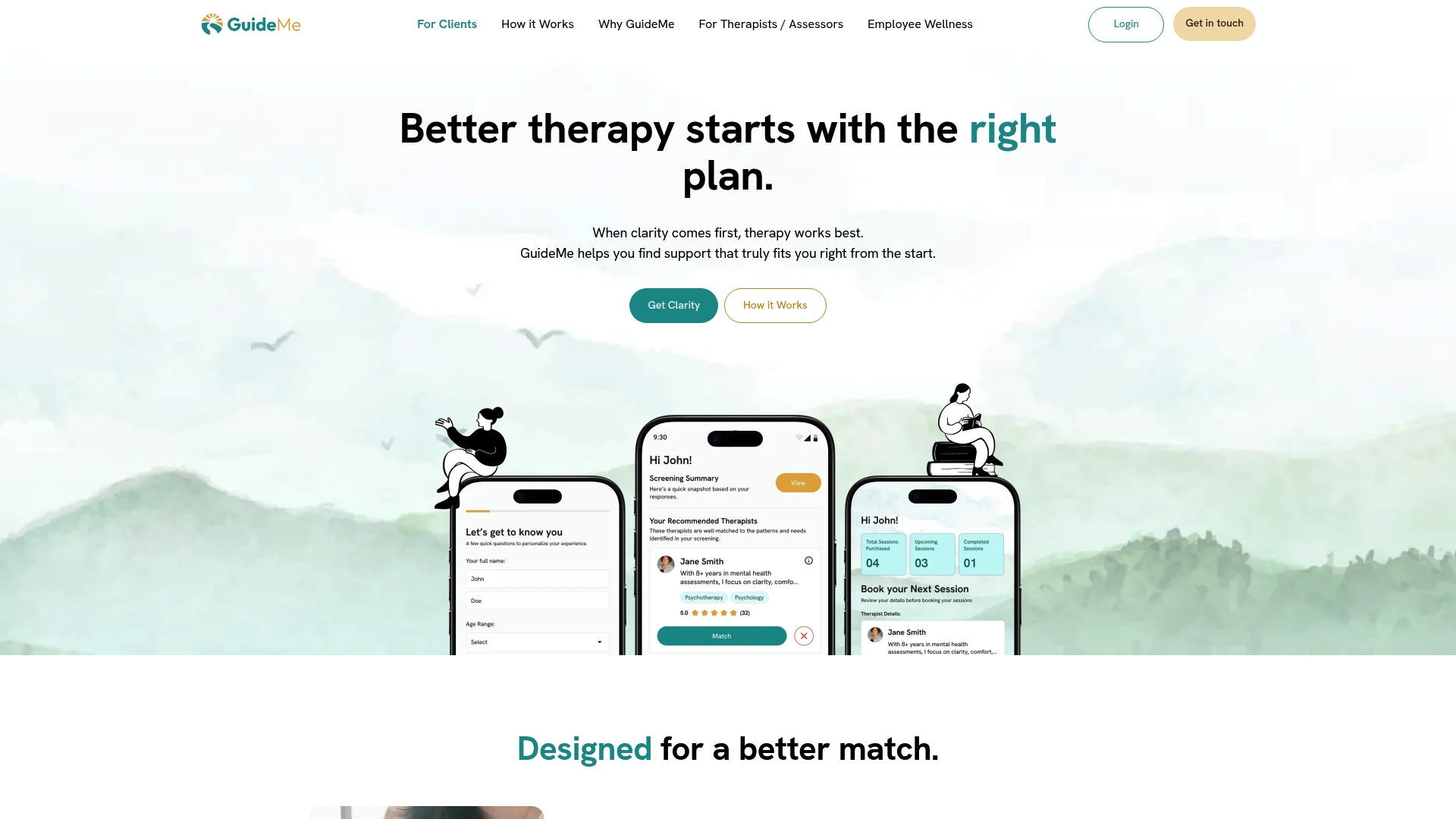
Guidemetherapy combines in-depth screening with AI-assisted and human-led matching to connect you with a therapist suited to your situation, not just your postcode. You get a personalised therapy plan before your first session, ongoing support between appointments, and the ability to filter for therapists with experience in corporate and finance environments. Three steps to get started: complete a short self-screen, apply filters for finance-sector experience and scheduling needs, then book a confidential session. No long waiting lists, no HR involvement unless you choose it.
Start your therapy match with Guidemetherapy and find a therapist who fits your work and your life.
This article is general information, not professional medical or psychological advice. Please consult a qualified clinician or your GP for guidance specific to your own situation.
Useful sources and further reading
- NHS Talking Therapies: Self-referral route for NHS-funded talking therapies in England; no GP required.
- BACP: The British Association for Counselling and Psychotherapy; use their register to verify a therapist's credentials.
- HCPC: The Health and Care Professions Council; regulates psychologists and other protected health titles in the UK.
- Samaritans: Free, confidential crisis support, 24 hours a day, on 116 123.
- Cambridge debt and recovery study: Feasibility and potential effects of a combined money advice and psychological therapy intervention within NHS Talking Therapies services — the primary source for the 22% vs 50% recovery rate finding.