

TL;DR:
- Financial therapy combines psychological support with financial knowledge to reduce workplace stress and improve well-being among financial services professionals. It focuses on emotional patterns and behavioral roots of financial difficulty, distinct from financial advice or coaching. Early engagement in therapy yields better results and helps professionals manage stress more effectively.
Financial services therapy is the integrated practice of addressing the psychological relationship with money alongside mental health support to reduce workplace stress and improve well-being. The standard industry term for this field is financial therapy, a discipline recognised by the Financial Therapy Association (FTA) as combining financial planning knowledge with psychological counselling skills. For professionals working in banking, investment, insurance, or accounting, this approach goes well beyond budgeting advice. It targets the emotional patterns, limiting beliefs, and behavioural cycles that drive financial stress at work and at home. This guide covers everything you need to find the right support, apply effective strategies, and build lasting financial wellness.
What is a financial services therapy guide and why does it matter?
Financial therapy is defined as a process that helps people understand and change their emotional relationship with money. Financial therapists focus on psychological and behavioural patterns related to money, which distinguishes them clearly from financial advisors who manage investments and portfolios. That distinction matters enormously for financial services professionals, who often already possess strong technical knowledge but struggle with the emotional weight that comes with the role.

Working in financial services places you in daily contact with other people's money, market volatility, and high-stakes decisions. That exposure creates a specific kind of stress that generic workplace wellness programmes rarely address. Financial therapy provides a structured, clinically informed space to process that pressure, identify unhealthy coping patterns, and build a more stable relationship with money in both your professional and personal life. The benefits of mental health support in finance careers are well documented, and financial therapy sits at the centre of that support.
How do you find a qualified financial therapist?
Finding the right therapist starts with understanding credentials. A qualified financial therapist typically holds one of the following:
- Clinical licensure such as Licensed Clinical Social Worker (LCSW) or Licensed Mental Health Counsellor (LMHC), which allows the practitioner to diagnose and treat mental health conditions.
- FTA certification, awarded by the Financial Therapy Association to practitioners trained in both financial planning and psychological counselling.
- Combined qualifications, where a therapist holds both a clinical licence and a financial planning credential such as Certified Financial Planner (CFP).
Verifying clinical licensure is critical because it affects both the depth of therapy available and whether sessions may be covered by health insurance. Therapists with a clinical mental health licence may bill insurance when treatment addresses a diagnosed mental health condition. Non-licensed coaches generally cannot accept insurance. In the UK context, check whether the practitioner is registered with the British Association for Counselling and Psychotherapy (BACP) or the UK Council for Psychotherapy (UKCP) in addition to any financial therapy credentials.
The FTA directory is the primary resource for locating certified financial therapists internationally. Professional directories from BACP and UKCP are the most reliable starting points in the UK. You can also use platforms like Guidemetherapy, which matches professionals with therapists based on their specific needs and circumstances.
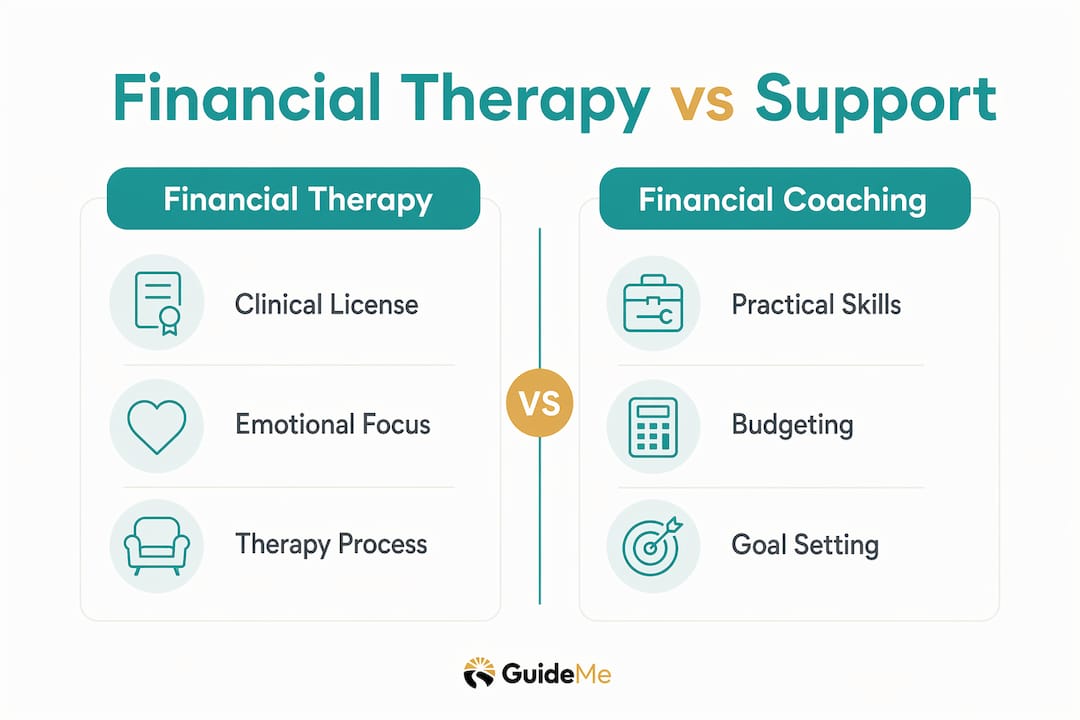
Understanding the difference between a financial therapist, a financial advisor, and a financial coach is equally important. A financial advisor manages investments and provides regulated financial planning. A financial coach offers practical money management guidance but does not address clinical mental health concerns. A financial therapist addresses the psychological and behavioural roots of financial difficulty. For coaching versus therapy distinctions, the key question is whether you need clinical mental health support or practical skills development.
Pro Tip: Ask any prospective therapist three questions before committing: What clinical licence do you hold? Have you worked with financial services professionals before? How do you approach money beliefs rooted in early life experience? The answers will tell you quickly whether the fit is right.
Effective strategies to manage workplace stress through financial therapy
Financial services professionals tend to experience a recognisable set of emotional patterns around money. Awareness of these patterns is the first step toward changing them.
-
Identify your money scripts. Money scripts are the core beliefs about money formed in childhood, such as "money is dangerous" or "I must always earn more." Clients often resist challenging these beliefs because they feel fundamental to identity. A financial therapist helps you surface and examine them without judgement.
-
Use cognitive-behavioural techniques to reality-test financial anxiety. Therapists guide clients to reality-test emotional triggers around money, reframing responses from fear to agency. For a financial services professional, this might mean separating a client's portfolio loss from your own sense of professional worth.
-
Set personal financial boundaries at work. Boundary-setting in a financial role means defining where your professional responsibility ends and emotional absorption begins. Therapy provides the framework to practise this distinction consistently.
-
Integrate mindfulness into financial decision-making. Brief mindfulness practices before high-stakes decisions reduce reactive thinking. This is not about relaxation alone. It is about creating a pause between stimulus and response during volatile market conditions or difficult client conversations.
-
Address avoidance behaviours directly. Financial avoidance, such as ignoring personal finances or procrastinating on important decisions, is one of the most common patterns therapists treat. Financial therapists address overspending, avoidance, and financial shame as interconnected issues rather than isolated habits.
Pro Tip: Keep a brief daily log of your emotional state before and after financial decisions at work. After two weeks, patterns become visible. Share the log with your therapist to accelerate the work.
The mindset shift that therapy produces is not simply about feeling better. It changes the quality of your professional judgement. Professionals who have addressed their own financial anxiety report greater clarity in client conversations and reduced burnout over time.
How do financial wellness resources complement mental health support?
Sustained well-being in financial services requires more than therapy alone. A layered approach combines several types of support, each serving a different function.
Financial coaching focuses on practical skills: budgeting, debt management, and financial goal-setting. It is skills-based and forward-looking. Financial counselling, offered by organisations such as the Money and Pensions Service in the UK, addresses specific financial problems like debt or benefit entitlement. Financial therapy addresses the psychological roots of financial behaviour. These three are not interchangeable, but they work well together.
| Resource type | Primary focus | Clinical mental health support |
|---|---|---|
| Financial coaching | Practical money skills and goal-setting | No |
| Financial counselling | Problem-specific guidance (debt, benefits) | No |
| Financial therapy | Psychological and behavioural money patterns | Yes, if clinically licensed |
| Online therapy platforms | Accessible mental health support | Yes |
Online counselling for finance stress has grown significantly as a practical option for professionals with demanding schedules. Remote therapy removes the barrier of geography and allows sessions to fit around market hours or shift patterns. The clinical quality of online therapy is equivalent to in-person work for most presentations of financial anxiety and stress.
Mental health support positively influences money management habits in measurable ways. When anxiety decreases, impulsive financial decisions become less frequent. When shame around money reduces, people engage more consistently with budgeting and financial planning. The psychological work and the practical financial work reinforce each other.
To build a sustainable personal plan, consider these steps:
- Start with a financial therapy assessment to identify your primary emotional patterns around money.
- Add a financial wellness resource, such as a budgeting tool or financial counsellor, once the emotional groundwork is in place.
- Review your plan every six months, adjusting the balance between therapy and practical financial support as your needs change.
- Use your employer's Employee Assistance Programme (EAP) if one is available, as many now include financial counselling sessions.
What challenges arise in financial services therapy?
The most common obstacle is emotional resistance. Success in financial therapy depends on willingness to address childhood money scripts and confront limiting beliefs. Many financial professionals find this particularly difficult because their professional identity is built around financial competence. Admitting emotional difficulty with money can feel contradictory to that identity.
Cost is a practical barrier. Financial therapy sessions cost between £100 and £800 per hour depending on therapist credentials and location. That range reflects significant variation in experience and geography. Insurance may offset some cost if the therapist holds clinical licensure and your policy covers mental health treatment.
Finding the right therapist fit takes time. The first therapist you see may not be the right match, and that is normal. Factors such as communication style, cultural competence, and experience with financial services professionals all affect the quality of the therapeutic relationship.
"Financial professionals should know when to refer clients to licensed therapists for trauma or mental health disorders." This principle applies equally to professionals seeking support for themselves. If your symptoms include persistent anxiety, depression, or trauma responses, a clinically licensed therapist is the appropriate starting point, not a coach or counsellor.
A critical boundary to understand is that financial therapists do not manage investments. They do not provide regulated financial advice. If you enter therapy expecting portfolio guidance, you will be disappointed. The work is psychological. When complex mental health conditions such as trauma, obsessive-compulsive patterns, or severe depression are present, referral to a specialist is the responsible next step.
Key takeaways
Financial therapy is the most direct route for financial services professionals to address the emotional roots of workplace stress and build lasting well-being.
| Point | Details |
|---|---|
| Verify credentials first | Confirm clinical licensure and FTA certification before committing to a therapist. |
| Therapy differs from advice | Financial therapists address psychological patterns, not investments or financial planning. |
| Layer your resources | Combine therapy with financial coaching or counselling for the most sustained results. |
| Expect emotional work | Challenging childhood money beliefs is central to the process and takes genuine openness. |
| Start before crisis | Engaging with therapy early produces better outcomes than waiting for burnout or breakdown. |
Why I think financial services professionals wait too long
Working closely with people who carry significant professional responsibility for other people's money, I have noticed a consistent pattern. The professionals who benefit most from financial therapy are rarely the ones in acute crisis. They are the ones who recognised the early signs of stress and acted before those signs became unmanageable.
There is a particular kind of pride in financial services that makes asking for help feel like a professional failure. You manage risk for a living. You are expected to have your own finances and emotions in order. That expectation is both understandable and damaging. The connection between therapists and financial decisions is not a soft topic. It is a clinical one, with real consequences for professional performance and personal health.
The professionals I have seen engage with financial therapy early report something consistent: they wish they had started sooner. Not because the work is easy, but because the clarity it produces changes how they show up at work and at home. Vulnerability in therapy is not weakness. It is the mechanism through which change actually happens. Therapy before crisis is not a luxury. For people in high-pressure financial roles, it is a professional investment.
— Yetty
How Guidemetherapy supports financial services professionals
Guidemetherapy is a therapy navigation platform built for people who want to find the right therapist from the start, not after several false starts. It combines human expertise with AI-powered matching to create a personalised therapy plan based on your specific needs, including the pressures unique to financial services roles.

If you are a financial services professional carrying the weight of workplace stress, financial anxiety, or emotional patterns that affect your performance, Guidemetherapy can match you with a therapist who understands your world. The process begins with an in-depth assessment, so your first session is already informed by what matters most to you. Visit Guidemetherapy to start your personalised therapy plan today.
FAQ
What is financial therapy?
Financial therapy is a practice that combines psychological counselling with financial knowledge to address the emotional and behavioural roots of money-related stress. It is distinct from financial advice, which focuses on investment and planning.
How do I find a qualified financial therapist in the UK?
Use the Financial Therapy Association directory for certified practitioners, and check BACP or UKCP registration for clinical licensure. Platforms like Guidemetherapy also offer therapist matching for finance workers based on your specific needs.
Does insurance cover financial therapy sessions?
Insurance may cover sessions if the therapist holds a clinical mental health licence and treatment addresses a diagnosed condition. Non-licensed coaches and counsellors generally cannot bill insurance.
How much does financial therapy cost?
Sessions typically cost between £100 and £800 per hour, depending on the therapist's credentials, experience, and location. Employer EAPs may provide subsidised access to financial counselling as a starting point.
Is financial therapy the same as financial advice?
No. Financial therapists focus exclusively on psychological and behavioural patterns related to money. They do not manage investments, provide regulated financial advice, or replace the role of a financial advisor or planner.