

Therapy journaling prompts are targeted questions you write down to process emotion, practise techniques from your therapy sessions, and bring useful material into the room with your therapist. They differ from a general diary because they're built to do a specific job, whether that's untangling an anxious thought or naming what you need after a loss. This article gives you research-backed benefits, a clear way to structure your writing time, and prompt sets organised by therapeutic aim.
TL;DR:
- Focused prompts help you examine specific thoughts or feelings, making journal entries more actionable and easier for therapists to interpret.
- Regular sessions of a few minutes, including grounding techniques, are more effective than long, infrequent writing practices.
- Different prompts target specific goals like anxiety, grief, or mindfulness, allowing you to tailor journaling to your current needs.
- On difficult days, scale down to single sentences or sensory observations to maintain consistency without feeling overwhelmed.
- Using journal insights to prepare for therapy sessions can reveal recurring patterns and help identify when professional support is needed.
Table of Contents
- What are therapy journaling prompts, and why do they work better than free writing?
- How do you use these prompts without it becoming another chore?
- Therapy journal prompts organised by what you're working through
- What should you do on the days journaling feels impossible?
- How does journaling connect back to your actual therapy sessions?
- A word on consistency and self-kindness
- Ready to take your journaling further? Guidemetherapy can help you find the right support
- Sources
What are therapy journaling prompts, and why do they work better than free writing?
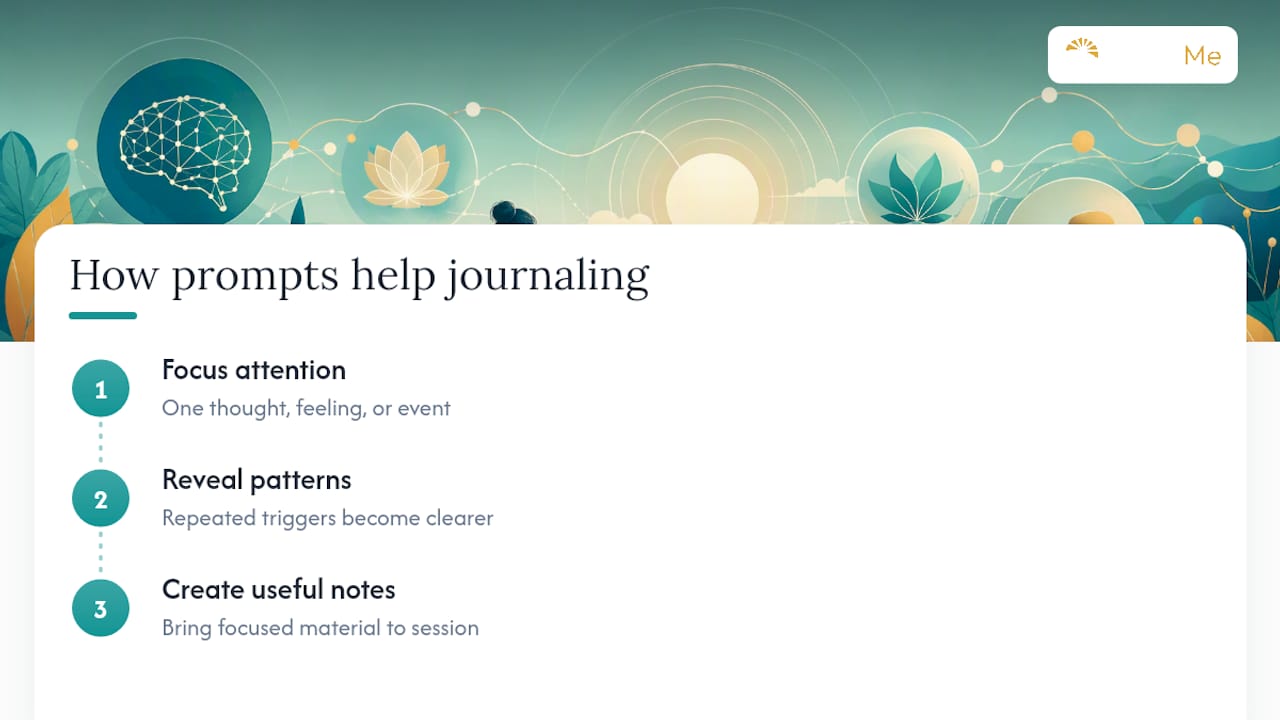
Open-ended journaling can feel vague. You sit with a blank page, write a paragraph about your day, and close the notebook no clearer than when you started. Directive prompts remove that friction. Narrowing your focus to one specific thought, feeling, or event helps you actually examine it, rather than skating across the surface of your week.
That's the logic behind therapy writing exercises: a good prompt does some of the thinking for you, pointing you towards the emotional processing, cognitive restructuring, or reduced rumination that unfocused writing rarely achieves. Practitioner guidance from HelpGuide backs this up, recommending brief, prompt-led sessions of 5 to 20 minutes rather than long, meandering entries.
There's a practical payoff too. Clients who journal with purpose often arrive at sessions with clearer material to discuss. Instead of "I've had a rough week," you might bring: "I noticed the same catastrophic thought three times this week, and here's what triggered it each time." That's the kind of note a therapist can actually work with.
How do you use these prompts without it becoming another chore?
Consistency beats intensity. Guides on mental health journal ideas generally recommend sessions of a few minutes, done regularly several times a week, rather than one exhausting hour-long entry every few weeks, since Reflection notes regular short sessions tend to outperform sporadic long ones. Think of it like brushing your teeth for your mind: small, repeated effort matters more than the occasional deep scrub.
A simple structure keeps sessions from sprawling:
- Ground yourself first. Take three slow breaths or name five things you can see. This settles your nervous system before you start writing about anything difficult.
- Pick one prompt that matches how you feel right now, not the one you think you should answer.
- Write without editing. Grammar doesn't matter here.
- Close with a grounding note or small self-care line ("I will make tea after this") so you don't finish mid-thought and mid-feeling.
Match the prompt to your current state. If you're anxious, reach for a grounding or anxiety prompt rather than a self-compassion one that needs more emotional bandwidth than you have that day.
Pro Tip: Keep three or four prompts bookmarked for "low battery" days, things like one-sentence check-ins or simple lists, so you're never facing a blank page when you're already running on empty.
Therapy journal prompts organised by what you're working through
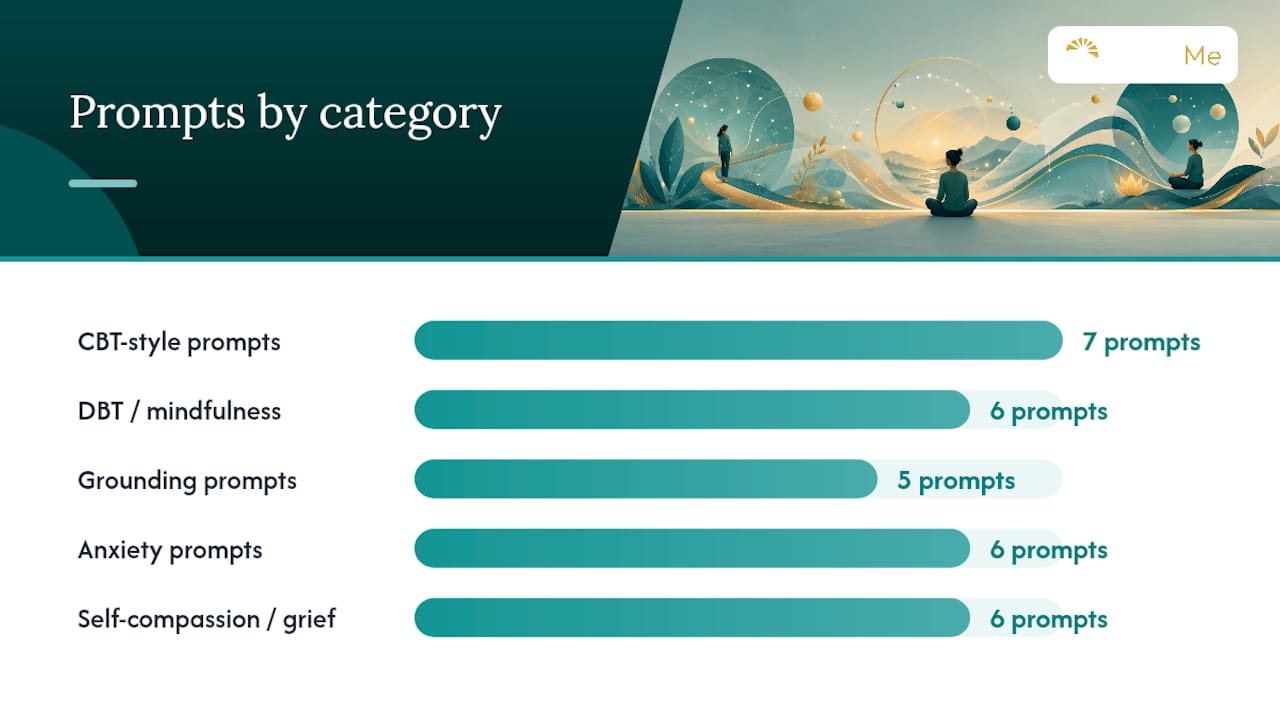
Different therapeutic goals call for different questions. A prompt built for anxiety won't do much for grief, and a grounding exercise won't help you challenge a distorted thought. Therapists often adapt prompts to modality, according to Positivepsychology, with CBT prompts targeting the thought-feeling-behaviour link and DBT prompts leaning on mindfulness and distress tolerance. Pick the set that matches what's actually going on for you today.
CBT-style prompts (identifying and testing automatic thoughts):
- What thought went through my mind right before I felt this way?
- What evidence actually supports this thought? What evidence contradicts it?
- Am I assuming I know what someone else is thinking, without asking them?
- If a friend had this exact thought about themselves, what would I tell them?
- What's a more balanced way to see this situation?
- What would change if this thought turned out not to be true?
DBT and mindfulness prompts (present-moment awareness, distress tolerance):
- What can I notice right now using each of my five senses?
- What emotion is strongest in my body at this moment, and where do I feel it physically?
- What's one thing I can do in the next ten minutes to tolerate this feeling without making it worse?
- When did I last act opposite to an unhelpful urge, and what happened?
- What would "wise mind" say about this situation, somewhere between pure emotion and pure logic?
- How can I accept this moment as it is, even if I don't like it?
Grounding prompts (for acute distress or overwhelm):
- Describe your safe place in as much sensory detail as possible: what you'd see, hear, and smell.
- List five objects in the room right now and one detail about each.
- What does the chair or floor feel like beneath you right now?
- Write the alphabet and name one calming thing for each letter you can.
- What sound is happening around you right now, and what does it remind you of?
Anxiety prompts (trigger mapping and reappraisal):
- What specifically triggered this anxious spiral, and when did I first notice it?
- What's the worst-case outcome I'm imagining, and how likely is it, honestly?
- What has actually happened in similar situations before?
- What's within my control right now, and what isn't?
- If this anxiety is trying to protect me from something, what is it?
- What would "good enough" look like here, instead of perfect?
Self-compassion and grief prompts:
- What do I need right now that I haven't given myself permission to ask for?
- How would I comfort a close friend feeling exactly what I feel today?
- What am I grieving that isn't a person, a routine, an identity, a future I imagined?
- What's one kind thing I can say to myself about how I'm coping?
- What memory of what I've lost brings comfort rather than pain?
- Where do I still feel connected to what or who I've lost?
What should you do on the days journaling feels impossible?
Some days, a full prompt is too much, and that's fine. Low-effort formats still count: a single sentence, a bulleted list of three feelings, or a few sensory notes about what's happening in your body. Crisis Text Line recommends exactly this kind of scaled-down approach when writing brings up more than you can process in one sitting.
Try a few of these on harder days:
- Write just one sentence describing how you feel, nothing more.
- List three things you can see, hear, and feel right now.
- Note one small thing that went okay today.
- Ground yourself with slow breathing before and after writing, especially if a prompt touched something raw.
Watch for warning signs that journaling alone isn't enough: thoughts that feel unmanageable, urges to harm yourself, or a sense of being stuck that doesn't lift after grounding. If that happens, stop writing and reach out. In the UK, Samaritans is available 24 hours a day, and your therapist should always be your first call for anything beyond what a journal can hold.
How does journaling connect back to your actual therapy sessions?
Journal entries become far more useful when they don't just sit in a notebook. Before a session, skim your recent entries and highlight anything that surprised you, a repeated thought, an intense reaction, a question you couldn't answer alone. A short summary or a two-line question list gives your therapist something concrete to work with, rather than a vague "it's been a hard week."
Journaling can also double as therapy homework, turning your writing into a way to track progress between appointments. Patterns that are invisible day to day, a recurring trigger, a slowly shifting mood, often become obvious once you look back over a few weeks of entries.
- Highlight one or two entries that felt significant before each session.
- Bring specific questions your journal raised but didn't answer.
- Use entries to notice whether a technique from therapy is actually helping.
If your journaling keeps surfacing something you can't work through alone, that's not a failure. It's usually a sign you need a therapist who understands what you're carrying, which is precisely the kind of matching Guidemetherapy was built around.
A word on consistency and self-kindness
Journaling rarely feels dramatic day to day. Some entries will feel pointless, some prompts won't land, and you'll miss days. None of that means it isn't working. The value tends to show up slowly, in a pattern you only notice weeks later, not in any single breakthrough entry.
Aim for small, regular check-ins over rare marathon sessions, as explained in how to build a trading journal that actually improves your edge. A rough two-minute entry four times a week will teach you more about yourself than one polished page a month. Be as patient with your own process as you'd want a friend to be with theirs.
— Yetty
Ready to take your journaling further? Guidemetherapy can help you find the right support
Journaling is a genuinely useful starting point, but it has a ceiling: a notebook can't ask follow-up questions, challenge a distortion in real time, or notice a pattern you're too close to see. That's where working with a therapist changes what's possible.

Guidemetherapy exists for the moment your journal raises more questions than it answers. Instead of searching through directories and guessing which therapist might suit you, A therapy navigation platform screens your situation in depth, builds a personalised therapy plan, and matches you with a therapist using both human judgement and AI-assisted matching, so you're not starting from scratch in the first session explaining who you are. If your entries keep circling the same trigger, or grief, anxiety, or a thought pattern feels bigger than a page can hold, that's a reasonable moment to explore professional support. Visit Guidemetherapy to see how the matching process works and take the next step towards a therapist suited to what you're actually dealing with.
This article is general information, not a substitute for advice from a qualified doctor. Consult a qualified healthcare professional about your own circumstances before acting on anything here.
Sources
- Journaling for Mental Health and Wellness — HelpGuide
- 100 journal prompts for better self-care — Crisis Text Line
- Reflection