

Therapy homework is short, collaboratively agreed tasks you practise between sessions to turn therapeutic insight into real-life change. If you are in therapy right now and want something concrete to try this week, here are three places to start:
- Keep a brief mood and activity log. Each evening, note your mood out of 10 and one thing you did that day. Five minutes is enough. This gives your therapist real data and helps you spot patterns you would otherwise miss.
- Try one 5-minute grounding practice. Slow your breath to a count of four in and six out, or run through the 5-4-3-2-1 senses exercise. Mindfulness in therapy has a fuller guide if you want more detail.
- Set one small behavioural experiment. Choose a single, low-stakes action you have been avoiding, do it once before your next session, and write down what actually happened versus what you expected.
These are the kinds of between-session assignments recommended by the NHS and endorsed by the BABCP (British Association for Behavioural and Cognitive Psychotherapies) as part of structured psychological treatment. If at any point your distress feels unmanageable, call 999 in an emergency, contact NHS 111 for urgent mental health support, or ring Samaritans on 116 123 any time of day or night. Guidemetherapy also offers structured between-session support for people who want more guidance between appointments.
Key takeaways
Between-session tasks with a medium effect size (d ≈ 0.53) on treatment outcomes are most effective when collaboratively designed, written down, and reviewed in the following session.
| Point | Details |
|---|---|
| What therapy homework is | Short, agreed tasks practised between sessions to build skills and test new behaviours in real life. |
| What helps completion | Specific, achievable tasks agreed collaboratively, written in duplicate, and scheduled at a fixed time each week. |
| Core templates to try | Thought record, activity schedule, exposure hierarchy, behavioural experiment, grounding practice, and sleep/mood log. |
| Safety reminder | If symptoms worsen or you have thoughts of self-harm, call 999, NHS 111, or Samaritans (116 123) immediately. |
| Guidemetherapy | Offers personalised therapy plans, structured between-session support, and therapist matching to complement your treatment. |
This article is general information, not a substitute for advice from a qualified doctor. Consult a qualified healthcare professional about your own circumstances before acting on anything here.
Table of Contents
- Where to find worksheets and what types of therapy homework exist
- Why therapy homework genuinely improves outcomes
- How to design homework you will actually complete
- Ready-to-use templates you can copy right now
- Recognising limits and knowing when to seek urgent help
- UK services and clinician-reviewed resources worth bookmarking
- Homework works best when it feels like a shared experiment
- Structured between-session support with Guidemetherapy
- Sources
Where to find worksheets and what types of therapy homework exist
The most widely used categories of between-session assignments map closely onto the techniques therapists use in session. Knowing the category helps you find the right worksheet quickly.
- CBT thought records. A thought record captures a situation, the automatic thought it triggered, the emotion and its intensity, and a more balanced alternative thought. Common CBT homework types include thought records as the foundational tool for challenging unhelpful thinking patterns. Research shows that more accurate and frequent thought records mid-treatment correlate with better post-treatment outcomes and lower relapse rates in depression and anxiety.
- Behavioural activation and activity scheduling. A simple weekly grid where you plan three or more small, meaningful activities in advance. The goal is to break the low-mood cycle by reconnecting with activities that bring a sense of achievement or pleasure.
- Exposure hierarchies. A ranked list of feared situations from least to most anxiety-provoking, each given a subjective anxiety rating (0–100). You work up the list gradually, staying in each situation until anxiety naturally reduces.
- Behavioural experiments. You write a prediction ("If I speak up in a meeting, everyone will think I am incompetent"), test it in real life, and record what actually happened. This is one of the most direct ways to update unhelpful beliefs.
- Relaxation and mindfulness exercises. Guided breathing scripts, progressive muscle relaxation, or body-scan meditations practised for 5–20 minutes daily. These are particularly useful as standalone tasks for anxiety and stress.
- Sleep and mood logs. A nightly record of sleep times, wake times, mood rating, and any notable events. Over two weeks, patterns emerge that inform treatment decisions.
- Self-monitoring forms and DBT/ACT skills sheets. Diary cards from Dialectical Behaviour Therapy (DBT) track emotions, urges, and skills used each day. Acceptance and Commitment Therapy (ACT) worksheets focus on values clarification and psychological flexibility exercises.
Where to download worksheets. Four sources are worth bookmarking:
- TherapistAid offers free, clinician-reviewed PDFs covering most CBT categories, with fillable digital versions for many sheets.
- PsychologyTools provides a large library of evidence-based worksheets, many available free; clinician packs with additional resources require a subscription.
- NHS self-help pages include free, accessible guides on common conditions with built-in exercises.
- Mind (UK) publishes plain-language worksheets and local service directories, particularly useful if you want to find in-person support alongside self-help materials.
Look for a clinician's name, professional affiliation, or BABCP endorsement on any worksheet page before using it. That tag signals the content has been reviewed against current clinical standards rather than assembled from general advice.
Why therapy homework genuinely improves outcomes
Completing tasks between sessions is not just a good habit. The evidence that it changes treatment outcomes is consistent across multiple research designs.
A special-issue synthesis in the Journal of Clinical Psychology reports a medium effect size (d ≈ 0.53) for between-session homework on treatment outcomes, alongside a modest positive correlation between homework engagement and improvement (r ≈ 0.26). Peer-reviewed meta-analyses further show that therapist behaviours around selecting, planning, and reviewing homework predict better engagement even after controlling for the quality of the therapeutic alliance.
| Metric | Value | What it means in plain English |
|---|---|---|
| Effect size (d) | ≈ 0.53 | A medium effect: consistent homework completion is associated with meaningfully better outcomes, not just a marginal difference |
| Correlation with outcome (r) | ≈ 0.26 | A modest positive link: more engagement with tasks tends to go with more improvement, though other factors also matter |
| Homework quality (thought records) | Predicts lower relapse | More accurate thought records mid-treatment correlate with better post-treatment scores in depression and anxiety samples |
The mechanisms behind these numbers are straightforward. Behavioural repetition builds new habits and reduces avoidance. Practising skills outside the therapy room tests whether they generalise to real life. Recording thoughts and moods gives the therapist richer data than memory alone can provide. And completing a task, however small, builds the confidence that change is possible.
What this means practically:
- Consistent practice, even imperfect practice, tends to help more than waiting for the "right moment."
- Therapist review of completed tasks increases the benefit, so bringing your log or worksheet to every session matters.
- The quality of a thought record, not just its frequency, predicts outcomes, so accuracy and honesty in recording are worth prioritising.
How to design homework you will actually complete
The single most reliable predictor of whether a task gets done is how it was agreed in the first place. Collaborative task design, presuppositional language, and keeping duplicate written instructions are the practitioner techniques with the strongest evidence for increasing engagement.
Here is a practical framework for creating tasks that stick, whether you are a client negotiating with your therapist or a therapist guiding the process.
- Make it specific. "Notice my thoughts" is too vague. "Fill in one thought record on Tuesday evening after work" is specific enough to act on.
- Keep it measurable. Agree on exactly what you will record and how. One completed thought record, three mood ratings, five minutes of breathing practice, all are measurable.
- Check it is achievable. Ask yourself (or your client): "On a scale of 0–100, how likely am I to do this?" If the answer is below 70, simplify the task until it reaches that threshold.
- Make it relevant. The task should connect directly to the goal you are working on in therapy. A sleep log is relevant for someone addressing fatigue; an exposure step is relevant for someone working on social anxiety.
- Set a time boundary. Agree the exact day, time, and duration. "Before Thursday at 8pm" is far more likely to happen than "sometime this week."
- Start it in session. Write the first line of the thought record together, or take the first breath of the grounding exercise before leaving the room. Starting in session reduces the uncertainty of beginning alone.
- Write two copies. The therapist keeps one; the client takes one. Therapists who keep a duplicate written record are more likely to follow up reliably and report higher client engagement.
Techniques to improve follow-through between sessions:
- Use presuppositional language: "When you fill in the log on Tuesday..." rather than "If you manage to do the log..." This frames completion as the expected outcome.
- Schedule the task in your calendar or phone as a recurring reminder at a fixed time.
- Break any task that feels large into the smallest possible first step. "Open the notebook" counts.
- Tell someone you trust what you plan to do. Social commitment is a reliable adherence device.
- Agree in advance how you will report back: bring the written sheet, a photo of your notes, or a one-sentence verbal summary.
Pro Tip: If a task has not been completed two weeks in a row, that is clinically useful information, not a failure. Discuss the barrier openly with your therapist. The conversation usually reveals something important about the problem you are both working on, and the task can be recalibrated accordingly. A personalised therapy plan can help structure this kind of iterative adjustment.
Ready-to-use templates you can copy right now
Each template below is designed to be copied into a notebook or typed into a notes app. Bring your completed version to your next session. Patient-facing guidance consistently stresses that the most helpful homework feels naturally integrated into daily life rather than burdensome, so choose the template that fits your current goal and keep it short.
1. CBT thought record Goal: Identify and challenge unhelpful automatic thoughts. Situation (what happened, where, when): __________ Automatic thought (what went through your mind): __________
Evidence that supports the thought: __________ Evidence that does not support it: __________ Balanced alternative thought: __________
Frequency: once per triggering situation, or once daily. Bring one completed example to your next session.
2. Activity schedule (behavioural activation) Goal: Increase engagement with meaningful activities to lift mood. For each day this week, plan one activity in each column: Achievement (something you get done), Pleasure (something you enjoy), Connection (time with another person). Day / Activity / Mood before (0–10) / Mood after (0–10) Frequency: plan on Sunday, record daily. Bring the completed grid.

3. Exposure hierarchy starter Goal: Gradually reduce avoidance of a feared situation. Write your feared situation at the top. List 6–8 steps from least scary (anxiety rating 10–20/100) to most scary (anxiety rating 80–100/100). Start with step 1 only. Stay in the situation until anxiety drops by at least half before leaving. Step / Description / Anxiety rating before / Anxiety rating after Frequency: one exposure attempt per week minimum. Report the ratings back.
4. Behavioural experiment Goal: Test a belief against real-world evidence. Belief to test: __________ Prediction (what I think will happen): __________ Experiment (what I will do): __________ What actually happened: __________ What this tells me about my belief: __________ Frequency: one experiment per week. Bring the completed sheet.
5. 5-minute grounding and breathing practice Goal: Reduce acute anxiety or stress. Breathe in for 4 counts, hold for 2, out for 6. Repeat 5 times. Then name: 5 things you can see, 4 you can touch, 3 you can hear, 2 you can smell, 1 you can taste. Record: Date / Time / Anxiety before (0–10) / Anxiety after (0–10) / Notes Frequency: once daily, or whenever anxiety spikes. Bring two weeks of ratings.
6. Sleep and mood log Goal: Identify patterns linking sleep, mood, and daily events. Each morning, record: Bedtime / Wake time / Hours slept (estimated) / Sleep quality (1–5) / Mood on waking (0–10) / Notable event yesterday Frequency: every morning for two weeks. Bring the completed log.
Downloadable versions: TherapistAid and PsychologyTools both offer printable PDF and fillable digital versions of all six template types above. Ask your therapist to print a copy for you, or download directly from their sites.
Recognising limits and knowing when to seek urgent help
Therapy homework supports treatment. It does not replace it, and there are clear signs that a task is not the right next step.
If completing a task repeatedly feels impossible, if your symptoms are worsening rather than improving, or if you are having thoughts of harming yourself or others, stop and speak to your therapist or a crisis service immediately. Homework alone is never the full treatment.
Common reasons tasks do not get done, and quick fixes:
- The task was unclear. Fix: rewrite it in one sentence with a specific day, time, and duration before leaving the session.
- The task felt too large. Fix: break it into the smallest possible first step. "Open the notebook" is a valid starting point.
- Emotional overwhelm blocked the attempt. Fix: tell your therapist. This is clinically important information. The task needs recalibrating, not repeating unchanged.
- Practical barriers got in the way (no time, no quiet space, forgot). Fix: schedule it in your phone, set a reminder, and identify a backup time.
- The task felt irrelevant. Fix: discuss whether the goal it targets is still the right priority for this stage of treatment.
UK crisis contacts, clearly stated:
- 999 — call if there is immediate risk to life.
- NHS 111 — call or go online for urgent mental health support that does not require A&E.
- Samaritans: 116 123 — free, 24/7, for anyone in emotional distress.
- Crisis teams: many NHS trusts run local mental health crisis lines. Ask your GP or therapist for the number specific to your area.
Therapists working in the UK are expected to follow professional guidance from bodies such as the BABCP, which advises that tasks are adapted for safety and appropriateness at every stage of treatment. If a task ever feels unsafe, say so. A good therapist will adjust it without hesitation.
UK services and clinician-reviewed resources worth bookmarking
Finding trustworthy worksheets in the UK takes less time when you know where to look. The sources below are either NHS-backed, charity-produced, or carry clear clinician-review credentials.
- NHS self-help pages — free, condition-specific guides with built-in exercises for anxiety, depression, sleep problems, and more. No registration required. Content varies slightly across England, Scotland, Wales, and Northern Ireland because mental health services are devolved, so check your local NHS trust's site for region-specific resources.
- Mind (UK) — free worksheets, information sheets, and a local services directory. Mind's content is written in plain language and reviewed by people with lived experience as well as clinicians. Particularly useful for finding local Mind branches that offer face-to-face support.
- BABCP — the professional body for CBT practitioners in the UK. Its website includes a find-a-therapist directory and publishes professional standards that underpin the quality of CBT-based homework across the country. Worksheets endorsed or produced by BABCP-accredited practitioners carry a meaningful quality signal.
- TherapistAid — US-based but widely used by UK clinicians. Free PDFs with clinician names and affiliations listed. Fillable digital versions available for most worksheets.
- PsychologyTools — UK-founded, with a large free library and a subscription-based clinician pack. Worksheets are explicitly evidence-based and reference the CBT literature. A good first stop for thought records, behavioural experiments, and ACT exercises.
How to verify a worksheet's quality before using it: look for a named clinician or clinical team in the author field, a professional affiliation (NHS trust, university department, or BABCP membership), and a date of last review. If none of those appear, treat the worksheet as general self-help rather than clinician-reviewed material and mention it to your therapist before using it in treatment.
Pro Tip: Ask your therapist which specific worksheet library they use. Many NHS IAPT (Improving Access to Psychological Therapies) services use PsychologyTools or their own trust-produced PDFs, and your therapist may be able to email you a fillable version directly.
Homework works best when it feels like a shared experiment
The most common mistake people make with between-session tasks is treating them as a test they can pass or fail. They are not. They are collaborative experiments, and the result, whether the task was completed, partially done, or not attempted at all, is clinical information that belongs in the therapy room.
There is a real difference between a therapist who says "Did you do the homework?" and one who says "What did you notice when you tried the thought record?" The first question invites a yes or no. The second opens a conversation that is useful regardless of the answer.
When a task is not completed, the most productive response is curiosity. What got in the way? Was the task too large, too vague, or emotionally loaded in a way that was not anticipated? Discussing that barrier honestly usually surfaces something important about the problem being treated. Non-completion is not a setback. It is data.
One practical shift that helps: negotiate a smaller version of the task after a missed week rather than repeating the same assignment unchanged. If a full thought record felt too demanding, agree to write down just the situation and the emotion, nothing more. That smaller step often produces more useful clinical material than a blank sheet would have, and it keeps the momentum of the therapeutic work moving forward.
Structured between-session support with Guidemetherapy
Worksheets and templates are most effective when they sit inside a coherent plan, one that connects your between-session tasks to your therapy goals and makes it easy to track what you are learning week by week.
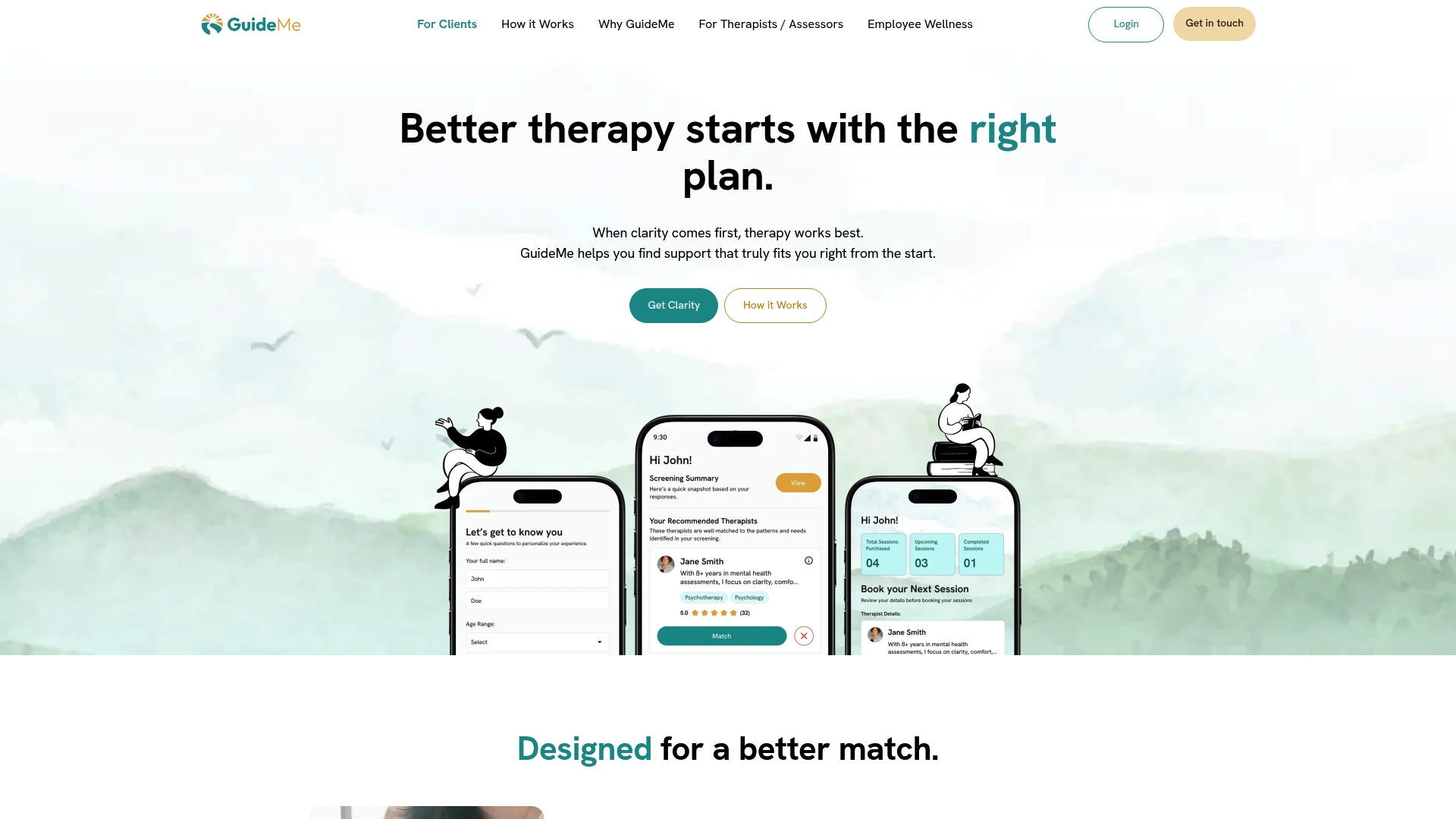
Guidemetherapy offers in-depth mental health screening, a personalised therapy plan, and AI-assisted and human-led therapist matching, all designed to give you a clearer picture of where you are and what kind of support fits your situation. Between sessions, the platform provides structured plans and resources that complement the work you do with your therapist, rather than replacing it. If you are currently without a therapist or looking for one who matches your specific needs, Guidemetherapy's therapy discovery process can help you find the right fit from the start. Before using any third-party platform alongside your current therapy, discuss it with your therapist so they can advise on how it fits your treatment plan. Start your therapy plan with Guidemetherapy today.
Sources
- How to get clients to do their homework — Psychotherapy Networker