

TL;DR:
- Diagnosis in therapy is a clinical tool that helps match individuals with appropriate treatments based on symptom patterns. It relies on interviews, questionnaires, and observations rather than medical tests, and can be revised or absent altogether depending on the case. Understanding and collaborative engagement with diagnosis improve therapy outcomes, reduce stigma, and support personalized care.
Many people approaching therapy for the first time worry that a diagnosis means being labelled, medicated, or boxed into a category. That fear is understandable, but it is largely misplaced. Understanding what is diagnosis in therapy means recognising it as a clinical tool designed to help, not define you. A diagnosis shapes how your therapist understands your experiences, selects the right approach, and supports your progress. This guide explains exactly what that process involves, who carries it out, and why it genuinely matters for the quality of care you receive.
Table of Contents
- Key takeaways
- What diagnosis in therapy actually means
- Who gives a diagnosis and why it matters
- Common myths about therapy diagnosis
- How diagnosis supports your therapy journey
- My view on diagnosis in therapy
- Start your therapy journey with confidence
- FAQ
Key takeaways
| Point | Details |
|---|---|
| Diagnosis is a clinical guide | It helps therapists match you with the right treatment based on your specific symptom patterns. |
| No single test determines it | Diagnosis in mental health relies on clinical interviews, questionnaires, and observation, not blood tests. |
| Not everyone needs a formal diagnosis | Therapy can begin and continue without a definitive diagnosis in many cases. |
| Diagnosis can change over time | As therapy progresses, assessments are revisited and updated to reflect your evolving needs. |
| Collaboration makes it better | Clients who understand and engage with their diagnosis tend to see stronger therapy outcomes. |
What diagnosis in therapy actually means
When mental health professionals talk about diagnosis in therapy, they are referring to the process of identifying whether your symptoms match recognised patterns of mental disorders. The two main classification systems used worldwide are the DSM-5-TR (Diagnostic and Statistical Manual of Mental Disorders) and the ICD-11 (International Classification of Diseases). Diagnosis clarifies symptom patterns matching specific mental disorders and guides subsequent treatment decisions.
One thing worth understanding clearly: no single medical test diagnoses a mental disorder. There is no blood test or brain scan that produces a definitive result. Instead, clinicians use psychological evaluations and rule out other possible causes, including physical health conditions or the effects of substances.
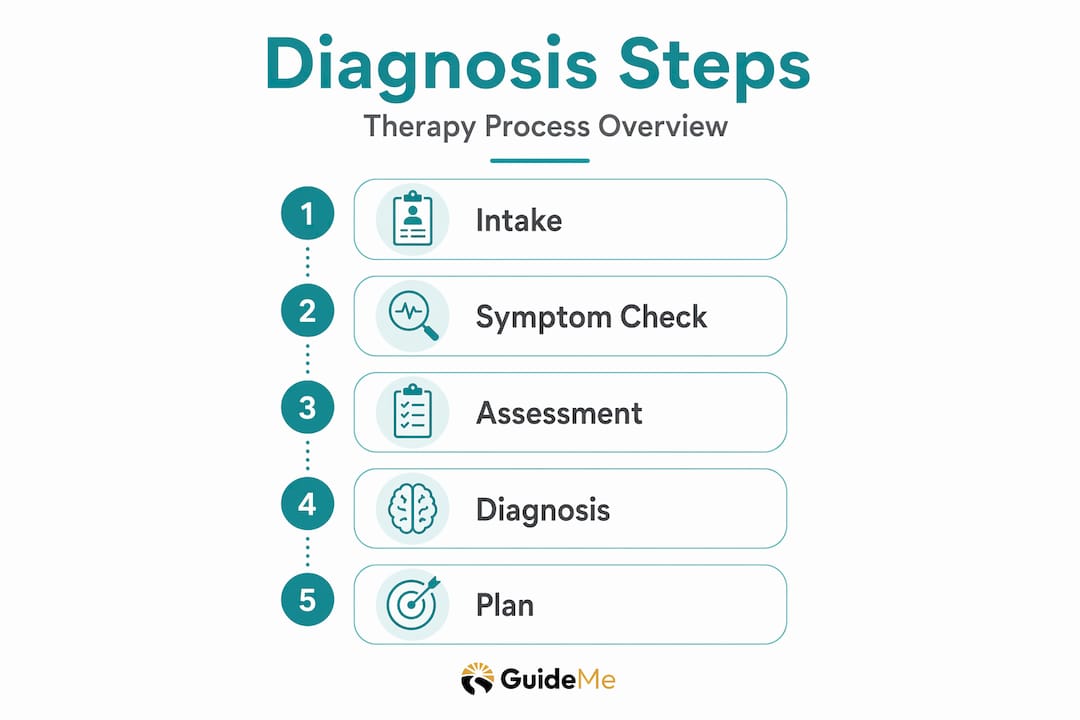
The therapy assessment process typically involves several methods working together:
- Clinical interviews: Your therapist or clinician asks detailed questions about your symptoms, history, and daily functioning.
- Standardised questionnaires: Validated tools such as the PHQ-9 for depression or the GAD-7 for anxiety help quantify what you are experiencing.
- Behavioural observation: How you present during sessions, including your mood, speech, and thought patterns, contributes to the overall picture.
- Collateral information: In some cases, information from family members or previous treatment providers adds context.
The WHO defines mental disorder as a clinically significant disturbance in cognition, emotional regulation, or behaviour that causes distress or functional impairment. This means not every difficult symptom will meet the threshold for a formal diagnosis. The clinician weighs up how much your experiences are affecting your daily life before assigning a diagnosis.
A diagnosis is also distinct from your treatment plan. Diagnosis supports treatment and prognosis decisions based on symptom severity and distress, but having a diagnosis does not automatically mean you need treatment, and some forms of therapy proceed without a formal diagnosis at all.
Who gives a diagnosis and why it matters
Not every mental health professional has the same authority when it comes to diagnosis. Understanding the difference helps you know what to expect from the person you are working with.
| Professional | Diagnostic authority | Can prescribe medication |
|---|---|---|
| Psychiatrist | Full diagnostic authority | Yes |
| Clinical psychologist | Full diagnostic authority | No (in most countries) |
| Licensed therapist or counsellor | Varies by licence and region | No |
| GP or medical doctor | Can provide initial diagnosis | Yes |
Diagnosis and medication authority depends heavily on professional roles and geographic regulations. In the UK, for example, a licensed counsellor may identify symptoms and work therapeutically with them but would typically refer a client to a psychiatrist or clinical psychologist for a formal diagnosis when one is needed.
For complex presentations or cases where medication might be appropriate, therapists refer clients to psychiatrists or psychologists as part of responsible practice. This kind of teamwork between professionals supports the most thorough care.

Why does the importance of therapy diagnosis go beyond the professional side? A diagnosis serves as a shared language. It allows care providers to communicate clearly about your needs, supports access to insurance-funded treatment, and ensures that your therapy plan draws on the most relevant research and evidence.
That said, diagnosis has its limits. It is not always definitive, especially early in therapy. Context matters enormously. Two people with the same diagnosis can have very different experiences, and a good therapist will never reduce you to a label.
Pro Tip: When meeting a new therapist, it is completely reasonable to ask what their diagnostic process involves and how they will use any diagnosis to guide your sessions. Understanding this from the outset builds trust and helps you feel more in control.
Common myths about therapy diagnosis
Concerns about diagnosis often stop people from seeking help or engaging fully once they are in therapy. Most of those concerns are based on misunderstandings. Here are the most common ones, and what is actually true.
-
"A diagnosis means I will be put on medication." This is one of the most widespread fears. In reality, therapy and diagnosis are entirely separate from prescribing. Diagnosis is a clinical tool, not a judgement, and it does not automatically lead to medication. Many people receive a diagnosis and manage their mental health entirely through talking therapy.
-
"Being diagnosed will follow me around forever." A diagnosis is not a permanent mark on your identity. It can be revised, removed, or updated as your understanding of your own experiences deepens. Assessment is ongoing throughout the therapy process, meaning your therapist is always working with the most current picture of how you are doing.
-
"I will be limited or judged by my diagnosis." Many people worry that a diagnosis will restrict what kind of support they can access. In practice, a diagnosis often opens doors rather than closing them. It enables more targeted therapy, clearer communication between providers, and in many cases, access to funded treatment.
-
"You cannot receive therapy without a diagnosis." This is simply not true. Diagnosis and treatment decisions are separable. You can begin working with a therapist based on your presenting concerns, and a formal diagnosis may come later, or never, depending on what is clinically appropriate.
-
"The stigma around my diagnosis will define how others see me." Mental health stigma is real and worth acknowledging. But diagnosis in a clinical setting is confidential. It is shared only within your care team and for specific purposes like insurance claims, with your consent.
It is also worth knowing that not all symptoms meet criteria for a disorder if distress or impairment is low. Feeling anxious before a big life event is not the same as having an anxiety disorder. A thorough clinician will always consider context before applying any diagnostic label.
Breaking through these barriers to mental health support starts with having accurate information, and that is exactly what a good intake and assessment process provides.
How diagnosis supports your therapy journey
Understanding the role of diagnosis in therapy shows you why it matters in practical terms, not just administrative ones.
-
Selecting the right treatment approach. Diagnostic categories drive treatment planning and risk screening. For example, someone diagnosed with post-traumatic stress disorder will typically benefit from trauma-focused cognitive behavioural therapy or EMDR, approaches that have strong evidence behind them for that specific condition. Without a diagnosis, treatment selection becomes more generalised.
-
Anticipating outcomes and risks. Diagnosis helps your therapist understand what challenges might come up during treatment. Some conditions carry specific risks that require monitoring, such as periods of heightened distress during trauma processing. Knowing this in advance means your therapist can prepare and support you more effectively.
-
Giving you clarity about your own experiences. Many people describe receiving a diagnosis as a relief. When you have spent years feeling confused about why you think or feel in certain ways, having a name for it can be genuinely empowering. It says: this is real, it has a pattern, and there are people who understand it.
-
Tracking progress over time. Therapy becomes more meaningful when you have a shared framework for measuring how things are changing. Diagnosis, when revisited regularly, shows you and your therapist where growth has happened and where more work is needed. Knowing how to measure real progress is one of the most valuable things you can take into therapy.
-
Supporting collaborative care. When your GP, therapist, and any other support providers are working from the same diagnostic understanding, your care becomes more joined up. Nothing falls through the gaps.
Pro Tip: Ask your therapist to explain your diagnosis in plain language and what it means specifically for your treatment goals. The clearer you are on the reasoning behind your care plan, the more actively you can participate in it.
My view on diagnosis in therapy
I have spent considerable time working with people navigating the therapy process, and I will be honest: diagnosis makes a genuine difference when it is handled well. The problem is not diagnosis itself. The problem is when it is delivered without context, without sensitivity, and without involving the person sitting across from the therapist.
In my experience, the clients who benefit most from therapy are the ones who understand their diagnosis, not just its name, but what it means for their day-to-day life and their treatment. When therapists take the time to walk someone through what a diagnosis means and what it does not mean, that conversation alone can shift how a client feels about themselves.
I have seen people come into therapy terrified of being labelled. They leave those early sessions with a clearer sense of their own mind and a stronger sense of agency. That is what good diagnosis practice looks like. It is not a judgement. It is a starting point.
My advice to anyone beginning therapy is this: ask questions about your diagnosis. Push back if something does not feel right. Good therapist fit means working with someone who welcomes that kind of dialogue. Collaborative understanding of diagnosis aids engagement and leads to better outcomes. That is not a theory. It is something I see borne out consistently.
— Yetty
Start your therapy journey with confidence
Understanding diagnosis is one part of preparing yourself for therapy well. The next step is finding the right therapist and the right process from the start.

At Guidemetherapy, the intake and assessment process is designed to be thorough, collaborative, and human. Before you are matched with a therapist, you complete an in-depth therapy plan that takes your needs, concerns, and goals seriously. This means that by the time you begin sessions, you and your therapist share a clear foundation. You are not starting from zero.
If you are ready to take that first step, visit Guidemetherapy to get matched with a therapist who understands your needs. You can also read more about what happens in an intake session to know what to expect before you begin.
FAQ
What is diagnosis in therapy?
Diagnosis in therapy is the process of identifying whether a person's symptoms match recognised criteria for a mental disorder, using tools like the DSM-5-TR or ICD-11. It guides treatment planning and helps therapists select the most evidence-based approach for each individual.
Do you always need a diagnosis to start therapy?
No. Many people begin therapy without a formal diagnosis, working from their presenting concerns and goals. A diagnosis may be established later in the process or not at all, depending on what is clinically appropriate.
Who can give a mental health diagnosis?
Psychiatrists and clinical psychologists hold full diagnostic authority in most countries. Licensed therapists and counsellors can assess and work with symptoms, but may refer clients to other professionals for a formal diagnosis when needed.
Will a diagnosis mean I have to take medication?
No. Diagnosis and medication are entirely separate. A diagnosis identifies a pattern of symptoms and guides therapy. Whether medication is appropriate is a separate clinical decision, made by a prescribing professional such as a psychiatrist or GP.
Can a therapy diagnosis change over time?
Yes. Diagnosis is not fixed. Clinicians revisit and update assessments as therapy progresses, and a diagnosis may be refined, revised, or removed as your experiences and circumstances become clearer.