

TL;DR:
- Integrative therapy is a structured, deliberate approach that combines multiple therapeutic models tailored to individual needs. It differs from eclectic therapy by applying coherent theories like psychodynamic or cognitive-behavioral frameworks within a unified treatment plan. This flexibility allows therapists to adapt techniques over time, addressing complex concerns and promoting personalized mental health support.
If you have heard the term integrative therapy and felt unsure what it actually means, you are not alone. Many people assume it simply means mixing whatever techniques a therapist fancies, but that misses the point entirely. Integrative therapy is a deliberate, organised approach that draws on multiple therapeutic models within a structured framework, tailored to your specific needs. Whether you are managing anxiety, navigating a relationship difficulty, or simply trying to understand yourself better, knowing what integrative therapy involves helps you make far clearer choices about your care.
Table of Contents
- Understanding integrative therapy and how it works
- The five pathways of integrating psychotherapy
- Benefits and common misconceptions of integrative therapy
- How integrative therapy supports personalised mental health treatment
- Key considerations for choosing an integrative therapist
- Why understanding the depth of integrative therapy helps your healing journey
- Discover integrative therapy tailored to you with Guide Me
- Frequently asked questions
Key Takeaways
| Point | Details |
|---|---|
| Deliberate combination | Integrative therapy uses a structured approach combining multiple therapy modalities rather than random mixing. |
| Five integration pathways | Therapists apply one of five recognised frameworks to guide how therapies are blended coherently. |
| Customised care | This therapy adapts to individual needs, offering flexibility and responsiveness during treatment. |
| Choose wisely | Understanding a therapist’s integrative style helps you select effective and coherent treatment. |
| Broad applicability | Integrative therapy supports individuals and couples with a range of mental health and emotional issues. |
Understanding integrative therapy and how it works
Integrative therapy is not a single method. It is a way of practising therapy that deliberately combines elements from different therapeutic traditions to create a treatment plan suited to you as an individual. The key word here is deliberate. This is not a therapist randomly pulling techniques from a catalogue. It is a structured, theory-informed process.
The most important distinction to understand is the difference between integrative therapy and what clinicians call eclectic therapy. Eclectic therapy selects techniques based on what seems useful in the moment, without a strong unifying theory. Integrative therapy, by contrast, combines psychodynamic, humanistic, and cognitive-behavioural approaches within a coherent philosophical structure. The therapist has a clear rationale for why specific methods are being brought together for you.
Common therapeutic modalities you might find integrated include:
- Cognitive-behavioural therapy (CBT): Focuses on identifying and changing unhelpful thought patterns and behaviours
- Psychodynamic therapy: Explores how past experiences and unconscious processes shape current feelings and relationships
- Person-centred therapy: Prioritises your autonomy, self-awareness, and the therapeutic relationship itself
- Mindfulness-based approaches: Incorporate present-moment awareness to support emotional regulation
- Somatic techniques: Address the connection between physical sensations and emotional experience
Understanding these building blocks helps you have more informed conversations with your therapist. If you want to explore the benefits of guided therapy before your first session, or prepare questions to ask your therapist, doing so early can make a real difference.
The five pathways of integrating psychotherapy
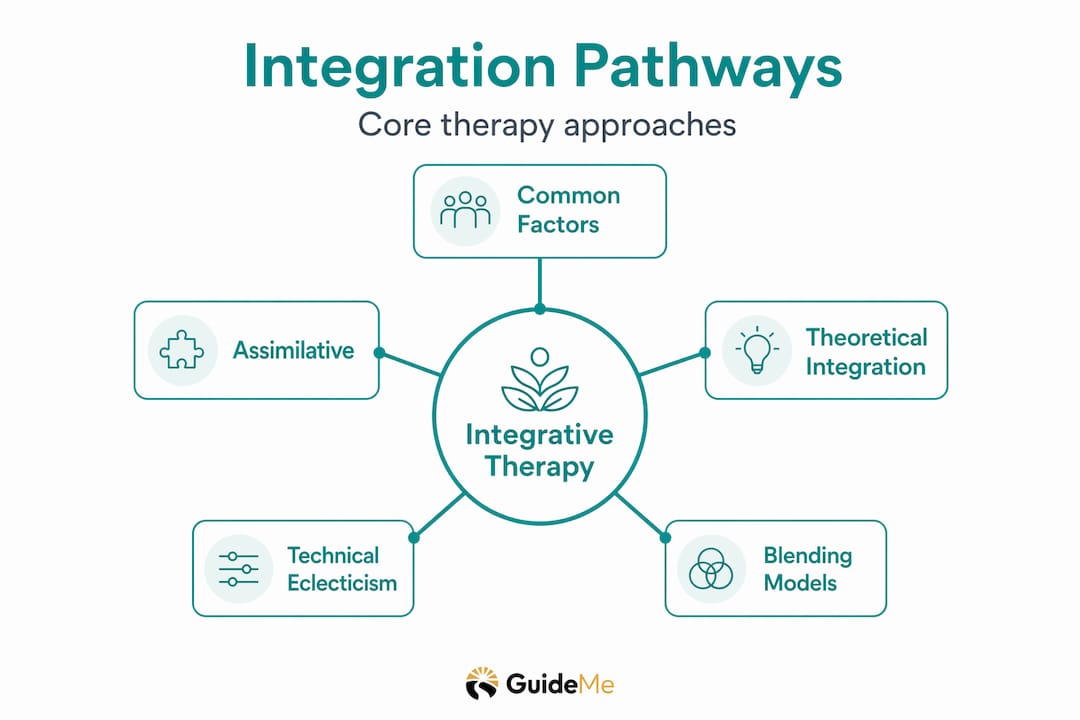
Once you understand the basic integrative therapy definition, it helps to know that clinicians do not all integrate therapy in the same way. Researchers have identified five distinct pathways through which psychotherapies can be combined. Each pathway reflects a different philosophy about how and why integration works.
- Common factors: This approach identifies shared elements across therapies, such as the quality of the therapeutic relationship, that contribute to positive outcomes regardless of technique
- Technical eclecticism: Techniques are selected from different models based on evidence for specific problems, without necessarily adopting their underlying theories
- Theoretical integration: Two or more therapy models are blended at both the conceptual and practical level to form a new, unified approach
- Assimilative integration: The therapist works primarily from one core model but selectively incorporates techniques from other approaches when appropriate
- Unification: Seeks to build an overarching theory that explains and connects all forms of psychotherapy at a deeper level
| Pathway | Theoretical depth | Focus | Best suited to |
|---|---|---|---|
| Common factors | Moderate | Shared therapeutic elements | Broad client presentations |
| Technical eclecticism | Low to moderate | Evidence-based technique selection | Specific symptom relief |
| Theoretical integration | High | Blending two or more full models | Complex emotional needs |
| Assimilative integration | High | One core model with added techniques | Clients needing stability and flexibility |
| Unification | Very high | Grand unified theory of therapy | Research and clinical development |
This variety explains why two therapists who both describe themselves as integrative may work quite differently in practice. Before committing to a therapist, reviewing a therapy referral checklist can help you ask the right questions about their specific integration style.
Benefits and common misconceptions of integrative therapy
The biggest misconception about integrative therapy is that it is just random cherry-picking of techniques. In reality, effective integration requires specific training, a coherent treatment plan, and ongoing clinical judgement. A well-trained integrative therapist is not improvising. They are applying structured knowledge.
Once that myth is cleared away, the genuine benefits of integrative therapy become clear:
- Flexibility: Your therapist can adapt the approach as your needs change over time, rather than being locked into one fixed method
- Personalisation: The treatment plan is built around you, not around a one-size-fits-all model
- Breadth of care: Integrative therapy addresses thoughts, emotions, behaviours, and often the body, rather than focusing narrowly on one dimension
- Responsiveness: If one approach is not working, the framework allows your therapist to shift emphasis without abandoning the therapeutic relationship
- Suitability for co-occurring difficulties: Many people carry more than one concern at once, such as anxiety alongside relationship difficulties, and integrative therapy can hold that complexity
"Integrative therapy is particularly well-suited to people who have not responded fully to a single-modality approach, or whose needs are layered and changing over time."
Pro Tip: When speaking with a potential therapist, ask them to describe their integrative framework in plain language. A skilled integrative therapist should be able to explain clearly how they combine approaches and why, without relying on jargon.
For a broader overview of the different counselling approaches available, it is worth reading around before you book your first session.
How integrative therapy supports personalised mental health treatment
One of the most practical aspects of integrative therapy is how it evolves alongside you. Treatment is not static. As you progress, your therapist adjusts the balance of techniques and theoretical focus based on what is happening in your life and how you are responding. Research confirms that integrative therapy adapts over time to changes during treatment, which is a significant advantage over fixed-protocol approaches.
In practice, this means integrative therapy can support a wide range of situations:
- Anxiety and depression: A therapist might combine CBT techniques for managing thought patterns with psychodynamic exploration of underlying causes
- Relationship difficulties: Couples may benefit from person-centred dialogue combined with attachment-focused approaches
- Trauma: Somatic techniques and mindfulness can be woven alongside trauma-informed psychodynamic work
- Low self-esteem or identity concerns: Humanistic and narrative approaches can be integrated to support deeper self-understanding
- Life transitions: Grief, career change, or parenthood may call for a flexible blend that changes as circumstances evolve
The therapist-client relationship is central to this process. You are not a passive recipient of treatment. Your feedback, your experience, and your goals all shape how the therapy develops. This collaborative quality is one reason many people find integrative therapy more engaging than approaches that follow a rigid manual.
Pro Tip: Keep a brief note between sessions of what felt helpful and what did not. Sharing this with your therapist actively informs the integrative process and helps them refine their approach for you.

When choosing the right therapist, looking specifically for someone trained in integrative frameworks rather than a single modality can open up a broader, more responsive range of support.
Key considerations for choosing an integrative therapist
Not all therapists who describe themselves as integrative have the same level of training or theoretical coherence in how they work. This matters because the effectiveness of integrative therapy depends heavily on the quality and structure of the integration being applied. Integration styles vary considerably, and understanding what your therapist actually practises helps you assess whether their approach fits your needs.
When you speak with a potential integrative therapist, consider asking:
- Which therapeutic models inform your practice? A confident integrative therapist should name two or more and explain briefly how they relate
- Do you follow a particular integration pathway? This question reveals whether their approach is theoretically grounded or more ad hoc
- How do you decide which approach to use with a particular client? The answer should reflect a clear process, not guesswork
- How do you adapt your approach as therapy progresses? This shows whether they treat integration as ongoing and responsive
- What training have you completed in integrative frameworks? Look for post-qualification training or specialist certification in integrative methods
These questions are not about catching a therapist out. They are about finding someone whose way of working genuinely matches what you need. The difference between a coherent integrative approach and loosely combined techniques can significantly affect your outcomes.
If you are not sure where to start, questions to ask therapists and a practical guide to finding the right therapist can give you a clear starting point before your first consultation.
Why understanding the depth of integrative therapy helps your healing journey
Most articles about integrative therapy stop at a surface definition. But here is something worth sitting with: knowing what type of integration your therapist uses may be just as important as knowing they are integrative at all. Integration is not monolithic, and the difference between a therapist using assimilative integration with a deep grounding in psychodynamic theory and one loosely blending techniques without a clear rationale is significant for your outcomes.
Clients who understand this tend to ask better questions, notice when something feels off, and engage more actively in shaping their treatment. That is not a small thing. Research consistently shows that the quality of the therapeutic relationship and the degree of client involvement both predict outcomes. When you understand what integrative therapy is and what it is not, you become a more effective participant in your own care.
The real risk of superficial eclecticism, where a therapist pulls techniques without a governing framework, is not that every session will feel wrong. It is that the treatment lacks direction over time. You may feel temporarily better after a session but find no sustained progress because the underlying approach is inconsistent. Knowing what to look for protects you from that outcome.
This is why guided therapy that includes a structured matching process is so valuable. Being paired with a therapist whose integration style suits your specific presentation from the outset saves you from the frustration of trial and error.
Discover integrative therapy tailored to you with Guide Me
Finding the right integrative therapist can feel overwhelming, especially when different therapists describe their approach in such varying ways. Guide Me takes the guesswork out of that process entirely.
Guide Me is a human-led, AI-powered therapy navigation platform that helps you understand your mental health needs through an in-depth therapy plan, then matches you with a therapist whose approach genuinely fits those needs. If integrative therapy is the right direction for you, including therapy for anxiety, relationship concerns, or emotional wellbeing, Guide Me's matching service connects you with practitioners trained in integrative frameworks, so you can begin with confidence rather than confusion. You deserve a therapy experience that is built around you from the start.
Frequently asked questions
What exactly does integrative therapy involve?
Integrative therapy combines psychodynamic, humanistic, and cognitive-behavioural techniques within a structured framework, tailored specifically to each individual's needs rather than following a single fixed model.
How is integrative therapy different from eclectic therapy?
Integrative therapy blends approaches within a coherent theoretical framework, whereas eclectic therapy selects techniques more opportunistically without a unifying theory to hold them together.
What should I ask a therapist to ensure they use integrative therapy properly?
Ask which models inform their practice, how they decide which approach to use, and how they adapt over time. Clients should inquire about their therapist's integration style and framework to assess coherence and effectiveness.
Can integrative therapy help with couple's therapy and emotional well-being?
Yes. Integrative therapy is adaptable for individual, couples, and group settings, making it well-suited to relationship concerns, emotional difficulties, and the overlapping needs that couples often bring to therapy.