

AI in mental health care works best as a gap filler, not a replacement for your therapist. It helps with screening, symptom monitoring, and support between sessions, and a recent meta-analysis found generative AI chatbots produce a small but real reduction in symptoms across multiple trials. The main risks are hallucinated advice, privacy exposure, and emotional dependency on a tool that cannot actually understand you. Used carefully, alongside human care, the evidence supports cautious, specific use rather than blanket enthusiasm or blanket dismissal.
TL;DR:
- Generative AI chatbots show a small but statistically significant symptom reduction, with an effect size of 0.30, though results vary across studies.
- AI tools that support continuous care and engagement alongside human therapy tend to have more consistent benefits than standalone chatbots.
- Major risks include hallucinated, inaccurate responses, emotional dependency, privacy violations, and bias, especially in crisis or severe cases.
- Effectiveness data is limited mainly to young, English-speaking populations and excludes high-risk groups, requiring cautious application.
- Future AI developments will focus on interpretability, multimodal data, and integration with clinical oversight to ensure safety and fairness.
Table of Contents
- How is AI used across the mental health care pathway?
- Do the trials and reviews actually show AI helps?
- What are the biggest risks of using AI for mental health support?
- How can you use AI tools for mental health safely?
- How is AI in mental health regulated in the UK?
- Where does human-led support fit alongside AI tools?
- Does AI in mental health widen or close the access gap?
- What's next for AI in mental health care?
- Why does data quality matter so much for these tools?
- A cautiously optimistic verdict on AI in mental health care
- Sources
How is AI used across the mental health care pathway?
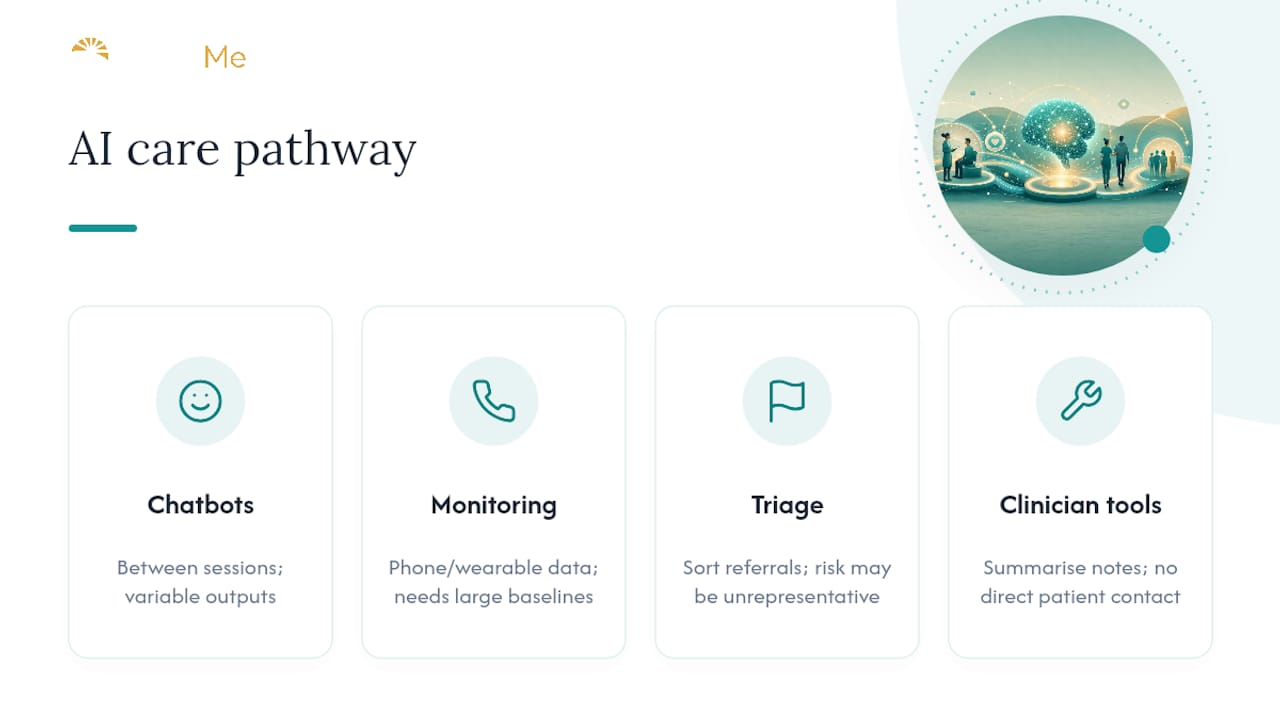
AI tools in mental health care fall into four broad categories, and confusing them is where a lot of the public debate goes wrong. A chatbot that offers coping strategies at 2am is doing something fundamentally different from an algorithm flagging suicide risk in a GP's notes. Knowing which category you're dealing with tells you what to expect from it, and what to watch for.
Conversational agents and chatbots. These are the AI mental health tools most people picture first: apps built around large language models that respond to what you type, offer coping techniques, or simulate a supportive conversation. Some are purpose-built for mental wellness; others are general-purpose AI systems people have started using informally for emotional and psychological support. They're typically used between therapy sessions, during waitlist periods, or by people who haven't yet decided to seek formal care. Their biggest limitation is consistency: outputs can vary from genuinely useful to actively unhelpful within the same conversation, because the model has no real memory of your clinical history unless the product is specifically engineered to retain and use it.
Digital phenotyping and monitoring tools. These use data from your phone, wearable, or app usage, such as typing speed, sleep patterns, or movement, to infer changes in mood or risk. They're used mostly in research settings and by some specialist services trying to catch deterioration early, particularly in conditions like bipolar disorder where behavioural shifts can precede a crisis. The catch is data quality: a bad week of sleep can look identical to a data glitch, and these tools need a huge amount of individual baseline data before their inferences mean much.
Screening and triage algorithms. These sit at the front door of care: services use them to sort referrals, flag high-risk cases for faster review, or estimate the severity of a presenting problem before a clinician ever speaks to the person. They're common in primary care and NHS-adjacent digital services, where waitlists make efficient triage genuinely valuable. Our guide to the role of screening in therapy covers how this process should work when it's done well. The limitation here is representativeness: an algorithm trained mostly on one demographic can systematically under or overestimate risk in others.
Clinician decision-support and workflow tools. These don't interact with patients directly at all. They summarise session notes, suggest treatment options based on presenting symptoms, or flag inconsistencies in a caseload for a supervisor to review. Clinicians tend to be more sceptical of these tools than patients are of chatbots, according to research on stakeholder attitudes to AI mental health tools, largely because clinicians carry the professional and legal accountability if a tool's suggestion turns out to be wrong.
Each category depends on one thing across the board: human oversight. Strip that out, and even the most well-designed system starts making decisions nobody signed off on.
Do the trials and reviews actually show AI helps?
The strongest current evidence for AI in therapy comes from a 2025 systematic review and meta-analysis of 14 randomised controlled trials involving generative AI chatbots.
The number that matters: across those 14 RCTs, generative AI chatbots produced a small but statistically significant reduction in negative mental health symptoms, with an effect size of 0.30 (95% CI 0.004–0.59). That's a real signal, but the confidence interval nearly touches zero at its lower bound, and the prediction interval stretches from -0.85 to 1.67, meaning a future trial could plausibly show no benefit at all, or a much bigger one.
Translating that into plain terms: an effect size of 0.30 is generally considered small by clinical research standards, roughly comparable to modest but genuine improvements seen in some low-intensity self-help interventions. It's not nothing. It's also nowhere near the effect sizes typically reported for structured, clinician-delivered CBT. The review's authors were explicit about the caveats: only 14 trials, a combined sample of 6,314 participants, and considerable heterogeneity in how "chatbot" and "symptom improvement" were even defined study to study.
A separate and differently designed study adds a useful second data point. A large employer-sponsored quasi-experimental study looked at what happens when AI-enabled continuous care features, tools that support communication and tracking between sessions, are layered onto existing clinician-delivered therapy. The findings, published in npj Digital Medicine, showed:
- A 5% increase in session attendance (rate ratio 1.05) among people with access to the continuous care features.
- Faster time to a second therapy session compared with those without access.
- Small additional symptom reductions, with effect sizes between 0.15 and 0.16, on top of the benefit from therapy itself.
This is a genuinely different kind of finding to the chatbot trials, because it isn't measuring AI replacing anything. It's measuring what happens when AI support is bolted onto human-delivered care that's already working, which lines up with the broader recommendation from npj Digital Medicine that conversational AI should be designed to fill the "white space" in care, screening, waitlist periods, between-session continuity, rather than trying to substitute for the therapist entirely.
Where does the evidence show the clearest signal, and where is it thinnest? A few patterns stand out:
- Social-oriented chatbots outperform task-oriented apps on short-term symptom change, according to the same 2025 meta-analysis, suggesting the conversational, validating quality of an interaction matters more than a checklist-style intervention.
- Continuous care and engagement features show a more consistent, if modest, benefit than standalone chatbot use, likely because they're anchored to a real clinician relationship rather than replacing one.
- Crisis and severe-symptom populations are almost entirely absent from the trial evidence base. Nearly every RCT in the current literature recruits people with mild to moderate symptoms, so claims about AI's usefulness for anyone in acute distress rest on extrapolation, not data.
- Cultural and age-group adaptation remains a significant research gap; most trials have been run on relatively narrow, often younger, English-speaking populations, which limits how confidently the findings generalise.
None of this supports the idea that AI in therapy is either a breakthrough or a gimmick. It supports a narrower, more useful conclusion: certain applications, in certain contexts, produce a modest, measurable benefit, and the honest caveat attached to every figure above is that the evidence base is still small.
What are the biggest risks of using AI for mental health support?
The risks of AI in mental health care aren't hypothetical. They're specific, documented, and in some cases already causing harm.
Hallucinations are the most dangerous failure mode. Large language models can generate confident, plausible-sounding responses that are simply wrong, and in a mental health context that might mean minimising a genuine risk, suggesting an inappropriate coping strategy, or failing to recognise crisis language for what it is. Systematic reviews of large language models in mental health settings consistently flag hallucination risk as one of the primary barriers to safe clinical use, alongside the related problem of interpretability: even the developers of some models can't fully explain why a given output was generated. Relying on an AI tool for crisis support carries particular danger for exactly this reason, since a hallucinated response during a genuine emergency can delay someone from reaching a real person who could help.
Dependency and anthropomorphism creep in quietly. A chatbot that's always available, never judges, and responds instantly to whatever you type can start to feel like a relationship. That's by design in some products, and it isn't automatically harmful. But when someone starts substituting AI conversation for human contact, or avoiding the discomfort of real therapeutic work because the chatbot is easier, the tool has stopped supporting coping and started replacing it. Over time, that can erode the exact skills therapy is meant to build.
Privacy and data risks are often underestimated. Mental health disclosures are among the most sensitive data a person can generate, and it isn't always clear where that data goes, how long it's retained, or whether it could be re-identified and used for purposes you never agreed to, such as targeted advertising or third-party data sales. Read the privacy policy of any AI mental health tool before disclosing anything you wouldn't want stored indefinitely.
Bias can quietly disadvantage the people who need the most care. Algorithms trained predominantly on data from one demographic tend to perform worse for everyone outside it. That's a known issue across healthcare AI generally, and mental health tools are not exempt: a triage algorithm calibrated on one population can under-flag risk in another, with consequences that fall hardest on already underserved groups.
How do you know when an AI interaction has crossed from helpful to harmful? Watch for a few signs:
- The tool is giving advice that contradicts what a clinician has told you, or that feels off but is stated with total confidence.
- You're turning to the chatbot instead of contacting your therapist, a crisis line, or a trusted person during moments of real distress.
- You feel worse, more anxious, or more isolated after using the tool regularly, rather than better.
- The app has asked for or stored information you're not comfortable with, without clear explanation.
Pro Tip: If you're ever in crisis, don't route through an AI tool at all. Go straight to a crisis line or emergency services. No chatbot, however well designed, should be your first call when safety is at stake.
How can you use AI tools for mental health safely?
Whether you're an individual considering a mental health app or a clinician evaluating one for a service, the same core question applies before anything else: does this tool have any real evidence behind it, or just marketing copy?
Start with a short assessment checklist. A trustworthy AI mental health tool should be able to answer yes, with evidence, to each of these:
- Is there published evidence, ideally a peer-reviewed trial, of benefit for the specific use case being offered?
- Does the provider explain clearly, in plain language, what the tool does and doesn't do?
- Does the tool have a defined, visible pathway for detecting crisis language and directing users to human help?
- Is the data policy explicit about storage, retention, and third-party sharing?
- Is there a named point of human oversight, whether that's a clinician reviewing outputs or a support team monitoring flagged conversations?
If you're an individual trying a tool, follow these steps:
- Read the privacy policy before your first real conversation with the app, not after.
- Trial it for a specific, narrow purpose, journaling prompts, mood tracking, coping technique reminders, rather than as a general confidant.
- Set a boundary in advance: if the tool ever gives advice about self-harm, medication, or crisis situations, you stop and contact a real person.
- Cross-check anything that sounds like clinical advice with your therapist or GP before acting on it.
- Reassess after two to four weeks: are you feeling supported, or increasingly dependent on it instead of building your own coping skills?
If you're a clinician or service evaluating a tool, the steps look different:
- Pilot with a small, defined group before wider rollout, and set specific engagement and safety metrics in advance.
- Document informed consent clearly: patients should know when they're interacting with AI versus a human, and what happens to their data.
- Build a monitoring routine that reviews flagged or unusual outputs regularly, not just at launch.
- Keep a clear record of any AI-derived suggestion that informed a clinical decision, since accountability still sits with the clinician, not the software.
Pro Tip: If a mental health app can't clearly explain, in one or two sentences, what happens when someone types something suggesting they're in danger, that's a red flag serious enough to stop using it immediately.
How is AI in mental health regulated in the UK?
Regulation is catching up, but it isn't absent, and knowing where to look matters more than most people realise. The World Health Organization has called for safe, ethical governance of AI in health, setting high-level principles that inform how national regulators approach the issue. In the UK specifically, the MHRA has issued guidance for people using mental health apps and technologies, aimed at helping the public understand what regulatory oversight does and doesn't cover for a given product. NHS Digital maintains resources tracking AI use across health services, and gov.uk has convened commissions gathering evidence on how AI in healthcare should be regulated going forward.
For services and organisations adopting these tools, governance isn't a one-off checkbox. It's an ongoing process:
- Procurement checks: verify any vendor claim of clinical evidence against the actual published trial, not just the marketing summary.
- Validation before rollout: test the tool on a representative sample of the population it will actually serve, not just the demographic it was built for.
- Adverse event reporting: where a tool causes or contributes to harm, report it through the appropriate channel, similar in spirit to the Yellow Card Scheme used for medicines and medical devices.
- Clinician accountability: document every instance where an AI-derived suggestion informed care, since the clinician, not the algorithm, remains responsible for the decision.
| Governance area | UK-relevant resource | Purpose |
|---|---|---|
| App and technology guidance | MHRA guidance for mental health apps | Helps the public assess AI mental health products |
| AI knowledge and tracking | NHS Digital AI resources | Tracks AI deployment across health services |
| Policy evidence gathering | gov.uk commissions on AI in healthcare | Shapes future regulatory frameworks |
| International principles | WHO guidance on safe, ethical AI for health | Sets high-level governance expectations |
Our clinical personalisation guide for mental health professionals goes further into how clinicians can document AI-assisted decisions without losing sight of their own clinical judgement.
Where does human-led support fit alongside AI tools?
Some therapy navigation platforms use a combination of human-led oversight and AI to help users understand their mental health through detailed planning and matching with therapists suited to their situation, aiming to go beyond generic algorithmic matching.
Some platforms differ from standalone chatbots by including human oversight throughout their processes, including personalized planning and therapist matching that considers context, ongoing support between sessions, and aim for continuity rather than disconnected tools.
It's worth being direct about the boundary here: These platforms complement clinical care and aim to help users find appropriate support more efficiently. They are not crisis services and do not replace the judgement of licensed clinicians. If you are in crisis, contact emergency services or a crisis line first. For everything else, a service like online therapist directories or Guidemetherapy's matching process exists to make the harder part, finding someone right for you, less of a guessing game.
Does AI in mental health widen or close the access gap?
AI's effect on mental health disparities cuts both ways, and it's genuinely too early to say which effect dominates.
On the access side, the case for optimism is real. Screening and triage algorithms can process referrals faster than overstretched services, which matters most in areas with the longest waits and fewest clinicians. A chatbot available at 2am costs nothing extra to run for the thousandth user, which theoretically puts some form of support within reach of people who can't afford private therapy or don't live near a service at all.
But the same technology can just as easily widen the gap it's meant to close. Algorithms trained on data from one demographic tend to underperform for people outside it, which means the communities already underserved by traditional mental health care, including racial and ethnic minorities, older adults, and non-English speakers, risk getting the least accurate version of a tool marketed as universally helpful. Most trial evidence to date comes from relatively narrow, English-speaking populations, so claims of broad accessibility benefit are still ahead of the actual data.
There's also a quieter access issue: AI mental health tools assume a smartphone, reliable internet, and enough digital literacy to use an app confidently. For some of the people most in need of support, that assumption doesn't hold. Closing the access gap with AI will require deliberate design for underserved groups, not just assuming benefit will trickle down.
What's next for AI in mental health care?
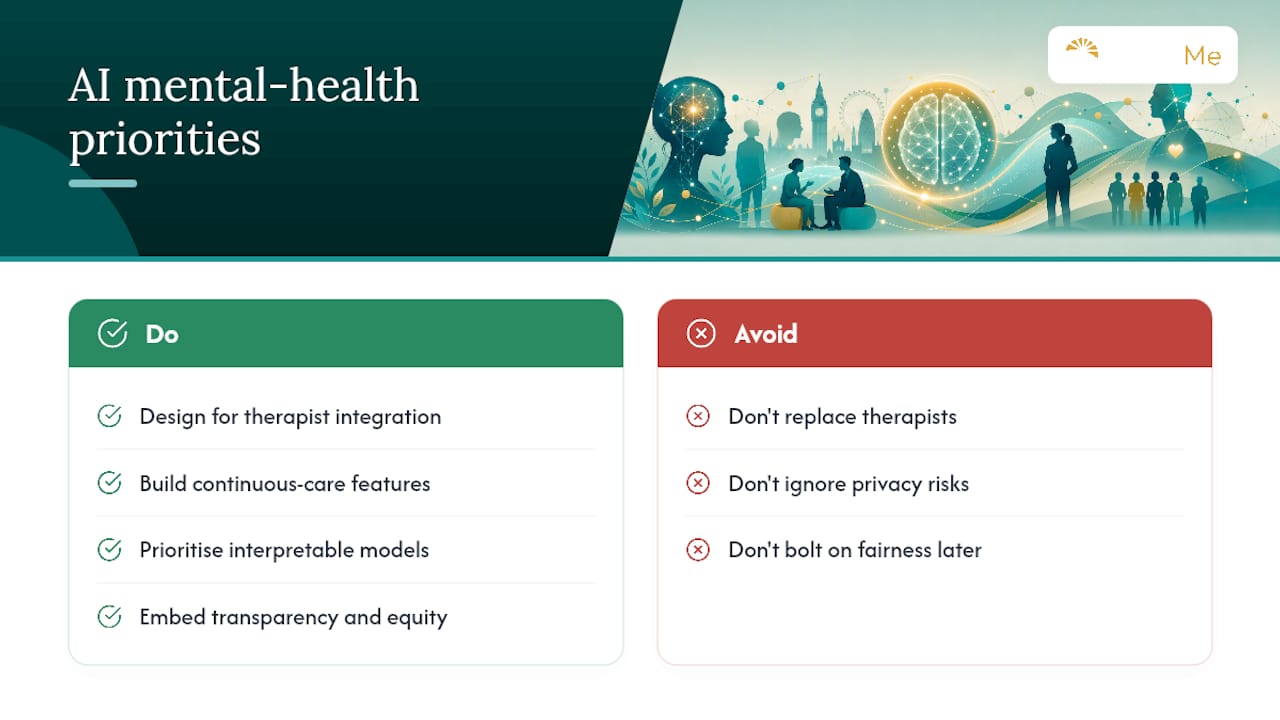
The next wave of AI mental health tools is moving away from generic chatbots and toward systems built specifically for clinical integration, designed from the outset to sit alongside a therapist rather than compete with one.
Expect more tools built around the "continuous care" model already showing modest benefit: AI features that support communication, tracking, and engagement between sessions, layered onto human-delivered therapy rather than replacing it. That's the direction the npj Digital Medicine research on filling the "white space" in care points towards, and it's a more defensible model than trying to automate therapy itself.
Interpretability is likely to become a bigger focus than raw capability. Right now, one of the main reasons clinicians remain sceptical of AI mental health tools is that they can't see why a system reached a particular conclusion. Research priorities are shifting towards models that can explain their reasoning in terms a clinician can actually evaluate, rather than just producing an output and expecting trust.
Multimodal AI, combining text, voice tone, and behavioural data, is another area attracting research attention, particularly for earlier detection of deterioration. It also raises the stakes on privacy and bias, since more data streams mean more ways for a system to get it wrong for someone outside its training population. The tools that succeed long-term will likely be the ones that treat transparency and equity as core features, not afterthoughts bolted on after a regulator asks questions.
Why does data quality matter so much for these tools?
Every AI mental health tool is only as good as the data it learned from, and that data has some serious blind spots.
Most training data comes from a narrow slice of the population: predominantly younger, English-speaking, and drawn from whoever happened to use an app or take part in a study. That's a problem when the tool is then marketed as suitable for everyone, because a model has no way of generalising accurately to people it has never effectively seen.
Mental health data is also unusually messy to begin with. Self-reported symptoms vary depending on mood, memory, and willingness to disclose. Digital phenotyping data, sleep patterns, phone usage, movement, can look identical whether someone is genuinely deteriorating or just had a stressful week at work. Distinguishing signal from noise requires a huge amount of individual baseline data, which most consumer apps simply don't have time to gather before making claims.
There's a structural issue too: much of the available research data comes from clinical trial populations that don't reflect real-world diversity in age, ethnicity, language, or severity of symptoms. A model validated on that data can look impressively accurate in a paper while performing far less reliably for the person actually using the app. Until AI mental health tools are trained and tested on genuinely representative populations, claims about their accuracy deserve a degree of scepticism, however good the underlying technology is.
A cautiously optimistic verdict on AI in mental health care
The honest position on AI in mental health care sits somewhere between the hype and the panic, and that middle ground is more interesting than either extreme. The evidence genuinely shows benefit, an effect size of 0.30 across 14 RCTs isn't nothing, and continuous care features measurably improve attendance. But the same evidence base is small, heterogeneous, and almost entirely silent on crisis populations, older adults, and non-English speakers.
What would move this field forward faster than any new chatbot feature is transparency: models that can explain their outputs, trials that actually recruit underserved groups, and regulation that keeps pace with deployment rather than trailing years behind it. Right now, too much of the evidence describes people who look alike, young, moderate symptoms, comfortable with technology, and too little describes everyone else.
None of that is a reason to dismiss these tools. It's a reason to use them specifically, not generally. If you're considering an AI mental health tool, ask what evidence actually supports your use case, and talk to a clinician before letting an algorithm's suggestion replace professional judgement. Guidemetherapy's approach, keeping AI in service of human-led matching rather than the other way round, reflects where the strongest current evidence actually points.
— Yetty
This article is general information, not a substitute for advice from a qualified doctor. Consult a qualified healthcare professional about your own circumstances before acting on anything here.
Sources
- Large language models and multimodal AI for mental health: systematic review (2026)
- AI-enabled continuous care features enhance engagement and clinical outcomes in psychotherapy (npj Digital Medicine, 2026)
- WHO calls for safe and ethical AI for health