

For most people in the UK, the fastest route to professional counselling is either self-referral to NHS talking therapies (IAPT) or booking directly through a therapy navigation service like Guidemetherapy. The term "guidance counselor" is commonly used in the US to describe school advisors, but in the UK context it refers to the professional counsellors and psychotherapists who support mental health for individuals and organisations. Here is where to start:
- NHS / IAPT: Self-refer online or via your GP for free talking therapies. Waiting times vary by region, and the NHS commonly allocates multiple sessions based on local provision and clinical assessment [NHS counselling]
- Charity / low-cost: Mind and local Mind centres offer free or subsidised support where NHS waiting lists are long.
- Private / Guidemetherapy: For faster access and greater choice of modality, use a private therapist or Guidemetherapy's AI-assisted matching to find a BACP- or UKCP-registered counsellor suited to your needs.
Your immediate next step: visit your GP or self-refer to your local IAPT service today, or use Guidemetherapy's navigator for a personalised therapy plan without the wait.
Key takeaways
Accessing the right counsellor in the UK comes down to matching your route to your timeline, budget, and clinical need — then verifying credentials before you commit.
| Point | Details |
|---|---|
| Start with NHS or self-referral | Self-refer to IAPT online or ask your GP; NHS sessions are free and typically run 8–16 sessions of 50–60 minutes each. |
| Verify registration first | Check BACP, UKCP, BABCP, or NCPS membership before booking any private therapist. |
| Budget for private therapy | Private fees typically range from around £40 to over £100 per session; trainees and charities offer lower rates. |
| Employers: specify confidentiality | Build clear data-handling and confidentiality terms into any EAP or contracted counselling agreement before launch. |
| Guidemetherapy for faster matching | Guidemetherapy's screening and AI-assisted matching connects individuals and organisations to registered therapists across the UK without directory searching. |
Table of Contents
- How do you access therapy in the UK?
- How do you choose the right therapist or counsellor?
- What do sessions cost, and what happens in your first appointment?
- How can organisations arrange mental-health support for staff?
- What actually helps people get therapy that works?
- Guidemetherapy: matched to the right therapist, faster
- Sources
How do you access therapy in the UK?
You can reach professional counselling via six primary routes. Each has a different timeline, cost, and level of choice.
-
Self-refer to NHS talking therapies (IAPT). In England, many areas allow direct self-referral without a GP appointment. Search "NHS talking therapies" plus your postcode, complete a short online form, and expect an initial assessment call within a few weeks. The NHS e-Referral Service also has a phone line if you prefer to book that way.
-
Ask your GP for a referral. Tell your GP you are struggling with your mental health and ask specifically about talking therapies or a referral to a local psychological therapies service. GPs can refer through the NHS e-Referral system, giving you a choice of provider and appointment time.
-
Contact a charity service. Mind and local Mind centres provide free or low-cost counselling in many areas. Availability varies by region, so check your local Mind website directly.
-
Use your university counselling service. Most UK universities offer free short-term counselling for enrolled students. Contact your student services office to join the waiting list.
-
Check your Employee Assistance Programme (EAP). Many employers provide an EAP that includes a set number of free counselling sessions. The number is usually printed on your staff intranet or HR handbook. Access is confidential and separate from your employment record.
-
Book privately or through Guidemetherapy. Private therapy typically begins within days rather than weeks. Guidemetherapy's step-by-step booking process matches you to a registered therapist based on an in-depth screening, so you are not choosing blindly from a directory.
Pro Tip: Before your first assessment, write down one or two specific goals — for example, "reduce anxiety before work meetings" rather than "feel better". UKCP practitioners advise that clear goals help therapists tailor their approach from session one, making early progress more likely.
How do you choose the right therapist or counsellor?
Look for these trust signals first. The title "counsellor" is not legally protected in the UK, so registration with a recognised body is the practical safeguard.
Professional registrations to check
- BACP (British Association for Counselling and Psychotherapy): the largest UK register, accredited by the Professional Standards Authority, covering training standards, an ethical framework, and a complaints process.
- UKCP (UK Council for Psychotherapy): covers psychotherapists and psychotherapeutic counsellors; also PSA-accredited.
- BABCP (British Association for Behavioural and Cognitive Psychotherapies): the specialist register for CBT practitioners.
- NCPS (National Counselling and Psychotherapy Society): a further PSA-accredited register worth checking for counsellors not listed on BACP.
Registration is voluntary, but choosing someone on a PSA-accredited register means they have met defined training standards and you have a formal complaints route if something goes wrong.
Questions to ask at first contact
Use these lines directly — they are short, polite, and give you the information you need:
- "Which professional body are you registered with, and can I verify your membership number?"
- "What is your main therapeutic approach, and have you worked with [your specific concern] before?"
- "How long are sessions, what is your fee, and what is your cancellation policy?"
- "How do you handle confidentiality, and who else might see my notes?"
Pro Tip: Treat the first session as a trial of fit, not a commitment. Therapeutic relationship quality is one of the strongest predictors of outcome, so if the connection feels wrong after two or three sessions, it is entirely reasonable to try a different therapist.
Red flags to watch for
- No credentials disclosed when asked directly.
- Pressure to share personal details outside of sessions (via text or social media).
- Vague or absent explanation of the complaints process.
- Promises of a specific outcome or cure.
For a full list of questions to ask your therapist, the Guidemetherapy blog covers every scenario in detail.
What do sessions cost, and what happens in your first appointment?
Session length: NHS counselling sessions typically last 50–60 minutes, and services commonly allocate between 8 and 16 sessions depending on local provision and clinical assessment.
Private sessions follow a similar 50–60 minute format, though some therapists offer 40-minute or 90-minute slots. Typical private fees vary widely but often start around forty pounds per session, increasing with location and therapist experience [Mind therapy costs] Trainees supervised by qualified practitioners often charge at the lower end, and many charities offer sliding-scale fees.
Typical private cost considerations:
- Standard private session: approximately £50–£100 in most UK cities.
- Concession or trainee rates: often £25–£45.
- Assessment fee: some therapists charge a separate initial assessment fee; ask in advance.
- Cancellation policy: most require 24–48 hours' notice to avoid a charge.
What to expect in your first session
Your first session is an assessment, not a deep dive into your past. The therapist will ask about what has brought you to therapy, your current situation, and what you hope to achieve. You will not be expected to share everything at once — skilled practitioners say only enough context to explain why you are seeking support is needed at this stage.
Bring to your first session:
- Your one or two prepared goals (see the pro tip above).
- Any relevant information about current medication or existing support.
- Questions about confidentiality and how your notes are stored.
- Your payment method if booking privately.
If therapy is not working, raise it with your therapist directly first. If you remain unsatisfied, you can escalate a complaint to the therapist's registration body (BACP, UKCP, or BABCP). Switching therapists is not a failure; it is a practical step toward finding the right fit. The therapy intake guide on the Guidemetherapy blog walks through the full assessment process.
How can organisations arrange mental-health support for staff?
Employers typically choose between EAPs, contracted provider partnerships, or platform-based access like Guidemetherapy, and each suits a different need.

EAP (Employee Assistance Programme): Best for short-term, reactive support. Usually provides a fixed number of sessions (commonly six) at no cost to the employee, accessed via a confidential helpline. Low administrative burden but limited clinical depth.
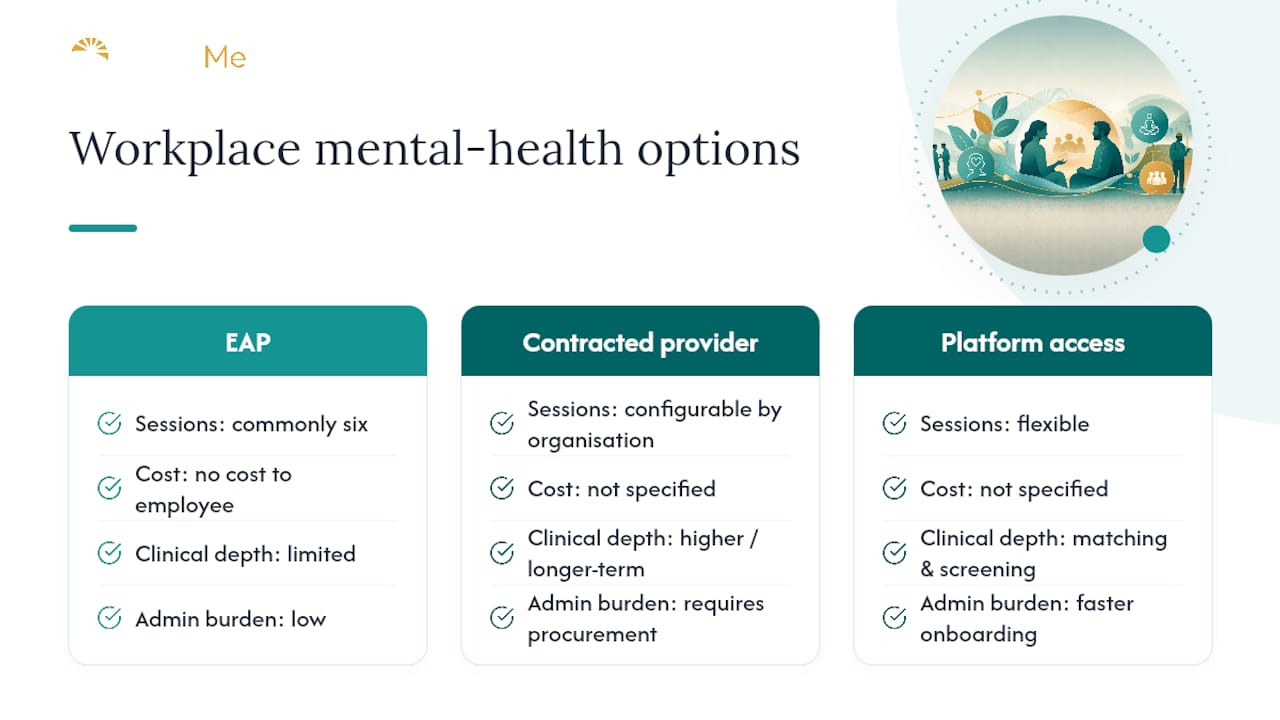
Contracted counselling provider: Better for organisations with higher clinical need or longer-term support requirements. Requires a procurement process, but gives more control over modality, session counts, and reporting.
Platform-based access (e.g. Guidemetherapy): Combines matching, screening, and reporting in one place. Suited to organisations that want flexibility, faster onboarding, and data on utilisation without building a full clinical contract from scratch.
HR procurement checklist
- Define scope: how many employees, which locations, which presenting issues?
- Confirm confidentiality terms: individual session content must remain private; only aggregate, anonymised data should flow to the employer.
- Verify safeguarding protocols: what happens if a therapist identifies a risk to life?
- Agree session counts and referral routes: how many sessions per employee, and how do staff access them?
- Set SLAs: maximum waiting time from referral to first session.
- Request reporting KPIs: utilisation rate, average waiting time, employee satisfaction scores, and clinical escalation rates.
A note on staff consent: employees must understand that their employer funds the service but cannot access their individual session content. Stating this clearly in internal communications significantly increases uptake. Employers who under-specify confidentiality terms in procurement often find staff reluctant to engage, so build those protections into the contract before launch.
What actually helps people get therapy that works?
Guided matching and clear goal-setting speed up meaningful progress more reliably than any other single factor.
The pattern Guidemetherapy sees consistently is this: people who arrive at their first session with even one concrete goal, and who have been matched to a therapist by modality and presenting concern rather than availability alone, engage more fully and report progress earlier. The matching step is where most self-directed searches fall short. Scrolling a directory and picking someone whose photo looks approachable is not the same as being matched on clinical fit.
For employers, the equivalent insight is simpler: staff who know the service is genuinely confidential use it. Organisations that communicate data-handling terms clearly before launch see higher utilisation than those that leave it to employees to assume.
Guidemetherapy: matched to the right therapist, faster
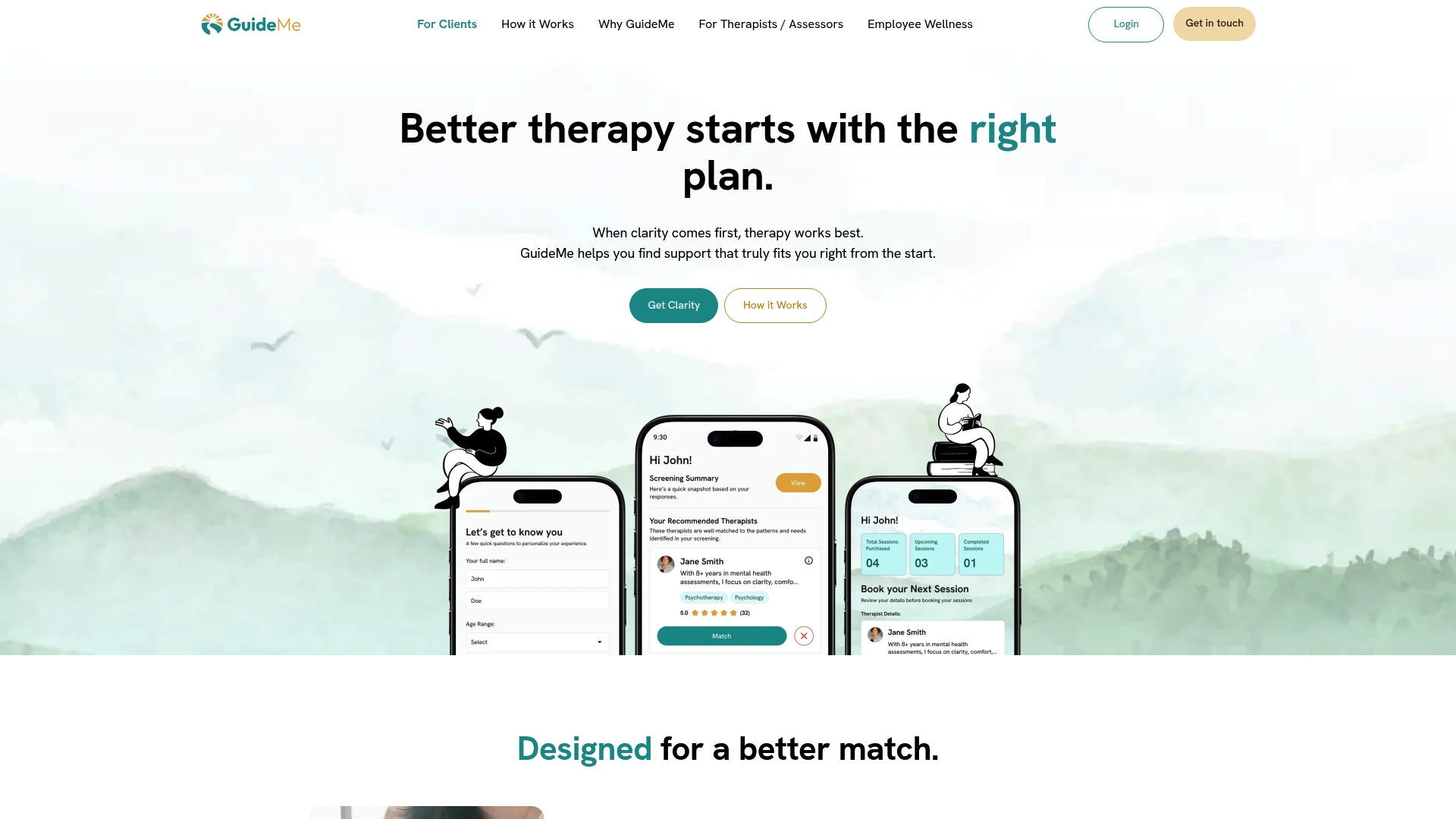
Guidemetherapy offers human-led, AI-assisted therapy navigation across the UK, matching individuals and organisations to accredited therapists quickly and without the guesswork of a directory search.
What Guidemetherapy provides:
- In-depth mental health screening to build a personalised therapy plan before your first session.
- AI-assisted and human-led therapist matching by modality, specialism, and availability.
- Ongoing support between sessions so progress does not stall.
- Corporate reporting and enterprise contracts for HR and people teams.
- Matches only to BACP- or UKCP-registered therapists across the UK.
Getting started takes minutes. Visit Guidemetherapy, complete the screening, and receive a personalised therapy plan with matched therapist options. For organisations, the enterprise route includes a scoping call, confidentiality terms, and a reporting dashboard. There are no long-term lock-ins for individuals — you book sessions as you need them, with the platform handling the admin.
Sources
Authoritative sources to bookmark when verifying registrations, locating services, or following official referral routes:
- How to get therapy | BACP
- How to find therapy or counselling | Mind
- Full renewal report: BACP | Professional Standards Authority (Feb 2025)
For individuals and employers who want a single starting point, Guidemetherapy combines screening, matching, and verified therapist access in one place across the UK.
This article is general information, not a substitute for advice from a qualified doctor. Consult a qualified healthcare professional about your own circumstances before acting on anything here.