

Culturally sensitive therapy is care in which your therapist actively recognises how your cultural background, identity, and lived experience shape what you're going through, and adapts their approach accordingly. It matters because that adaptation builds a stronger therapeutic alliance, deeper trust, and more accurate assessment from the first session onwards. It matters most for people from diverse, minority, or marginalised cultural backgrounds, who research consistently shows are more likely to stay in treatment when their therapist gets this right.
TL;DR:
- Research shows that culturally adapted therapy improves engagement and retention, especially among minority and marginalized groups.
- Good practice involves therapists actively broaching cultural topics through intentional questions and demonstrating cultural humility, not just competence.
- Systematic reviews indicate that culturally sensitive interventions increase treatment adherence, but evidence on symptom reduction remains limited and heterogeneous.
- Therapists should pursue ongoing training aligned with frameworks like MSJCC, and clients can assess cultural sensitivity through their willingness to ask or share about their background.
- Institutional factors such as funding, interpreter availability, and service design significantly influence whether culturally sensitive care is accessible and effective.
Table of Contents
- What culturally sensitive therapy actually means
- What this looks like inside a real session
- Does culturally adapted therapy actually work? What the research shows
- Why this matters to you, not just to researchers
- Questions to ask before you commit to a therapist
- How GuideMe helps you find the right cultural fit
- Training and certification programmes for culturally sensitive therapy
- What culturally sensitive therapy looks like in practice
- Ethical considerations unique to this kind of care
- How systems and institutions shape what's actually possible
- Editorial take: what the research actually supports
- Ready to find a therapist who actually gets your background
- Sources
- FAQ
What culturally sensitive therapy actually means
Three terms get used almost interchangeably in this space, and the differences matter. Cultural sensitivity is an attitude: a willingness to notice that culture shapes how someone experiences distress, expresses it, and expects help to look. Cultural competence goes further, describing a set of skills a therapist builds over time to work effectively across difference. Cultural humility is different again. Rather than treating competence as a box to tick, it frames cultural understanding as a lifelong, unfinished process, one where the therapist stays a learner rather than an expert on your identity.
That distinction between competence and humility isn't academic hair-splitting. A therapist who believes they've "achieved" cultural competence risks the exact trap the field warns against: stereotyping the very people they're trying to help. Cultural humility asks the clinician to stay curious, to hold their assumptions loosely, and to treat you as the expert on your own experience.
The field's most widely used framework for building this skill set, from Sue and Sue's Counseling the Culturally Diverse, rests on three pillars:
- Awareness — the therapist's own self-reflection on their biases, assumptions, and cultural lens, and how these might colour what they hear in the room.
- Knowledge — a working understanding of your cultural context: how your community talks about mental health, what help-seeking looks like, and what symptoms might mean within that context.
- Skills — the practical ability to adapt interventions, language, and pacing so therapy actually fits, rather than asking you to fit therapy.
A newer, complementary lens comes from the Multicultural and Social Justice Counseling Competencies, often shortened to MSJCC. This framework pushes the conversation beyond individual awareness into structural territory: power, privilege, and oppression. It asks therapists to consider not just "how does culture shape this person" but "how do systems of advantage and disadvantage shape what brought them here, and what they can access." That's a meaningfully broader ask than the older competence models, and it's increasingly the standard against which training programmes are measured.
What this looks like inside a real session
Good intentions don't automatically translate into good practice. The clearest marker of culturally sensitive work in the room is something called broaching: the therapist's deliberate choice to raise culture, identity, or power dynamics rather than waiting for you to bring it up first.
Broaching matters because silence isn't neutral. Research on broaching and bridging models in cross-cultural psychotherapy argues that avoiding these conversations can quietly reinforce what's called epistemic injustice, the harm done when someone's knowledge of their own experience is dismissed or never invited into the room at all. A therapist who never asks about your background isn't being tactful. They're leaving a gap you're left to fill alone.
In practice, broaching sounds ordinary rather than clinical. A therapist might open with something like:
- "I'm aware I don't share your cultural background. Can you tell me what would be helpful for me to understand?"
- "How does your family or community typically respond when someone is struggling like this?"
- "Is there anything about how I'm working with you that doesn't feel like it fits how you'd want to approach this?"
None of these questions demand you become a teacher explaining your culture from scratch. They open a door and let you decide how far to walk through it.
Cultural humility shows up alongside broaching as a stance rather than a script. It's the therapist checking their own power in the relationship, being honest when they don't know something, and resisting the urge to slot you into a category based on your background. The PMC review on culturally sensitive psychotherapy frames this balance precisely: awareness without humility tips into stereotyping, while humility without any cultural knowledge risks leaving the therapist unable to help at all. The two need each other.
Beyond conversation, culturally sensitive practice often includes concrete adjustments:
- Language access, whether through a qualified interpreter or a therapist who works in your first language.
- Adjusting therapeutic role, since some clients expect a more directive, advice-giving therapist while others prefer a collaborative, non-directive style, and a culturally attuned clinician will ask rather than assume.
- Making space for cultural or spiritual healing practices — prayer, ritual, elder or community involvement — alongside, not instead of, clinical treatment, an approach explored further in this guide to integrative therapy.
- Using metaphors and examples that land, rather than defaulting to frameworks or idioms that assume a particular cultural reference point.
Pro Tip: If a therapist seems unsure how to raise cultural topics, you can open the door yourself. Try saying, "There's something about my background I think is relevant here." A culturally humble therapist will welcome that, not deflect it.
Does culturally adapted therapy actually work? What the research shows
The honest answer sits between "yes, clearly" and "we need more data." Systematic reviews of cross-cultural psychotherapy research consistently find that culturally adapted interventions improve engagement and retention, meaning people are more likely to turn up, keep coming back, and stay in treatment long enough for it to work.
Concrete examples back this up. Adapted parenting and behavioural programmes, along with culturally tailored behavioural activation, have shown improved engagement across diverse populations when the intervention's language, examples, and delivery were shaped around the client's cultural context rather than applied unchanged from a standard manual.
Reviewers examining this evidence base consistently report better retention and engagement from cultural adaptations, but flag heterogeneity across studies as a genuine limitation.
That heterogeneity is worth sitting with rather than glossing over. Reviews in this field tend to note a few recurring gaps:
- Studies vary widely in what "cultural adaptation" actually means, from swapping case examples to fully restructuring a treatment model, which makes results hard to compare directly.
- Much of the research measures process outcomes (did people stay in therapy, did they feel understood) rather than hard clinical outcomes (did symptoms reduce by a measurable amount), so the evidence is stronger on engagement than on cure rates.
- There's a persistent call for more UK-specific trials, since much of the existing evidence base comes from US settings with different healthcare systems, migration histories, and community structures.
None of this undermines the core finding. It simply means the honest claim is "cultural adaptation reliably keeps people engaged in therapy," not "cultural adaptation is a proven cure for any given diagnosis." Engagement is not a minor detail. Therapy that people abandon after two sessions cannot help anyone, however well designed the underlying model.
Why this matters to you, not just to researchers
The clinical language translates into something much simpler at the level of a single appointment: do you feel understood, or do you feel like you're constantly explaining yourself instead of getting help?
When a therapist gets cultural context right, the benefits show up quickly. You tend to disclose more honestly, because you're not spending energy managing how a piece of your life will be received. You're less likely to drop out after a session or two, because the relationship feels workable. And the therapist's assessment of what's actually going on tends to be more accurate, since they're not filtering your experience through the wrong cultural lens.
The harms of getting it wrong are just as real and often quieter than you'd expect:
- Misdiagnosis, when a symptom that's a normal cultural expression of grief or distress gets read as pathology.
- Ruptured trust, when a client raises something cultural and the therapist responds with discomfort, defensiveness, or silence.
- Epistemic injustice, the specific harm of having your own understanding of your situation dismissed in favour of the therapist's framework.
Two short scenarios make this concrete. In one, a client from a close-knit religious community mentions family involvement in decision-making; the therapist asks curious follow-up questions and builds treatment around that reality rather than around an individualistic model, and the client stays in therapy for months. In another, a client references a culturally specific way of describing anxiety, and the therapist quietly reinterprets it through a diagnostic label the client never used or recognised. That client doesn't come back for session three.
Questions to ask before you commit to a therapist
You don't need clinical training to assess whether a prospective therapist is genuinely culturally sensitive. You need a short list of direct questions and a willingness to trust your gut in the first session.
- Ask about their training and ongoing learning. "What training have you had in working with clients from my background?" A confident, specific answer beats a vague "I'm very open-minded" every time.
- Ask about direct community experience. Have they worked with people from your specific background before, and what did they learn from it? Genuine humility sounds like "here's what I learned I got wrong," not a checklist of credentials.
- Ask about language and communication. If English isn't your first language, or if certain concepts don't translate cleanly, will they use an interpreter or adjust how they explain things?
- Ask how they handle cultural or spiritual practices. Will they integrate faith, ritual, or community involvement into your plan, or expect you to leave that at the door?
Once you're in the room, a handful of signs tell you quickly whether the fit is real. A culturally sensitive therapist broaches culture without waiting to be prompted, admits when they don't know something instead of guessing, and visibly adjusts their approach based on what you tell them rather than running the same script for every client.
The red flags are just as clear: a therapist who insists culture "doesn't really matter" to the work, who gets defensive when you raise a cultural misunderstanding, or who makes assumptions about your beliefs based on your background rather than asking. If you spot these early, it's reasonable to name the concern directly in session, and equally reasonable to switch therapists if things don't improve. Fit is not a luxury in this work; it's the mechanism through which therapy works at all.
Pro Tip: Keep a mental note after your first session: did the therapist ask you more questions about your background, or did they explain your background back to you? The direction of that conversation tells you almost everything.
How GuideMe helps you find the right cultural fit
Finding a therapist who fits your cultural context usually means wading through directories with almost no information about how a clinician actually works, which is exactly the gap a navigation platform like Guidemetherapy is built to close. Rather than leaving you to guess from a one-line bio, Guidemetherapy starts with in-depth screening designed to surface what actually matters to you, including cultural background, language preferences, and the kind of therapeutic relationship you're looking for.
That screening feeds into a personalised therapy plan, which then informs the matching process itself. The platform combines AI-assisted matching with human oversight, so the process moves quickly without losing the judgement a purely automated system would miss. The goal is to get you to a therapist who fits from the beginning, rather than leaving you to discover later that the fit isn't right.
If you're using a matching service of any kind, cultural fit only improves when you're specific about what you need. Say plainly if you want a therapist from a particular background, someone experienced with a specific community, or someone comfortable integrating faith or cultural practices into treatment. Vague answers produce vague matches. The more precisely you describe what "understood" looks like for you, the better any matching process, human or AI-assisted, can act on it.
Training and certification programmes for culturally sensitive therapy
Cultural competence isn't something a therapist picks up once and carries forever; most training pathways treat it as ongoing continuing education rather than a single certificate. Postgraduate counselling and clinical psychology programmes increasingly build multicultural competence modules directly into core training, often explicitly aligned with frameworks like the MSJCC, rather than treating cultural work as an elective add-on.
Beyond initial qualification, many practitioners pursue specific continuing professional development in areas such as trauma-informed care for refugee and migrant populations, working with interpreters, or community-specific practice, for instance, therapy tailored to particular faith communities or LGBTQ+ populations of colour. Professional bodies in the UK increasingly expect evidence of this kind of ongoing learning as part of standard accreditation renewal, reflecting the same shift the MSJCC framework represents: cultural competence as a continuous professional obligation, not a box ticked at graduation.
For you as a therapy-seeker, the practical takeaway is simple: a therapist's initial degree tells you very little about their cultural competence. What tells you more is whether they can point to specific, ongoing training relevant to your background, and whether they talk about that learning as finished or still in progress. The second answer is usually the more trustworthy one.
What culturally sensitive therapy looks like in practice
Consider a client who grew up in a collectivist culture where family involvement in major decisions is expected, not unusual. A therapist trained only in individualistic models might initially frame that involvement as a boundary problem to be corrected. A culturally sensitive therapist instead asks how family fits into the client's decision-making, and builds a treatment plan that works with that structure rather than against it, perhaps involving a family session at key points rather than treating the client in isolation.
Consider a second case: a client whose cultural background frames emotional distress somatically, describing anxiety as physical tension or exhaustion rather than in the language of Western diagnostic categories. A therapist unfamiliar with that pattern might miss the anxiety entirely, focusing instead on physical symptoms as a separate medical issue. A therapist practising broaching would ask directly how the client experiences and describes their distress, catching the connection a purely symptom-checklist approach would miss.
Neither example requires an exotic clinical technique. Both simply require the therapist to ask before assuming, which is the entire practical core of broaching and cultural humility translated into a real appointment.
Ethical considerations unique to this kind of care
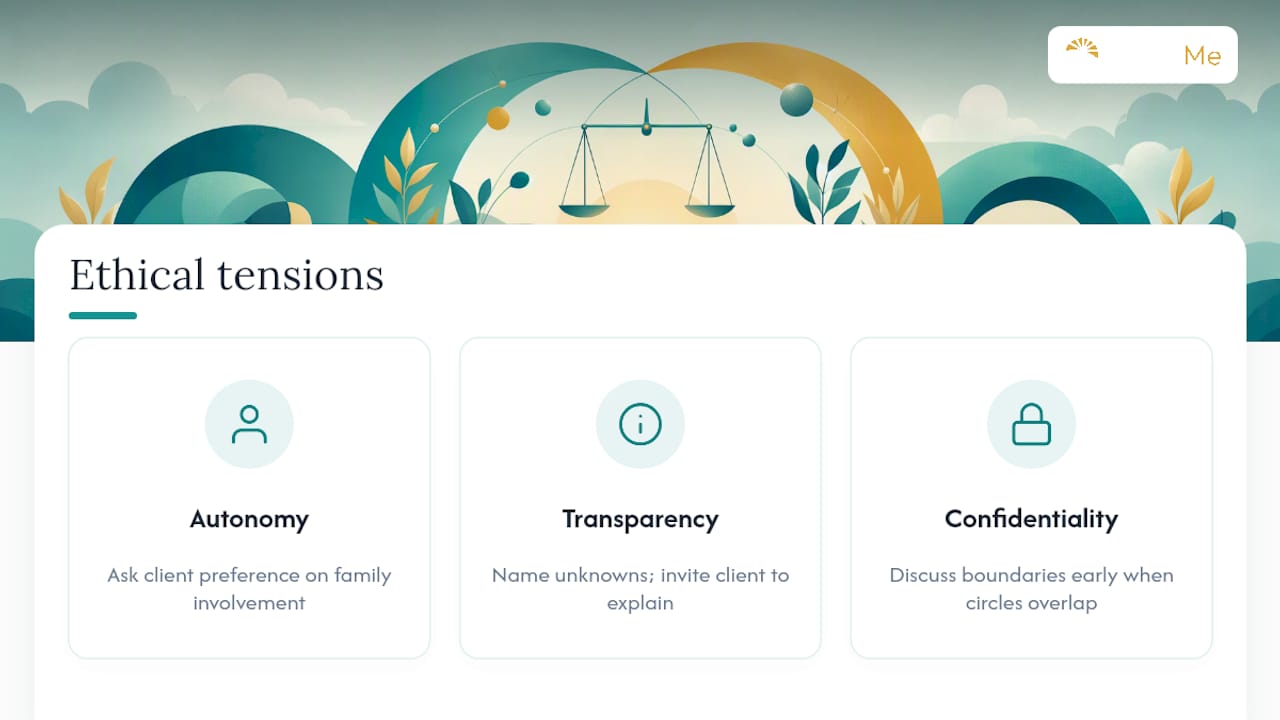
Standard therapeutic ethics, confidentiality, informed consent, avoiding harm, apply here as everywhere. But cultural work introduces a few tensions that deserve specific attention.
The sharpest one sits between individual autonomy and family or community involvement. Western therapeutic ethics generally centre the individual client's wishes above all else, but some cultural contexts treat family involvement as central to wellbeing rather than a boundary violation. An ethically careful therapist navigates this by asking the client directly how they want to handle it, rather than imposing either a strictly individualistic or a strictly family-centred model by default.
A second tension involves the limits of a therapist's own cultural knowledge. Claiming expertise you don't have is a genuine ethical risk, one that can tip into the stereotyping problem raised earlier. The more defensible ethical stance, and the one cultural humility is built around, is transparency: naming what you don't know and inviting the client to fill that gap, rather than guessing and risking a confidently wrong assumption.
A third consideration is confidentiality within tight-knit communities, where a client and therapist might share overlapping social circles. Handling that requires explicit conversation about boundaries early on, not silence and hope it never becomes an issue.
How systems and institutions shape what's actually possible
Individual therapist skill matters enormously, but it operates inside a system that can either support or undermine it. In the UK, NHS England's work on advancing mental health equalities explicitly names cultural competence as part of closing access gaps, recognising that unequal outcomes across communities aren't purely a matter of individual clinician skill.
Institutional factors that shape whether culturally sensitive care is actually available include how services are commissioned, whether interpreter budgets exist, how long waiting lists run in areas with high linguistic diversity, and whether staff training includes protected time for cultural competence development rather than treating it as something clinicians absorb informally. A brilliantly skilled individual therapist working inside a system with no interpreter funding and six-month waiting lists can still deliver a poor experience to someone who needed rapid, culturally attuned support.
This is part of why the MSJCC framework insists on looking at power and privilege at a structural level, not just within the therapy room. A therapist can be personally exemplary and still be working inside a service that systematically underserves certain communities through funding decisions, staffing patterns, or referral pathways that were never designed with cultural diversity in mind. Recognising that distinction matters when you're assessing your own experience: sometimes the gap you're feeling is about your specific therapist, and sometimes it's about the system around them.
Editorial take: what the research actually supports
Here's where much of the popular advice on this topic goes soft: it treats cultural sensitivity as a personality trait, warm, open-minded therapists have it, and rigid ones don't. The evidence points somewhere more useful. It's a set of observable behaviours, chiefly broaching, and a stance, humility over assumed competence, that can be assessed directly in how a therapist talks to you.

That reframe matters because it hands you a genuine filter rather than a vibe to trust. You don't need to guess whether someone is culturally sensitive. You can listen for whether they ask before they assume, and whether they treat their own cultural knowledge as incomplete.
The evidence base is honest about its limits too, strong on engagement and retention, thinner on hard outcome data, and light on UK-specific trials. That gap shouldn't discourage anyone from seeking culturally attuned care; it should discourage anyone from treating it as a settled science with guaranteed results. Prioritise finding a therapist who broaches well over one with the longest list of credentials. The conversation itself is the diagnostic tool.
— Yetty
Ready to find a therapist who actually gets your background
Reading about broaching and cultural humility is one thing. Finding a real therapist who practises both, in your city, in your budget, speaking your language, is a different problem entirely, and it's the one Guidemetherapy was built to solve. Rather than scrolling directory bios hoping for the best, you start with proper screening that captures your cultural context, your preferences, and what "understood" needs to look like for you.

From there, the platform builds a personalised therapy plan and matches you with a therapist using AI-assisted matching backed by human review, so the process moves fast without skipping the judgement calls that matter. It won't guarantee a perfect fit on the first try; no matching process can promise that. But it does mean you start from a plan built around your actual context, not a random shortlist. If you're ready to stop guessing and start with a proper screening, visit Guidemetherapy and get matched with a therapist suited to your background from the outset.
Sources
For readers who want to verify the frameworks and evidence covered here, these sources go deeper:
- Culturally sensitive psychotherapy—technique or attitude?
- Multicultural and Social Justice Counseling Competencies (MSJCC)
- Counseling the Culturally Diverse
- Developing a model of broaching and bridging in cross-cultural psychotherapy
- A knowledge synthesis of cross-cultural psychotherapy research: a critical review
This article is general information, not a substitute for advice from a qualified doctor. Consult a qualified healthcare professional about your own circumstances before acting on anything here.
FAQ
What is culturally sensitive therapy?
It's therapy in which the clinician actively recognises and adapts to your cultural background, identity, and context, using practices like broaching and cultural humility to build a stronger, more accurate therapeutic relationship.
What are the four Cs of cultural sensitivity?
Definitions vary across training programmes, and there isn't one universally agreed four-C model in the research covered here; the more consistently cited framework is the three-pillar model of Awareness, Knowledge, and Skills, alongside cultural humility as an underlying stance.
I feel like my therapist isn't understanding me. Is this normal?
It's a common enough experience, and it's worth raising directly rather than assuming it's your fault. If your therapist responds with curiosity and adjusts, that's a good sign; if they dismiss the concern, it may be time to look for a different fit, something a matching service like Guidemetherapy can help with.
What are Carl Rogers' three core conditions?
Rogers identified empathy, unconditional positive regard, and congruence (genuineness) as the three core conditions for effective therapy. Culturally sensitive practice builds directly on these, since empathy and genuineness are difficult to demonstrate convincingly without also engaging honestly with a client's cultural context.