

Psychological safety at work is the shared belief that people can speak up, ask questions, admit mistakes, or raise concerns without being punished or humiliated for it. The single most important thing a leader can do to build it is make safety an explicit team priority and model fallibility openly, rather than hoping trust develops on its own. CCL's research and McKinsey-cited workforce data both point the same direction: this is a leadership behaviour, not a personality trait of "nice" teams.
TL;DR:
- Psychological safety is most effectively established by leaders explicitly valuing open communication and modeling vulnerability, not by team personality traits.
- Safe teams often still argue and disagree openly, as safety allows honest confrontation without shame, contrary to the misconception that silence equals safety.
- Regular pulse surveys and behavioral cues are essential to accurately diagnose and monitor psychological safety levels within teams.
- Leader reactions to mistakes and disagreements must be consistently supportive and non-defensive to prevent eroding safety during disruptions or change.
- Building trust through policy and behaviour, along with access to confidential mental health support, leads to more durable psychological safety across organizations.
Table of Contents
- What psychological safety at work actually means
- The business case: why psychological safety matters more than most leaders assume
- Building psychological safety: what leaders should actually do this week
- How to measure and diagnose psychological safety in your team
- Common barriers to psychological safety and how to fix them
- Psychological safety in hybrid and remote teams
- Where therapy navigation fits alongside leadership action
- Culture and policy: the structure that makes safety stick
- Psychological safety, mental health, and employee well-being
- What employees can do, not just leaders
- Examples of psychological safety working in practice
- A note from Yetty: why leaders can't build this alone
- Sources
What psychological safety at work actually means
Amy Edmondson, the Harvard Business School researcher who coined the term, defines psychological safety as a shared belief that the team is safe for interpersonal risk taking. That means someone can say "I don't understand this" in a meeting, flag a colleague's error, or admit they missed a deadline, without expecting to be shamed, ignored, or quietly marked down for it. It sounds simple. Most teams get it wrong in practice, because they mistake the absence of open conflict for the presence of safety.
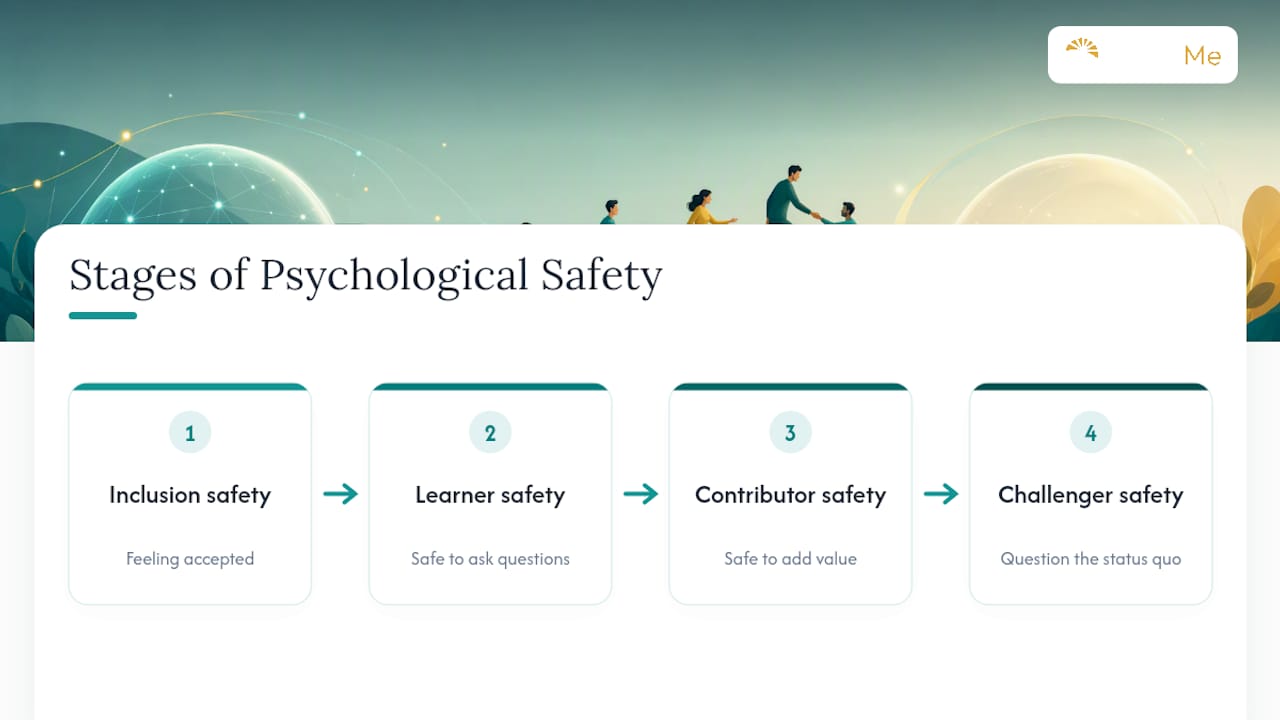
Leadership expert Timothy R. Clark offers a more granular model that helps explain why. He breaks psychological safety into four stages: inclusion safety (feeling accepted for who you are), learner safety (feeling safe to ask questions and make mistakes), contributor safety (feeling safe to use your skills and add value), and challenger safety (feeling safe to question the status quo). Teams rarely arrive at challenger safety by accident. They earn it stage by stage, and a leader can usually tell which stage a team is stuck at just by watching who talks in meetings and who stays quiet.
Here's the myth-busting part managers most need: psychological safety is not the same as being agreeable. A team can be psychologically safe and still argue hard, because safety is what makes honest disagreement possible in the first place. A team that avoids friction to "keep the peace" is often the least safe team in the building. Watch for the tell: does anyone ever say "I think that's wrong" to a senior person's face? If not, you don't have safety. You have silence.
The business case: why psychological safety matters more than most leaders assume
Harvard Business Review's research is blunt on this point: psychological safety is one of the strongest predictors of high team performance, because safe teams learn faster and catch errors earlier than teams where people sit on bad news. That matters most in fast-moving or high-stakes environments, where a hidden mistake compounds before anyone with authority hears about it.
The workforce data backs this up at scale.
The number leaders should quote in the boardroom: 89% of employees say psychological safety is essential for a positive, effective workplace, according to a McKinsey-cited survey reported by Workday.
That's not a fringe preference. It's close to universal agreement among the workforce that this is a baseline expectation, not a nice-to-have layered on top of "real" management priorities.
The UK-facing picture adds nuance. The CIPD's evidence review on trust and psychological safety links the two concepts directly: trust in leadership and psychological safety tend to rise and fall together, and organisations that treat trust-building as a deliberate practice, rather than an assumed by-product of good intentions, see stronger results. That's useful ammunition if you're pitching this to a board that wants evidence before it invests time in culture work rather than headcount.
Building psychological safety: what leaders should actually do this week
Knowing the theory doesn't change a team on Monday morning. Here's a practical order of operations, starting with the highest-leverage move.
- Say it out loud. Tell your team explicitly that raising problems, asking questions, and admitting mistakes are valued, not tolerated. Connect it to a real purpose, for example: "We catch errors faster when people flag them early, so flag them early."
- Model fallibility first. Before asking your team to be vulnerable, go first. Say "I got that wrong last week, here's what I missed" in a real meeting. CCL's guidance is clear that leaders who normalise their own mistakes give everyone else permission to do the same.
- Structure who speaks. Use a round-robin for contentious topics instead of open floor, and send pre-meeting prompts to quieter team members so they arrive with a formed view rather than being put on the spot live.
- Run blameless debriefs. After anything goes wrong, ask "what happened and what do we change" before you ask "who did this". A lessons-learned ritual that starts with blame will train people to hide problems next time.
- Invite disagreement on purpose. Ask "what am I missing?" or "who sees this differently?" after you state a decision, not just before. HBR's research points to a specific high-leverage moment here: your immediate reaction the first time someone challenges you is the strongest signal your team gets about whether voice is actually safe.
- React the right way, every time. When someone raises something uncomfortable, thank them and ask a follow-up question before you respond with your own view. Defensiveness, even mild, teaches the room to stay quiet next time.
- Watch two metrics. Track how often people volunteer bad news unprompted, and how many questions get asked in meetings versus asked privately afterwards. Both should trend upward if safety is genuinely improving.
Pro Tip: Script your own reaction to disagreement in advance. Something as simple as "Thanks, tell me more" bought before the meeting starts is far more reliable than trying to improvise composure in the moment someone challenges you in front of the whole team.
Give this a week, not a quarter, before checking in. Psychological safety is fragile and easily undone by a single bad reaction, but it also responds quickly to a leader who is visibly, consistently trying.
How to measure and diagnose psychological safety in your team
You can't manage what you don't measure, and psychological safety is measurable with a short, honest pulse survey. Try three to five items, scored on a simple agreement scale:
- "If I make a mistake on this team, it is not held against me."
- "It's safe to raise a problem or concern, even an unpopular one."
- "I can ask for help without it being seen as a weakness."
- "My unique skills and perspective are valued on this team."
- "We take on hard problems, even risky ones, without fear of blame."
Survey scores only tell half the story. Watch behavioural signals too: who speaks first in meetings, how often junior staff ask questions unprompted, and whether disagreement ever surfaces openly rather than in side conversations afterwards. A team that scores well on the survey but never disagrees out loud is giving you a warning sign, not a clean bill of health.
Break results down by subgroup, not just team average. Uneven scores between roles, tenure levels, or demographic groups usually point to a specific, fixable problem rather than a team-wide culture issue, and they deserve a short follow-up conversation rather than an assumption. Because safety fluctuates rather than sets permanently, run this pulse check quarterly, pairing the numbers with a handful of one-to-one conversations to catch what a survey alone will miss.
Common barriers to psychological safety and how to fix them
Most teams don't lack safety because leaders don't care. They lack it because of small, repeated habits nobody notices in the moment.
- The leader who punishes voice without meaning to. A sharp "well, why didn't you say that sooner" after someone flags a problem teaches the room to stay quiet next time. Swap it for "thanks for catching that, what do you need from me now?"
- Uneven safety across the team. Newer staff, junior roles, and minority voices often report lower safety scores than senior staff on the same team. Fix this with deliberate inclusion, such as asking quieter people by name for their view rather than waiting for volunteers.
- Mistaking niceness for safety. A team that never disagrees openly isn't safe, it's suppressed. Reward constructive pushback visibly, so people see that disagreeing with you doesn't cost them anything.
- Letting safety slip during change. Restructures, layoffs, and leadership changes are when safety erodes fastest. Keep a short weekly check-in ritual running through the disruption rather than pausing it "until things settle down."
Pro Tip: If you only fix one habit this month, fix your first reaction to bad news. It's the cheapest, fastest lever you have, and it's the one people remember longest.
Psychological safety in hybrid and remote teams
Distributed teams face their own version of this problem, and it's easy to miss if you're only used to reading a room in person. Camera-off habits, delayed chat replies, and one or two dominant voices on every call can quietly erode safety without anyone flagging it, because the usual visual cues (a hesitant face, a half-raised hand) simply aren't there.
HBR's research on hybrid teams points to deliberate structure as the fix, not just more video calls:
- Send asynchronous prompts before meetings so quieter or timezone-disadvantaged people can contribute in writing first.
- Use explicit turn-taking on calls (call people by name) rather than relying on natural pauses that dominant speakers fill first.
- Rotate who facilitates, so the same one or two voices don't shape every discussion by default.
- Follow up big decisions with a written summary and an open channel for delayed questions, since remote workers often process concerns later than the meeting itself.
Where therapy navigation fits alongside leadership action
Leaders can build safety at team level, but some concerns run deeper than a manager should try to handle alone: burnout, anxiety, grief, or trauma that a meeting culture shift won't fix, so confidential access to clinical psychotherapy services is essential. Confidential access to professional support gives employees somewhere to take what they can't yet say out loud in a team setting, which reduces stigma and often makes people more willing to speak up at work once they feel supported outside it.
This is where a therapy navigation platform complements, rather than replaces, manager-level work. Pairing structured referral pathways with trauma-informed responses helps organisations respond well after a difficult incident, during onboarding, or as ongoing support between the peaks of a stressful project. It's a second layer beneath the culture work, not a substitute for it.
Culture and policy: the structure that makes safety stick
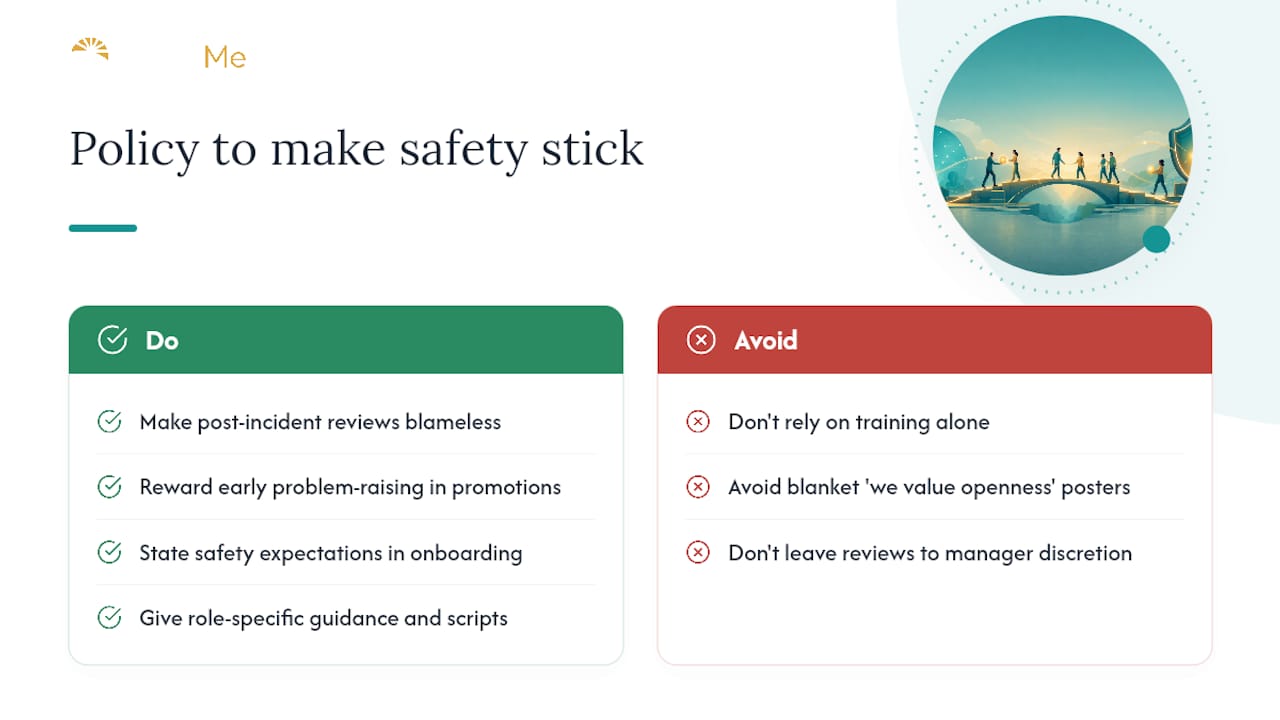
Individual leader behaviour builds trust one team at a time, but it erodes quickly if the wider organisation contradicts it. A manager who models fallibility looks credible right up until a performance review process punishes the exact mistake they just told their team was safe to admit.
Policy has to back the behaviour. That means blameless post-incident reviews written into process, not left to individual manager discretion; promotion criteria that reward raising problems early rather than hiding them until they're unavoidable; and onboarding that states the safety expectation explicitly rather than assuming new hires will absorb it by osmosis. The CIPD's evidence review is specific on this point: organisations that pair leader behaviour with consistent, practical policy see stronger and more durable trust than those relying on training alone.
Public-sector guidance echoes the same principle from a different angle. NHS Employers' guidance on staff psychological safety recommends tailoring language and support to specific roles, rather than issuing one generic culture statement for an entire organisation. A ward manager and a finance team need different scripts for the same underlying principle. A blanket "we value openness" poster achieves very little on its own; role-specific guidance, reinforced by policy, does considerably more.
None of this requires a heavy rewrite of your HR handbook. Start with the policies that most directly contradict safe behaviour, usually performance reviews and incident response, and fix those first.
Psychological safety, mental health, and employee well-being
The link between psychological safety and mental health at work runs in both directions. Teams where people fear speaking up report higher stress, because unresolved problems and unspoken concerns don't disappear, they just get carried privately. That's a heavier load than most people register consciously, and it shows up eventually as burnout, disengagement, or unplanned absence.
The reverse is also true. When people know they can raise a concern, ask for help, or admit they're struggling with workload without professional consequences, the psychological burden of hiding it lifts. That doesn't mean psychological safety cures mental ill health, it doesn't, and no manager should treat it as a substitute for proper support. But it does remove one significant, entirely avoidable source of strain: the exhausting daily work of managing appearances instead of managing the actual problem. Workplaces that get this right tend to see it reflected in wider workplace mental health outcomes, not just in performance metrics.
This is also where the limits of a manager's role become important to name honestly. A team lead can build the conditions for someone to say "I'm struggling." What happens after that disclosure, proper clinical support, is a different responsibility entirely, and pretending otherwise puts too much weight on managers who aren't trained for it.
What employees can do, not just leaders
Psychological safety isn't built by managers alone. It's a team-level property, and employees shape it just as much through their own daily choices, even without any formal authority to change policy.
The most useful thing an individual can do is respond well when a colleague takes a risk. If someone admits a mistake or asks a "obvious" question in a meeting, a colleague's reaction (a shrug, a raised eyebrow, a dismissive comment) carries almost as much weight as a manager's. Backing up a colleague who speaks up, rather than staying silent while they take the risk alone, spreads safety sideways across a team faster than any top-down initiative.
Asking genuine questions in meetings, rather than staying quiet to avoid looking uninformed, also normalises the behaviour for everyone else watching. And giving feedback to peers, not just upward to managers, closes a gap that many "safe" teams still have: plenty of safety to speak to the boss, very little to speak to each other. Employees who proactively use organisational support rather than waiting to be offered it also help normalise seeking help as an ordinary part of working life, not an exception.
Examples of psychological safety working in practice
The pattern holds across very different industries, even though the specific risk being surfaced changes completely. In healthcare, research on team-level psychological safety has repeatedly linked it to earlier error detection, junior clinical staff catching and reporting near-misses that would otherwise reach a patient. In software and product teams, the same mechanism shows up as engineers flagging a flawed architecture decision before launch rather than after a costly rebuild.
Retail and hospitality settings tell a slightly different story, often about hierarchy rather than technical risk: frontline staff who feel safe telling a shift manager that a process is broken tend to surface operational problems weeks before they'd otherwise reach senior leadership through a formal complaint. What connects every example is timing. Psychologically safe environments surface problems earlier, when they're still cheap and simple to fix, rather than later, when they've become expensive or public. That single mechanism, faster surfacing of bad news, explains most of the performance gap between safe and unsafe teams, regardless of sector.
A note from Yetty: why leaders can't build this alone
Psychological safety is genuinely a leadership job, and most of what makes it work costs nothing but attention: a script, a pause before reacting, a decision to say "I got that wrong" out loud. But I think leaders sometimes ask their own behaviour to do more than it can. A manager can build the conditions for someone to speak up. They can't always be the right person to hear what comes next, particularly when it touches something clinical, personal, or beyond a working relationship's scope.
That's the honest gap most culture guides skip over. Building safety and providing proper mental health support are related jobs, not the same job, and organisations that treat therapy access as a genuine complement to leadership, rather than an afterthought in the wellbeing budget, tend to get more honest teams as a result. GuideMe exists in that gap, helping individuals and organisations find the right therapist without the usual confusion of working out where to even start.
— Yetty
Sources
- How Leaders Can Build Psychological Safety at Work — CCL
- Why psychological safety is important — Workday (McKinsey-cited stat)
- Trust and psychological safety: An evidence review — CIPD
- High-performing teams need psychological safety — HBR