

TL;DR:
- Choosing therapy begins with clearly identifying two or three specific issues you want to address to ensure focused support.
- Matching therapy modality to the underlying mechanisms maintaining distress, rather than diagnosis alone, leads to more effective treatment.
- A strong therapeutic relationship and clarity during initial consultations are crucial, as they significantly influence therapy outcomes.
Finding the right therapy can feel overwhelming. There are dozens of approaches, hundreds of therapists, and very little guidance on where to actually start. Selecting therapy type step by step is one of the most practical things you can do before you book a single session. It means you go in with clarity instead of confusion, and you make choices based on your actual needs rather than guesswork. This guide walks you through every stage, from understanding your mental health goals to evaluating therapists and booking your first appointment.
Table of Contents
- Key takeaways
- Identifying your needs and therapy goals
- Common therapy types and what they treat
- How to evaluate therapists
- From research to your first appointment
- When therapy is not working as expected
- My honest perspective on choosing therapy
- How Guidemetherapy helps you get matched
- FAQ
Key takeaways
| Point | Details |
|---|---|
| Start with your goals | Write down 2–3 specific issues before you search, so your therapy choices are focused and relevant. |
| Match modality to mechanism | Choose a therapy type based on what sustains your distress, not just your diagnosis label. |
| Treat consultations as interviews | Use short first meetings to ask direct questions about approach, structure, and how progress is measured. |
| Shortlist before committing | Identify 3–5 therapists before booking, and use filters like speciality, modality, and cost to narrow down. |
| Expect some adjustment | It is normal to try more than one therapist or approach before finding the right fit. |
Identifying your needs and therapy goals
Before you search for a therapist, you need a clear picture of what you want to address. Many people skip this step and end up picking a therapist based on availability or price alone. That approach often leads to disappointment.
Writing down your top therapy goals before you begin searching helps focus your choices and allows you to look for therapists who specialise in exactly those areas. Be as specific as you can. "I want to feel better" is too vague. "I want to manage panic attacks and stop avoiding social situations" gives a therapist real information to work with.
Think about the following when clarifying your goals:
- What are the two or three main problems that are affecting your daily life right now?
- How long have you been experiencing them, and have they changed in severity?
- Have you tried therapy before, and what worked or did not work?
- Are there specific triggers, patterns, or behaviours you want to change?
- What does meaningful progress look like to you in three to six months?
Once you have written these down, you have a reference point. You can use it to filter therapist profiles, guide your first consultation, and check whether therapy is actually working later on.
Pro Tip: Take ten minutes to write your answers on paper before you search online. Seeing your own words in front of you makes it much easier to recognise what kind of support you actually need.
Common therapy types and what they treat
Understanding the main therapy modalities helps you make an informed request rather than relying entirely on a therapist to decide for you. Each type is built on a different understanding of what causes and maintains psychological distress.
Clinicians match therapy type to symptom-maintaining mechanisms rather than randomly assigning modalities. That means a good therapist is thinking about what keeps your distress going, not just what diagnosis you carry. Avoidance, for example, maintains anxiety disorders. Emotional dysregulation underlies many personality disorder presentations. Trauma intrusion sustains PTSD. The therapy you choose should target those specific mechanisms.
The table below outlines the main modalities and their primary applications.
| Therapy type | Best suited for | Key characteristics |
|---|---|---|
| Cognitive Behavioural Therapy (CBT) | Anxiety, depression, OCD, phobias | Structured, goal-focused, addresses thinking and behaviour patterns |
| Dialectical Behaviour Therapy (DBT) | Borderline personality disorder, self-harm, emotional dysregulation | Skills-based programme covering mindfulness, distress tolerance, emotion regulation, interpersonal effectiveness |
| Acceptance and Commitment Therapy (ACT) | Chronic pain, generalised anxiety, avoidance | Focuses on values-driven action and psychological flexibility |
| Eye Movement Desensitisation and Reprocessing (EMDR) | PTSD, trauma, phobias | Bilateral stimulation to reprocess distressing memories |
| Psychodynamic therapy | Relational difficulties, depression, identity concerns | Exploratory, insight-focused, less structured |
| Person-centred therapy | Low self-esteem, life transitions, general wellbeing | Non-directive, warm, focuses on personal growth |
DBT is a structured 6 to 12 month programme with modules covering mindfulness, distress tolerance, emotion regulation, and interpersonal effectiveness. It is particularly effective for borderline personality disorder and combines individual therapy with group skills training. Seeking a comprehensive DBT programme that includes all four modules matters. Partial programmes are common but produce noticeably weaker results.
The difference between structured and exploratory therapies is also worth understanding. CBT, DBT, and EMDR follow set protocols with measurable milestones. Psychodynamic and person-centred therapies are more open-ended and rely heavily on the relationship itself. Neither is superior. The right choice depends on your goals, your preference for structure, and the nature of your distress.
If you want to understand therapy approaches in more depth before making a decision, taking time to read about how modalities are distinguished from one another is well worth it.
How to evaluate therapists
Finding a therapist whose approach matches your needs is one thing. Deciding whether they are the right person for you is another. Most therapists offer a short consultation of around 15 minutes as a two-way interview to evaluate fit, approach, session structure, and how progress is measured. Use it as exactly that.

Treating the first meeting as an interview reduces uncertainty and puts you in an active role rather than a passive one. You are not there to be assessed. You are also there to assess them.
Here are the questions worth asking in a consultation:
- What experience do you have working with people who have my specific concerns?
- Which therapy approach do you use, and why do you think it suits my situation?
- How do you structure sessions, and what does a typical session look like?
- How do you measure progress, and how will we know when things are improving?
- What are your fees, and do you offer a sliding scale or accept insurance?
- What happens if I feel the therapy is not working?
Pay attention to how the therapist responds to these questions, not just what they say. Clarity, warmth, and a willingness to explain their reasoning are all good signs. Vague answers or defensiveness are worth noting.
Therapeutic alliance is one of the strongest predictors of therapy outcomes, contributing roughly 7 to 10 per cent of outcome variance independent of technique. In practice, this means that how comfortable and understood you feel with a therapist matters enormously. If something feels off after two or three sessions, that is worth paying attention to. You have every right to raise it directly with the therapist or to seek a different fit.
Pro Tip: Prepare your consultation questions in writing before the call. It stops you from forgetting key points and sends a signal that you are an engaged and informed client, which tends to bring out the best in a therapist too.
For a more detailed list of what to ask, the Guidemetherapy guide on questions to ask your therapist covers the full range.
From research to your first appointment
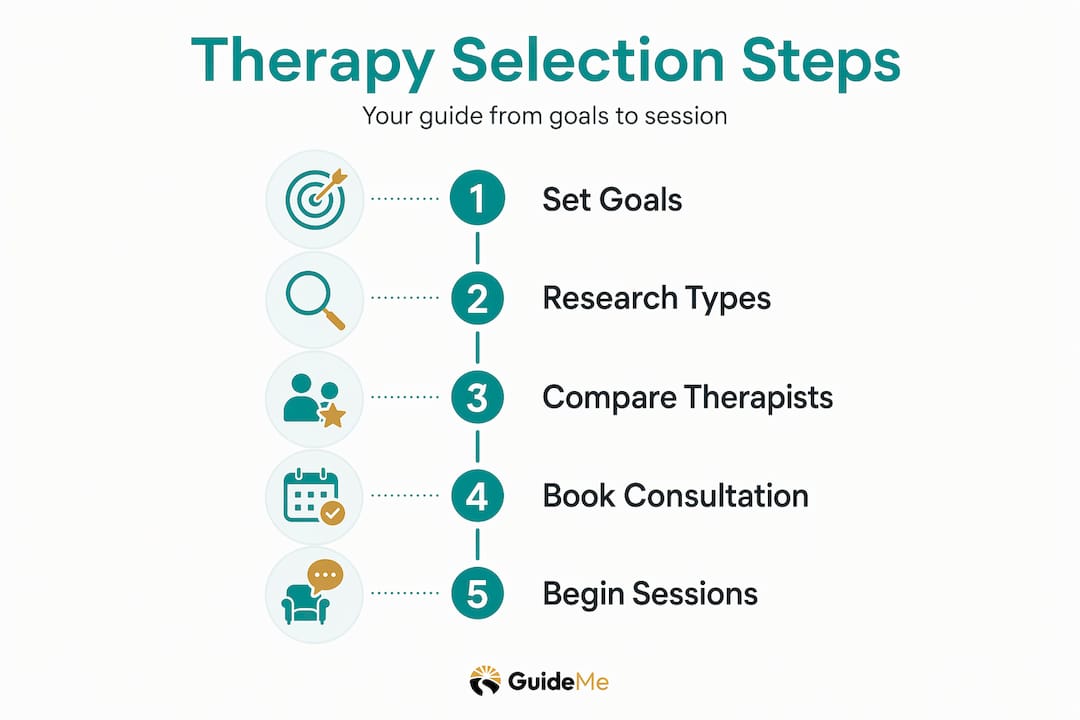
A clear process takes you from reading about therapy to sitting in a session. Skipping stages creates confusion and wasted time. Here is how to move from research to booking.
- Use trusted directories and official locators. In the UK, your GP can refer you through NHS talking therapies. For self-referral, verified official locators and professional directories list therapists by speciality, modality, and location.
- Translate your goals into search filters. If your goals involve trauma processing, search for therapists trained in EMDR or trauma-focused CBT. If emotional regulation is the priority, filter for DBT specialists.
- Shortlist three to five therapists. Do not contact just one. Having options means you can compare responses, availability, and consultation fit before committing.
- Book and prepare for consultations. Have your written goals and questions ready. Treat each consultation as a structured conversation, not a casual chat.
- Clarify cost and insurance before booking a full session. Many people discover affordability issues after they have already developed a preference for a particular therapist.
| Step | Action | What to consider |
|---|---|---|
| Set goals | Write 2–3 specific issues | Be concrete, not vague |
| Research modalities | Match goals to therapy types | Mechanism, not just symptom label |
| Find therapists | Use directories and referrals | Speciality, modality, location |
| Shortlist | Identify 3–5 candidates | Availability, cost, approach |
| Consult | Book 15-minute consultations | Ask structured questions |
| Decide | Choose based on fit and approach | Alliance matters as much as technique |
Preparing for your first session is covered in depth in the therapy intake guide from Guidemetherapy, which explains what to expect and how to set yourself up well from the start.
When therapy is not working as expected
Not every first match is the right one. That is not a failure. It is a normal part of the process, and knowing what to do when things are not clicking is just as useful as knowing how to start.
Watch for these signs that something needs to change:
- You feel consistently unheard or misunderstood after three or more sessions.
- The therapy approach does not seem to connect to what you actually came in with.
- You notice no shift at all in mood, thinking, or behaviour after six to eight sessions.
- You dread sessions rather than finding them useful or at least meaningful.
Session-by-session symptom tracking improves depression and anxiety outcomes by approximately 20 per cent. If your therapist is not measuring progress in any systematic way, raise it. Ask directly: "How are we tracking whether things are improving?" A good therapist will welcome that question.
If the modality is not matching your needs, you may need a different therapy type rather than a different therapist. Sometimes the approach itself is the issue. Being clear about your goals from the start makes it much easier to identify when a mismatch is happening.
My honest perspective on choosing therapy
When I look at how people typically go about selecting a therapist, I notice the same pattern repeatedly. People focus on the name of the therapy rather than understanding what it actually does. Someone hears "CBT" and books a CBT therapist without ever asking whether avoidance, rumination, or relationship patterns are what is actually sustaining their distress. The label becomes a proxy for clarity, but it is not the same thing.
In my experience, the most important question you can ask early on is not "which type of therapy should I try?" It is "what pattern is keeping my distress going, and does this therapist understand that pattern?" Choosing a therapy aligned with what maintains your distress produces better progress than choosing based on symptom category alone.
I have also seen people give up on therapy entirely because their first therapist was not the right fit. What I want people to understand is that the therapeutic alliance often matters more than the modality. You are not just picking a technique. You are picking a working relationship. If the relationship is not working, no technique will save it. Give it a few sessions, ask direct questions, and give yourself permission to move on if needed.
Measurement matters too. Ask how progress will be tracked. A therapist who can answer that question clearly is far more likely to adjust their approach when things are not moving.
— Yetty
How Guidemetherapy helps you get matched
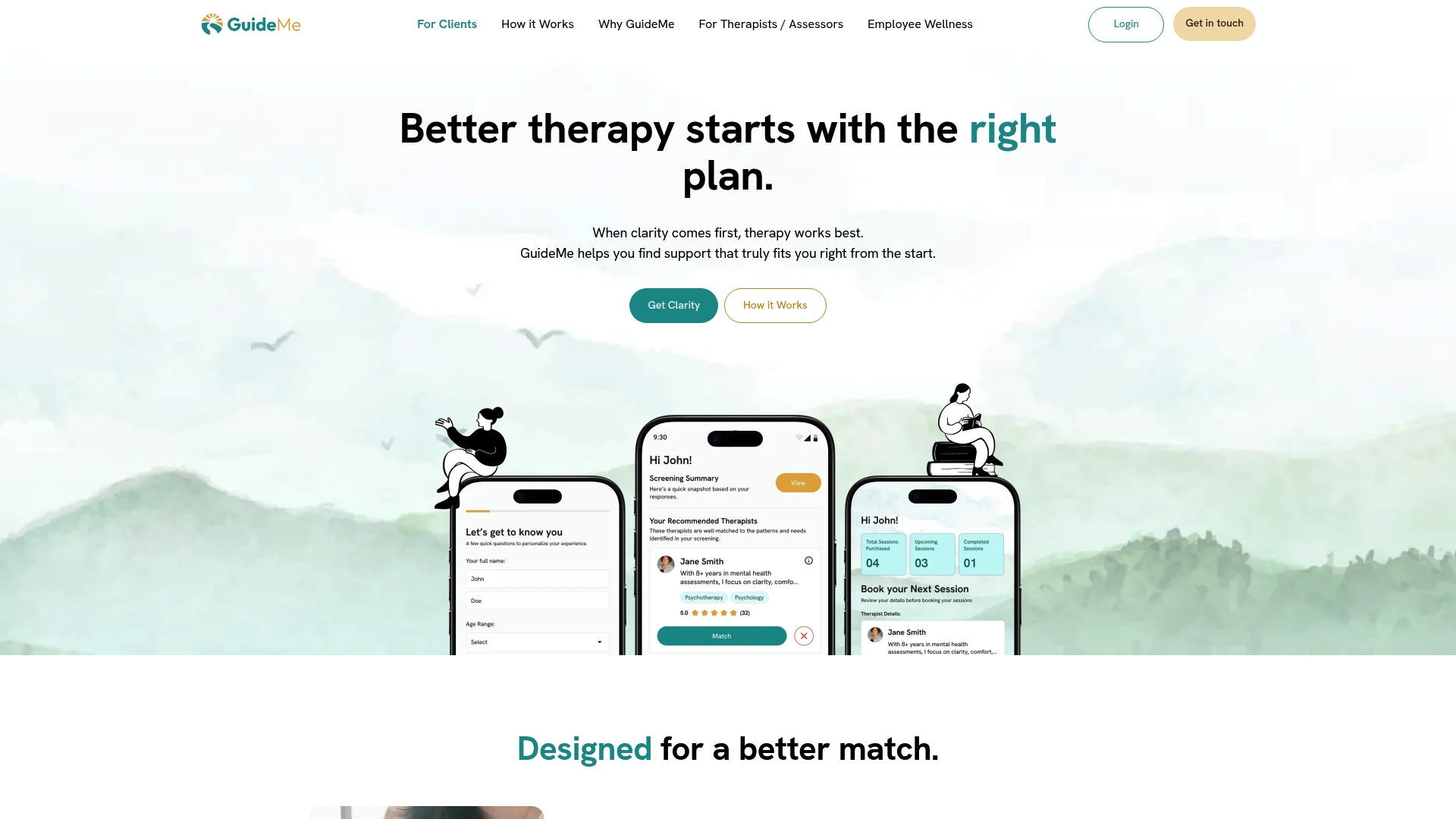
Choosing the right therapy type is hard enough without doing it completely alone. Guidemetherapy is a therapy navigation platform that combines human expertise with AI-powered matching to help you find the right therapist from the beginning. You receive an in-depth therapy plan based on your specific needs, and you are matched with therapists whose approach, speciality, and style genuinely suit you. There is no guessing and no scrolling through endless profiles. If you are ready to take the next step, start with Guidemetherapy and find a therapist you can actually work with.
FAQ
What is the first step in selecting a therapy type?
The first step is writing down two or three specific issues or goals you want to address. Translating your goals into clear issue areas makes it far easier to identify the right therapy type and find a therapist who specialises in your concerns.
How do I know which therapy type is right for me?
The right therapy type depends on what is maintaining your distress, not just your diagnosis. For example, avoidance-based anxiety responds well to exposure-focused CBT, while emotional dysregulation is better suited to DBT. A qualified therapist can help you identify the best match during an initial consultation.
Should I ask questions during a therapy consultation?
Yes. Treating a consultation as a two-way interview helps you assess fit, approach, and session structure before committing to full sessions. Ask about the therapist's experience with your specific concerns, how they measure progress, and what a typical session involves.
What if therapy is not working?
If you notice no meaningful change after six to eight sessions, raise it with your therapist and ask how progress is being measured. It may be that the approach needs adjusting, or that a different therapy type or therapist would be a better fit. Switching is a normal and constructive part of the process.
Does the type of therapy matter more than the therapist?
Research shows that therapeutic alliance predicts outcomes as strongly as the specific technique used. The relationship you have with your therapist is a significant factor in whether therapy works, so both the approach and the person delivering it matter.