
Texting your therapist between sessions is fine, but only when you've both agreed on it and the message is brief, non-urgent, and practical. It works well for rescheduling, quick check-ins, or homework updates. It doesn't replace a session and it's never a substitute for emergency support, so check your therapist's written messaging policy before you send anything.
TL;DR:
- Most therapists respond to non-urgent messages within one to three business days, and confidentiality policies may record texts as part of your file.
- Texting is appropriate for confirming appointments, brief check-ins, homework updates, or clarifying last session topics, but not for processing or emergency situations.
- Crisis situations involving imminent harm require immediate contact with emergency services or crisis lines, not messaging your therapist.
- Clear boundaries around messaging policies and response times should be discussed upfront to prevent misunderstandings and dependency.
- Platform matching processes aim to connect clients with therapists who have communication styles that suit their needs before issues arise with unclear boundaries.
Table of Contents
- When texting a therapist between sessions is appropriate
- What boundaries should you expect around response times and privacy?
- What should you actually text your therapist? (Templates and examples)
- What counts as a crisis, and who should you contact instead?
- How GuideMe thinks about messaging between sessions
- Why the messaging question usually points to a bigger mismatch
- How GuideMe supports clearer messaging arrangements
- Sources
When texting a therapist between sessions is appropriate
Most therapists welcome short, practical messages. The line gets blurry when a text starts doing the job a full session should do.
Appropriate uses fall into a few clear categories:
- Confirming, changing, or cancelling an appointment
- A brief check-in ("Had a rough morning, feeling steadier now")
- A quick update on homework, such as a mood log or a completed worksheet
- A short clarifying question about something discussed in your last session
Inappropriate uses look different. Sending a long message trying to work through a distressing event in real time, expecting the same depth of response you'd get face to face, or messaging repeatedly outside the hours you've agreed all cross into territory a text thread simply isn't built for.
There's a clinical reason for the boundary, not just a scheduling one, as explained on the Psychotherapy - John DeCosmo, D.O site. Therapists protect what's sometimes called therapeutic containment, the idea that difficult material gets processed safely inside the structure of a session, with time to sit with what comes up. Text strips that structure away. It also guards against a dependency where between-session contact starts substituting for the working relationship itself, which tends to weaken the therapy rather than support it.
What boundaries should you expect around response times and privacy?
Ask your therapist directly what their messaging policy is. Most will have one, even if it's never been written down for you.
Typical boundaries worth clarifying upfront:
- Response windows: many therapy platforms set expectations of one to three business days for non-urgent messages, and private practitioners often mirror something similar, commonly 24 to 72 hours on working days.
- Confidentiality: text exchanges may be recorded as part of your clinical file, so it's worth checking exactly what your informed consent covers regarding messaging.
- Practical limits: business hours only, no therapy conducted via text, and sometimes a rough cap on message length.
Pro Tip: If your therapist hasn't mentioned a messaging policy, ask them directly in your next session: "What's the best way to reach you between appointments, and how quickly should I expect to hear back?" It's a completely normal question, and a good therapist will welcome it.
Secure, HIPAA-style messaging platforms and documented response windows exist precisely to reduce these misunderstandings, so both of you know what to expect from the channel before you rely on it.
What should you actually text your therapist? (Templates and examples)
Good between-session messages are short, purposeful, and clear about what response, if any, you need.
Templates you can adapt:
- "Hi, I need to reschedule Thursday's session. Are you free any time Friday or Monday?"
- "Quick check-in, today was tough but I used the grounding exercise and it helped."
- "Finished this week's homework, wanted to flag one question for our next session rather than now."
- "Could we move my Tuesday session earlier in the day this week, if that works for you?"
- "Could you send me the worksheet from last time? I think I misplaced my copy."
- "Got the reading list, thank you. No response needed."
- "Not urgent, just wanted to note a change in my sleep since we last spoke, to bring up next time."
- "Running five minutes late for our video call, sorry."
Three examples to avoid, and why:
- "I can't stop thinking about what we talked about, can you call me now?" This asks for immediate therapeutic processing, which text can't safely deliver.
- A long paragraph detailing a childhood memory that surfaced unexpectedly, sent hoping for analysis before the next session.
- Multiple messages sent within an hour when the first goes unanswered, which pressures a response time neither of you agreed to.
Keep the tone concise, name the purpose in the first line, and set your own expectation clearly, something like "no rush, just flagging for next time" does more work than it looks like.
What counts as a crisis, and who should you contact instead?
A crisis means suicidal intent, self-harm in progress, or any situation involving imminent risk to you or someone else. Texting your therapist is not a reliable emergency route. Messages may go unread for hours, and even the most conscientious therapist can't guarantee they'll see a text the moment it matters most.
Use these instead, in order of urgency:
- Call 999 for immediate danger to life
- Use NHS 111 for urgent (non-emergency) health advice
- Contact your local NHS mental health crisis team
- Samaritans are available 24/7 by phone
Crisis lines exist specifically because immediate, dedicated support works better than waiting on a personal inbox. If your therapist has given you an out-of-hours plan, follow its exact steps rather than improvising a text.
How GuideMe thinks about messaging between sessions
Messaging between sessions works best as a bridge, not a substitute. It can keep momentum going and support homework, but it was never designed to replace the depth of a live session, and platforms offering text-based therapy are usually upfront about that limit.
At Guidemetherapy, we see between-session contact as one small piece of a much bigger picture: the right therapist, a clear plan, and boundaries that actually get discussed rather than assumed. If you're building healthier habits around waiting for your next appointment, our journalling prompts for therapy prep are worth trying, and our guide to therapy boundaries walks through how to raise the topic without it feeling awkward.
Why the messaging question usually points to a bigger mismatch
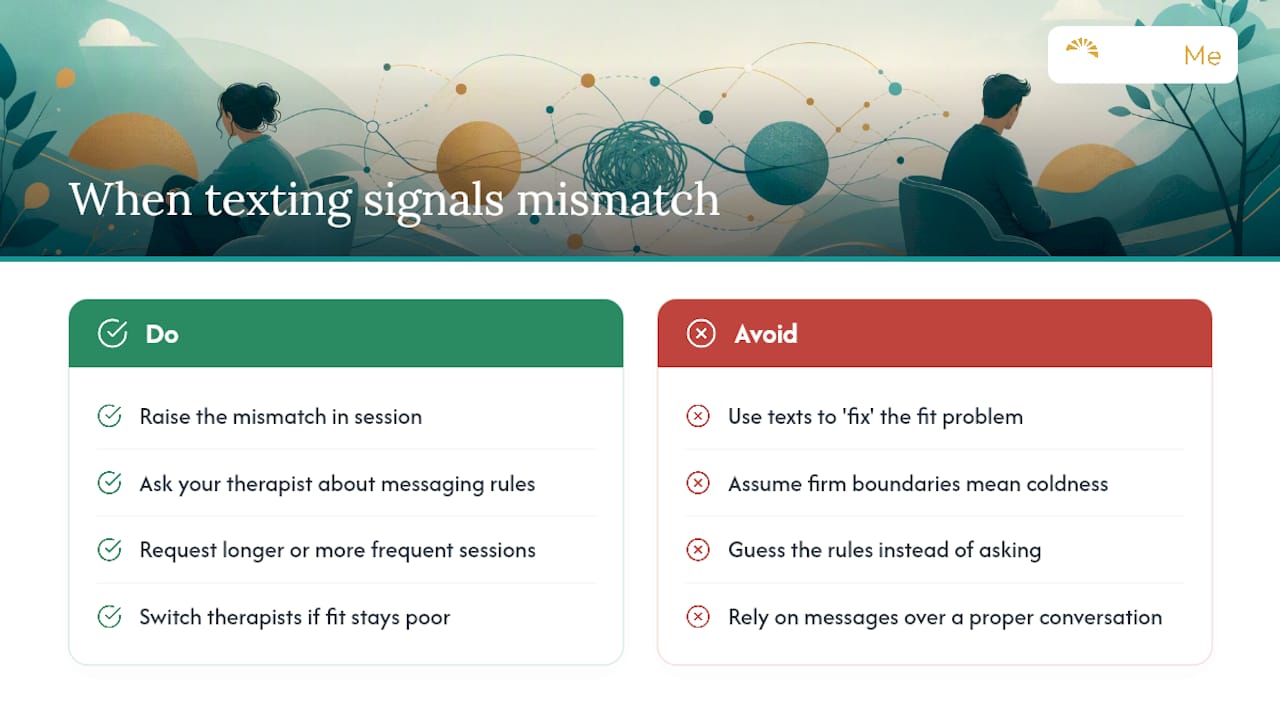
The truth about texting between sessions is that the anxiety around it rarely comes from the texting itself. It comes from uncertainty about whether the relationship can hold difficult feelings until the next appointment. If you're constantly tempted to message your therapist because a session felt rushed or incomplete, that's not really a texting problem. It's a signal that the therapeutic fit, or the session length, or the frequency, isn't quite right.
Therapists who set firm, clearly explained boundaries around messaging aren't being cold. Good boundaries protect the container that makes therapy work in the first place, and a therapist who explains theirs clearly, rather than leaving you to guess, is usually a good sign of the relationship generally. The mistake most people make is treating texting as the fix for a mismatch that actually needs a proper conversation, or a different therapist altogether.
— Yetty
How GuideMe supports clearer messaging arrangements
Finding out your therapist's messaging policy after months of guessing wastes time you don't get back. Guidemetherapy solves that earlier, at the matching stage, so you know what to expect before you've built a relationship around uncertain assumptions.
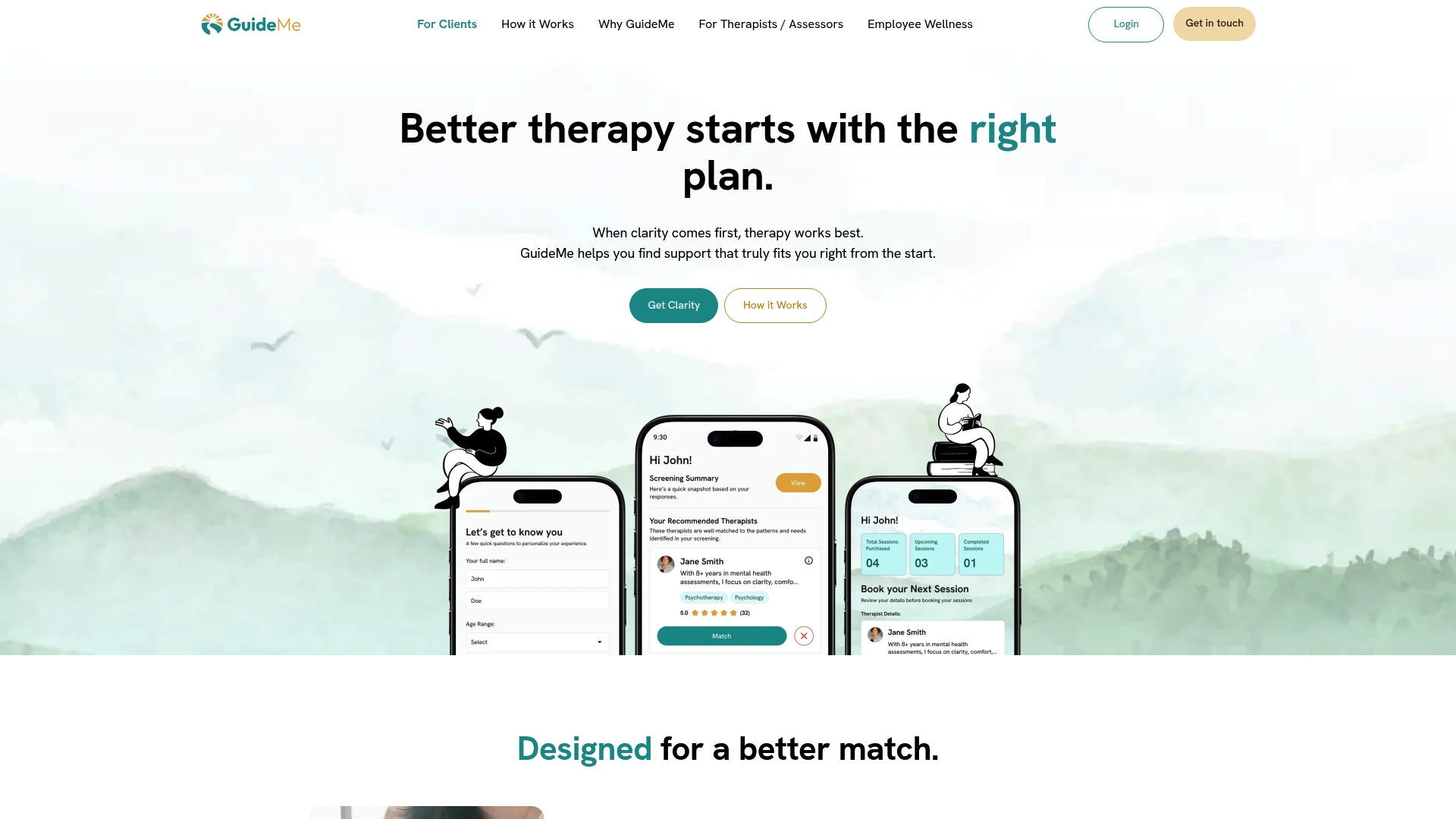
The platform combines an in-depth screening process with AI-assisted, human-led matching, aiming to connect you with a therapist whose communication style suits your preferences. That's a different starting point from booking blind and discovering the boundaries only once a text goes unanswered. It also provides resources for session preparation and boundary-setting conversations to help clarify messaging expectations early on. If you're currently searching for a therapist, or wondering whether your current arrangement fits, start your match with Guidemetherapy and get a plan built around how you actually want support to work between appointments.