

TL;DR:
- Legal compliance in therapy involves adhering to HIPAA rules and professional standards to protect client data and maintain trust. It requires ongoing efforts like risk analyses, signed agreements, and proper handling of psychotherapy notes to prevent enforcement actions and foster ethical practice.
Legal compliance in therapy is defined as the set of statutory obligations, regulatory frameworks, and professional standards that govern how therapists collect, store, and protect client information whilst delivering care. The role of legal compliance in therapy extends well beyond paperwork. It determines whether clients can trust their therapist with sensitive disclosures, and whether therapists can practise without facing enforcement action. In 2026, the regulatory environment has intensified, with HIPAA, the American Association for Marriage and Family Therapy (AAMFT), and the American Counseling Association (ACA) all setting expectations that carry real professional and financial consequences. Understanding these obligations is not optional. It is the foundation of safe, ethical practice.
What are the key legal obligations therapists must comply with in 2026?
Therapists, including those in solo practice, are fully covered entities under HIPAA with mandatory compliance across three distinct rules: the Privacy Rule, the Security Rule, and the Breach Notification Rule. This applies regardless of practice size. A sole practitioner working from a single consulting room carries the same legal weight as a large mental health clinic.

The HIPAA Privacy Rule governs how therapists use and disclose protected health information (PHI). Clients have the right to access their records, request amendments, and receive a notice of privacy practices. The Security Rule focuses on electronic PHI and requires therapists to conduct a formal Security Risk Analysis, implement multi-factor authentication, and maintain written security policies. HIPAA enforcement actions against therapists most frequently cite failures in Security Rule compliance, particularly missing or outdated risk analyses. That pattern tells you where regulators are looking first.
Psychotherapy notes occupy a special category under HIPAA. They require separate written authorisation for release and must be stored apart from standard medical records. A blanket release form does not satisfy this requirement. Many therapists overlook this distinction entirely, which creates a significant compliance gap.
The Breach Notification Rule requires therapists to notify affected clients, the Department of Health and Human Services, and in some cases the media, when a data breach occurs. Timelines are strict. Delays in notification have triggered enforcement action.
Key legal obligations for therapists in 2026 include:
- Conducting and documenting a Security Risk Analysis at least annually
- Signing Business Associate Agreements (BAAs) with any vendor handling PHI, including telehealth platforms and billing software
- Providing clients with a Notice of Privacy Practices at the start of treatment
- Responding to client record access requests within the statutory timeframe
- Storing psychotherapy notes separately from other clinical records
- Maintaining written policies on data security and staff training
Pro Tip: Review your BAAs every time you adopt a new technology platform. A telehealth tool or AI notetaking app that handles PHI without a signed BAA puts you in immediate breach of HIPAA.
How do ethical standards intersect and sometimes conflict with legal compliance?
Ethics and law are distinct frameworks, and therapists must follow the higher standard when the two diverge. The AAMFT Code of Ethics is explicit on this point: ethical standards are enforceable and provide mandatory guidance in areas where law is silent. The ACA takes a similar position. This means that being legally compliant is not automatically the same as being ethically compliant.
The clearest point of tension is mandatory reporting. Legal mandates for reporting child maltreatment or imminent harm override a therapist's clinical discretion. Research shows this creates moral distress and over-reporting among therapists who face unclear legal thresholds. Over-reporting is not a neutral act. It can damage the therapeutic relationship and discourage clients from disclosing future risk.
"Therapists often transition from therapeutic to defensive practice in response to legal compliance demands, potentially harming client care if not carefully managed."
This shift towards defensive practice is one of the least discussed consequences of legal pressure in mental health settings. When therapists prioritise liability protection over clinical judgement, the quality of care suffers. Clients sense it.
Strategies for navigating ethics and law together include:
- Consulting your professional body's ethics guidance before acting on a legal mandate where the two appear to conflict
- Documenting your clinical reasoning thoroughly when you make a mandatory report
- Seeking supervision or peer consultation when facing an ethics-law dilemma
- Reviewing the role of confidentiality in therapy to understand where legal limits apply
Ethical standards in therapy exist to protect clients in situations the law has not anticipated. Treating them as secondary to legal compliance misunderstands both frameworks.
What practical steps can therapists take to maintain compliance?
Compliance is not a single event. It is a set of ongoing responsibilities that require regular attention. The most common failure point for solo practitioners is treating initial setup as sufficient. Many solo practices lack written policies, regular training, or documented risk analyses. That gap is precisely where enforcement actions begin.
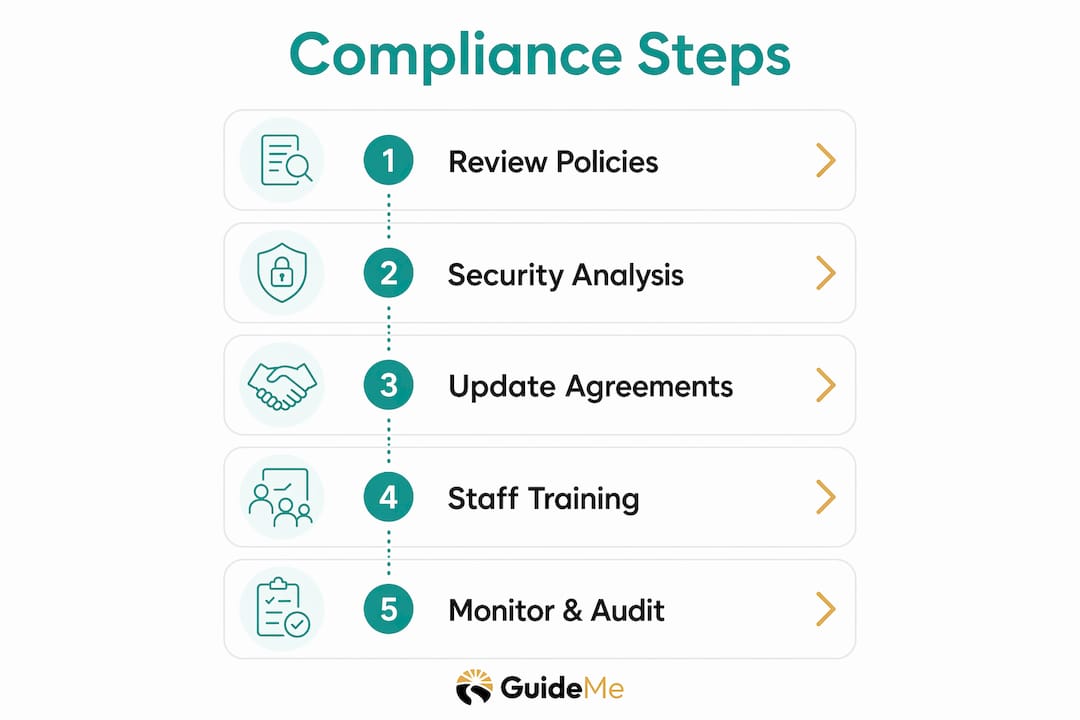
A practical compliance framework for therapists in 2026 looks like this:
- Conduct a Security Risk Analysis annually. Document every system that stores or transmits PHI. Identify vulnerabilities and record the steps you took to address them. Regulators request this document during investigations.
- Audit your vendor agreements. Every platform you use for scheduling, billing, telehealth, or clinical notes must have a signed BAA in place before you share any client data.
- Treat informed consent as an ongoing dialogue. Informed consent is a continuous process, not a form signed at intake. Revisit confidentiality limits, reporting obligations, and data handling with clients as their treatment evolves.
- Handle record access requests promptly. Between 2019 and 2025, 46 enforcement actions were taken under HIPAA's Right of Access mandate, with fines reaching $200,000. Solo practitioners have been fined $100,000 for failing to respond to record requests on time.
- Store psychotherapy notes separately. Keep them in a distinct file from standard medical records and require explicit written authorisation before releasing them.
Pro Tip: Set a calendar reminder each january to review your Security Risk Analysis, update your BAAs, and check for any regulatory changes. Compliance is far easier to maintain than to rebuild after an enforcement action.
The table below summarises the most common compliance gaps and the corrective action for each.
| Compliance gap | Corrective action |
|---|---|
| No documented Security Risk Analysis | Complete and date a formal analysis; repeat annually |
| Missing or unsigned BAAs | Audit all vendors and obtain signed agreements before sharing PHI |
| Informed consent treated as a one-off form | Revisit consent discussions at key points throughout treatment |
| Psychotherapy notes stored with medical records | Separate storage and require explicit written authorisation for release |
| No written data security policy | Draft and implement a policy covering access, storage, and breach response |
Understanding the therapy intake process is a useful starting point for building informed consent into your practice from the very first session.
What are the consequences of non-compliance for therapists?
Non-compliance carries financial, professional, and relational consequences. The financial penalties under HIPAA are not theoretical. Solo practitioners have received fines of $100,000 for ignoring timely record requests. Enforcement actions related to the Right of Access mandate alone numbered 46 between 2019 and 2025. These are not edge cases. They reflect a consistent regulatory focus on therapist compliance.
Beyond fines, non-compliance damages client trust. When a client discovers that their psychotherapy notes were released without explicit authorisation, or that their data was stored on an unsecured platform, the therapeutic relationship rarely recovers. Mandatory reporting conflicts add another layer of risk: clients who feel their confidentiality was breached without clear justification may disengage from treatment entirely.
The benefits of building a compliance culture within your practice include:
- Reduced risk of enforcement action and financial penalties
- Stronger client trust, particularly around confidentiality and data handling
- Clearer clinical decision-making when ethics and law appear to conflict
- Better documentation habits that protect you in the event of a complaint
- A more confident, less defensive approach to clinical practice
Ongoing training is not a luxury for larger organisations. Solo practitioners who understand their legal responsibilities are better placed to avoid the compliance failures that regulators consistently target.
Key takeaways
Legal compliance in therapy requires therapists to meet HIPAA's Privacy, Security, and Breach Notification rules, follow ethical codes from bodies such as AAMFT and ACA, and treat informed consent as a continuous clinical responsibility rather than a one-time administrative task.
| Point | Details |
|---|---|
| HIPAA applies to all therapists | Solo practitioners carry the same compliance obligations as large mental health clinics. |
| Security Rule is the top enforcement target | Missing or outdated Security Risk Analyses are the most cited failure in HIPAA investigations. |
| Psychotherapy notes need separate handling | They require explicit written authorisation for release and must be stored apart from medical records. |
| Informed consent is ongoing | Treating it as a single intake form is both legally and ethically insufficient. |
| Non-compliance has real financial consequences | Fines for Right of Access violations have reached $200,000, including for solo practitioners. |
Where ethics and compliance meet in practice: my perspective
The conversation about legal compliance in therapy often gets framed as a burden. I understand why. The paperwork, the risk analyses, the BAAs — none of it feels like the reason most therapists entered this profession. But I think that framing is a mistake.
What I have observed is that the therapists who struggle most with compliance are the ones who treat it as separate from clinical work. They see HIPAA as an administrative obligation and ethics as the "real" practice. The two are not separate. When you handle psychotherapy notes with care, you are communicating to your client that their most private disclosures are protected. When you revisit informed consent as treatment progresses, you are reinforcing their autonomy. These are therapeutic acts.
The harder challenge is mandatory reporting. I have seen therapists experience genuine moral distress when a legal mandate forces a disclosure that their clinical judgement would not have made. That distress is valid. The answer is not to suppress it but to build the skills to navigate it: thorough documentation, peer consultation, and a clear understanding of where the law ends and ethical discretion begins. Viewing therapy boundaries clearly helps here.
Compliance, at its best, is a framework that supports good practice. It sets a floor, not a ceiling. The therapists I most respect are those who meet every legal requirement and then ask what ethics demands beyond that.
— Yetty
How Guidemetherapy supports therapists navigating compliance
Staying on top of legal compliance in therapy is demanding, particularly for solo practitioners who carry every responsibility alone. Guidemetherapy is a therapy navigation platform that helps therapists and clients build better working relationships from the start, with tools designed to support documentation, informed consent, and therapist-client matching.

Whether you are reviewing your compliance processes or looking for resources to support your clients through the therapy process, Guidemetherapy brings together human expertise and AI-powered matching to make the experience clearer for everyone involved. Visit Guidemetherapy to see how the platform supports both therapists and clients in building a more structured, trust-centred practice.
FAQ
What is the role of legal compliance in therapy?
Legal compliance in therapy refers to the statutory and regulatory obligations therapists must meet to protect client data, maintain confidentiality, and practise within the law. Key frameworks include HIPAA's Privacy, Security, and Breach Notification rules, alongside professional ethical codes from bodies such as AAMFT and ACA.
Does HIPAA apply to solo therapists?
HIPAA applies fully to solo practitioners. Solo therapists are covered entities under HIPAA and must meet all Privacy Rule, Security Rule, and Breach Notification Rule requirements, including conducting a formal Security Risk Analysis and signing BAAs with relevant vendors.
What happens if a therapist breaches HIPAA?
Enforcement actions can result in fines of up to $200,000. Between 2019 and 2025, 46 enforcement actions were taken under the Right of Access mandate alone, with solo practitioners among those fined for failing to respond to record requests on time.
How are psychotherapy notes different from other clinical records?
Psychotherapy notes require a separate, explicit written authorisation for release and must be stored apart from standard medical records. A blanket release form does not satisfy HIPAA requirements for this category of documentation.
When do ethics and legal compliance conflict in therapy?
Ethics and law conflict most commonly around mandatory reporting obligations. Legal mandates for reporting child maltreatment or imminent harm override clinical discretion, which can cause moral distress and lead to over-reporting. Therapists should follow the higher standard, document their reasoning thoroughly, and seek supervision when facing these dilemmas.