

TL;DR:
- Therapy outcome measurement uses standardized tools to track symptoms and progress during treatment. It enhances transparency, personalizes care, and enables early detection of ineffective approaches. Regular monitoring improves outcomes, supports better therapist matching, and fosters shared understanding between patients and clinicians.
Therapy outcome measurement means using standardised tools to track your symptoms, wellbeing, and day-to-day functioning throughout a course of therapy, so that both you and your therapist can see whether treatment is working. The Faculty of Medical Psychotherapy recommends a minimum set of these measures for psychotherapy services in the UK, and the NHS uses routine outcome monitoring as a model for clinical accountability. Guidemetherapy builds this same principle into its matching process, using screening data to connect you with a therapist whose expertise fits your specific needs.
Why does this matter to you?
- It makes therapy transparent: you can see progress in concrete terms, not just feel it.
- It helps detect early when a treatment approach is not working, before weeks are wasted.
- It supports personalised therapy plans by giving clinicians data to refine their approach.
- It improves therapist matching by revealing the type and severity of difficulties you face.
Table of Contents
- What counts as a therapy outcome measure?
- Why does outcome measurement improve care?
- Which measures will you encounter in UK therapy?
- How outcome measurement works in actual therapy sessions
- How to read your scores: what counts as real change?
- What you can do as a patient: questions to ask
- Common limitations and how to avoid misuse
- How long do measures take, and do they cost you anything?
- How outcome measurement supports personalised plans and better matching
- Key takeaways
- Scores are a conversation starter, not a verdict
- Guidemetherapy matches you with therapists who use outcome measurement
- Further reading and authoritative UK sources
What counts as a therapy outcome measure?
Patient-reported outcome measures (PROs) are questionnaires you complete yourself, capturing your subjective experience of symptoms, quality of life, and functioning. Clinician-rated measures are assessments completed by the therapist based on observation and clinical interview. Session-by-session trackers are short questionnaires completed before or after each appointment to catch week-to-week changes quickly.
Each category serves a different purpose:
- PROs (e.g. CORE-OM, PHQ-9, GAD-7): record what you notice about your own mental state.
- Clinician-rated measures: capture clinical observations that patients may not self-report accurately.
- Session trackers: brief scales used every week to flag sudden deterioration or plateau.
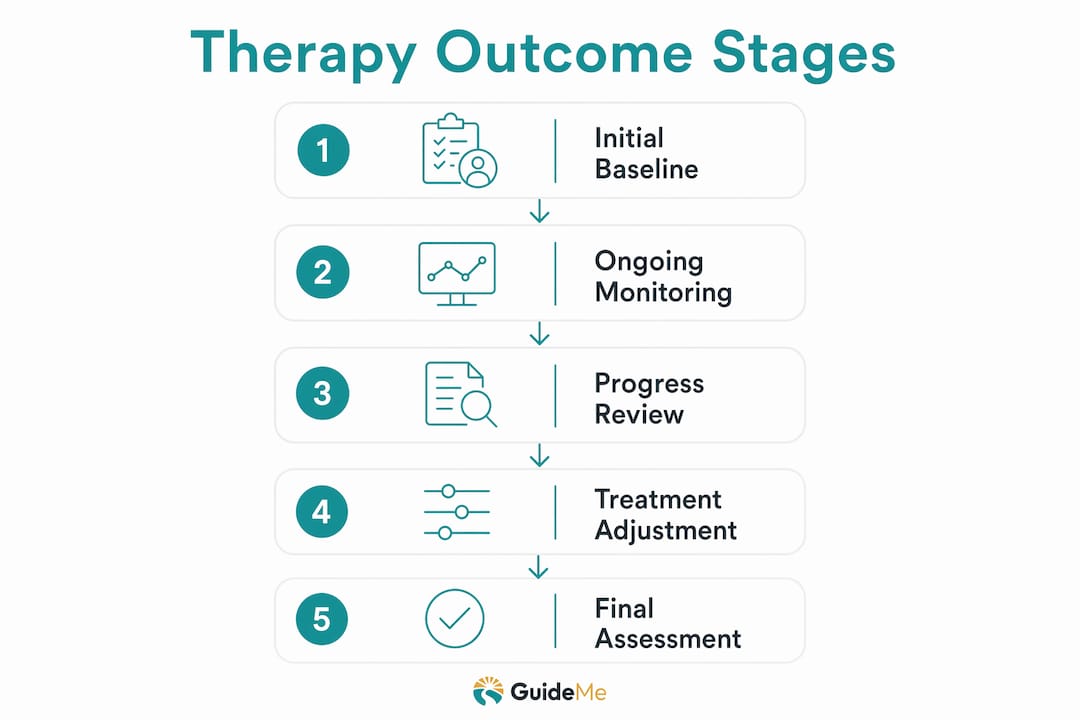
Measures are also used at different stages. A longer questionnaire at the start of therapy gives a baseline. Shorter versions track progress session by session. A full assessment at the end shows how much has changed and whether further support is needed.
Why does outcome measurement improve care?
Meta-analytic and review evidence consistently shows that feedback-informed monitoring reduces dropout and improves outcomes compared with standard care. When therapists receive regular data on how a patient is progressing, they can intervene earlier and adjust their approach before problems become entrenched.
The value-based healthcare case is equally clear. Measuring patient-centred outcomes drives transparency, enables benchmarking across services, and reveals variation in clinical practice that would otherwise go unnoticed. Commissioners and NHS services increasingly request outcome data precisely because it holds services accountable.
UK professional guidance reinforces this. The Royal College of Psychiatrists highlights the NHS Improving Access to Psychological Therapies (IAPT) programme's routine completion and review of measures as a model for the wider sector.
Which measures will you encounter in UK therapy?
| Measure | What it assesses | Items / time | Typical use | Psychometric quality | Benchmarks | Patient burden | Licensing |
|---|---|---|---|---|---|---|---|
| CORE-OM | Wellbeing, symptoms, functioning, risk | 5–10 min | Baseline and post-treatment | Strong; widely validated in UK | UK population norms available | Moderate | Free |
| PHQ-9 | Depression severity | 9 items / 2–3 min | Screening and session tracking | Excellent; internationally validated | Severity bands | Low | Free |
| GAD-7 | Anxiety severity | 7 items / 2 min | Screening and session tracking | Excellent | Severity bands | Low | Free |
| WSAS | Work and social adjustment / functioning | 5 items / 1–2 min | Baseline, mid- and post-treatment | Good; validated for multiple conditions | High scores suggest significant impairment | Very low | Free |
The Faculty of Medical Psychotherapy recommends CORE-OM and WSAS as part of a minimum set for psychodynamic services, alongside the Inventory of Interpersonal Problems (IIP) and a patient-experience questionnaire.
A few practical points on choosing between them:
- PHQ-9 and GAD-7 are ideal for depression and anxiety screening; they are brief and free.
- CORE-OM covers a broader range of difficulties and is better suited to complex presentations.
- WSAS focuses specifically on how symptoms affect work, home, and social life, making it useful when functional recovery is the goal.
- Longer measures suit assessment; shorter versions or single-domain tools work better for weekly tracking.
How outcome measurement works in actual therapy sessions
Data-informed therapy systems combine pre-treatment assessments with ongoing monitoring and algorithms that alert clinicians when a patient deviates from an expected recovery curve. In practice, this is less technical than it sounds.
The typical workflow looks like this:
- Baseline assessment: before your first session, you complete one or more measures to establish a starting point.
- Session-by-session tracking: a short questionnaire (often PHQ-9 or a brief CORE form) is completed before each appointment.
- Score review: your therapist reviews the trend at the start of the session, not just the latest number.
- Feedback loop: if scores plateau or worsen over several sessions, the therapist raises this with you and considers changing the approach.
- End-of-treatment evaluation: a full measure is repeated to compare with the baseline and decide whether further support is needed.
Routine outcome monitoring systems use empirically derived thresholds to flag patients at increased risk of treatment failure, giving the therapist a decision-support prompt rather than a definitive verdict.
How to read your scores: what counts as real change?

A single score tells you very little on its own. What matters is the direction and size of change over time. Outcome monitoring systems use expected recovery curves, derived from large datasets, to show whether your progress is on track, slower than typical, or heading in the wrong direction.
Clinically meaningful change is different from measurement noise. A one-point shift on the PHQ-9 from one week to the next is unlikely to mean much. A consistent five-point drop over four sessions is a genuine signal of improvement.
Watch for these patterns:
- Early response: significant improvement in the first two to four sessions often predicts a good overall outcome.
- Plateau: scores that stop moving after several sessions may indicate the current approach needs adjusting.
- Sudden deterioration: a sharp rise in scores between sessions warrants an immediate conversation with your therapist.
Pro Tip: Ask your therapist to show you your score trend on a graph rather than just the latest number. Seeing the trajectory makes it far easier to have a meaningful conversation about whether the current plan is working.
What you can do as a patient: questions to ask
You have every right to understand how your progress is being measured. Before or during your first session, consider asking:
- Which outcome measures does this service use, and why?
- How often will I complete them, and how long do they take?
- How will my scores influence the decisions we make together?
- Who has access to my data, and how is it stored?
- Can I opt out of measurement, and what happens if I do?
On consent and data privacy: any service operating in the UK must comply with UK GDPR. Your outcome data should be explained clearly in a privacy notice before you complete any questionnaire. You have the right to access your own data and to ask how long it is retained.
Outcome scores belong to the conversation between you and your therapist. They are a starting point for shared planning, not a verdict on how you are doing.
Use your scores actively. If a measure shows your functioning at work has not improved even though your mood has lifted, that is useful information for setting the next goal together.
- Review your baseline scores with your therapist at the start of treatment.
- Ask for a brief explanation of what each score means in plain language.
- Revisit scores at agreed review points and use them to co-design the next phase of your plan.
Common limitations and how to avoid misuse
Outcome measures are useful tools, not infallible tests. Knowing their limits helps you use them well.
Common limitations:
- Cultural and translation issues: many measures were developed in Western, English-speaking contexts. Scores may not carry the same meaning across all cultural backgrounds or languages.
- Measurement burden: completing multiple long questionnaires every session can feel tedious and reduce honest responding.
- False positives and negatives: a low score does not always mean a person is well; a high score does not always mean crisis.
- Overreliance on numbers: a therapist who adjusts treatment based solely on scores, without clinical conversation, is misusing the tool.
Red flags to watch for in a service:
- Scores are collected but never discussed with you.
- You are not told what the measures are for or how they affect your care.
- There is no shared planning around results.
- Scores appear to be used for administrative purposes rather than clinical ones.
Guidance consistently recommends combining PROs with clinician-rated assessments so that improvements in social and work adjustment are not missed. Numbers inform clinical judgement; they do not replace it.
How long do measures take, and do they cost you anything?
Most measures used in UK therapy are brief. PHQ-9 and GAD-7 each take around two to three minutes. WSAS takes one to two minutes. CORE-OM, the most detailed of the common UK measures, takes five to ten minutes.
In terms of frequency, session-by-session trackers are completed before each appointment. Longer assessments are typically used at three key points: before treatment starts, at a mid-treatment review, and at the end.
Cost to you as a patient is usually nothing. PHQ-9, GAD-7, and WSAS are freely available. CORE-OM is also free to use. Some specialist or commercial outcome systems carry licence fees, but these are paid by the service or platform, not the individual. Within NHS services, all measurement is provided as part of care. In private practice, the cost is absorbed by the therapist or clinic. Employers who commission corporate therapy services typically cover the cost of any measurement platform used in their employee wellbeing programme.
How outcome measurement supports personalised plans and better matching
Combining PROs with clinician assessments gives a fuller picture of your difficulties than either alone. A PHQ-9 score shows depression severity; a WSAS score shows how that depression is affecting your ability to work and maintain relationships. Together, they help a therapist identify whether cognitive behavioural therapy, psychodynamic work, or another modality is the better fit, and whether the therapist's specific expertise aligns with your needs.
Data-informed therapy goes further: systems that track progress against expected recovery curves can flag mid-course problems before they become crises. Consider a person whose PHQ-9 scores improve steadily for six sessions, then plateau. Without measurement, this might go unnoticed for weeks. With it, the therapist can raise the plateau in session, explore what has changed, and adjust the approach, perhaps introducing a different technique or considering a referral for a more specialist assessment.
When outcome data is built into the matching process from the start, the chance of a good fit between patient and therapist increases substantially.
Pro Tip: When exploring therapy platforms or services, ask directly whether their matching process uses outcome data and benchmarks. A platform that uses your screening results to inform therapist selection is offering something meaningfully different from a directory search.
- Outcome data helps identify which therapeutic modality suits your presentation.
- Baseline scores guide therapist selection by revealing severity and functional impact.
- Ongoing tracking allows personalised therapy plans to be adjusted in real time.
- Shared review of scores builds a collaborative therapeutic relationship from the outset.
Key takeaways
Therapy outcome measurement works because standardised tools give both patients and therapists objective data to guide decisions, catch problems early, and personalise care throughout treatment.
| Point | Details |
|---|---|
| What it is | Standardised questionnaires (CORE-OM, PHQ-9, GAD-7, WSAS) that track symptoms, wellbeing, and functioning. |
| Why it matters | Feedback-informed monitoring reduces dropout and improves outcomes compared with standard care. |
| Reading your scores | Consistent trends over several sessions matter; single-point fluctuations are usually measurement noise. |
| Your rights | Ask which measures are used, who sees the data, and how scores influence your care plan under UK GDPR. |
| Guidemetherapy | Uses screening and outcome data from the start to match you with a therapist whose expertise fits your needs. |
Scores are a conversation starter, not a verdict
There is an understandable worry that filling in a questionnaire every week reduces a complex, personal experience to a number. Clinicians who use these tools well treat scores exactly as a clinical temperature check: a prompt to open a conversation, not a label to attach to a person.
If your therapist shows you a score and moves on without explanation, ask them to pause. What does this number mean in practice? What would you expect it to look like in four sessions' time? How does it compare with people who have similar difficulties? Those questions turn a passive data-collection exercise into genuine shared planning, which is where the real value of measurement lies. Seek out services and therapists who treat your scores as yours, not just theirs.
Guidemetherapy matches you with therapists who use outcome measurement
Feeling clearer about what outcome measurement is does not always make it easier to find a therapist who uses it well. Guidemetherapy takes the searching out of that process. The platform begins with an in-depth therapy screening that captures your symptoms, functioning, and goals, then uses that data, alongside human expertise and AI-assisted matching, to connect you with a therapist whose clinical approach and experience fit your specific picture.
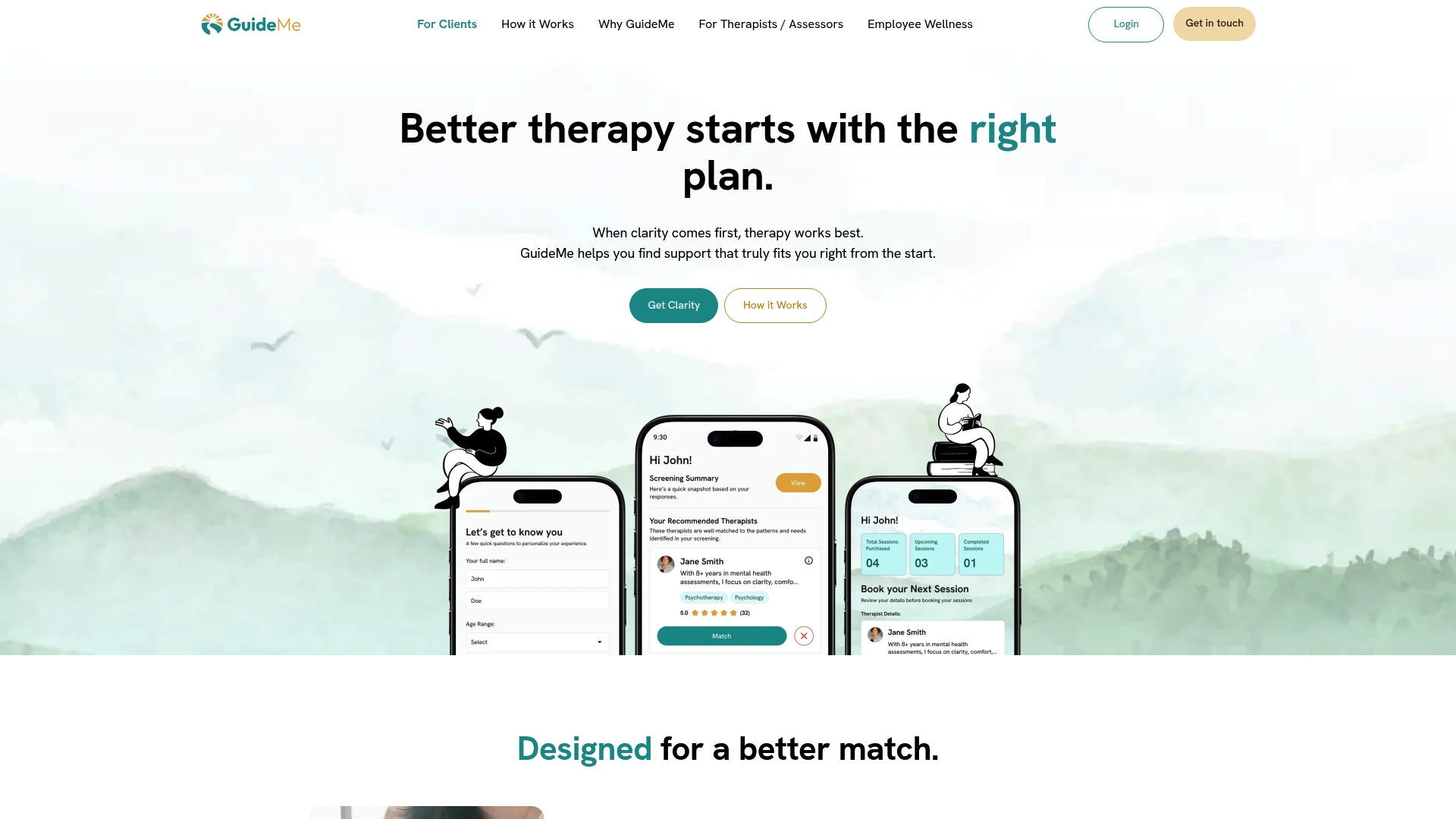
You get a personalised therapy plan before your first session, not after several false starts. Measurement stays part of the process throughout, so progress is visible and your plan can be adjusted when it needs to be. Whether you are an individual looking for the right fit or an employer exploring workplace mental health support, the platform is built to make measurement-informed care accessible from day one. Start your therapy plan with Guidemetherapy today.
Further reading and authoritative UK sources
The sources below underpin the evidence in this article and are worth reading if you want to ask more informed questions of a therapist or service.
UK-specific guidance:
- Faculty of Medical Psychotherapy: Outcome measures for psychodynamic psychotherapy services — the Royal College of Psychiatrists document setting out recommended minimum measures (CORE-OM, WSAS, IIP) and timepoints for UK psychotherapy services.
- CORE-OM psychometric properties (British Journal of Psychiatry) — the primary validation study for CORE-OM, useful for understanding what the measure can and cannot tell you.
Broader evidence syntheses:
- Outcome measures for practice (Annual Reviews) — a peer-reviewed review of meta-analytic evidence on feedback-informed monitoring and measurement-based care.
- Continuous outcome measurement in data-informed psychotherapies (PMC) — covers session-by-session tracking, decision rules, and clinical alert systems in plain terms.
- Why measuring outcomes matters in healthcare (PMC) — explains the value-based care rationale for routine measurement.
- Patient-reported outcome measures: importance and use (Springer) — explains why PROs are central to personalising treatment and informing commissioning decisions.
Practical selection guidance:
- How to choose a therapy outcome measure — a practical guide to aligning measure choice with purpose, balancing length with feasibility, and checking licensing costs.
Use the UK-specific sources to check whether a service you are considering follows recognised guidance. Use the evidence syntheses to understand what the research actually shows about measurement-informed care, rather than relying on a service's own claims. If a therapist or platform cannot tell you which measures they use and why, that is worth noting before you commit.
This article provides general information about therapy outcome measurement and is not a substitute for professional clinical advice. Always discuss your specific situation with a qualified mental health professional or your GP.