

TL;DR:
- A therapy intake workflow pre-qualifies clients through administrative steps, ensuring the first session focuses on clinical rapport.
- Platforms use automation and human judgment to streamline screening, consent, and scheduling, reducing delays.
A therapy intake workflow is the standard sequence of pre-session steps that moves you from your first enquiry to a confirmed appointment, with all the administrative and financial work completed beforehand. The goal is straightforward: by the time you sit down with a therapist, the paperwork is done, consent is signed, and the clinical hour belongs entirely to you.
On a therapist-matching platform like Guidemetherapy, the therapy intake process typically covers:
- Enquiry capture — your initial contact or registration
- Pre-screening — a brief fit check (often automated, sometimes a short call)
- Digital paperwork and consent — forms covering your history, goals, and GDPR rights
- Payment or fee confirmation — session costs, deposits, or card-on-file
- Scheduling — booking your first appointment
- Reminders and welcome information — what to expect before session one
Professional registration checks (BACP, UKCP, HCPC) and GDPR-compliant data handling are part of a well-run intake on any reputable UK platform. The intake is also a two-way process: you are assessing therapist fit just as much as the platform is gathering your information.
Table of Contents
- How the therapy intake workflow unfolds, step by step
- What intake forms and questions will actually ask you
- How automation and people should share the intake work
- Your privacy rights and professional safeguards in the UK
- A practical pre-intake checklist for therapy seekers
- Typical timeline and costs from enquiry to first session
- What happens after intake: care plans and next steps
- Key takeaways
- Why the intake process deserves more attention than it usually gets
- How Guidemetherapy supports a smoother intake and better match
- Useful sources and further reading
How the therapy intake workflow unfolds, step by step
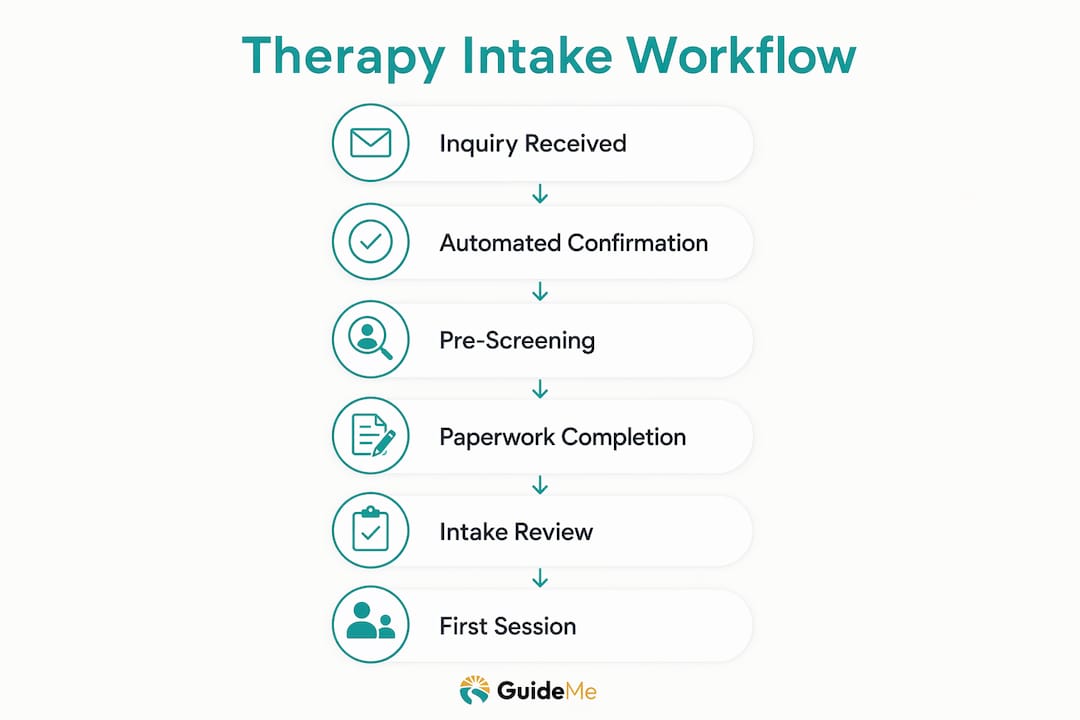
A well-designed client intake workflow follows a clear sequence. Here is what you can expect on a platform-led process:
- Enquiry or registration — You submit a form, start a chat, or complete an initial screening questionnaire. Confirmation arrives immediately.
- Automated eligibility check — The platform checks for duplicate records and routes your enquiry to the right service type. This is instant.
- Pre-screening or fit call — A brief call or AI-assisted conversation to clarify your presenting concern, preferred modality, and any urgent needs. Typically happens within 24 hours.
- Document and consent distribution — Intake forms, privacy notices, and consent documents are sent as a single welcome packet. Unified welcome packets reduce client anxiety and increase the likelihood that forms are completed before the first session.
- Payment or card-on-file step — Fee confirmation, deposit (where applicable), or employee assistance programme verification. Clarifying fees at this stage avoids unexpected costs later.
- Scheduling — You choose a session time; the platform writes this to the clinician's calendar automatically.
- Reminder cadence — Automated reminders are sent 48 hours and 24 hours before your appointment.
- Clinician hand-off — Your completed intake data is reviewed by the assigned therapist before session one.
Timeline to expect: automated confirmations are immediate; pre-screening and paperwork are usually completed within 24–72 hours; your first session is commonly scheduled 3–14 days after enquiry, depending on therapist availability.
Pro Tip: Moving administrative and financial steps to the pre-session phase protects the clinical hour so your first session focuses on rapport and clinical fit, not paperwork.
What intake forms and questions will actually ask you
Intake forms are not just administrative boxes to tick. Clinicians use your answers to prepare clinically before you meet, which means thorough responses genuinely reduce the time spent collecting background in session one.
The core question categories you will encounter:
- Contact and demographics — name, date of birth, GP details, emergency contact
- Presenting problem and goals — what brings you to therapy now, and what you hope to achieve
- Clinical and medication history — previous diagnoses, current medication, relevant physical health
- Risk and crisis screening — questions about self-harm, suicidal ideation, or harm to others (answered honestly, these help the clinician prepare appropriately)
- Previous therapy — what approaches you have tried and how they went
- Logistics — preferred language, session modality (video, phone, in-person), availability
- Payment and consent — fee agreement, GDPR consent, and limits of confidentiality
Pro Tip: Your answers to the risk screening and primary presenting problem fields carry the most weight in therapist allocation. Be specific rather than vague — "low mood and difficulty sleeping for six months" is more useful than "feeling down."
How automation and people should share the intake work
Good platforms use automation to handle routine admin and preserve human judgement for the moments that matter most: assessing clinical fit and responding to complex or urgent presentations.

| Approach | What it automates | Where humans stay involved |
|---|---|---|
| Full automation | Forms, scheduling, reminders | Minimal — clinician reviews notes before session |
| Hybrid (AI-led + human review) | Capture, routing, reminders | Human reviews fit, handles complex cases |
| Human-first | Manual pre-screening only | Every step involves a person |
A hybrid model offers the best balance for most therapy seekers. Multi-step, progressive forms complete at significantly higher rates than long static forms, and automated routing means your enquiry is not sitting in an inbox waiting for someone to notice it.
When evaluating a platform, look for:
- Fast initial response (within minutes, not hours)
- A single, unified welcome packet rather than multiple separate emails
- Clear statements on data storage and retention
- A named human contact for complex or urgent presentations
- Crisis-routing capability for high-risk disclosures
Guidemetherapy uses human-led matching supported by AI-assisted screening. The AI handles capture and initial fit logic; a human reviews the match before it is confirmed. This means clinician empathy is preserved at the point where it matters most.
Your privacy rights and professional safeguards in the UK
UK law and professional standards set clear expectations for how your data and welfare are handled during intake.
- GDPR — health data is a special category under UK GDPR. The platform must obtain explicit consent before processing it and must explain how long it is retained and who can access it.
- Secure storage — reputable platforms use encrypted storage and have data-processing agreements with any third-party tools they use.
- Telehealth consent — if sessions are online, you should receive a separate consent statement covering the specific risks and limitations of remote therapy.
- Professional registration — ask to see your therapist's registration number with BACP, UKCP, or HCPC. These registers are publicly searchable and confirm the therapist meets professional training and ethical standards.
Confidentiality in therapy has limits. A therapist is required to break confidentiality if they believe you or someone else is at serious risk of harm, or if a court orders disclosure. A good intake process explains these limits clearly before your first session, not during it.
Trust signals to look for on any platform: a visible privacy policy link, therapist registration numbers, a physical or registered business address, and a clear statement of who holds your clinical record.
A practical pre-intake checklist for therapy seekers
Arriving prepared makes the process faster and your first session more focused. Work through this before you complete your intake forms:
- Personal details — full name, date of birth, GP name and surgery address, emergency contact
- Current medication — names, doses, and prescribing clinician
- Presenting problem summary — two or three sentences on what is bringing you to therapy now and how long it has been going on
- Goals — what you would like to be different after therapy
- Previous therapy — approaches tried, approximate dates, and what helped or did not
- Logistics — preferred days and times, modality preference (video, phone, in-person), any accessibility needs
- Payment — your payment method and any questions about fees, sliding scale, or cancellation charges
- Tech check (for telehealth) — test your browser, camera, and microphone in advance; confirm you have a private, quiet space
Questions worth asking during the screening call:
- What therapeutic approach do you use, and why might it suit my situation?
- What is your cancellation policy and how much notice do you need?
- How long are sessions, and how frequently would you recommend we meet?
Pro Tip: A therapy checklist completed before intake reduces back-and-forth and means your clinician receives a complete picture before session one.
Typical timeline and costs from enquiry to first session
Timeline at a glance:
- Automated confirmation: immediate
- Pre-screening call or fit assessment is typically completed shortly after enquiry
- Forms and consent are usually completed within a few days after enquiry.
- First session scheduled: typically 3–14 days after enquiry
Cost expectations in UK private therapy:
- Per-session fees vary considerably by clinician, region, and specialism. Asking for a clear fee breakdown during intake is standard practice and any reputable platform will provide one.
- Some platforms or practices request a deposit or card-on-file at the point of booking. This is common and reduces no-shows for both you and the therapist.
- If your employer offers an employee assistance programme, confirm eligibility during intake to avoid paying out of pocket unnecessarily.
- Cancellation policies typically require 24–48 hours' notice; late cancellations may incur a fee.
Industry guidance consistently recommends verifying fees and payment terms before the first session to avoid unexpected financial friction later.
Fees vary by clinician, region, and service type. Always ask for a written fee breakdown during intake and confirm whether the platform or the therapist collects payment directly.
What happens after intake: care plans and next steps
Once your intake is complete, several things happen in quick succession:
- Confirmed appointment — you receive a calendar invitation and session link (for telehealth) or address details.
- Clinician preparation — your therapist reviews your intake responses and may note initial clinical observations or suggested focus areas.
- Care plan or initial goals — some platforms assign a suggested therapy plan or initial session agenda based on your intake answers.
- Assessment measures — you may be asked to complete a brief standardised questionnaire (such as the PHQ-9 or GAD-7) before session one.
Your record may be touched by an intake coordinator, the assigned clinician, and in some services a clinical supervisor. Each has a defined role: the coordinator manages logistics, the clinician holds the clinical record, and the supervisor provides oversight.
If you do not receive a confirmation or welcome packet within 48 hours of completing your forms, contact the platform directly. A well-run therapy onboarding process should never leave you waiting without knowing what comes next.
Key takeaways
A well-run therapy intake workflow moves all admin to the pre-session phase so your first appointment focuses entirely on clinical fit and rapport.
| Point | Details |
|---|---|
| Complete admin before session one | Finishing forms, consent, and payment before your first session protects the clinical hour for therapeutic work. |
| Intake is two-way | Use the process to assess therapist responsiveness, organisation, and communication style, not only to provide information. |
| Ask about registration early | Verify BACP, UKCP, or HCPC registration and ask for data-handling details before your first session. |
| Honest, detailed answers matter | Clinicians use intake data for clinical preparation; thorough responses reduce background-gathering in session one. |
| Guidemetherapy | Uses human-led matching with AI-assisted screening to balance speed and clinical fit from the first step. |
Why the intake process deserves more attention than it usually gets
Most people treat intake as a formality to get through before the "real" therapy begins. That framing misses something important. The way a platform handles your first contact tells you a great deal about how it will handle everything else: whether it respects your time, whether it communicates clearly, and whether the people behind it have thought carefully about what you actually need.
The shift to platform-based matching has made intake faster and more consistent, which is genuinely good. But speed without human judgement at the matching stage can produce a technically efficient process that still puts you in front of the wrong therapist. The rapport built in those early interactions is not a soft extra; it is one of the strongest predictors of whether therapy will help you.
My view is this: treat the intake as your first opportunity to evaluate the platform and the therapist, not just a queue to join. A clinician who responds thoughtfully to your screening answers, a platform that sends one clear welcome message rather than five confusing emails, a privacy policy that actually explains what happens to your data — these are not minor details. They are the signals that tell you whether the care you are about to receive will be worth your time and money.
How Guidemetherapy supports a smoother intake and better match
Finding the right therapist is hard enough without an intake process that leaves you confused about what happens next. Guidemetherapy was built to change that. The platform combines in-depth therapy screening with human-led matching, so you are not simply handed to the first available clinician but matched based on your presenting concerns, goals, and preferences.
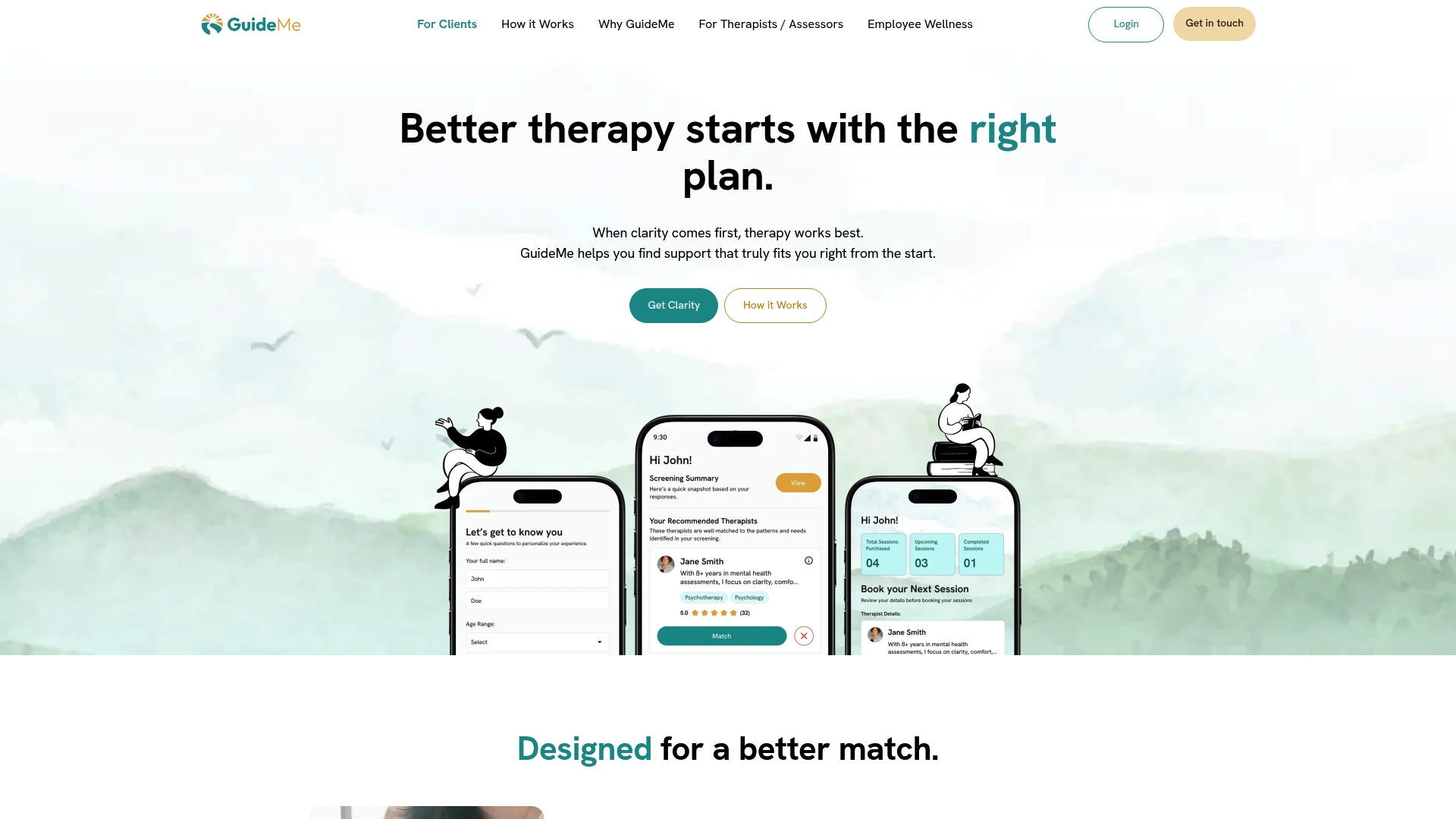
Every person who comes through Guidemetherapy receives a unified welcome experience: clear information about their matched therapist, secure handling of their health data under UK GDPR, and support for both telehealth and in-person sessions. Clinician registration with BACP, UKCP, or HCPC is verified as part of the matching process, so you do not have to chase that information yourself.
If you are ready to move from enquiry to a first session with less friction and a better chance of genuine fit, start your therapy match with Guidemetherapy today.
Useful sources and further reading
- BACP — British Association for Counselling and Psychotherapy — search the register to verify a therapist's professional accreditation.
- UKCP — UK Council for Psychotherapy — registration search for psychotherapists and psychotherapeutic counsellors.
- HCPC — Health and Care Professions Council — statutory register for clinical psychologists and other regulated health professions.
- ICO — Information Commissioner's Office — the UK's data-protection regulator; use it to understand your rights under UK GDPR.
- Guidemetherapy — therapy matching and intake guidance — the platform's landing page for therapy navigation, human-led matching, and intake support.
- Preparing for your first therapy session — practical guidance on completing intake forms and what to expect.
- Your therapy onboarding guide — what happens after intake and how to prepare for session one.