

TL;DR:
- Understanding is an active process where the brain builds mental models connecting new information to prior knowledge. Developing deep comprehension relies on skills like decoding, reasoning, vocabulary, and self-monitoring, which support meaningful insight. Emotions and relationships are understood through bodily experiences and metaphor, emphasizing the importance of physical awareness in self-understanding and therapy.
Understanding is the active cognitive process of constructing mental models that connect new information to what you already know. It is not simply absorbing facts. Cognitive scientist Philip Johnson-Laird described comprehension as building internal representations that allow you to reason, predict, and act. In mental health and therapy, this distinction matters enormously. Grasping concepts about your own emotions, relationships, and thought patterns requires effort, not just exposure. This guide explains how understanding works, what skills support it, and how you can develop deeper insight into yourself and the people around you.
What cognitive skills support deep understanding?
Deep understanding is an active, energy-consuming process where the brain builds and tests internal models, rather than simply acquiring information. This is why two people can read the same book and come away with entirely different levels of comprehension. One person connects the material to existing knowledge and questions it. The other reads passively and retains very little.
Philosophers draw a clear line between knowledge and understanding. Knowing facts versus understanding them are different things. Understanding means grasping how information connects, why it matters, and how to use it. You might know that anxiety triggers a stress response, but understanding anxiety means recognising the patterns in your own body, thoughts, and behaviour that sustain it.
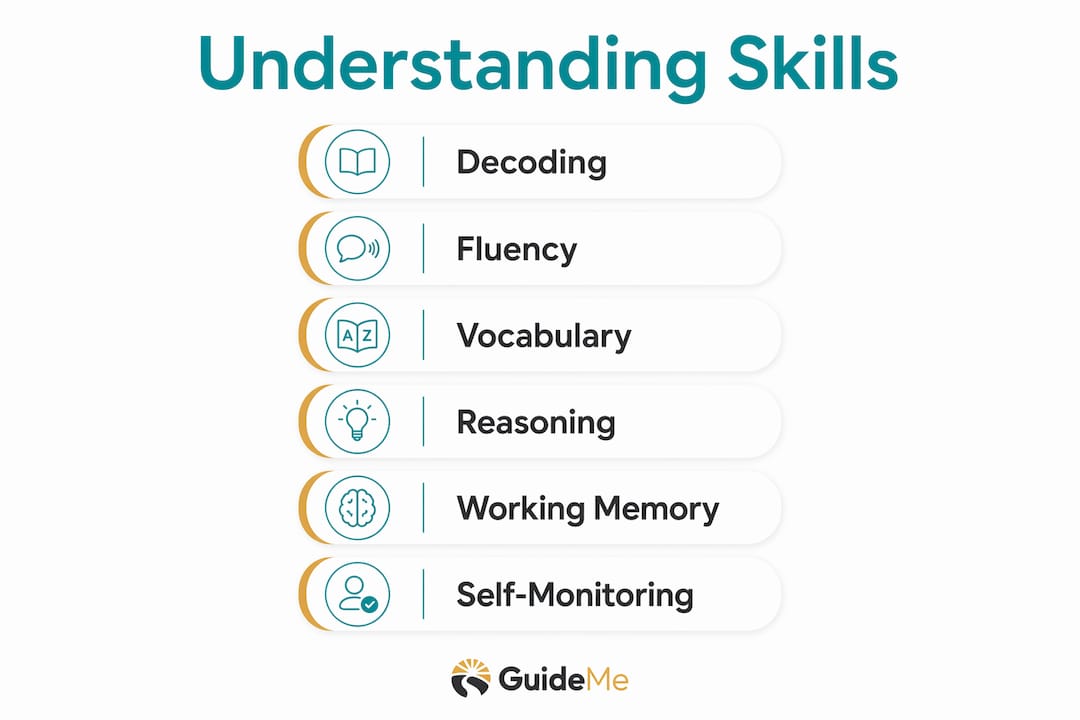
Six interdependent skills underpin effective comprehension. Reading comprehension depends on decoding, fluency, vocabulary, sentence structure, reasoning, and working memory. Each skill supports the others. A deficit in any one area, such as those associated with ADHD or dyslexia, can disrupt the whole process. This applies equally to understanding written text and to understanding emotional experiences.
Here is what each skill contributes:
- Decoding breaks information into recognisable units. In emotional contexts, this means identifying what you are actually feeling rather than labelling everything as "stressed."
- Fluency allows you to process information without excessive effort, freeing mental resources for deeper analysis.
- Vocabulary gives you the words to name and communicate experiences. Vocabulary and prior knowledge are key for interpreting complex material and achieving deep comprehension.
- Sentence structure helps you follow logical relationships between ideas, including cause and effect in your own thought patterns.
- Reasoning lets you draw conclusions, spot inconsistencies, and make inferences beyond what is directly stated.
- Working memory holds information in mind long enough to connect it to other ideas. Without it, comprehension collapses mid-process.
Pro Tip: If you find yourself re-reading the same paragraph repeatedly or losing the thread of a conversation, working memory may be the limiting factor. Short, focused sessions with deliberate pauses for reflection improve retention more than extended passive reading.
Self-monitoring is the skill that ties all six together. Self-monitoring as a comprehension skill means recognising when you are confused and treating that confusion as a signal to re-evaluate, not as a failure. In therapy, this translates directly to noticing when something does not quite fit your current understanding of yourself and staying curious about why.

How does questioning structure promote different levels of understanding?
One of the most useful frameworks for comprehension comes from philosophy. All understanding is interrogative: you understand something when you can grasp a complete and correct answer to the questions it raises. This means understanding is not a state you arrive at. It is an ongoing process of asking better questions.
Three question types build progressively deeper comprehension. Comprehension questions fall into literal, inferential, and evaluative categories, each demanding a different level of cognitive engagement.
-
Literal questions ask what is directly stated. In therapy, this might be: "What happened in that situation?" These questions establish the facts of an experience without interpretation.
-
Inferential questions ask what is implied or connected. "What does this pattern suggest about how I respond to conflict?" Inferential thinking moves you from surface events to underlying meaning. This is where most therapeutic insight lives.
-
Evaluative questions ask you to analyse and judge. "Is my interpretation of that situation accurate, or am I applying an old assumption to a new context?" These questions require critical thinking skills and the willingness to challenge your own conclusions.
The table below shows how each question type applies differently in therapy versus everyday learning:
| Question type | In therapy | In everyday learning |
|---|---|---|
| Literal | "What did I feel in that moment?" | "What does this text say?" |
| Inferential | "What does this feeling tell me about my needs?" | "What is the author implying?" |
| Evaluative | "Is this belief serving me well?" | "Do I agree with this argument?" |
Moving through all three levels is what separates surface awareness from genuine self-knowledge. Most people stop at literal. Therapy, done well, pushes you into inferential and evaluative territory consistently.
In what ways is understanding shaped by bodily experience?
Abstract concepts are not purely intellectual. Humans understand abstract ideas through metaphorical extensions linked to bodily experience. The phrase "grasping an idea" is not accidental. It reflects the embodied cognition theory, which holds that the body's physical experiences shape how the mind processes even intangible concepts.
This matters deeply in emotional and relational contexts. When you say you feel "weighed down" by grief or "closed off" from someone you love, you are using physical metaphors to describe internal states. These are not decorative expressions. They reflect how the brain actually organises emotional experience. Therapists trained in somatic approaches use this principle directly, asking clients to locate feelings in the body before attempting to analyse them intellectually.
Understanding emotions, justice, and time all follow the same pattern. Embodied cognition roots abstract understanding in bodily experience and metaphor. A person who has never experienced physical warmth from a caregiver may struggle to understand emotional warmth in relationships, not because they lack intelligence, but because the embodied reference point is absent or distorted.
Pro Tip: When you are trying to understand a difficult emotion, try describing it in physical terms first. Where do you feel it in your body? What texture or weight does it have? This approach activates embodied cognition and often produces clearer insight than purely analytical reflection.
Relational understanding works the same way. Comprehension of another person's experience requires you to draw on your own bodily and emotional memory. This is why shared experience builds connection, and why therapy can help you develop the internal reference points needed to understand others more accurately.
How can you cultivate deeper understanding for emotional well-being?
Deeper self-knowledge and relational comprehension are skills you can build deliberately. The cognitive science behind active self-monitoring and mental model building applies directly to personal growth, not just academic learning.
These strategies are grounded in research on comprehension and emotional intelligence:
- Ask inferential questions about your own patterns. Do not stop at "I felt angry." Ask what the anger was protecting, what need it was signalling, and whether your response matched the situation.
- Build your emotional vocabulary. The more precisely you can name what you feel, the more accurately you can communicate it and work with it. Psychologist Lisa Feldman Barrett's research on emotional granularity shows that people with richer emotional vocabularies report better mental health outcomes.
- Reflect in writing. Journalling creates a record of your mental models over time. Reviewing past entries shows you where your understanding has shifted and where old assumptions still operate.
- Seek dialogue, not just information. Active questioning in therapy and informed health choices depend on genuine two-way exchange. A therapist who asks good questions helps you build better internal models of yourself.
- Use multi-sensory experiences. Mastering concepts through varied experiences, including movement, conversation, and creative expression, strengthens comprehension before moving to purely abstract reflection.
The importance of vocabulary extends beyond self-expression. Vocabulary and prior knowledge are foundational for interpreting complex material. In therapy, this means that building a shared language with your therapist directly improves the quality of your self-understanding. When you and your therapist use the same words to describe your experience, the work becomes more precise and more effective.
Clinical personalisation in mental health relies on exactly this principle. Constructing internal mental models that are specific to your history, relationships, and patterns produces better outcomes than generic frameworks applied without adaptation.
For those supporting loved ones with cognitive challenges, working memory support strategies can reduce cognitive load and make complex information more accessible, which directly supports deeper comprehension in care contexts.
Key takeaways
Genuine understanding requires active mental model building, not passive exposure, and this applies as much to emotional self-knowledge as it does to academic learning.
| Point | Details |
|---|---|
| Understanding is active, not passive | The brain builds and tests internal models; simply receiving information does not produce comprehension. |
| Six skills underpin comprehension | Decoding, fluency, vocabulary, sentence structure, reasoning, and working memory all contribute to deep understanding. |
| Question types determine depth | Literal, inferential, and evaluative questions each produce a different level of insight into yourself and others. |
| Embodied experience shapes abstract understanding | Emotions and relational concepts are processed through bodily metaphor, not purely intellectual analysis. |
| Vocabulary and self-monitoring are practical tools | Naming emotions precisely and noticing confusion as a signal both improve comprehension and emotional well-being. |
Why I think we underestimate how hard understanding actually is
Most people assume that if they have heard something, they understand it. I have seen this play out repeatedly in conversations about therapy. Someone attends a few sessions, picks up some terminology, and concludes they have understood themselves. But comprehension is not the same as familiarity.
What I find genuinely useful is the interrogative framing. When you treat your own experience as a set of questions to answer rather than a story to confirm, everything shifts. You stop looking for validation and start looking for accuracy. That is uncomfortable, but it is where real growth happens.
The embodied piece also tends to be undervalued. People come to therapy expecting to think their way to clarity. But understanding emotions often starts in the body, not the mind. Slowing down enough to notice physical sensation before reaching for an explanation is a discipline, and it produces insight that purely cognitive approaches miss.
The most honest thing I can say is this: understanding yourself and others is effortful, ongoing, and worth every bit of that effort. It does not arrive as a single moment of clarity. It builds, layer by layer, through questioning, reflection, and the willingness to revise what you thought you knew.
— Yetty
How Guidemetherapy supports your understanding of mental health
Knowing that understanding requires active effort is one thing. Having the right support to do that work is another.

Guidemetherapy is a therapy navigation platform that helps you build a clearer picture of your mental health before you even meet a therapist. It combines human expertise with AI-powered matching to create a personalised therapy plan based on your specific needs, history, and goals. Rather than leaving you to search through directories and hope for the best, Guidemetherapy helps you find the right therapist from the start, so the work of understanding yourself can begin with the right person beside you.
FAQ
What is the difference between knowledge and understanding?
Knowledge means holding facts. Understanding means grasping how those facts connect, why they matter, and how to apply them. Philosophers describe understanding as going beyond knowledge by grasping relationships and meaning, not just information.
What are the main skills needed for comprehension?
Six core skills support comprehension: decoding, fluency, vocabulary, sentence structure, reasoning, and working memory. A deficit in any one of these areas can disrupt the whole process.
How does questioning improve self-understanding in therapy?
Literal questions establish facts, inferential questions uncover patterns and meaning, and evaluative questions challenge assumptions. Moving through all three levels produces the kind of deeper insight that therapy is designed to support.
Why does emotional vocabulary matter for mental health?
Naming emotions precisely gives you more control over them. Research on emotional granularity shows that people with richer emotional vocabularies report better mental health outcomes and communicate their needs more effectively in relationships.
What is embodied cognition and why does it matter in therapy?
Embodied cognition is the theory that abstract concepts, including emotions, are understood through bodily experience and physical metaphor. In therapy, this means that understanding abstract emotions often starts with noticing physical sensations before attempting intellectual analysis.