

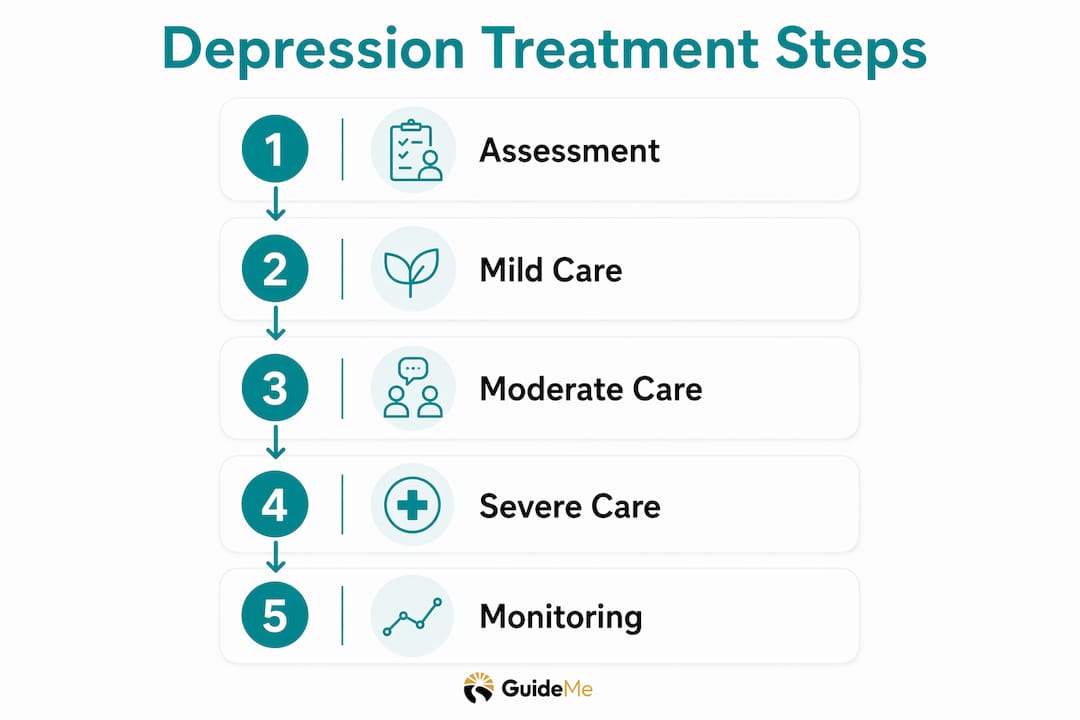
Depression treatment refers to evidence-based interventions, tailored by symptom severity, that combine psychological therapies, medications, and lifestyle changes to reduce symptoms and restore daily functioning. Clinical care in the UK follows a stratified model, meaning the intensity of treatment matches how severe your depression is. Mild, moderate, and severe depression each have their own recommended pathways, shaped by NHS clinical guidelines and overseen by your GP or a specialist mental health team.
The main treatment modalities are:
- Psychological therapies such as cognitive behavioural therapy (CBT), interpersonal therapy (IPT), behavioural activation, and problem-solving therapy
- Antidepressant medications including SSRIs, SNRIs, tricyclics, and MAOIs
- Lifestyle interventions such as structured physical activity, sleep hygiene, and stress management
- Specialised treatments for severe or treatment-resistant cases, including Electroconvulsive Therapy (ECT) and Transcranial Magnetic Stimulation (TMS)
No single approach works for everyone. Treatment plans are individualised, and finding the right combination often takes time and honest dialogue with your care team.
How is mild depression treated?
Mild depression does not automatically require medication or intensive therapy. The NHS recommends a stepped-care approach, starting with the least intensive intervention that is likely to help.

The first step is often watchful waiting, which involves a planned reassessment in primary care within a few weeks rather than immediately prescribing treatment. This avoids over-medicalising what may be a temporary low mood tied to a specific life event. If symptoms persist or worsen at review, active treatment begins.
Guided self-help is a common next step. It typically involves 6–8 sessions of supported workbook or online-based therapy, usually grounded in CBT principles. A practitioner guides you through the material but does not deliver full therapy sessions. For many people with mild symptoms, this structured support is enough to produce meaningful improvement.
Physical activity is not an optional add-on at this stage. Exercise is prescribed as a frontline treatment for mild depression because it directly improves mood and energy levels. Structured programmes, whether group-based or individual, are often recommended alongside or instead of guided self-help.
- Watchful waiting: reassessment within 2–4 weeks, no immediate treatment
- Guided self-help: 6–8 sessions, CBT-based, supported by a practitioner
- Structured exercise: prescribed as a primary treatment, not a lifestyle suggestion
- Low-intensity talking therapy: brief counselling or computerised CBT if self-help is insufficient
- Further intervention: considered if symptoms do not improve after initial steps
Pro Tip: If you are using guided self-help, pairing it with self-care strategies such as consistent sleep routines and limiting alcohol significantly improves outcomes. The workbook alone works better when your daily habits support it.
What treatments work for moderate to severe depression?
Moderate to severe depression requires more intensive intervention, and waiting is rarely appropriate. The NHS recommends antidepressant medication, a structured talking therapy, or both, often delivered in combination for the best results.

Combined treatment with antidepressants and psychotherapy consistently outperforms either approach alone. Medication can reduce symptoms enough to make psychological work more accessible, particularly when severe low mood makes it hard to engage with therapy at all. A network meta-analysis of randomised clinical trials found greater symptom improvement with combined treatment than with psychotherapy alone or medication alone.
For severe depression, a community mental health team or specialist psychiatrist typically becomes involved. This may include a care coordinator, a psychiatrist for medication management, and a clinical psychologist or therapist. Inpatient admission is considered when there is a significant risk of self-harm or when the person is unable to care for themselves.
- Antidepressants: usually SSRIs as first-line medication for moderate to severe depression
- Talking therapy: CBT or IPT delivered over a structured course of sessions
- Combined treatment: medication plus therapy for more severe or chronic presentations
- Community mental health teams: multidisciplinary support for complex cases
- Inpatient care: for severe risk or when outpatient treatment has not been effective
| Severity | First-line treatment | Additional options |
|---|---|---|
| Mild | Watchful waiting, guided self-help, exercise | Low-intensity CBT, brief counselling |
| Moderate | Antidepressants or talking therapy | Combined treatment, IAPT referral |
| Severe | Combined antidepressants and therapy | Specialist team, inpatient care |
| Treatment-resistant | Augmentation strategies | ECT, TMS, specialist review |
Depression treatment goals centre on symptom remission and restored functioning, with combined approaches reducing relapse risk better than single-modality care.
Which talking therapies are used to treat depression?
Talking therapies are a cornerstone of depression care at every level of severity. They are not passive conversations. Therapy is an active, skill-building process that involves structured sessions, between-session tasks, and deliberate practice of new ways of thinking and behaving.
The most widely used therapies for depression in the UK are:
- Cognitive behavioural therapy (CBT): helps you identify and challenge unhelpful thought patterns and behaviours. CBT is the most extensively researched therapy for depression and is recommended across NHS guidelines as a first-line psychological treatment. You can read more about CBT skills and process to understand what sessions typically involve.
- Interpersonal therapy (IPT): focuses on relationships and life events that affect mood. IPT is particularly useful when depression is linked to grief, role transitions, or relationship difficulties.
- Behavioural activation: targets the withdrawal and inactivity that maintain depression. Rather than waiting to feel motivated, you schedule activities that provide a sense of achievement or pleasure, which gradually lifts mood.
- Problem-solving therapy: a structured approach to breaking down overwhelming problems into manageable steps, reducing the helplessness that often accompanies depression.
Therapy is available face-to-face, online, or by telephone through NHS Talking Therapies (formerly IAPT). Most courses run for 8–20 sessions depending on the type and severity of your depression.
Pro Tip: Therapy works best when you treat it like a skill you are practising, not a service being done to you. Completing therapy homework between sessions, such as mood logs or behavioural experiments, significantly improves outcomes.
What you need to know about antidepressant medication
Antidepressants are the most commonly prescribed medication for depression, and they work by altering the brain's use of chemicals involved in mood regulation. There are four main classes, each with a different side effect profile and set of considerations.
- SSRIs (selective serotonin reuptake inhibitors): the standard first-line choice, including fluoxetine, sertraline, and citalopram. Generally well tolerated, with side effects including nausea, sleep disturbance, and sexual dysfunction.
- SNRIs (serotonin-norepinephrine reuptake inhibitors): such as venlafaxine and duloxetine. Often used when SSRIs have not been effective or when anxiety is a prominent feature.
- Tricyclic antidepressants: older medications with more pronounced side effects, including sedation and dry mouth. Used less frequently as first-line treatment but still prescribed in certain cases.
- MAOIs (monoamine oxidase inhibitors): require strict dietary restrictions due to potentially dangerous interactions with tyramine-containing foods. Reserved for cases where other medications have failed.
One of the most common reasons antidepressants do not work is stopping them too early. Antidepressants typically take 4–8 weeks to produce substantial mood improvement, though sleep and appetite may improve sooner. Many people discontinue during this waiting period, mistakenly concluding the medication is not working.
When a first antidepressant is ineffective, options include switching to a different medication, adding a second antidepressant, or augmenting with a non-antidepressant such as an antipsychotic or mood stabiliser. These second-line strategies have broadly similar success rates according to clinical evidence.
How long does depression treatment take, and how is it monitored?
Depression treatment is not a fixed course with a predictable end date. Duration varies considerably depending on severity, treatment response, and whether this is a first episode or a recurrence.
Acute treatment typically aims to reduce symptoms enough to restore normal functioning. This phase usually lasts several weeks to a few months. Continuation treatment follows, lasting several months beyond symptom improvement, with the goal of preventing relapse. For people with recurrent depression or chronic presentations, longer-term treatment spanning years may be appropriate.
Monitoring is built into the process. In primary care, your GP will typically schedule follow-up appointments within the first few weeks of starting treatment to assess response and tolerability. In specialist care, a care coordinator or psychiatrist manages this more closely. Structured outcome measures, such as the PHQ-9 questionnaire, are used in NHS Talking Therapies to track progress session by session.
- Follow-up within 1–2 weeks of starting antidepressants to check for side effects and early response
- Regular review appointments to assess whether treatment is working and adjust if needed
- Outcome monitoring using validated tools such as the PHQ-9 in talking therapy services
- Medication continuation for at least 6 months after remission to reduce relapse risk
- Referral to specialist services if primary care treatment has not produced sufficient improvement after adequate trials
Accessing treatment in the UK starts with your GP. Self-referral to NHS Talking Therapies is also available in England, meaning you do not need a GP referral to access CBT or other psychological therapies through the NHS. Waiting times vary by area, and private therapy is an option for those who prefer faster access or greater choice of therapist.
Specialised treatments and what happens when standard care is not enough
Most people with depression respond to talking therapy, antidepressants, or a combination of both. When they do not, a range of specialised treatments becomes available, and the care pathway shifts to specialist mental health services.
Treatment-resistant depression is generally defined as a failure to respond to at least two adequate antidepressant trials. At this point, brain stimulation therapies may be considered. ECT and TMS are the most established options. ECT involves passing a brief electrical current through the brain under general anaesthetic to induce a controlled seizure and is highly effective for severe, treatment-resistant depression, particularly when there is a risk to life. TMS uses magnetic pulses to stimulate specific brain regions and is less intensive, carried out as an outpatient procedure without anaesthesia.
- ECT: used for severe, life-threatening, or treatment-resistant depression; carried out under general anaesthetic
- TMS: outpatient procedure using magnetic fields to stimulate brain activity; fewer side effects than ECT
- Augmentation strategies: adding lithium, antipsychotics, or thyroid hormone to an existing antidepressant regimen
- Complementary approaches: mindfulness-based cognitive therapy (MBCT) has strong evidence for preventing relapse in recurrent depression; light therapy is used for seasonal affective disorder (SAD)
The therapeutic alliance between a patient and their therapist often predicts treatment success more reliably than the specific therapy model used. If you have tried therapy and found it unhelpful, the issue may be the fit with your therapist rather than therapy itself.
Pro Tip: If standard treatment has not worked, ask your GP specifically for a referral to a specialist mood disorders service rather than a general community mental health team. Specialist services have access to a wider range of interventions and more experienced clinicians for complex presentations.
Lifestyle factors remain relevant even at this stage. Regular physical activity, consistent sleep, and reduced alcohol use support treatment at every level of severity, not just in mild depression. They are not a replacement for clinical care, but they do improve its effectiveness.
How does depression treatment differ for children, adolescents, and older adults?
Age shapes both how depression presents and which treatments are appropriate. Clinical guidelines in the UK recognise distinct pathways for children, adolescents, and older adults, and these differ meaningfully from adult care.
Children and adolescents
For children and young people, psychological therapy is the recommended first-line treatment. Antidepressants are not routinely prescribed to under-18s and are only considered when depression is moderate to severe and has not responded to therapy. When medication is used, fluoxetine is the only antidepressant licensed for use in children and adolescents in the UK, and it is always prescribed alongside psychological support.
Family involvement is a significant part of treatment for younger people. Family therapy or parental guidance may be offered alongside individual therapy. CAMHS (Child and Adolescent Mental Health Services) provides specialist assessment and treatment, with referral usually coming from a GP or school-based mental health support.
Older adults
Older adults are at higher risk of depression being missed or attributed to physical health conditions or cognitive decline. Treatment principles are broadly similar to those for working-age adults, but medication choices require more care due to interactions with other medicines and increased sensitivity to side effects. SSRIs remain first-line, but starting doses are often lower.
Talking therapies are equally effective for older adults and should be offered on the same basis as for younger people. Social isolation, bereavement, and loss of independence are common contributing factors, and therapy that addresses these directly, such as IPT, tends to be particularly relevant. NHS Talking Therapies services are available to adults of all ages, including older adults.
Finding the right therapist starts here
Knowing what depression treatment involves is one thing. Finding the right support to actually begin it is another, and that gap is where many people get stuck.
Guidemetherapy is a therapy navigation platform built to close that gap. Rather than leaving you to search through directories or take a chance on the first available therapist, Guidemetherapy combines an in-depth therapy plan with a human-led, AI-powered matching process to connect you with a therapist who genuinely fits your needs. Whether you are weighing up CBT versus IPT, unsure whether you need therapy or medication, or simply want to feel more confident before your first session, Guidemetherapy gives you clarity from the start. Find your therapist and begin with a plan that is built around you, not a waiting list.
Key takeaways
Effective depression treatment is always matched to severity, and combining psychological therapy with medication produces better outcomes than either approach alone.
| Point | Details |
|---|---|
| Treatment is stratified by severity | Mild depression starts with watchful waiting and guided self-help; moderate to severe cases require therapy, medication, or both. |
| Antidepressants need time | Mood improvement typically takes 4–8 weeks; stopping early is the most common reason treatment fails. |
| Therapy is an active process | Completing between-session tasks such as mood logs significantly improves therapy outcomes. |
| Therapeutic alliance matters | The fit between patient and therapist often predicts success more than the specific therapy model used. |
| Guidemetherapy matches you to the right therapist | Its human-led, AI-powered platform creates a personalised therapy plan before matching you with a suitable therapist. |