

TL;DR:
- Peer support involves mutual assistance based on shared experiences, aiding recovery without clinical intervention. Its main models include one-to-one mentoring, group programs, online support, and workplace initiatives, each suited to different needs. Evidence shows peer support enhances personal recovery and confidence but works best alongside professional mental health care.
Peer support is a mutual, non-clinical relationship in which people with shared lived experience help one another through recovery, emotional difficulty, or mental health challenges. It is not therapy, and it does not require a clinical professional to deliver it. What makes it work is shared experience: the knowledge that the person sitting with you has been through something similar and come out the other side.
- Who delivers it: people with their own lived experience of mental health difficulties, addiction, or recovery, working as trained volunteers, paid peer support workers, or peer specialists within NHS teams and community organisations.
- Where it happens: NHS mental health services, community charities, recovery community centres, schools, workplaces, and online platforms and forums.
- What it aims to do: provide emotional support, practical guidance, recovery planning, and a sense of hope — complementing rather than replacing clinical care.
This guide covers the main models of peer support, the evidence behind it, what good practice looks like, and how to find the right option for you in the UK.
Table of Contents
- What peer support really means — and how it differs from therapy
- The main models of peer support you will encounter in the UK
- Why peer support matters — what the evidence actually shows
- What good peer support looks like in practice
- What peer support workers do — roles, training, and a typical working day
- UK examples: peer support in real services and settings
- How to find peer support in the UK and what to expect
- How to choose the right peer support for you
- Key takeaways
- Peer support works — but it is not the whole picture
- Guided therapy matching: an adjacent option worth knowing about
- Useful sources and further reading
What peer support really means — and how it differs from therapy
Peer support is strengths-based and non-clinical. It does not involve diagnosis, prescribing, or clinical treatment. Instead, it centres on a mutual relationship where both people bring something real: one brings their experience of recovery, the other brings their current need for support. That mutuality changes the power dynamic in a way clinical relationships cannot replicate.

SAMHSA describes this as "peerness" — the active ingredient that reduces isolation and builds hope through shared lived experience. A peer supporter is not positioned above you as an expert on your life. They are alongside you, which is a meaningfully different relationship.
Peer support and professional therapy are complementary, not competing. A peer support worker helps you set recovery goals, access community resources, and navigate daily life. A therapist or counsellor provides clinical assessment, diagnosis, and evidence-based treatment. If you want to understand where professional counselling fits alongside peer support, the distinction is worth reading carefully. Many people use both at different stages of their recovery.
Pro Tip: Before joining any peer support group or programme, ask whether participation is voluntary and whether you can leave at any time without it affecting your access to other NHS or clinical services. The WHO confirms that peer support participation should always be based on informed consent.
The main models of peer support you will encounter in the UK
Peer support is not one thing. It is delivered in several distinct formats, each suited to different needs and circumstances. The model that works for someone managing anxiety in a school setting looks quite different from one supporting someone leaving inpatient psychiatric care.
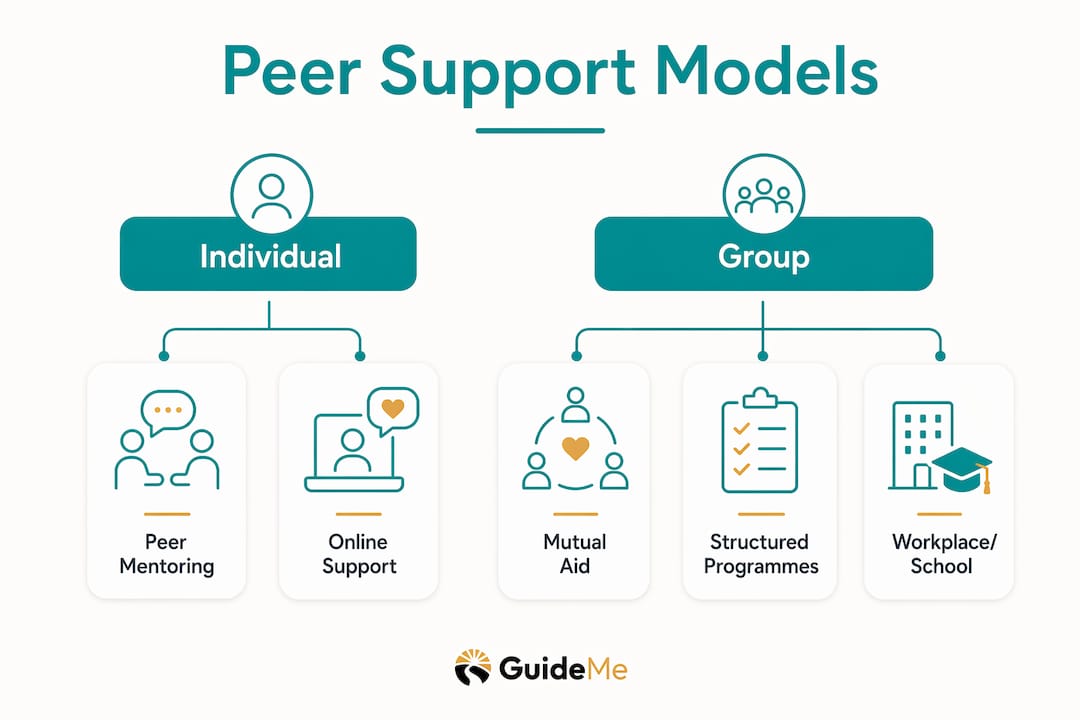
One-to-one peer mentoring
A trained peer supporter meets regularly with one person, usually weekly or fortnightly, to offer consistent emotional support and practical guidance. This model is common in NHS community mental health teams and in charity-run services. The relationship is structured but personal, and the peer supporter draws on their own recovery experience to help the other person set goals and build confidence.
Volunteer-led mutual aid groups
Informal groups where people with shared experience meet regularly, often without a paid facilitator. These are common in addiction recovery (such as 12-step fellowships) and in mental health peer networks run by charities. The emphasis is on shared experience and collective support rather than structured programming.
Structured group programmes co-produced by peers
More formal group programmes designed and delivered with significant input from people with lived experience. These often run for a fixed number of weeks and include facilitated discussions, recovery planning tools, and skills-building activities. NHS trusts and voluntary sector organisations both run these.
Online and telephone peer support
Moderated digital forums, peer support apps, and telephone befriending services. The breadth of settings for peer support now includes fully remote options, which are particularly useful for people with mobility difficulties, social anxiety, or limited local provision. Evidence suggests online peer support shows promising, if modest, effects.
Workplace and school peer support
Trained peer supporters within an employer or school setting, often called mental health champions or peer listeners. These programmes are typically co-ordinated by HR teams or pastoral staff and focus on early support and signposting rather than sustained recovery work. The benefits of mental health support in workplace settings are well documented.
How the main models compare
| Model | Who delivers it | Typical setting | Primary aim | Training and supervision | Access route |
|---|---|---|---|---|---|
| One-to-one peer mentoring | Paid peer support worker or trained volunteer | NHS team, community charity | Recovery planning, emotional support | Formal induction, ongoing supervision | GP/NHS referral, self-referral |
| Volunteer mutual aid group | Volunteer peers with lived experience | Community venue, charity | Shared support, reducing isolation | Varies; often peer-led with minimal formal training | Self-referral, charity drop-in |
| Structured group programme | Lived-experience facilitator, often paid | NHS service, voluntary sector | Skills building, recovery goals | Formal training, facilitated supervision | NHS referral, charity application |
| Online/telephone support | Trained volunteer or paid peer worker | Digital platform, telephone service | Accessible emotional support | Moderated; training standards vary | Self-referral, online registration |
| Workplace/school peer support | Trained peer listener or mental health champion | Employer, school | Early support, signposting | Employer-led training, line manager oversight | Internal referral, self-referral |
Why peer support matters — what the evidence actually shows
The evidence for peer support is real, but it is worth being clear about where it is strongest. A systematic review and meta-analysis found small positive effects on personal recovery and self-efficacy, with little or no effect on clinical recovery outcomes such as symptom reduction. That is not a failure of peer support — it reflects what peer support is designed to do. It builds hope, confidence, and a sense of agency, not clinical remission.
Recent randomised controlled trial evidence supports this picture. A peer-led group intervention trial (the PEER "Paths to Everyday Life" study) found modest improvements in personal recovery, social functioning, and quality of life. These are meaningful gains for people who have often felt stuck or isolated.
Research finding: A systematic review found peer support produces small but consistent positive effects on personal recovery and self-efficacy — the outcomes that matter most to people in the early and middle stages of recovery.
Where peer support is less effective is as a standalone replacement for clinical care in acute or complex presentations. The research consistently suggests it works best alongside, not instead of, clinical services. If you are weighing up when to seek professional help, it is worth reading about why therapy before crisis tends to produce better outcomes.
Pro Tip: If you are currently receiving clinical care, tell your care coordinator or GP that you are considering peer support. Many NHS teams can refer you directly to a peer support worker who is already embedded in the team.
What good peer support looks like in practice
Not all peer support is equally safe or effective. These five principles are the markers of a well-run offer.
- Mutuality: the relationship is reciprocal. The peer supporter shares relevant experience rather than positioning themselves as an authority. If a group or worker never discloses anything of their own, that is worth noticing.
- Hope and strengths focus: good peer support starts from what you can do and where you want to go, not from a deficit model of what is wrong with you.
- Choice and voluntariness: participation is always voluntary. The WHO is clear that informed consent is foundational. You should be able to leave at any time without penalty.
- Confidentiality and clear boundaries: peer supporters should explain what is confidential and what is not (including safeguarding exceptions) before you start. Boundaries around the relationship — including contact outside sessions — should be explicit.
- Supervised training and safeguarding: formal peer support roles in the UK require induction, boundaries training, and ongoing supervision. Ask whether the worker or facilitator has received this.
Questions to ask before you join
- Has the peer supporter completed a formal training programme?
- Is there a named supervisor or clinical lead overseeing the service?
- What happens if I disclose something that raises a safeguarding concern?
- Can I leave the group or end the relationship at any time?
- Is there a complaints or concerns process?
Red flags to watch for
- Pressure to attend or stay in a group.
- A peer supporter offering clinical advice, diagnosis, or treatment.
- No clear confidentiality policy.
- No supervision structure or named point of accountability.
- Contact outside agreed sessions without clear boundaries.
What peer support workers do — roles, training, and a typical working day
Peer support workers (also called peer specialists, peer recovery coaches, or peer advocates) are experientially credentialled by their own recovery journey. That lived experience is not incidental — it is the core qualification. In the UK, formal roles increasingly sit within NHS mental health teams, community mental health services, and voluntary sector organisations.
Day-to-day, a peer support worker might spend the morning co-facilitating a recovery group, then meet one-to-one with someone recently discharged from inpatient care to help them identify practical next steps. In the afternoon, they might attend a team meeting alongside clinical colleagues, contribute to a care plan review, or help someone navigate a housing or benefits referral. The role spans emotional support, practical signposting, advocacy, and group facilitation.
NHS England sets out clear expectations for formal peer support worker roles: induction, boundaries training, ongoing supervision, and continuing professional development where applicable. Quality and safeguarding standards are still developing across services, but the direction of travel is towards greater consistency and formal recognition of the role.
Peer support workers complement, not replace, therapists and clinicians. They do not provide therapy, and they do not hold clinical responsibility. For readers wanting to understand the full range of mental health professionals and how they differ, a guide to types of mental health professionals is a useful reference.
UK examples: peer support in real services and settings
NHS peer support initiatives
NHS England has embedded peer support workers in community mental health teams across England as part of its Community Mental Health Framework. Peer workers in these teams support people with complex needs, often working alongside psychiatrists, social workers, and occupational therapists. The aim is to provide continuity of support and a recovery-oriented perspective within clinical settings.
- Setting: NHS community mental health teams
- Who delivers it: trained, paid peer support workers with lived experience of mental health services
- Primary aim: recovery planning, reducing re-admission, supporting transition from inpatient care
- Key learning: embedding peers in clinical teams requires clear role boundaries and active supervision to prevent role drift
Scottish Recovery Network
The Scottish Recovery Network has been central to developing peer support infrastructure in Scotland since 2004. It trains peer support workers, develops resources, and advocates for recovery-oriented approaches across Scottish mental health services.
- Setting: Scotland-wide, across NHS and voluntary sector services
- Who delivers it: trained peer support workers and facilitators
- Primary aim: building a recovery-oriented culture; workforce development; peer support training
- Key learning: sustained investment in peer workforce development produces measurable improvements in service culture
Anna Freud Centre school-based peer support
The Anna Freud Centre runs school-based mental health programmes that include peer support elements, training young people to support their peers and reducing stigma around mental health in educational settings.
- Setting: secondary schools across England
- Who delivers it: trained young peer supporters, supervised by school staff and mental health professionals
- Primary aim: early intervention, reducing stigma, building help-seeking behaviour
- Key learning: young people are more likely to disclose mental health difficulties to a peer than to an adult
Community charity model
Organisations such as Mind run peer support groups across England and Wales, covering conditions including depression, anxiety, and psychosis. Groups are typically volunteer-facilitated, free to attend, and accessible via self-referral.
- Setting: community venues and online
- Who delivers it: trained volunteer peer facilitators with lived experience
- Primary aim: reducing isolation, building community, sharing coping strategies
- Key learning: low-barrier access (no referral needed, no waiting list) is a significant advantage over clinical pathways for people in the early stages of seeking help
How to find peer support in the UK and what to expect
-
Identify what you need. Think about whether you want one-to-one support, a group setting, or something you can access online. Consider whether you want a structured programme or a more informal space. Being clear about your preference makes it easier to find the right fit.
-
Check the model and safety standards. Before committing, ask about training, supervision, and confidentiality (see the questions listed in the principles section above). A reputable service will answer these questions readily.
-
Contact a provider. Options include your GP (who can refer you to an NHS peer support worker), your local Mind or Rethink Mental Illness branch (self-referral, usually free), the Scottish Recovery Network (if you are in Scotland), community mental health teams, and online moderated platforms. Kin Wellness also offers community wellness and peer support services worth exploring.
-
Attend your first session. Most peer support groups and one-to-one relationships begin with an informal conversation about what you are looking for and what the service offers. You are not committing to anything at this stage. It is a chance to see whether the setting and the people feel right.
-
Review the fit and revisit your boundaries. After two or three sessions, check in with yourself. Is this helping? Do you feel safe? Are the boundaries clear? There is no single best model — the WHO guidance is explicit that effectiveness depends on fit between your needs and the delivery format. If it is not working, try a different model.
When to seek clinical support instead: if you are in crisis, experiencing suicidal thoughts, or managing a complex diagnosis, peer support alone is not sufficient. Contact your GP, call NHS 111, or reach out to a crisis line. Peer support and clinical care work best together, and recognising when you need therapy is a sign of self-awareness, not weakness.
How to choose the right peer support for you
The right choice depends on your goals, your preferred format, and the quality of what is available locally. This checklist helps you compare options before committing.
- Does it fit your personal goals? Recovery planning, reducing isolation, building confidence, and managing a specific condition all point towards different models.
- What format suits you? One-to-one support offers privacy and consistency. Group settings offer community and shared experience. Online options offer flexibility and anonymity.
- Is there evidence of training and supervision? Ask directly. A peer support worker in an NHS team will have formal induction and ongoing supervision. A volunteer-led group may have less formal oversight — that is not automatically a problem, but you should know.
- How do you access it? Some services require a GP or NHS referral. Others are open to self-referral. Charity drop-ins are often the most accessible starting point.
- What does it cost? Most NHS and charity peer support is free. Some private or community wellness services charge a fee.
Sample questions to ask a provider
- What training has the peer supporter or facilitator completed?
- Is there a supervisor or clinical lead I can contact if I have concerns?
- What happens if I disclose something serious during a session?
- Is there a waiting list, and how long is it?
- Can I try one session before committing?
Two scenarios to consider
Scenario one: you are managing anxiety and social isolation and find it hard to leave the house. A moderated online peer support group — accessible via self-referral, free, and available evenings — is likely a better starting point than a face-to-face group that requires travel and feels exposing.
Scenario two: you have recently been discharged from inpatient psychiatric care and are working with a community mental health team. A peer support worker embedded in that team, who can attend appointments with you and help you navigate your care plan, is likely to offer more continuity and safety than an informal community group at this stage.
Key takeaways
Peer support is a mutual, non-clinical relationship built on shared lived experience, and the evidence shows it reliably improves personal recovery and self-efficacy when delivered well and paired with appropriate clinical care.
| Point | Details |
|---|---|
| Core definition | Peer support is mutual, non-clinical, and delivered by people with lived experience of mental health or recovery. |
| Models vary widely | One-to-one, group, online, and workplace formats each suit different needs — there is no single best option. |
| Evidence is clear on scope | Research shows small positive effects on personal recovery and self-efficacy; peer support complements but does not replace clinical care. |
| Safety checks matter | Ask about training, supervision, confidentiality, and voluntary participation before joining any service. |
| Guidemetherapy as a next step | For those who want guided therapy matching alongside or instead of peer support, Guidemetherapy offers a structured therapy navigation pathway. |
Peer support works — but it is not the whole picture
Peer support is a valuable but often underused resource in UK mental health care, and the reason is usually simple: people do not know it exists or do not feel they deserve it. The evidence is clear that it builds hope and self-efficacy in ways that clinical services alone often cannot. But the conversation about peer support sometimes tips into overclaiming — presenting it as a replacement for therapy or clinical treatment when the research does not support that.
The most honest framing is this: peer support is most powerful when it sits alongside clinical care, not instead of it. Someone managing a complex diagnosis benefits from both a peer who has been through something similar and a clinician who can provide structured treatment. Treating these as competing options does a disservice to both. The people who tend to get the most from peer support are those who use it as one part of a broader approach to their mental health, not as the only tool available to them.
Guided therapy matching: an adjacent option worth knowing about
If you have read this far and realised that what you actually need is professional therapy rather than peer-only support, Guidemetherapy offers something different from both.
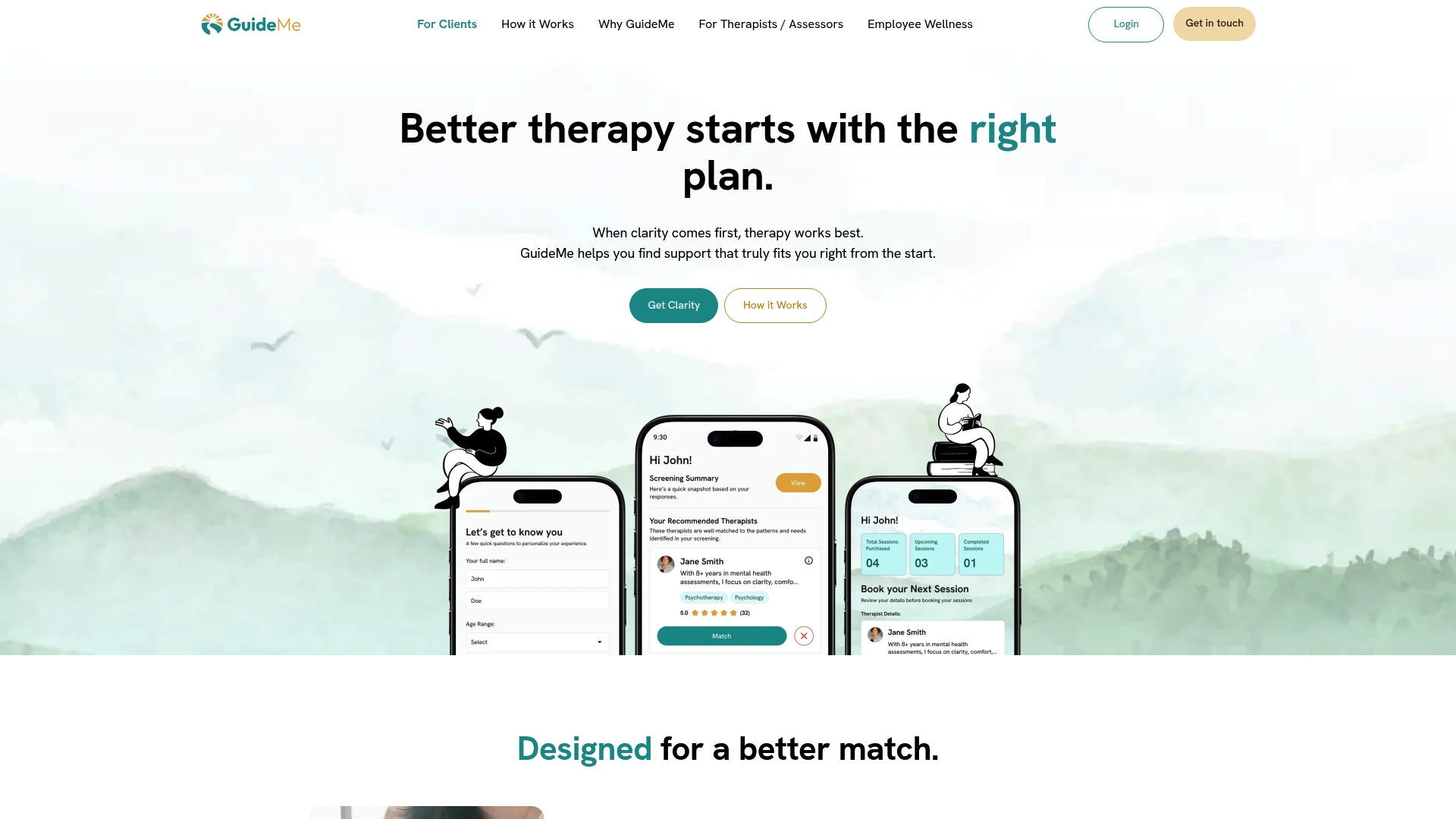
Guidemetherapy is a therapy navigation platform that combines human insight and AI-powered matching to help you find the right therapist from the start. Rather than searching alone and hoping for the best, you receive an in-depth therapy plan and a matched recommendation based on your specific needs. It is a paid service, clearly distinct from peer support, and designed for people who want a more guided, structured route into professional care.
If you are weighing up your options, start with GuideMe to see what a personalised therapy pathway looks like before making any decisions.
This article provides general information about peer support and is not a substitute for professional mental health advice. Please speak with your GP or a qualified mental health professional about your own situation.
Useful sources and further reading
Start with the NHS England guidance if you want to understand what peer support looks like within UK services. If you are in Scotland, the Scottish Recovery Network is the most relevant starting point. For evidence, the systematic review in Psychiatric Services is the most accessible summary of what the research shows.
- NHS England peer support guidance — the most comprehensive UK-specific overview of peer support roles, standards, and delivery models. Read this first if you are trying to access or commission peer support within NHS services.
- Scottish Recovery Network — Scotland's leading peer support and recovery organisation; includes training resources and a directory of peer support services.
- Anna Freud Centre — resources on school-based mental health and peer support programmes for young people.
- Mind — practical information on finding peer support groups across England and Wales, with a service finder tool.
- WHO peer support guidance — international framework covering voluntariness, consent, and quality standards; useful for understanding the principles underpinning good practice.
- Systematic review and meta-analysis (Psychiatric Services) — the clearest summary of the evidence base; read this if you want to understand what peer support reliably does and does not achieve.
- PEER intervention RCT (BMC Psychiatry) — recent trial evidence on peer-led group interventions; useful for professionals and researchers.
- GOV.UK: recovery, peer support and lived experience — UK government introduction to recovery support and lived experience initiatives; a good policy-level overview.