

TL;DR:
- Self-esteem therapy helps individuals rebuild their self-worth by addressing deep beliefs using evidence-based techniques. It typically requires 8 to 12 weeks of weekly sessions, focusing on internal change rather than external validation. Practical exercises like thought journaling and behavioral experiments aid lasting progress.
Self-esteem therapy is a structured form of counselling designed to help individuals build a stable, compassionate relationship with themselves by identifying and reshaping the deep-rooted beliefs that fuel self-doubt. Unlike a quick confidence boost or a round of positive affirmations, this process draws on evidence-based methods including Cognitive Behavioural Therapy (CBT), Acceptance and Commitment Therapy (ACT), and psychodynamic therapy. Clinicians commonly refer to this work as self-worth therapy or self-esteem counselling, and most programmes recommend a minimum of 8–12 weeks of weekly sessions to produce lasting change. The goal is not to feel good all the time. The goal is to develop a sense of self that holds steady even when life gets difficult.
What are the signs of low self-esteem and common misconceptions?
Low self-esteem is not simply shyness or a lack of confidence. It is a pattern of deeply held negative beliefs about your own worth, and those beliefs shape how you behave, relate to others, and interpret everyday events.
Common signs include:
- Persistent self-criticism that goes far beyond normal self-reflection
- Difficulty accepting compliments or attributing success to luck rather than ability
- Perfectionism driven by fear of failure rather than genuine standards
- Social withdrawal to avoid judgement or rejection
- Chronic people-pleasing and difficulty setting boundaries
- A strong inner voice that frames mistakes as proof of inadequacy
Many people assume low self-esteem is the same as arrogance in reverse, or that it simply means feeling a bit down about yourself. The reality is more complex. Self-esteem issues are frequently linked to depression, anxiety, and perfectionism, making therapy multi-dimensional rather than a surface-level fix. Addressing them requires more than repeating "I am enough" in the mirror each morning.
Another common misconception is that therapy is about being told you are wonderful. Practitioners emphasise a consistent, compassionate relationship with self over external validation. The work is internal, and it takes time.
Pro Tip: If you notice that your inner critic is loudest after social interactions or when you make small mistakes, that pattern is worth bringing to a first therapy session. It gives your counsellor a concrete starting point.
Which therapeutic approaches are used in self-esteem therapy?
Most self-esteem programmes use multiple therapeutic modalities rather than relying on a single technique. Each approach targets a different layer of the problem.
Cognitive Behavioural Therapy (CBT)
CBT targets automatic negative thoughts, the rapid, often unconscious judgements you make about yourself in daily situations. A therapist helps you identify these thoughts, examine the evidence for and against them, and practise more balanced responses. Over time, this process weakens the grip of the inner critic.
Acceptance and Commitment Therapy (ACT)
ACT shifts the focus from fighting negative thoughts to accepting them without letting them dictate behaviour. The approach helps you clarify your personal values and commit to actions that align with those values, regardless of what your inner critic says. This is particularly useful for people whose self-worth has long depended on external approval.
Psychodynamic therapy
Psychodynamic therapy explores the historical origins of self-doubt, including childhood environments, relational feedback from caregivers, and early experiences of criticism or neglect. Understanding where a belief came from does not erase it, but it does reduce its power.
Compassion-focused and person-centred approaches
Compassion-focused and person-centred therapy help clients experience unconditional acceptance, which is often missing in early development. These methods cultivate a kinder inner voice and build self-compassion as a daily practice rather than a concept.
| Approach | Primary focus | Best suited for |
|---|---|---|
| CBT | Challenging negative automatic thoughts | Persistent self-criticism and perfectionism |
| ACT | Values clarification and acceptance | External validation dependency |
| Psychodynamic | Exploring origins of self-doubt | Deep-rooted patterns from childhood |
| Compassion-focused | Building a kinder inner voice | Harsh self-judgement and shame |
| Person-centred | Unconditional self-acceptance | General self-worth and identity work |
A skilled therapist will draw from several of these counselling approaches depending on what emerges in sessions. The integration of methods is the norm, not the exception.
What does the self-esteem therapy process look like?
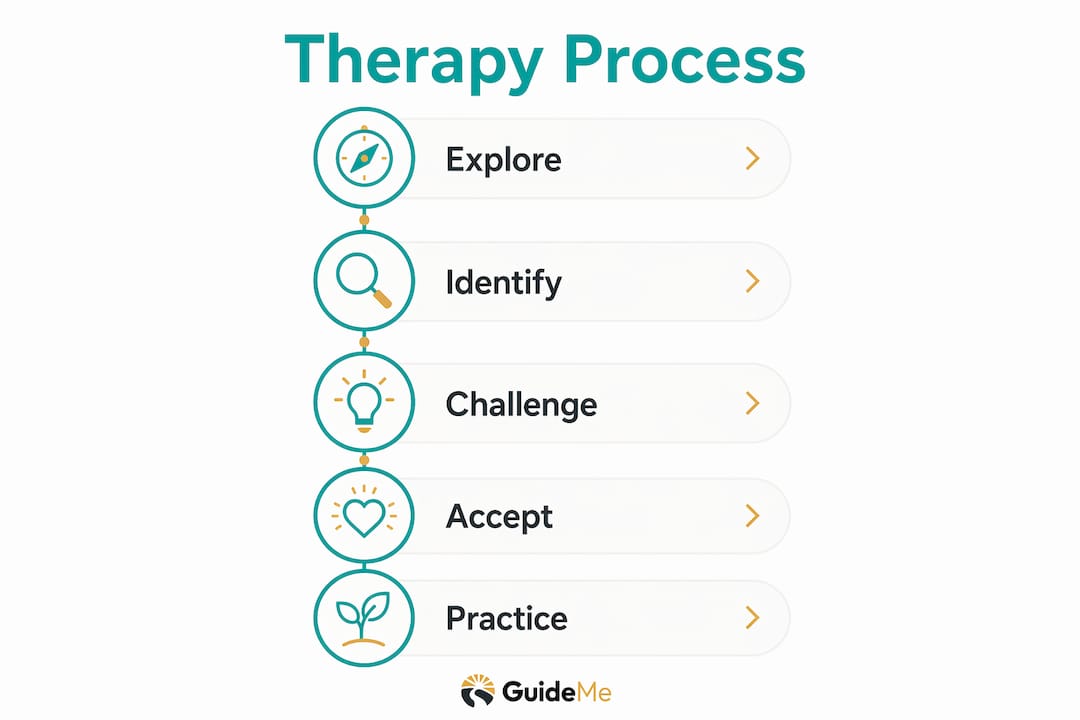
Understanding the typical progression helps you set realistic expectations before you begin. The process is not linear, but it does follow a recognisable shape.
-
Initial exploration. Early sessions prioritise understanding the origins of self-doubt before attempting any correction. Your therapist will ask about childhood experiences, key relationships, and the moments when negative self-beliefs first took hold. This phase can feel slow, but it is foundational.
-
Mapping the patterns. Once the origins are clearer, therapy moves to identifying how those early beliefs show up in your current life. You begin to see the connections between past experiences and present behaviour, such as why you apologise constantly or avoid speaking up in meetings.
-
Challenging and testing beliefs. This is where CBT and ACT techniques come into play. You examine the evidence for your negative beliefs and begin to question whether they are facts or interpretations. Behavioural experiments, small real-world tests, are assigned between sessions to build lived evidence that contradicts old narratives.
-
Building new patterns. Self-esteem improvements result not just from cognitive shifts but from lived experience that contradicts old negative narratives. Gradually, new, more accurate beliefs about yourself become the default.
-
Consolidation and independence. The final phase focuses on sustaining progress without the therapist. You develop tools to manage setbacks, recognise triggers, and maintain the self-compassion built during therapy.
Meaningful shifts in self-esteem typically appear within 4–8 weeks of consistent work. Deeper change, particularly where trauma or chronic invalidation is involved, commonly takes 3–6 months or more. Knowing this upfront prevents early discouragement.
Pro Tip: Track your therapy progress between sessions by noting moments when you responded to a situation differently than you would have before. These small shifts are the real evidence of change.

How can you apply the benefits of self-esteem therapy in daily life?
Therapy sessions provide the framework, but the real work happens outside the room. Applying what you learn between sessions is what converts insight into lasting change.
Practical strategies that support the benefits of self-esteem therapy include:
- Track your self-talk. Thought journalling and behavioural experiments between sessions are a core part of the process. Write down moments of self-criticism and examine what triggered them.
- Practise self-compassion deliberately. Respond to your own mistakes the way you would respond to a close friend. This is not about excusing poor behaviour. It is about removing the punishment that serves no purpose.
- Set small, specific goals. Start with boundary-setting in low-stakes situations, such as declining a request you would normally accept out of guilt. Each success builds real evidence of your own capability.
- Clarify your values. When your sense of worth is anchored to your own values rather than others' opinions, external criticism loses much of its power. Therapy helps you identify what genuinely matters to you.
- Use mindfulness and somatic awareness. Mindfulness and somatic techniques support self-esteem by calming a nervous system primed for self-criticism. Noticing physical tension during moments of self-doubt is a useful entry point for this work.
Consistent self-care practices reinforce the gains made in therapy. They are not optional extras. They are part of the treatment.
Key takeaways
Self-esteem therapy is a structured, evidence-based process that rebuilds self-worth by addressing deep-rooted beliefs, not surface-level confidence, through CBT, ACT, and psychodynamic approaches over a minimum of 8–12 weeks.
| Point | Details |
|---|---|
| Definition | Self-esteem therapy targets deep-rooted negative beliefs, not just surface-level confidence. |
| Core approaches | CBT, ACT, and psychodynamic therapy are the primary evidence-based methods used. |
| Realistic timeline | Meaningful change typically requires 8–12 weeks of weekly sessions as a minimum. |
| Outside sessions | Behavioural experiments and thought journalling between sessions are essential for progress. |
| Sustaining gains | Anchoring self-worth to personal values, rather than external approval, produces lasting results. |
What I have learned from watching self-esteem therapy work
People come to self-esteem counselling expecting to feel better quickly. What surprises them is that the first few sessions rarely feel uplifting. They feel illuminating, sometimes uncomfortable, and occasionally confronting. That is exactly how it should be.
The exploration phase is where the real work begins. Clients who resist it, who want to skip straight to techniques, tend to make slower progress. The origins of self-doubt matter. A belief formed in a critical household at age eight does not dissolve because you read a self-help book. It dissolves because you examine it, trace it back to its source, and see it for what it is: someone else's opinion that you absorbed as fact.
What I find most underestimated is the role of behavioural experiments. Clients often treat homework as optional. It is not. The moment you speak up in a meeting and the world does not end, or you decline an invitation and your friendships survive, that is the lived evidence that rewrites the old story. No amount of in-session insight matches the power of that experience.
The shift from seeking external validation to trusting your own values is the most meaningful change I see in people who commit to this work. It is not dramatic. It is quiet, steady, and far more durable than confidence built on compliments.
— Yetty
How Guidemetherapy supports your self-esteem work
Self-esteem counselling works best when you are matched with a therapist who genuinely understands the approach and fits your needs from the start. Guidemetherapy is a therapy navigation platform that combines human expertise with AI-powered matching to connect you with the right therapist before your first session.

Rather than leaving you to search through directories and hope for the best, Guidemetherapy creates an in-depth therapy plan based on your specific concerns, including low self-esteem, self-worth challenges, and related mental health patterns. The process is confidential, supportive, and designed to make the first step feel manageable. If you are ready to work with a therapist who understands evidence-based self-esteem therapy, Guidemetherapy is built to help you find that person.
FAQ
What is self-esteem therapy in simple terms?
Self-esteem therapy is a structured form of counselling that helps you identify and change the deep-rooted negative beliefs driving self-doubt. It uses evidence-based methods such as CBT, ACT, and psychodynamic therapy rather than affirmations or quick fixes.
How long does self-esteem therapy take?
A minimum of 8–12 weeks of weekly sessions is commonly recommended for foundational work. Deeper patterns, particularly those linked to trauma, may require 3–6 months or more.
Is self-esteem therapy the same as self-confidence therapy?
They overlap but are not identical. Self-confidence therapy tends to focus on specific skills and performance. Self-esteem therapy addresses the underlying beliefs about your fundamental worth as a person, which is a deeper and more durable form of change.
What happens in a typical self-esteem therapy session?
Sessions typically involve exploring the origins of self-doubt, identifying negative thought patterns, and practising techniques to challenge those patterns. Clients often receive homework such as thought journalling or behavioural experiments to complete between appointments.
Can self-esteem therapy help with anxiety and depression?
Self-esteem is closely linked to both anxiety and depression, and therapy that addresses underlying self-worth beliefs often reduces symptoms of both. A therapist will assess the full picture and adapt the approach to your specific needs.