

TL;DR:
- Talk therapy is a structured, evidence-based psychological treatment where a trained professional helps you understand and modify unhelpful thoughts, feelings, and behaviors. It offers durable long-term benefits, including reduced anxiety and depression, improved coping skills, and personal growth, applicable to various mental health conditions. Choosing the right approach and therapist, actively participating, and staying honest enhance the effectiveness of this collaborative process.
Talk therapy is often dismissed as "just talking about your feelings." That misses the point entirely. What is talk therapy, really? It is a structured, evidence-backed form of psychological treatment where you work with a trained professional to understand and change the thoughts, feelings, and behaviours that are causing you difficulty. The NHS describes talking therapies as effective for conditions ranging from anxiety and depression to PTSD and eating disorders. If you have been wondering whether therapy is right for you, this guide explains how it works, what types exist, and what you can realistically expect.
Table of Contents
- Key takeaways
- What talk therapy actually is
- Types of talk therapy
- How talk therapy works
- Benefits of talk therapy: what the evidence shows
- Choosing therapy and making it work for you
- My perspective on what talk therapy really offers
- How Guidemetherapy can help you take the next step
- FAQ
Key takeaways
| Point | Details |
|---|---|
| More than conversation | Talk therapy is a structured, goal-directed process, not simply an informal chat with a professional. |
| Multiple types available | Approaches such as CBT, psychodynamic, and person-centred therapy suit different problems and preferences. |
| Evidence-backed benefits | Research shows talk therapy produces durable improvements, often outperforming medication for long-term outcomes. |
| Active participation matters | Progress depends on engaging between sessions, practising skills, and building an honest relationship with your therapist. |
| Finding the right fit | Matching therapy type and therapist to your individual needs significantly improves the likelihood of success. |
What talk therapy actually is
The American Psychological Association defines psychotherapy as a psychological service that primarily uses communication to address dysfunctional reactions, thinking, and behaviour. It can be delivered to individuals, couples, families, or groups. That definition is broader than most people expect.
Talk therapy is not a single method. It is a category of treatment that encompasses many different approaches, all sharing one feature: meaningful conversation between you and a trained professional, guided by a clear therapeutic framework. The conversation is not random. It follows a structure shaped by your goals, your history, and the specific approach your therapist uses.
A few features are common across nearly all forms of talk therapy:
- Collaboration: You and your therapist work together. The therapist does not simply hand you answers.
- Focus on thoughts, feelings, and behaviours: Sessions explore how these three things connect and influence each other.
- Skill-building: You learn techniques to use outside the therapy room, not just during sessions.
- Formats: Therapy can take place in person, online, by phone, or in a group setting, depending on what suits you.
Pro Tip: If you are exploring therapy for the first time, do not let the word "psychotherapy" put you off. It simply means therapy delivered through conversation, not medication or physical intervention.
The structured nature of talking therapies means your therapist actively helps you find your own solutions and learn to respond differently to difficult thoughts and feelings. That distinction matters. You are not being lectured. You are being guided to think and act in ways that serve you better.

Types of talk therapy
There is considerable diversity in therapeutic approaches, far more than popular culture suggests. Understanding the main categories helps you make a more informed choice. You can also explore different counselling approaches to get a fuller picture of the options available.
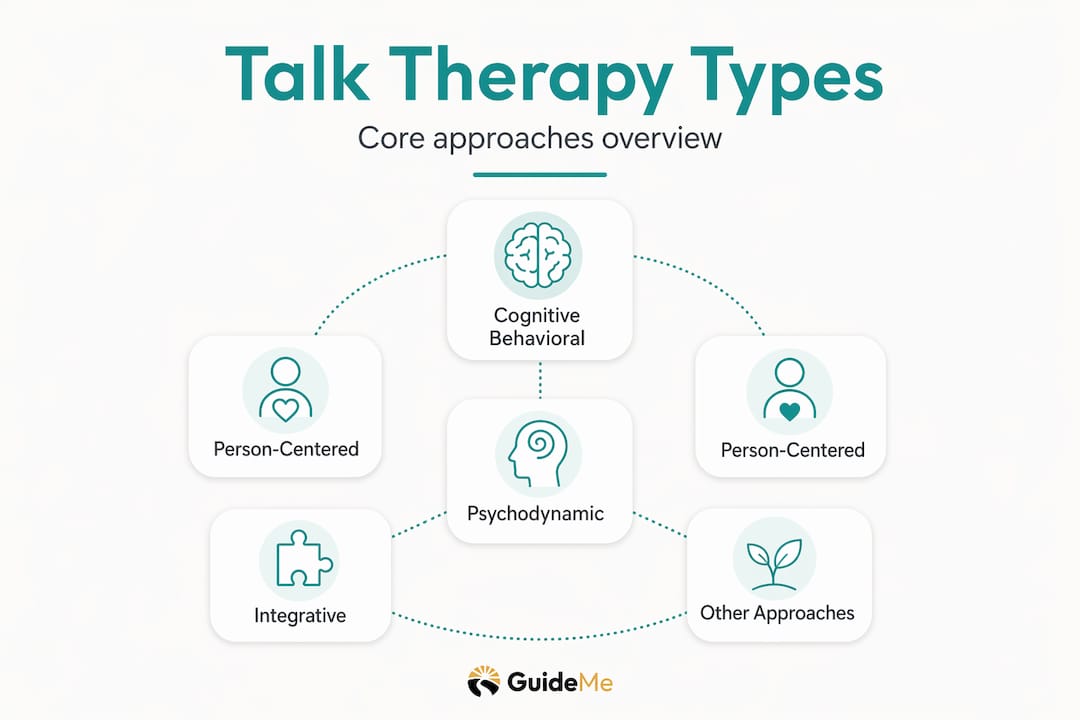
| Therapy type | Core focus | Best suited for |
|---|---|---|
| Cognitive behavioural therapy (CBT) | Changing unhelpful thought patterns and behaviours | Anxiety, depression, OCD, phobias |
| Psychodynamic therapy | Exploring unconscious patterns rooted in past experiences | Long-standing emotional difficulties, relationship issues |
| Person-centred therapy | Non-directive support; the client leads at their own pace | Self-esteem, personal growth, processing difficult emotions |
| Integrative therapy | Combines techniques from multiple approaches | Complex or mixed presentations |
| Mindfulness-based therapies | Present-moment awareness to manage thoughts and emotions | Stress, recurrent depression, chronic pain |
CBT is one of the most widely recommended types of talking therapy, particularly for anxiety and depression. It works by helping you identify thoughts that are distorted or unhelpful, and then testing them against reality. The NHS allows self-referral for CBT in many areas, which means you do not always need a GP to get started.
Psychodynamic therapy takes a different angle. It looks at how your past, particularly early relationships and experiences, shapes your present emotions and behaviour. Sessions tend to be more exploratory and less structured than CBT, but they can be particularly useful for people who feel stuck in repeating patterns.
Person-centred therapy treats you as the expert in your own life. The therapist is non-directive and supportive, offering a safe space to explore your feelings at whatever pace feels right for you. This approach is especially valued by people who feel unheard or misunderstood, and who simply need a consistent, non-judgemental presence. You can read more about how mindfulness in therapy complements many of these approaches.
How talk therapy works
Many people arrive at their first session unsure of what to expect. The process is more structured than most anticipate. Here is how a typical course of therapy unfolds:
- Initial assessment. Your first sessions are usually focused on understanding your situation, your history, and what you want to change. Therapists begin with an assessment to determine the most suitable therapy type based on your needs, not an arbitrary choice of method.
- Goal setting. You and your therapist agree on what you are working towards. Goals might be specific, such as managing panic attacks, or broader, such as improving your self-confidence.
- Regular sessions. Most therapy is delivered weekly or fortnightly, with sessions typically lasting 50 to 60 minutes.
- Active practice between sessions. This is often the part people underestimate. Progress continues between sessions, through exercises, reflections, or behavioural experiments your therapist assigns.
- Review and adjustment. Therapy is not static. Your therapist checks in on your progress and adjusts the approach as needed.
The therapeutic relationship itself plays a significant role. Research consistently shows that the quality of the bond between you and your therapist predicts outcomes as much as the specific technique being used. Honesty matters here. The more openly you engage, the more useful therapy becomes.
Pro Tip: Before your first session, write down two or three things you want your therapist to know about you. It takes the pressure off having to remember everything in the moment, and it signals to your therapist that you are ready to engage actively.
Therapy is available in person, via video call, and by phone. Each format has advantages. Online therapy removes travel barriers and can feel less intimidating for some people. In-person sessions provide a dedicated, contained space that many find easier to open up in. The right format is the one you will actually use consistently.
Benefits of talk therapy: what the evidence shows
Talk therapy for anxiety, depression, and many other conditions produces results that go well beyond symptom relief. The benefits are well documented and, perhaps more importantly, they tend to last.
A 2024 meta-analysis of 19 randomised controlled trials found that psychotherapy and combined treatment show superior long-term effects over medication alone, particularly in preventing relapse.
That finding matters because medication, while helpful for many people, primarily manages symptoms while you are taking it. Talk therapy builds the internal skills and understanding that continue working after treatment ends. If you want to understand more about why therapy supports long-term mental health, the evidence is compelling.
The benefits of talk therapy that people most commonly report include:
- Reduced anxiety and depression. Most people see measurable improvement within 8 to 16 sessions of structured therapy.
- Improved coping skills. You gain practical tools to manage stress, difficult relationships, and challenging emotions.
- Greater self-awareness. Understanding why you react the way you do is genuinely empowering, not just intellectually interesting.
- Relapse prevention. People who complete a course of therapy are significantly less likely to experience a return of symptoms compared to those who use medication alone.
- Personal growth. Therapy is not only for crisis. Many people use it to process life transitions, improve relationships, or simply understand themselves better.
Talk therapy also works across a wide range of presentations. The NHS recommends it for depression, anxiety disorders, PTSD, eating disorders, bipolar disorder, and more. It is not a niche option reserved for severe mental illness. It is a practical tool for anyone who wants to function better and feel better.
Choosing therapy and making it work for you
Knowing what talk therapy is and knowing how to make it work for you are two different things. The following considerations will help you approach the process with confidence.
- Clarify what you want to address. You do not need a formal diagnosis. Knowing broadly what is troubling you, whether that is persistent low mood, relationship difficulties, or overwhelming stress, is enough to start a conversation with a therapist.
- Consider the therapy format. If structured problem-solving appeals to you, CBT may suit you well. If you prefer a more exploratory approach, psychodynamic or person-centred therapy might feel more natural. Understanding how to choose the right therapy approach before you commit saves time and reduces the likelihood of an early dropout.
- Think about practicalities. Session frequency, cost, and format (online versus in person) all affect whether therapy is sustainable for you over time.
- Be patient with early sessions. The first two or three sessions are usually assessment-focused. You may not feel immediate relief, and that is normal. Give the process time before deciding whether it is working.
- Ask questions. You are allowed to ask your therapist about their approach, their experience, and what to expect. A good therapist welcomes these questions.
- Prepare for active effort. Talk therapy is not a passive experience. The more you engage between sessions, the faster you will see results. Measuring your progress along the way also helps you stay motivated and see how far you have come.
Common early challenges include feeling uncertain about what to say, or worry that your problems are not "serious enough" for therapy. Both are understandable concerns. Therapists are trained to work with people at all stages and with all kinds of difficulties. There is no minimum threshold of suffering required.
My perspective on what talk therapy really offers
I have spoken with a great many people who came to therapy expecting either a miracle or disappointment, and were surprised to find something more useful than either.
What I have seen again and again is that the biggest barrier to getting the most from talk therapy is not finding the right technique. It is the assumption that the therapist will do the heavy lifting. Therapy is a collaboration. The sessions give you the insight and the tools, but the real work happens in the hours and days between appointments. People who practise what they learn, who sit with discomfort instead of avoiding it, and who stay honest with their therapist, progress faster and maintain those gains longer.
I have also noticed that people often underestimate how much the match between therapist and client matters. A technically skilled therapist who does not feel like the right person for you will rarely produce the results that a good therapeutic fit will. If something feels off after three or four sessions, it is worth saying so or considering a change. That is not failure. That is good self-advocacy.
My honest view is that talk therapy is one of the most practical investments a person can make in their own wellbeing. The skills you build do not expire. The self-understanding you gain does not disappear when treatment ends. And the evidence backs that up. If you are on the fence, the question worth asking yourself is not whether you are struggling enough to deserve help. It is simply whether you would like things to be different than they are now.
— Yetty
How Guidemetherapy can help you take the next step
Finding the right therapist can feel like the hardest part of starting therapy. That is exactly what Guidemetherapy is designed to address.
Guidemetherapy is a therapy navigation platform that combines human expertise with AI-powered matching to help you understand your mental health needs and find a therapist who is genuinely right for you. Rather than leaving you to browse endless profiles and hope for the best, Guidemetherapy creates a personalised therapy plan based on your specific situation, then matches you with a therapist suited to your needs, preferences, and goals. Whether you are exploring talk therapy for the first time or looking to switch approaches, Guidemetherapy gives you the clarity to make a confident decision from the start.
FAQ
What is talk therapy in simple terms?
Talk therapy is a form of psychological treatment where you work with a trained therapist through structured conversation to understand and change unhelpful thoughts, feelings, and behaviours. It is delivered to individuals, couples, families, or groups depending on your needs.
Is talk therapy effective for anxiety and depression?
Yes. Talk therapy is one of the most evidence-backed treatments for both conditions. A 2024 meta-analysis found that psychotherapy produces superior long-term outcomes compared to medication alone, particularly in preventing relapse.
How long does talk therapy take to work?
Most people notice meaningful improvement within 8 to 16 sessions, though this varies depending on the type of therapy and the issues being addressed. CBT, for example, is typically a shorter-term treatment compared to psychodynamic therapy.
What types of talk therapy are available?
The main types include cognitive behavioural therapy, psychodynamic therapy, person-centred therapy, integrative therapy, and mindfulness-based approaches. Each suits different needs, and matching the approach to your preferences and goals improves outcomes.
Do I need a diagnosis to start talk therapy?
No. You do not need a formal diagnosis to begin therapy. Many people seek talk therapy to manage stress, improve relationships, or work through life changes, all without a clinical label attached to their experience.