

TL;DR:
- Teletherapy provides remote mental health counselling through digital tools with proven outcomes equal to in-person therapy. It enhances access by removing geographical barriers and suits most mild to moderate conditions, but requires proper therapist licensing and privacy precautions. The effectiveness depends on the therapist-client match, and hybrid models are emerging as a flexible future option.
Teletherapy is defined as mental health counselling delivered remotely through digital communication tools such as video calls, phone conversations, and secure messaging platforms. Also referred to as telemental health or online therapy, it gives you access to a licensed therapist without attending a physical clinic. Research confirms that teletherapy is equally effective as in-person therapy for mild to moderate conditions including depression and anxiety. Since the COVID-19 pandemic, teletherapy has become a mainstream option, and by 2026 it is a standard part of mental health care worldwide. If you are exploring your options, understanding how it works is the first step towards making a confident choice.
What is teletherapy and how does it work?
Teletherapy connects you with a licensed therapist using technology rather than a physical office. The session content, therapeutic techniques, and professional standards remain the same as in-person care. What changes is the delivery method.
The most common formats include:
- Video calls: The closest experience to face-to-face therapy. You see your therapist in real time, which supports non-verbal communication and rapport building.
- Phone calls: A practical option when video is not available or when you prefer audio only. Phone sessions also work well in low-bandwidth environments.
- Live text chat: Typed conversations in real time via a secure platform. This suits people who find it easier to express themselves in writing.
- Asynchronous messaging: You send a message and your therapist responds within an agreed timeframe. This format suits busy schedules and people in different time zones.
All legitimate teletherapy takes place on encrypted, privacy-compliant platforms. Therapists are bound by the same confidentiality rules as in-person practitioners. The platform itself is only part of the privacy picture, though. Your physical environment matters just as much as the technology.
Pro Tip: Use headphones during any teletherapy session. They prevent sound from carrying to others nearby and help you feel more present in the conversation.
One significant benefit of remote delivery is access. Teletherapy removes geographical barriers, meaning you can connect with a specialist who is not available in your local area. For people in rural communities or underserved regions, this is a genuine shift in what care is available to them.

How effective is teletherapy compared to in-person therapy?
The clinical evidence is clear. Numerous studies confirm that teletherapy produces outcomes equivalent to in-person therapy for mild to moderate mental health conditions. Conditions such as generalised anxiety disorder, depression, post-traumatic stress disorder, and phobias all respond well to remote treatment.
"The quality of the therapeutic relationship influences outcomes regardless of whether sessions happen in a room or on a screen. Therapeutic fit, not format, is the primary driver of progress."
This matters because many people assume that online therapy is a lesser version of the real thing. The research does not support that assumption. What does matter is the match between you, your therapist, and the treatment approach.
The table below outlines when teletherapy is a strong fit and when in-person care is preferable.
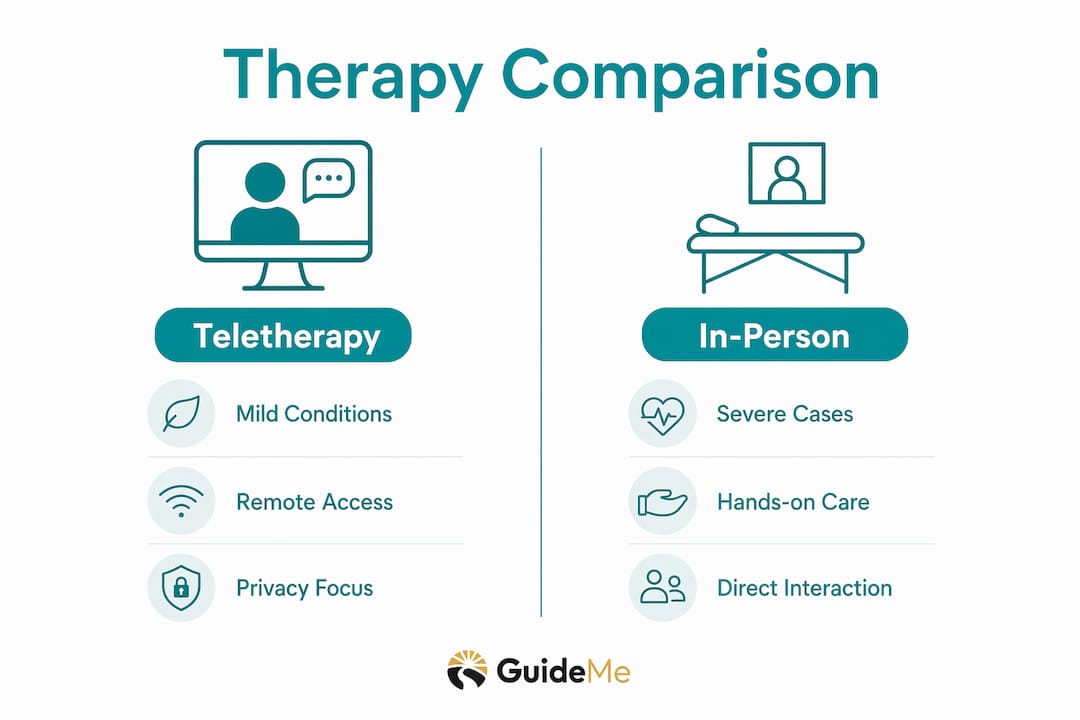
| Situation | Recommended approach |
|---|---|
| Mild to moderate anxiety or depression | Teletherapy is clinically equivalent to in-person care |
| Busy schedule or limited local options | Teletherapy offers flexible scheduling and specialist access |
| Crisis situations or risk of self-harm | In-person or emergency services are more appropriate |
| Severe psychiatric conditions requiring assessment | In-person evaluation is preferable |
| Preference for face-to-face contact | In-person or hybrid care models may suit better |
The concept of therapeutic fit goes beyond the question of remote versus in-person. Effective teletherapy depends on the connection between you and your therapist, the treatment modality used, and whether the format suits the issue you are working on. A skilled therapist working with the right approach in the right format will always outperform a mismatched pairing, regardless of location.
Hybrid models, which combine virtual and in-person sessions, are growing in popularity. They give you the convenience of remote access alongside the option of face-to-face contact when it adds value.
What legal and practical considerations affect teletherapy?
Teletherapy is not a free-for-all. Specific legal and practical rules govern how it works, and knowing them protects you.
The most important legal point is therapist licensure. Therapists must be licensed in the region where you are physically located at the time of the session, not where they are based. This means that if you travel abroad or move to a different country, your current therapist may not be legally permitted to continue your sessions. This is a genuine disruption to continuity of care that many people do not anticipate.
Privacy is another area where practical steps fall on you as the client. Digital platforms use encryption and comply with data protection regulations, but your physical environment can compromise confidentiality even when the technology is secure. A thin wall, a shared flat, or a session taken in a café all create real risks.
Practical steps to protect your privacy:
- Choose a private room with a closed door for every session.
- Use headphones to prevent audio from carrying to others.
- Inform household members that you are unavailable during your session time.
- Avoid public Wi-Fi networks; use a personal or home connection instead.
- Log out of the platform after each session and keep your login credentials secure.
Pro Tip: If you cannot find a private space at home, consider booking a private room at a local library or co-working space for your sessions. Many offer hourly bookings at low cost.
A critical distinction also applies to the tools you use. AI chatbots and wellness apps are not clinical therapy. They may offer support and psychoeducation, but they do not replace a licensed therapist. Only sessions conducted by a qualified, registered professional count as psychotherapy. When you are assessing your options, checking a therapist's credentials is non-negotiable. A guide to therapist qualifications can help you understand what to look for.
How can you prepare and get the most out of teletherapy?
Preparation makes a measurable difference to how useful your sessions feel. A few straightforward steps before your first appointment set you up for a better experience.
- Test your technology in advance. Check your camera, microphone, and internet connection before the session starts. A technical failure at the start of a session wastes time and disrupts your focus.
- Choose your format thoughtfully. Video is the most common choice, but phone or text-based sessions may suit you better depending on your comfort level and circumstances. Read about selecting your therapy type to understand which format fits your needs.
- Set up a consistent, private space. Use the same location each time if possible. Familiarity with your environment reduces distraction and helps you settle into the session more quickly.
- Assess therapist fit early. The first one or two sessions are partly about deciding whether this therapist is right for you. Pay attention to how comfortable you feel, whether you feel heard, and whether the approach makes sense for your situation. Learning how to assess therapist fit gives you a clear framework for this.
- Be honest about what is and is not working. If the format does not feel right, say so. A good therapist will work with you to adjust the approach, switch formats, or discuss whether a hybrid model would serve you better.
- Prepare a brief note before each session. Jot down what has come up since your last appointment. This keeps sessions focused and ensures you cover what matters most to you.
The therapeutic relationship is the single most important factor in whether therapy works. Therapeutic connection quality influences outcomes regardless of delivery mode. Investing time in finding the right therapist is not a luxury. It is the foundation of effective treatment.
Key takeaways
Teletherapy is clinically effective for mild to moderate mental health conditions, and the quality of the therapeutic relationship matters more than whether sessions happen online or in person.
| Point | Details |
|---|---|
| Teletherapy definition | Remote mental health counselling delivered via video, phone, or secure messaging with a licensed therapist. |
| Clinical effectiveness | Research confirms equivalent outcomes to in-person therapy for mild to moderate anxiety and depression. |
| Legal licensing rule | Your therapist must be licensed in the region where you are physically located during each session. |
| Privacy responsibility | Choose a private space and use headphones; your environment affects confidentiality as much as the platform does. |
| Therapeutic fit | The match between you, your therapist, and the treatment approach drives outcomes more than the delivery format. |
Teletherapy in practice: what I have seen change
I have watched teletherapy shift from a stopgap measure to a genuinely preferred option for a large number of people. What strikes me most is not the technology. It is how much the removal of a commute, a waiting room, and a fixed appointment window changes who actually shows up for therapy.
People who previously cited logistics as the reason they had not sought help are now attending sessions consistently. That is not a small thing. Consistency is one of the strongest predictors of therapeutic progress, and teletherapy makes consistency easier for a wider group of people.
What I would caution against is treating the format as the whole answer. I have seen people cycle through several online therapists without improvement, not because teletherapy does not work, but because the matching process was poor. The right therapist with the right approach in the right format is what produces results. Format alone does not.
The future of mental health care is almost certainly hybrid. Most people will move between remote and in-person sessions depending on what they need at a given point. The question is not whether teletherapy is real therapy. It is. The question is how to use it well, and that starts with being honest about what you need and finding someone genuinely qualified to help.
— Yetty
Finding the right therapist through Guidemetherapy
Starting therapy remotely is straightforward when you have the right support from the beginning.
Guidemetherapy is a therapy navigation platform that combines human expertise with AI-powered matching to connect you with a licensed therapist who fits your specific needs. Rather than leaving you to search through directories alone, Guidemetherapy builds an in-depth therapy plan for you and uses it to identify the right professional from the start. You can find your therapist through a process designed to reduce the trial and error that makes starting therapy feel difficult. Whether you are looking for video sessions, phone-based support, or a hybrid approach, Guidemetherapy helps you begin with clarity and confidence.
FAQ
What is the teletherapy definition in clinical terms?
Teletherapy is the delivery of licensed psychotherapy services through digital communication tools including video, phone, and secure messaging. It follows the same professional and ethical standards as in-person therapy.
Is teletherapy effective for anxiety?
Yes. Research confirms that teletherapy is equally effective as in-person therapy for anxiety and other mild to moderate mental health conditions.
Can my therapist treat me if I travel abroad?
Not always. Therapist licensure is tied to the client's physical location during the session, so your therapist may not be legally permitted to practise across international borders.
What is the difference between teletherapy and a wellness app?
Teletherapy involves a qualified, licensed therapist conducting clinical psychotherapy. Wellness apps and AI chatbots are not clinical substitutes and do not provide the same level of professional care.
How do I know if teletherapy is right for me?
Teletherapy suits most people seeking support for mild to moderate mental health concerns. If you are in crisis or require a formal psychiatric assessment, in-person care is more appropriate.