

TL;DR:
- Clarity is a trainable cognitive skill that improves within 1-2 weeks by improving sleep, movement, and habits. Techniques like written capture and grounding methods can achieve immediate mental clarity, while long-term habits sustain focus. Reducing mental overload and naming emotions enhances decision-making and emotional regulation.
Clarity is defined as the state of focused, alert mental processing that allows you to think, decide, and communicate without confusion. It is not a personality trait you either have or lack. Clarity is a cognitive skill, shaped by sleep, movement, mindfulness, and the habits you build each day. When your thinking is clear, your mental health improves, your relationships become more honest, and your decisions feel grounded rather than reactive. This article explains what the science says, which techniques work fastest, and how to sustain focused thinking over the long term.
What does clarity actually mean for your mental health?

Clarity, in psychological terms, refers to the quality of clear, focused thinking that enables confident decision-making and emotional regulation. It sits at the intersection of cognitive function and emotional wellbeing. When clarity is present, you can name what you feel, weigh your options, and act without being paralysed by doubt.
Mental fog is the opposite state, and it is more common than most people realise. Stress hormones, poor sleep, digital overload, and unprocessed emotion all reduce the brain's capacity to focus. The result is not weakness. Mental fog is often physiological working memory overload, not a character flaw. That distinction matters because it means the condition is reversible.
Clarity also affects how you relate to others. When your thinking is muddled, your words become imprecise and your intentions get misread. Clarity in communication is not just about choosing the right words. It is about having enough internal order to know what you actually mean before you speak.
What science reveals about achieving mental clarity
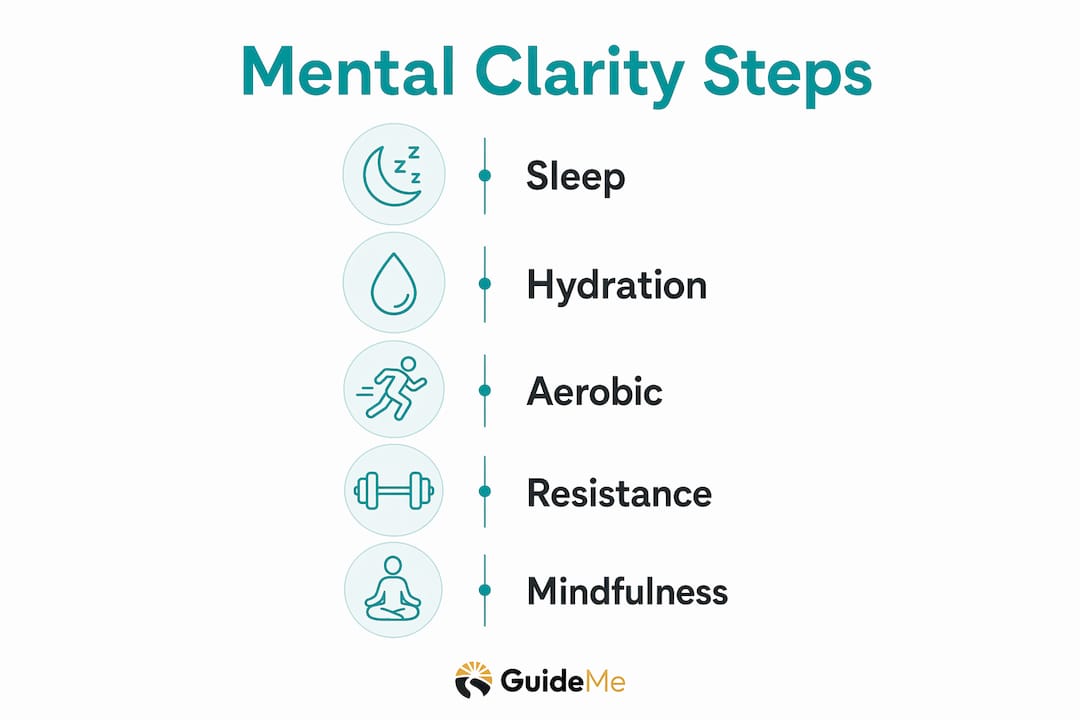
The physiological foundations of clear thinking are well established. Sustained mental clarity requires 7–9 hours of sleep per night and 30 minutes of aerobic activity five days a week. These are not aspirational targets. They are the baseline conditions under which the brain performs its consolidation and repair functions.
The timeline for improvement is shorter than most people expect. Noticeable cognitive improvements occur within 1–2 weeks of stabilising sleep and hydration. That means you can feel a measurable difference in your thinking within a fortnight of changing two habits.
Your sleep environment matters as much as sleep duration. Optimal sleep environments have bedroom temperatures between 65°F and 68°F, complete light blockage, and avoidance of alcohol three hours before bedtime. Alcohol disrupts REM sleep, which is the stage most associated with memory consolidation and emotional processing. For a structured approach to building these habits, the sleep meditation checklist from Orchestral Meditations offers practical guidance on optimising rest.
The table below summarises the key physiological factors and their effects on cognitive focus.
| Factor | Recommended level | Effect on clarity |
|---|---|---|
| Sleep duration | 7–9 hours per night | Consolidates memory, reduces mental fog |
| Aerobic exercise | 30 minutes, five days a week | Enhances focus for 4–6 hours post-session |
| Hydration | Consistent daily intake | Prevents cognitive slowdown from mild dehydration |
| Bedroom temperature | 65°F–68°F | Supports deeper, more restorative sleep |
| Alcohol before bed | Avoid within 3 hours | Protects REM sleep and emotional processing |
Pro Tip: Morning resistance training, such as bodyweight exercises or light weights, complements aerobic activity by supporting executive function. Combining both types of movement gives your brain the broadest cognitive benefit.
Which mental clarity techniques work fastest?
The fastest route to clearer thinking does not require meditation retreats or expensive tools. Immediate mental clarity can be achieved in under 30 minutes using written capture or environmental interventions such as total sensory isolation. Written capture means writing down every pending thought, worry, or task without organising it. The act of externalising the contents of your working memory frees up cognitive space almost immediately.
Mindfulness practice trains the brain to recognise wandering thoughts and return gently to the present moment, improving focus and reducing mental clutter. Even brief deep-breathing exercises significantly enhance cognitive alertness. You do not need a 45-minute session to feel the benefit. Understanding mindfulness in therapy can help you apply these techniques with more confidence and consistency.
The 5-4-3-2-1 grounding technique
This technique is one of the most effective tools for rapid clarity of thought in moments of stress or overwhelm. It works by redirecting attention from internal noise to external sensory input.
- See: Name five things you can see around you right now.
- Touch: Notice four things you can physically feel, such as the chair beneath you or your feet on the floor.
- Hear: Identify three sounds in your environment.
- Smell: Acknowledge two things you can smell, even faintly.
- Taste: Notice one thing you can taste.
The technique interrupts the stress response and brings the prefrontal cortex back online. It takes under two minutes and requires nothing except your attention.
Daily habits that support focused thinking
- Write down every open loop in your mind each morning before checking your phone.
- Take a ten-minute walk without headphones to allow passive mental processing.
- Practise one minute of slow, deliberate breathing before any high-stakes conversation.
- Limit decision-making to your peak cognitive hours, typically the first half of the day.
- Use a mindfulness habit checklist to track consistency across the week.
Pro Tip: If you feel overwhelmed before a difficult conversation or decision, name the emotion out loud or in writing. Verbalising emotions reduces their intensity and shifts your focus toward what you can actually do next.
How does clarity affect decision-making?
Decision-making is where the absence of clear thinking causes the most visible damage. People often assume they are confused when they are actually overloaded. These are different problems requiring different solutions.
People often confuse mental overload with confusion. Confusion means you lack information. Overload means you have too much input and no structure for processing it. Clarity in decision-making comes from reducing noise first, then identifying your real constraints, and then focusing only on the next immediate decision rather than the final outcome.
The table below compares these two mental states and the strategies that address each one.
| Mental state | What it feels like | Clarity strategy |
|---|---|---|
| Confused | Lacking information, uncertain what is true | Seek specific information, ask direct questions |
| Overloaded | Too many inputs, unable to prioritise | Create a reset window, reduce stimulation |
| Paralysed | Stuck between options, fear of choosing wrongly | Focus on the next small decision only |
| Emotionally reactive | Feelings driving choices, not values | Name the emotion, then pause before deciding |
Clarity arises from a layered approach: reduce external noise, identify constraints, and focus on next immediate decisions rather than final outcomes. This framework prevents analysis paralysis and supports consistent progress. Rather than asking "What is the right path for the rest of my life?", ask "What is the one decision I can make this week that moves me forward?"
Practical questions that build clarity in life and relationship challenges include:
- What do I actually know to be true right now, separate from what I fear?
- What would I advise a close friend in this exact situation?
- What is the smallest step I can take today that I will not regret?
- Which option aligns most closely with the values I have already identified as mine?
These questions are not rhetorical. Write the answers down. The act of writing converts vague anxiety into structured thought, which is the beginning of genuine clarity of thought.
What lifestyle habits sustain clarity over the long term?
Short-term techniques produce short-term results unless they are supported by consistent behavioural habits. The most damaging habit for sustained focus is multitasking. Multitasking deposits attention residue that reduces focus. Each time you switch tasks, a portion of your attention remains on the previous task. Over a full day, this accumulates into significant cognitive depletion.
Protecting the first 90 minutes of your day is one of the highest-return habits available. The first 90 minutes of the day are vital and should be free from communication platforms. No email, no social media, no messaging apps. Use that window for your most demanding cognitive work, or for the written capture and movement practices that set the tone for the rest of the day.
Emotional acceptance is equally important. Clarity is not a static state but a skill sharpened by practice, paradoxically improved by naming rather than ignoring emotions. Suppressing feelings does not produce focus. It produces background noise that consumes working memory without resolution.
Common pitfalls that undermine long-term clarity include:
- Checking your phone within the first ten minutes of waking.
- Eating irregularly, which causes blood sugar fluctuations that impair concentration.
- Skipping movement on days when you feel most mentally foggy, precisely when it would help most.
- Treating rest as a reward rather than a requirement for cognitive function.
- Seeking final answers to big questions before taking any small steps.
Mindfulness reduces stress and mind wandering, improves attention and memory, and enhances mental clarity sustainably. Short mindfulness breaks sharpen focus even when the sessions are brief. The key is regularity, not duration. A mental wellness checklist can help you track which habits you are maintaining and where the gaps are appearing.
Key takeaways
Clarity is a trainable cognitive skill, not a fixed trait, and it improves measurably within 1–2 weeks of addressing sleep, movement, and mental habits.
| Point | Details |
|---|---|
| Clarity is physiological | Sleep, hydration, and aerobic exercise are the foundation of focused thinking. |
| Written capture works fast | Offloading every open thought onto paper frees working memory within minutes. |
| Overload and confusion differ | Identifying which state you are in determines which strategy will actually help. |
| Protect your morning window | The first 90 minutes, free from devices, produce the highest cognitive output. |
| Name emotions to reduce them | Verbalising feelings reduces their intensity and restores focus under stress. |
What I have learned about clarity that most articles get wrong
People come to clarity work expecting a revelation. They want the moment when everything suddenly makes sense. In my experience, that moment rarely arrives the way people imagine it will.
What actually happens is quieter. You start sleeping more consistently. You write things down instead of cycling through them in your head. You stop trying to solve the whole problem at once and focus on the next small decision. And gradually, without fanfare, the fog lifts.
The misconception I encounter most often is that clarity is something you either have or you do not. People say things like "I am just not a clear thinker" as though it were a fixed characteristic, like eye colour. It is not. Clarity is a practice, and like any practice, it responds to attention and repetition.
The other thing I have noticed is that people resist naming their emotions because they think it will make the feelings stronger. The opposite is true. When you say "I am frightened about this decision" rather than pushing the fear aside, the fear loses some of its grip. You can think around it rather than through it.
The most honest advice I can offer is this: do not wait until you feel ready to start. Start with one habit, one morning, one written page. Clarity does not require perfect conditions. It requires consistent small choices, made with patience and without self-criticism.
— Yetty
How Guidemetherapy supports your path to clearer thinking
Feeling lost in your own thoughts is one of the most common reasons people seek therapy, and one of the most treatable. Guidemetherapy is a therapy navigation platform that matches you with the right therapist from the start, using an in-depth therapy plan built around your specific needs.

Whether you are working through a difficult decision, struggling with emotional overload, or simply wanting to think and communicate more clearly, Guidemetherapy connects you with a therapist who understands your situation. The platform is human-led and AI-powered, which means your matching process is both personal and precise. If you are ready to take the next step, find your therapist through Guidemetherapy and begin building the mental clarity that supports every area of your life.
FAQ
What is mental clarity and why does it matter?
Mental clarity is the state of focused, alert thinking that allows you to make decisions and communicate without confusion. It directly affects your mental health, relationships, and ability to manage daily challenges.
How quickly can you improve mental clarity?
Noticeable cognitive improvements occur within 1–2 weeks of stabilising sleep and hydration. Adding 30 minutes of aerobic exercise five days a week accelerates the process further.
What is the fastest technique for immediate clarity of thought?
Written capture, which means writing down every pending thought without organising it, can restore mental focus in under 30 minutes. The 5-4-3-2-1 grounding technique also works in under two minutes during moments of acute stress.
Does mindfulness actually help with clarity in decision-making?
Yes. Mindfulness trains the brain to recognise wandering thoughts and return to the present moment, reducing the mental clutter that makes decisions feel overwhelming. Even brief deep-breathing exercises produce measurable improvements in cognitive alertness.
What is the difference between mental confusion and overload?
Confusion means you lack the information needed to move forward. Overload means you have too much input and no structure for processing it. Each state requires a different strategy: confusion calls for targeted information-gathering, while overload calls for reducing stimulation and focusing on one small decision at a time.