

A therapist in the UK is a trained mental health professional who helps clients address emotional, psychological and behavioural difficulties through structured talking therapies. The five core responsibilities you will find in almost every therapist job description are: initial assessment and diagnostic formulation; personalised treatment planning; delivery of evidence-based therapy; confidential clinical record-keeping; and safeguarding and referral management. The term "therapist" is broad, as Verywell Mind notes, covering counsellors, psychotherapists, psychologists and social workers, so the professional registration required depends on the specialism.
At a glance — core duties:
- Assessment: conduct initial consultations, gather clinical history and formulate a working diagnosis or presenting problem
- Treatment planning: develop and review personalised, evidence-based therapy plans with measurable goals
- Therapy delivery: provide individual, couples, family or group sessions using modalities such as CBT, person-centred therapy or DBT
- Record-keeping: maintain accurate, GDPR-compliant clinical notes after every session
- Safeguarding and referrals: identify and manage risk, follow crisis protocols and refer to GPs, psychiatrists or social services when needed
Registration to check by specialism: BACP or UKCP for counsellors and psychotherapists; BPS or HCPC for psychologists; BABCP for cognitive behavioural therapists; HCPC for arts therapists and social workers in clinical roles.
Key takeaways
A complete therapist job description must cover registration, safeguarding, supervision and clinical duties to attract the right candidates and meet UK professional standards.
| Point | Details |
|---|---|
| Registration is non-negotiable | Verify BACP, UKCP, HCPC, BPS or BABCP registration before shortlisting any candidate. |
| DBS and indemnity must be explicit | State enhanced DBS and indemnity insurance requirements clearly in the JD, not just at offer stage. |
| Supervision belongs in the JD | Specify the frequency, format and supervisor qualifications the organisation provides, not only what it expects. |
| Experience bands vary by level | Entry roles suit 0–2 years with supervision; senior posts require 5+ years and complex caseload experience. |
| Setting shapes the role | State the client group and working environment in the JD to reduce poor-fit applications. |
Table of Contents
- What does a therapist do day to day?
- Three copyable therapist job description templates
- What qualifications and registrations do UK therapists need?
- How much experience do therapists need at each career stage?
- Typical pay, hours and where therapists work in the UK
- How HR teams should write a clear and legally sound JD
- How to screen and interview therapist candidates effectively
- Career progression and specialisations in therapy
- Common challenges in the therapist role and the support systems that help
- Where else do therapists work beyond the NHS and private practice?
- Why matching matters as much as credentials
- Sources
What does a therapist do day to day?
The clinical core of the role is well-established. Prospects describes psychotherapists as practitioners who use talking therapies to help clients explore thoughts, feelings and behaviour, working in short-term or long-term formats across a wide range of clinical presentations. In practice, that translates into a working week that mixes direct client contact with a significant volume of non-clinical tasks.
Core clinical duties:
- Conduct initial assessments, gather psychosocial history and produce a formulation
- Deliver individual, couples, family and group therapy sessions
- Apply evidence-based interventions: CBT, person-centred therapy, psychodynamic approaches, DBT, interpersonal therapy (IPT) and others as described by WebMD
- Monitor therapeutic progress using validated outcome measures (PHQ-9, GAD-7, CORE-OM)
- Adapt treatment plans in response to client progress or changing clinical need
- Provide clinical personalisation throughout the therapeutic relationship
Operational and administrative duties:
- Write session notes promptly after each appointment, in line with GDPR and organisational policy
- Maintain treatment plans, risk assessments and correspondence in a secure clinical record system
- Liaise with GPs, psychiatrists, social services and other MDT members
- Attend clinical supervision, team meetings and case conferences
- Complete outcome monitoring and contribute to service evaluation data
Safeguarding and risk management:
- Identify indicators of risk to self or others and document risk assessments
- Follow the organisation's safeguarding policy and escalate concerns appropriately
- Make referrals to statutory services when a client's safety requires it
- Hold a current enhanced DBS certificate and renew it per employer policy
- Adhere to a documented safeguarding policy and complete mandatory safeguarding training
| Task category | Typical weekly time allocation |
|---|---|
| Direct client therapy sessions | a majority of contracted hours |
| Clinical notes and record-keeping | a significant portion of contracted hours |
| Supervision, CPD and team meetings | a moderate portion of contracted hours |
| Referrals, liaison and admin | a smaller portion of contracted hours |
Pro Tip: Build scheduled admin time into the working week from day one. Administrative and compliance tasks consume more clinician time than most new hires anticipate, and unplanned admin is one of the leading contributors to therapist burnout.
Three copyable therapist job description templates
The structure below draws on standard JD formats used across UK recruitment, including the approach outlined by Gusto and Monster, adapted for the UK market. Copy, paste and edit the sections in square brackets.
1. Short template (job boards and quick adverts)
[Organisation name] — Therapist, [Location]
We are looking for a qualified therapist to join our [team/service] in [location]. You will deliver individual and/or group therapy to [client group], maintain clinical records and work collaboratively with our multidisciplinary team. Registration with [BACP/UKCP/HCPC/BPS] is required, along with an enhanced DBS certificate. Salary: [£ X–£ X] per annum/sessional rate. [Part-time/full-time/sessional] contract available. To apply, send your CV and a covering letter to [contact details].
2. Standard template (most vacancy pages)
Role summary [Organisation name] is seeking a [Therapist/Counsellor/Psychotherapist] to provide [individual/group/couples] therapy to [client group] within our [NHS trust/charity/private practice/school]. The post-holder will work [X] hours per week and report to [line manager title].
Key duties
- Conduct initial assessments and develop personalised treatment plans
- Deliver evidence-based therapy sessions, adapting approach to client need
- Maintain accurate, confidential clinical records in line with GDPR
- Attend regular clinical supervision and contribute to team meetings
- Identify and manage risk, following the organisation's safeguarding policy
- Liaise with GPs and other professionals as required
Essential qualifications and registration
- [Master's degree in counselling/psychotherapy/psychology or equivalent]
- Current registration with [BACP/UKCP/HCPC/BPS/BABCP]
- Enhanced DBS certificate (or willingness to obtain one)
- Professional indemnity insurance (for sessional/self-employed posts)
- Minimum [X] years' post-qualifying supervised clinical experience
Desirable
- Experience with [specific client group or modality]
- Supervision qualification
Salary and hours: [£X–£X] | [X] hours per week | [Employed/sessional/self-employed]
How to apply: Submit a CV and covering letter to [email/link] by [closing date].
3. Detailed template (senior or specialist posts)
Role summary [Organisation name] is recruiting a Senior [Therapist/Psychotherapist/Clinical Psychologist] to lead therapeutic provision for [client group] within [service/department]. The post-holder will hold a caseload of complex presentations, provide clinical supervision to junior staff and contribute to service development.
Expanded duties
- Manage a caseload of [X] clients presenting with [clinical presentations]
- Deliver individual, group and/or family therapy using [named modalities]
- Provide clinical supervision to [trainee/junior] therapists in line with [BACP/UKCP/BPS] standards
- Lead on outcome monitoring, audit and quality improvement within the team
- Contribute to training, CPD delivery and service development projects
- Ensure all practice meets [HCPC/BACP/UKCP] ethical frameworks and the organisation's clinical governance standards
- Maintain an enhanced DBS certificate and current professional indemnity insurance
- Complete mandatory safeguarding training at the level required for the role
Essential criteria
- Master's degree or doctoral qualification in [counselling/psychotherapy/clinical psychology]
- Current registration with [BACP/UKCP/HCPC/BPS/BABCP] — proof required at offer stage
- Minimum five years' post-qualifying clinical experience, including complex presentations
- Recognised supervision qualification or equivalent experience
- Enhanced DBS certificate
Desirable criteria
- Experience in [specific modality, e.g. EMDR, DBT, trauma-focused CBT]
- Published research or service evaluation experience
CPD and supervision: The post-holder is expected to maintain [X] hours of CPD per year in line with their registration body's requirements and to engage in regular clinical supervision.
Salary: [NHS Band X or £X–£X depending on experience] | [Full-time/part-time] | [Employed/sessional]
DBS and indemnity: An enhanced DBS check is required before commencement. Professional indemnity insurance must be maintained throughout employment.
How to apply: [Instructions and closing date]
What qualifications and registrations do UK therapists need?
UK employers typically require a master's degree in counselling, psychotherapy, psychology or social work, plus registration with a relevant professional body and at least two years of supervised clinical experience. Bachelor-level roles exist, particularly in counselling support or assistant practitioner posts, but they are the exception rather than the rule for independent practice.
Which registration body applies to which specialism?
| Registration body | Who it covers | What to check |
|---|---|---|
| BACP | Counsellors and psychotherapists | Accredited membership status on the BACP register |
| UKCP | Psychotherapists and psychotherapeutic counsellors | Registration on the UKCP register |
| BPS | Psychologists (chartered status) | Chartered Psychologist or Registered Psychologist status |
| HCPC | Clinical, counselling and forensic psychologists; arts therapists; social workers | Registration number on the HCPC register |
| BABCP | Cognitive behavioural therapists | Accredited CBT therapist status |
Registration shortlisting checklist for employers:
- Proof of current registration (screenshot or registration number verified on the body's public register)
- Enhanced DBS certificate dated within the last three years (or update service subscription)
- Professional indemnity insurance certificate (for sessional or self-employed posts)
- Two professional references, at least one from a clinical supervisor
- Evidence of current CPD log meeting the registration body's minimum hours
- Documented safeguarding training at the level appropriate to the role
Understanding evidence-based therapy approaches helps employers frame the modality requirements in the JD accurately, rather than listing every possible approach and attracting mismatched applicants.
How much experience do therapists need at each career stage?
Experience requirements vary considerably by role level, and conflating them in a JD leads to either under-qualified applicants or a pool that is too narrow. The National Careers Service provides a useful UK-specific baseline for role scope and typical contexts.
Entry level (0–2 years post-qualifying):
- Suitable for supervised or supported roles within a team, not independent caseloads
- Requires regular clinical supervision, typically weekly or fortnightly
- Training routes include postgraduate diplomas, master's programmes and accredited counselling training with clinical placement hours
- DBS check and student/provisional registration with the relevant body required
Mid-level (2–5 years post-qualifying):
- Can hold an independent caseload with less intensive supervision
- Expected to demonstrate competence across a range of presentations
- Supervision frequency typically monthly, with documented records
- Many practitioners at this stage pursue specialist post-qualifying training, such as BABCP accreditation for CBT or EMDR accreditation
Senior level (5+ years post-qualifying):
- Expected to manage complex and high-risk presentations
- Often holds a supervision qualification and provides supervision to junior colleagues
- Contributes to service development, training and clinical governance
- CPD requirements remain active; most registration bodies require a minimum number of hours per year
Supervision requirements across all levels:
- Supervision must be provided by a suitably qualified and experienced supervisor
- Supervision records should be documented and available for audit
- The frequency and format (individual, group, peer) should be specified in the JD
Pro Tip: When writing the JD, state the supervision arrangement the organisation provides, not just what it requires from the candidate. Applicants increasingly treat supervision quality as a deciding factor when choosing between offers.

Typical pay, hours and where therapists work in the UK
Therapists work across a wide range of settings, and pay varies significantly by sector, region and contract type. The National Careers Service offers UK-specific salary context and typical workplace descriptions. NHS job adverts show that employed NHS roles include supervision duties, multidisciplinary working and group therapy delivery alongside individual caseloads.
| Setting | Typical contract type | Pay range (indicative) |
|---|---|---|
| NHS trust | Employed (Band 5–8a typical) | Aligned to NHS Agenda for Change bands; check current NHS pay scales |
| Private practice | Self-employed/sessional | Hourly or sessional rates; varies widely by location and specialism |
| Charity/third sector | Employed or sessional | Often below NHS rates; may include pension and benefits |
| Schools and colleges | Employed or sessional | Varies; some roles are part-time or term-time only |
| Occupational health | Employed or contracted | Competitive; often includes EAP (Employee Assistance Programme) work |
| Social services | Employed | Aligned to local authority pay scales |
Working patterns and contract types:
- Full-time employed roles are most common in NHS trusts and larger charities
- Sessional and self-employed arrangements are standard in private practice and some school-based roles
- Part-time and flexible working is widely available, particularly in community and charity settings
- On-call or crisis arrangements are rare in outpatient therapy roles but may apply in inpatient or crisis services
Employers designing corporate mental health programmes should also consider how therapist roles interact with mental health benefits in premium plans, particularly when commissioning EAP or occupational health therapy services.
Always verify current NHS pay bands directly with NHS Employers and check local market rates before setting a salary range in a JD.
How HR teams should write a clear and legally sound JD
A well-constructed therapist JD does two things at once: it gives candidates enough information to self-select accurately, and it gives the hiring panel defensible, measurable criteria to assess against. Monster's template guidance makes the point that presenting the employer proposition alongside technical requirements attracts stronger applicants.
1. Include every structural element
- Role title, department, reporting line and location
- Role summary (two to three sentences on purpose and client group)
- Key duties (bulleted, specific and prioritised)
- Essential and desirable criteria (qualifications, registration, experience, competencies)
- Supervision and CPD arrangements
- DBS and indemnity requirements stated explicitly
- Salary range or band, hours and contract type
- How to apply and closing date
2. Write the person specification with measurable criteria
Avoid vague language such as "good communication skills." Replace it with "able to explain clinical formulations clearly to clients and to non-clinical colleagues in MDT settings." Each criterion should be assessable at application, interview or both.
3. Draft sample interview questions linked to competencies
- Clinical reasoning: "Describe a case where your initial formulation changed significantly during treatment. What led to the change and how did you adapt your approach?"
- Safeguarding: "Walk me through the steps you would take if a client disclosed information that raised a safeguarding concern."
- Therapeutic approach: "How do you decide which modality to use with a new client, and how do you review that decision over time?"
4. Use inclusive language and state reasonable adjustments
- Avoid gendered language or role descriptions that imply a particular background
- State that reasonable adjustments are available at interview
- Specify whether the role can be done remotely, in person or in a hybrid arrangement
How to screen and interview therapist candidates effectively
Shortlisting for a therapist post carries clinical safety implications that most other recruitment processes do not. A candidate who looks strong on paper but lacks genuine safeguarding competence or appropriate scope of practice is a risk to clients. Assessing therapist fit goes beyond checking credentials.
1. Complete a pre-interview screening checklist
- Verify registration on the relevant body's public register (BACP, UKCP, HCPC, BPS, BABCP)
- Confirm DBS status: current certificate or update service subscription
- Request two references, at least one from a clinical supervisor
- Ask for a brief clinical case example (anonymised) that demonstrates the candidate's primary modality
- Check scope of practice: does the candidate's training and experience match the client group and presentations in the JD?
2. Use a structured scoring rubric at interview
Score each candidate against the same criteria, using a simple 1–4 scale:
- Clinical experience and competence: depth and relevance of caseload experience
- Safeguarding knowledge: accuracy and confidence in describing safeguarding procedures
- Therapeutic approach fit: alignment between the candidate's primary modality and the service's clinical model
- Interpersonal and communication skills: clarity, warmth and professional boundaries in the interview itself
3. Use clinical vignette questions
Present a brief anonymised scenario and ask the candidate to talk through their clinical reasoning. Assess whether they identify risk factors, consider the client's context, choose an evidence-based approach and know when to refer on. Strong candidates will also acknowledge the limits of their competence.
4. Apply reasonable adjustments and consider remote interviewing
Offer remote interview options where possible and confirm adjustments in advance. A candidate who requests adjustments is not a weaker candidate; the process should assess clinical competence, not logistical flexibility.
Pro Tip: Guidemetherapy's matching approach combines AI-assisted screening with human oversight to balance clinical specialism and interpersonal fit. The same principle applies to in-house hiring: a candidate who ticks every credential box but whose interpersonal style is a poor fit for the client group will struggle to retain clients long-term.
Career progression and specialisations in therapy
Therapy offers a clear progression path, though the route looks different depending on the sector. In the NHS, progression typically follows Agenda for Change bands, moving from Band 5 or 6 entry roles through to Band 7 senior therapist and Band 8 consultant or lead positions. Each step usually requires demonstrable clinical experience, supervision competence and, at senior levels, a contribution to service development or research.
In private practice, progression is less linear. Therapists build a specialism, develop a reputation and often diversify into supervision, training or consultancy. Many pursue post-qualifying accreditations in areas such as trauma-focused CBT, EMDR, DBT, schema therapy or systemic family therapy. These credentials open access to specific client groups and, in some cases, higher sessional rates.
Common specialisations include: child and adolescent mental health (CAMHS); trauma and PTSD; eating disorders; addiction and substance misuse; perinatal mental health; relationship and couples therapy; and neuropsychology. Each specialism typically requires additional training beyond the core qualification, and some, such as CAMHS or forensic work, require specific registration endorsements or enhanced vetting.
Leadership roles in larger organisations may involve clinical governance, team management, training delivery and commissioning input. A supervision qualification is often the first formal step towards a leadership or consultant pathway.
Common challenges in the therapist role and the support systems that help
Therapist burnout is a genuine occupational risk. Holding space for clients in significant distress, managing complex risk, and carrying a heavy administrative load alongside a full clinical caseload creates sustained pressure. Secondary traumatic stress, compassion fatigue and vicarious trauma are recognised occupational hazards, not personal failings.
The most effective support systems are structural, not incidental. Regular clinical supervision is the primary protective mechanism: it provides a space to process difficult clinical material, review risk and maintain professional perspective. Supervision should be a contractual requirement, not an optional extra, and its frequency and format should be written into the JD from the outset.
Peer support networks, access to personal therapy and clear organisational policies on workload management all contribute to therapist wellbeing. Employers who invest in these structures see lower turnover and better clinical outcomes. The BACP, UKCP and BPS all publish guidance on practitioner wellbeing and ethical practice, and their frameworks are a useful reference when designing support structures for a therapy team.
Practical challenges also include: managing therapeutic endings and client disengagement; navigating complex multi-agency cases; maintaining professional boundaries in community or home-based settings; and keeping up with CPD requirements alongside a full caseload. Acknowledging these realities in the JD, rather than presenting the role as straightforwardly rewarding, tends to attract more resilient and self-aware applicants.
Where else do therapists work beyond the NHS and private practice?
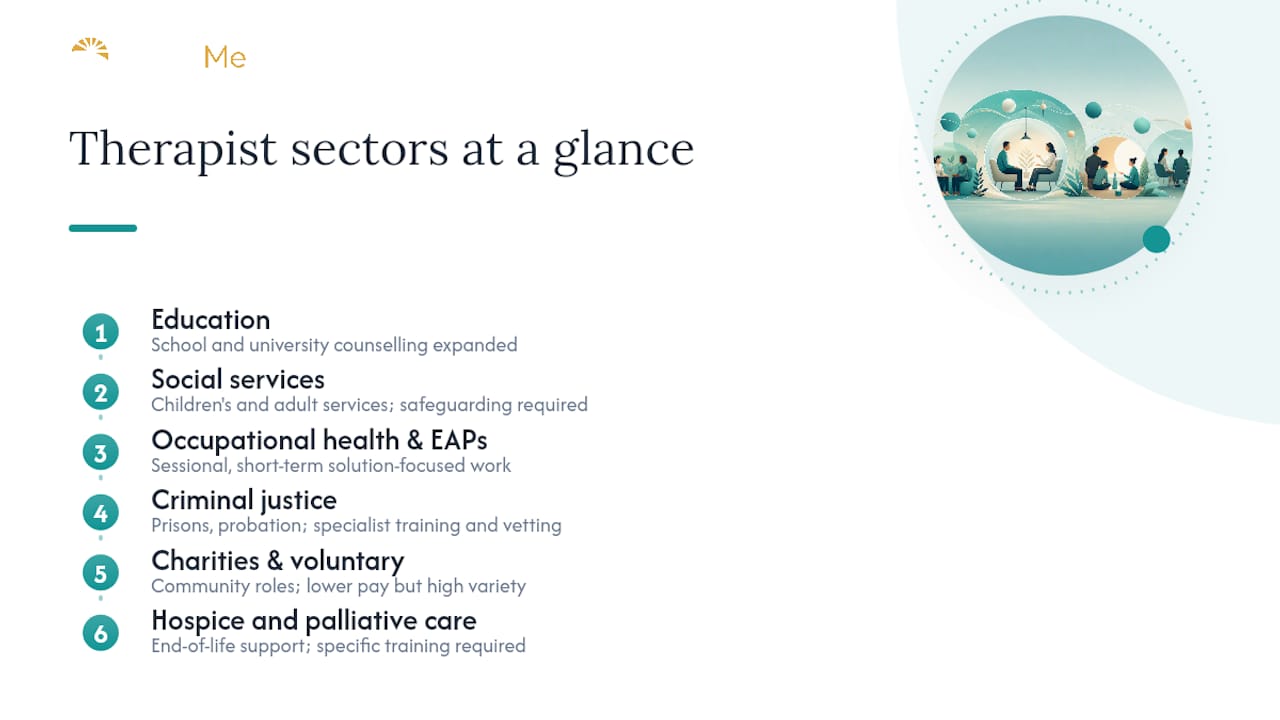
The NHS and private practice are the most visible employers, but a significant proportion of UK therapists work in sectors that are less often discussed in hiring guides.
Education: Schools, colleges and universities employ therapists and counsellors directly, or commission them through external providers. School-based counselling is increasingly common following investment in children's mental health services, and university counselling services have expanded substantially in recent years.
Social services and local authorities: Therapists work within children's services, adult social care and community mental health teams, often in roles that blend therapeutic and case management responsibilities. These posts typically require experience with complex safeguarding cases and familiarity with statutory frameworks.
Occupational health and employee assistance programmes (EAPs): Corporate employers commission therapy through EAP providers or occupational health services. These roles are often sessional and require the ability to work within short-term, solution-focused models.
Criminal justice and forensic settings: Prisons, probation services and secure units employ therapists to work with offenders, often with presentations that include personality disorder, trauma and substance misuse. These roles require specialist training and enhanced vetting.
Charities and voluntary sector: Organisations focused on domestic abuse, bereavement, addiction, homelessness and specific health conditions all employ therapists, often in community-based settings. Pay tends to be lower than NHS rates, but these roles offer significant clinical variety and social purpose.
Hospice and palliative care: Therapists working in end-of-life settings support patients and families through grief, loss and existential distress. This specialism requires specific training and a high degree of emotional resilience.
Listing the specific setting and client group in the JD, as Prospects recommends, reduces poor-fit applications and helps candidates assess whether the role genuinely matches their experience.
Why matching matters as much as credentials
The clinical qualifications in a therapist job description are necessary, but they are not the whole picture. A therapist can hold every required registration, pass every screening check and still be the wrong fit for a particular client or service. Interpersonal style, therapeutic approach and the specific client group all shape whether a therapeutic relationship is likely to be effective and sustainable.
At Guidemetherapy, we built our matching process around exactly this insight. Our platform combines AI-assisted screening with human-led oversight to assess clinical specialism and interpersonal fit together, not as separate steps. The result is a more considered match from the outset, which matters for client engagement and for long-term therapeutic outcomes. Credentials open the door; fit determines what happens inside the room.
Sources
Professional registration and guidance bodies:
- Therapist Job description Updated 2026
- Prospects
- Psychotherapist | Explore Careers
- Psychological Therapist
- Therapist Job Description | Gusto
- Therapist Job Description Sample | Monster.com
- What Therapists Do and When to See One
- What is a Psychotherapist? What They Do, When to See One, and What to Expect
Guidemetherapy resources:
For HR professionals: the BACP's Ethical Framework for the Counselling Professions and the NHS Employers safer recruitment guidance are both worth reading before finalising a JD for a clinical role.