

A sound mental health policy UK employers can rely on starts with one decision: adopt a tiered, HSE Management Standards-aligned policy that ties a documented stress risk assessment to named referral routes and clear manager responsibilities. Everything else follows from that.
Three things you can do this week:
- Run a role-level stress risk check. Pull sickness absence data, recent staff survey results and any exit interview themes. HSE guidance recommends reviewing exactly these sources before drafting or updating a policy, so you are satisfying legal due diligence from day one.
- Appoint a policy owner and a senior sponsor. Without a named owner, policies stall. The sponsor signals board-level commitment; the owner keeps the document live. ACAS and NICE both flag this as a prerequisite for a policy that staff actually use.
- Commit budget for manager training and therapy access. Manager capability is the single biggest multiplier of policy effectiveness. For organisations that need a single, fast solution for employee therapy access, Guidemetherapy offers an enterprise therapy navigation platform that matches employees to therapists using human-led and AI-assisted screening.
Key takeaways
A tiered, HSE-aligned workplace mental health policy with named referral pathways, documented manager training, and regular WEMWBS-tracked reviews is the most defensible and effective approach UK employers can adopt.
| Point | Details |
|---|---|
| Legal duties are clear | The Health and Safety at Work etc Act 1974 and Equality Act 2010 require a written policy and documented risk assessment. |
| Risk assessment comes first | Use absence data, staff surveys and exit interviews to identify real stressors before drafting policy actions. |
| Tiered model is NICE-recommended | Organisational fixes come before individual therapy; NICE NG212 sets this as the evidence-based sequence. |
| Measure with validated tools | Track WEMWBS scores biannually alongside absence rate, EAP uptake and time-to-first-appointment. |
| Guidemetherapy for fast access | Guidemetherapy's enterprise platform matches employees to accredited therapists quickly, with full clinical governance and UK GDPR compliance. |
Table of Contents
- Why does a formal mental health policy matter for UK employers?
- What should every UK workplace mental health policy include?
- How do you assess workplace mental health risks using HSE Management Standards?
- What does a tiered mental wellbeing model look like in practice?
- What are the practical options for employee therapy access?
- How do you implement or update the policy across your organisation?
- How do you measure whether the policy is working?
- Copy-and-paste policy snippets and implementation checklist
- What the policy documents rarely tell you
- Guidemetherapy: faster therapy access for your employees
- Sources
Why does a formal mental health policy matter for UK employers?
Two pieces of legislation create the legal floor. The Health and Safety at Work etc Act 1974 requires employers to protect, so far as is reasonably practicable, the health, safety and welfare of every employee. A written policy and a documented risk assessment are the clearest evidence that an employer has taken that duty seriously. The Equality Act 2010 adds a second layer: where a mental health condition amounts to a disability, employers must make reasonable adjustments and must not treat an employee less favourably because of it.
Beyond compliance, the business case is direct. Mental health-related absence costs UK employers significantly each year, and a policy with clear referral pathways reduces the time employees spend without support. CIPD guidance shows that return-to-work interviews and individual wellbeing plans, when embedded in policy, produce more sustainable recoveries than ad hoc manager responses.
What should every UK workplace mental health policy include?
ACAS recommends that a policy covers scope, manager responsibilities, support routes, absence processes and confidentiality. Below are the core clauses, with ready-to-copy language.
Scope and senior sponsor statement
"This policy applies to all employees, workers and contractors of [Organisation]. The Board is committed to protecting and promoting the mental wellbeing of everyone who works here. [Name, Title] is the senior sponsor accountable for this policy."
Manager responsibilities clause
"Line managers are responsible for: holding regular one-to-one conversations that create space to discuss workload and wellbeing; making reasonable adjustments where a health condition affects work; following the return-to-work procedure after any mental health-related absence; and signposting employees to the referral pathways listed in Section [X]."
HSE's line managers' resource advises early supportive contact, coordinated occupational health involvement and planned return-to-work activity as the core of this role.
Employee disclosure and confidentiality paragraph
"Employees are encouraged, but never required, to disclose a mental health condition. Any information shared will be treated in confidence and used only to arrange appropriate support or adjustments. Information will not be shared with others without consent, except where there is a serious risk of harm."
- Policy owner, review cadence (at minimum annually) and version control
- Roles: board, HR, line managers, safety representatives, occupational health
- Referral pathways: EAP, occupational health, NHS IAPT, Mind and local services
- Reasonable adjustments process and link to absence management procedure
- Communications plan: induction, team briefings, manager toolkits
Pro Tip: Include the policy in every new-starter induction pack and link it from your HR system. ACAS specifically recommends sharing the policy with staff and trade unions and using it at induction — a policy no one can find is a policy that does not exist.
How do you assess workplace mental health risks using HSE Management Standards?
The HSE Management Standards workbook sets a step-by-step preventive approach and recommends producing an action plan and an organisational stress policy to demonstrate duty of care. Running this process before finalising your policy means your interventions address real pressure points, not assumed ones.
- Gather your data. Pull sickness absence records (filter for mental health and stress-related codes), staff survey scores on workload, control, support and relationships, exit interview themes, overtime patterns and any near-miss or incident data. HSE advises using all of these sources together.
- Map stressors to the six Management Standards domains. The domains are: demands, control, support, relationships, role and change. Score each domain against your data and identify where the organisation falls below the standard.
- Prioritise by impact and frequency. A stressor affecting a large team repeatedly ranks higher than an isolated incident. Focus your first policy actions on the top two or three domains.
- Build an action plan. For each priority stressor, record: the risk identified, the intervention planned, the owner, the target date and the review date. This document is your evidence of reasonable steps under the 1974 Act.
- Review. Set a six-month check-in to assess whether the intervention has moved the data, then feed findings into the annual policy review.
Pro Tip: When running staff surveys as part of the risk assessment, anonymise responses at team level (minimum five respondents per group) before sharing results with safety representatives. This preserves confidentiality while giving reps the data they need to contribute meaningfully to the action plan.
What does a tiered mental wellbeing model look like in practice?
NICE guidance NG212 recommends a tiered approach: organisational foundations first, then manager and line-level interventions, then targeted individual support. The logic is that fixing a structural stressor prevents many individual crises; therapy for one person does not fix a broken rota system.
Tier 1: Organisational baseline
- Written mental health policy with board sign-off
- Job design that gives employees reasonable control over their work
- Flexible working options and clear workload management processes
- Psychological safety norms embedded in team culture
- Explore types of organisational support for a fuller menu of preventive strategies
Tier 2: Manager and line interventions
- Trained managers who can hold supportive conversations and spot early warning signs
- Individual wellbeing plans and reasonable adjustments for employees who need them
- Return-to-work interviews following any mental health-related absence
- Therapy support for managers themselves, so they can model help-seeking behaviour
Tier 3: Targeted individual support
- Employee Assistance Programme (EAP) counselling
- Occupational health referral and clinical assessment
- Employer-funded therapy or counselling sessions
- NHS IAPT referral for employees without immediate access to private provision
- Third-sector support via Mind or local mental health charities
What are the practical options for employee therapy access?
Getting employees to a first appointment quickly is where most policies fall short. The table below compares the main routes.
Confidentiality rules apply regardless of route. Employees must give explicit consent before any clinical information is shared with HR or managers. Where an occupational health report is commissioned, the employee sees the report before it is released. ACAS guidance on conversations is clear: managers should explain the limits of confidentiality (for example, where there is a risk of serious harm) at the start of any wellbeing discussion, not after.
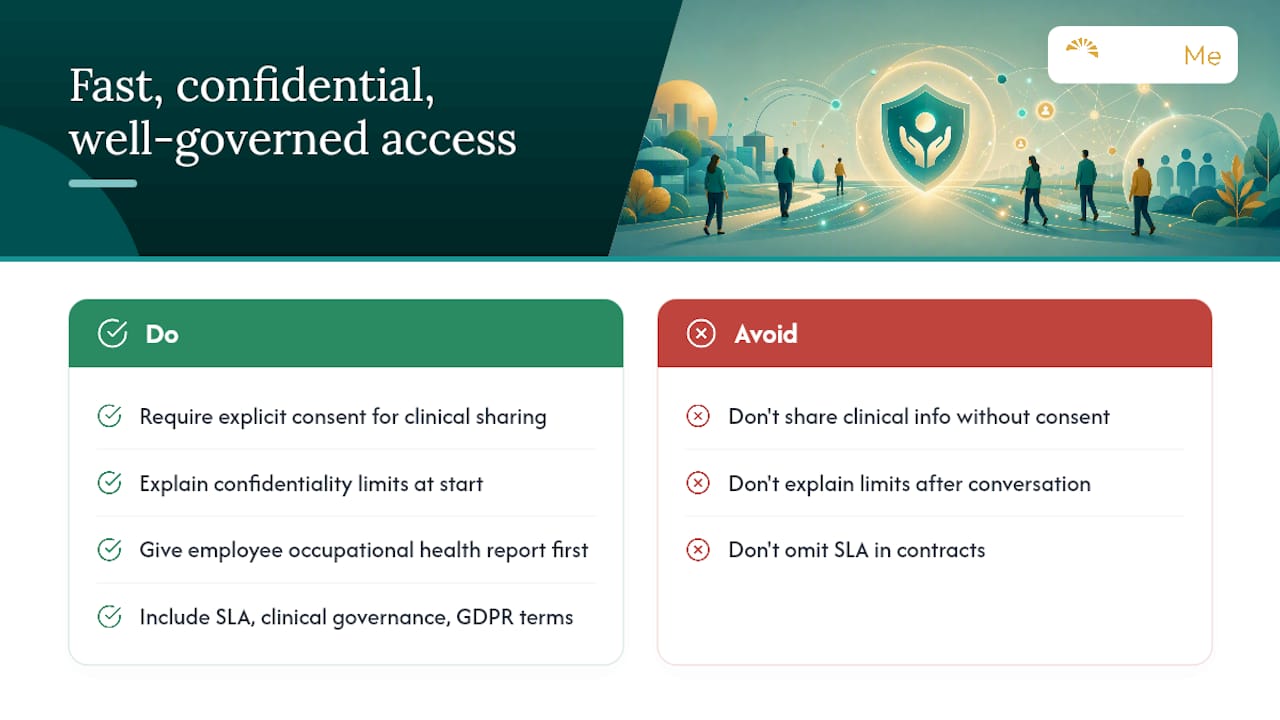
When commissioning a therapy supplier, include in the contract: a maximum time-to-first-appointment SLA, clinical governance standards (therapist accreditation body, supervision arrangements), data processing terms compliant with UK GDPR, and a quarterly reporting requirement on uptake and session completion. For a detailed procurement checklist, the corporate therapy services guide covers SLA elements and quality indicators.
How do you implement or update the policy across your organisation?
A policy that sits in a shared drive and is never activated is a liability, not an asset. Structure the rollout as a 90-day project.
- Days 1–30. Policy owner drafts or updates the document using the core elements above. Senior sponsor reviews and signs off. HR lead maps current referral pathways and identifies gaps. Communications lead drafts the internal announcement and manager briefing pack.
- Days 31–60. Manager training delivered (half-day minimum; CIPD and HSE both recommend documented refreshers). Policy published on the intranet and shared at team meetings. Referral pathway contracts confirmed or procured. Baseline KPI data collected (absence rate, current EAP uptake, any existing wellbeing survey scores).
- Days 61–90. First staff pulse survey or WEMWBS baseline run. Policy included in next new-starter induction. Policy owner schedules six-month review. Board receives a one-page summary of the risk assessment findings and the action plan.
For smaller organisations with limited HR resource, the cost does not need to be high. NHS IAPT self-referral is free. Mind offers employer resources and some local Mind organisations provide workplace training at low cost. A light-touch EAP covering telephone counselling can cost less than many organisations expect per employee per year.
How do you measure whether the policy is working?
NICE NG212 recommends using validated measures such as the Warwick-Edinburgh Mental Wellbeing Scale (WEMWBS) alongside operational metrics, rather than relying on absence data alone. WEMWBS is a 14-item validated scale that gives a population-level wellbeing score; running it twice a year lets you track directional change.
Suggested KPI set:
- Mental health-related absence rate (days lost per employee per year)
- EAP or therapy pathway uptake rate (percentage of workforce using the service annually)
- Time-to-first-appointment (target: within five working days for urgent referrals)
- WEMWBS mean score, tracked biannually
- Manager training completion rate (target: 100% within 90 days of policy launch)
Review cadence: a six-month operational review (policy owner and HR lead), an annual board update with anonymised staff feedback and supplier SLA performance, and a full policy revision every two years or after any significant organisational change.
Copy-and-paste policy snippets and implementation checklist
The three snippets in the core elements section above are ready for direct insertion into your HR policy document. Below is a condensed implementation checklist for audit and board sign-off.
- Policy drafted and version-controlled — Owner: HR lead. Evidence: dated document with tracked changes.
- Senior sponsor statement included and signed — Owner: Board/Executive. Evidence: signed policy page.
- Stress risk assessment completed — Owner: HR/People Analytics. Evidence: completed HSE Management Standards action plan.
- Referral pathways confirmed — Owner: HR lead. Evidence: signed contracts or confirmed NHS/charity routes.
- Manager training scheduled and delivered — Owner: Training lead. Evidence: attendance records.
- Policy communicated to all staff — Owner: Communications. Evidence: induction records, intranet publish date.
- Baseline KPIs recorded — Owner: HR lead. Evidence: dashboard or spreadsheet with date-stamped data.
- First review date set — Owner: Policy owner. Evidence: calendar entry and board agenda slot.
For a fuller operational playbook, the mental health programme implementation guide covers enterprise rollout in more depth.
What the policy documents rarely tell you
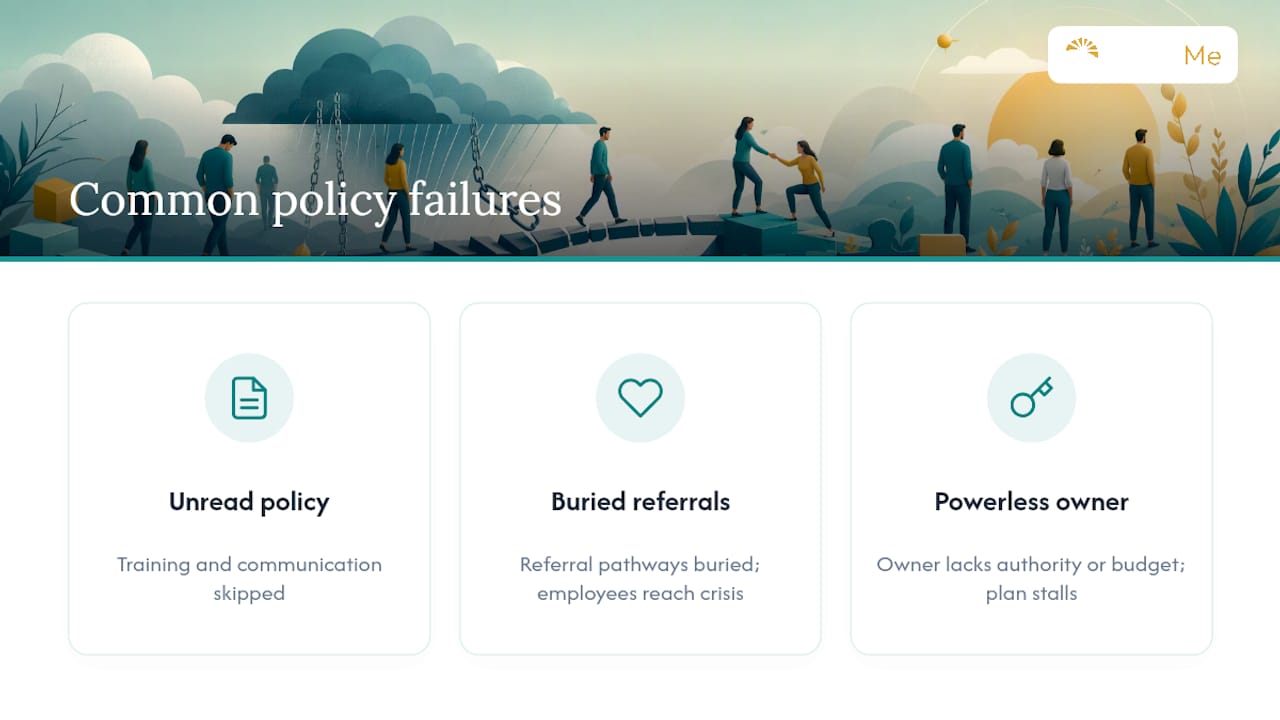
The most common failure mode is not a badly written policy. It is a well-written policy that managers have never read and employees do not know exists. Organisations that invest in a thorough document and then skip the training and communication steps end up with a compliance artefact rather than a functioning system.
The second pitfall is treating therapy access as a last resort. When referral pathways are buried at the back of a policy and managers are not trained to signpost them, employees often reach crisis point before they access support. Early, normalised access to counselling or therapy consistently reduces the length and severity of absence episodes.
A third, less-discussed issue: the policy owner role is often assigned to someone without the authority or budget to act on the risk assessment findings. If the owner cannot commission training, adjust a referral contract or escalate a systemic stressor to the board, the action plan stalls. Assign the role to someone with real operational reach.
Guidemetherapy: faster therapy access for your employees
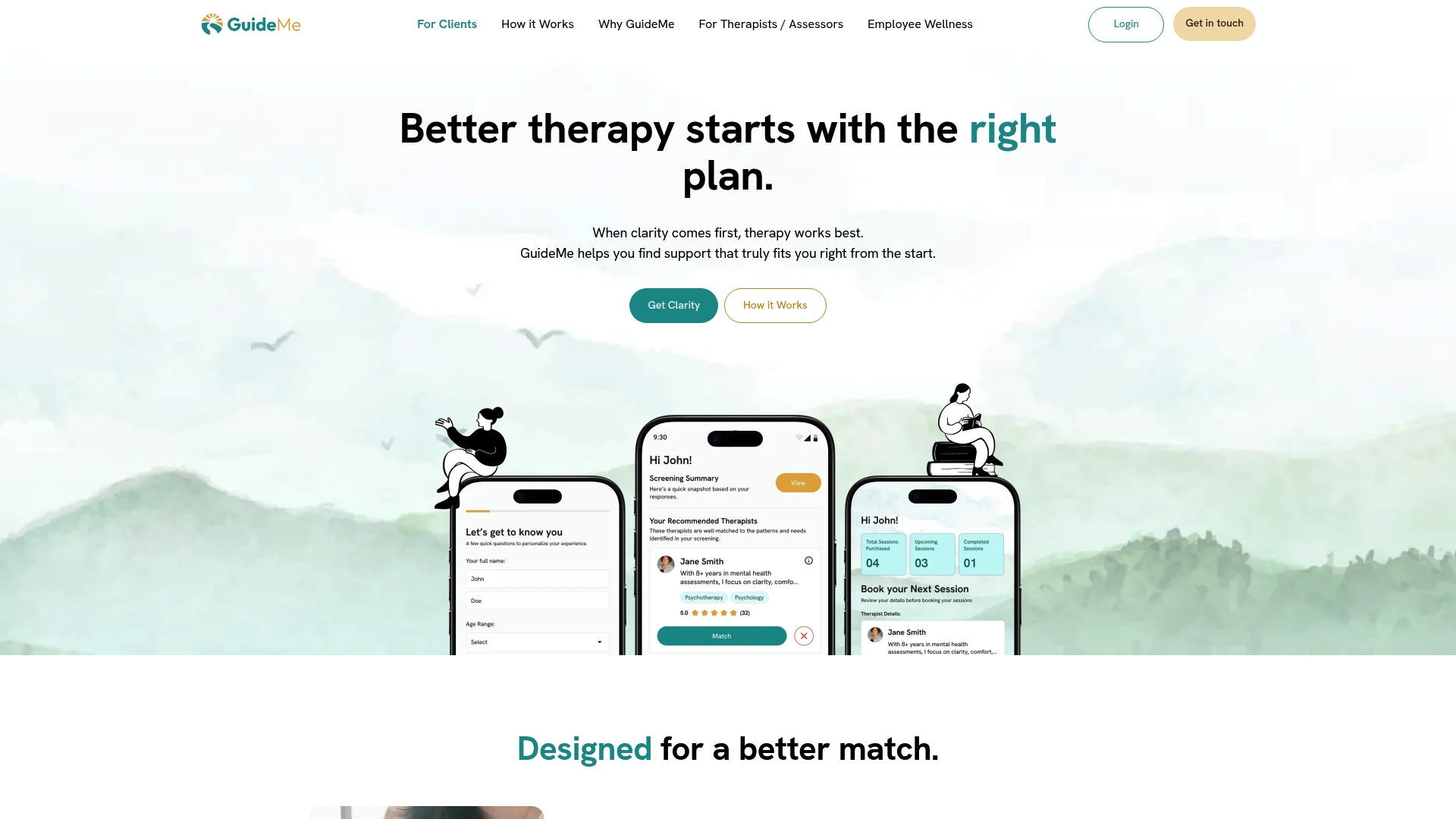
For organisations that need to move quickly on employee therapy access, Guidemetherapy offers a therapy navigation platform built for exactly this situation. Employees complete an in-depth screening process, receive a personalised therapy plan, and are matched to an accredited therapist using both human expertise and AI-assisted matching. The result is a shorter path from referral to first session, with full clinical confidentiality maintained throughout.
When procuring any therapy access solution, check for: therapist accreditation (BACP, UKCP or BPS registered), a documented clinical governance framework, UK GDPR-compliant data processing, a clear time-to-first-appointment SLA, and quarterly reporting on uptake and outcomes. Guidemetherapy's enterprise solution covers all of these, and the platform supports both individual employees and organisation-wide wellbeing programmes.
To request a procurement pack or arrange a demonstration, visit Guidemetherapy and contact the enterprise team directly.
Sources
- WBK01 - Tackling work-related stress using the Management Standards approach
- Recommendations | Mental wellbeing at work | Guidance | NICE
- Having a policy - Supporting mental health at work - Acas
- CIPD: Mental health support at work (employer guide)
This article is general information, not a substitute for advice from a qualified doctor. Consult a qualified healthcare professional about your own circumstances before acting on anything here.