

TL;DR:
- Therapy addresses clinical mental health needs by healing trauma and emotional dysregulation, while coaching focuses on goal achievement and behavioral change in stable individuals. Choosing the correct support depends on assessing whether you experience persistent symptoms or are mainly seeking personal or professional growth; misusing coaching can delay healing. Combining both approaches thoughtfully enhances personal development, but ethical boundaries and proper sequencing are essential for effective progress.
Many people reach a point where they know they need support, but feel unsure whether to seek a coach or a therapist. The role of coaching vs therapy is frequently misunderstood, and choosing the wrong type of support can slow your progress considerably. Coaching is not a lighter version of therapy, and therapy is not simply coaching with clinical language. Each serves a distinct purpose, targets different needs, and requires a different state of readiness. This article explains the differences clearly so you can make the right choice for where you are right now.
Table of Contents
- Key takeaways
- The role of coaching vs therapy: core definitions
- When to choose coaching or therapy
- Benefits of coaching and therapy for personal growth
- How coaching complements therapy
- Choosing the right professional
- My perspective on getting this right
- Find the right support with Guidemetherapy
- FAQ
Key takeaways
| Point | Details |
|---|---|
| Therapy treats clinical need | Therapy addresses trauma, mental health diagnoses, and emotional dysregulation that coaching cannot safely manage. |
| Coaching builds on stability | Coaching is most effective when you are emotionally stable and ready to focus on goals and behavioural change. |
| Sequencing matters greatly | Starting with therapy when needed, then moving to coaching, produces better and faster personal growth outcomes. |
| Both can work in parallel | Coaching and therapy complement each other when practitioners maintain clear ethical boundaries and separate roles. |
| Wrong choice stalls progress | Using coaching to avoid necessary therapy leaves root issues untreated and prolongs distress. |
The role of coaching vs therapy: core definitions
Therapy and coaching are not two points on the same spectrum. They are genuinely different disciplines with different goals, different regulatory frameworks, and different methods.
Therapy is clinical by design. It focuses on healing trauma, diagnosing and treating mental health conditions, and processing past experiences that affect how you function today. Therapists are licensed or accredited professionals who work within strict clinical and legal guidelines. They are trained to manage complex presentations including depression, anxiety disorders, PTSD, and personality disorders. The work is often slow, deeply emotional, and rooted in your history.
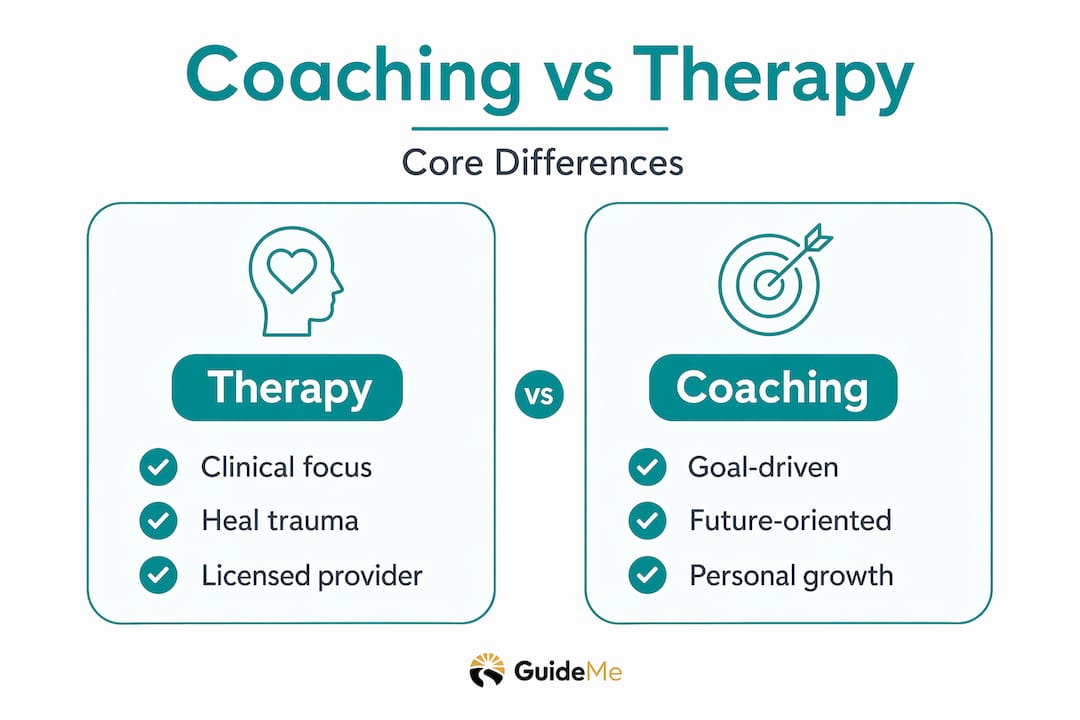
Coaching is forward-focused. Professional coaching is a partnership built on powerful questioning and accountability, not advice-giving or consultation. A coach helps you identify where you want to go and supports you in finding your own path to get there. The work focuses on behavioural change, goal achievement, and maximising your potential in areas like career, leadership, relationships, and personal performance.
Here are the foundational coaching and therapy differences at a glance:
- Therapy treats underlying psychological conditions and processes past wounds
- Coaching develops potential and drives forward momentum from a place of current stability
- Therapists hold regulated clinical qualifications; coaches are not regulated by law in most countries, though many hold professional certifications
- Therapy sessions often explore childhood, belief systems, and emotional history; coaching sessions focus on present behaviours and future goals
- Therapy is often long-term and open-ended; coaching tends to be time-limited and project-focused
One common misconception is that coaching is simply motivational cheerleading. It is not. Another is that therapy is only for people in crisis. That is equally untrue. Understanding where each genuinely fits is the first step toward getting real value from either.
When to choose coaching or therapy
Choosing between coaching and therapy is less about preference and more about clinical need. Getting this wrong does not just waste time and money. Using coaching to avoid therapy when deeper clinical issues are present can prolong distress and leave root problems untreated.
Here is how to assess your situation clearly:
- Consider therapy first if you are experiencing persistent low mood, anxiety, or panic that interferes with your daily life. These are clinical indicators, not simply life stressors.
- Choose therapy if you have experienced significant trauma that continues to affect your relationships, work, or sense of self. Unresolved trauma requires clinical work before coaching becomes productive.
- Look at your emotional regulation. If you regularly feel overwhelmed, dissociated, or unable to manage strong emotions, therapy provides the nervous system support you need.
- Consider coaching if you feel emotionally stable and your primary desire is to move forward, build skills, set goals, or improve performance. You do not need to be perfect to work with a coach, but you do need a functioning foundation.
- Coaching suits you if your challenges are situational, such as a career transition, leadership development, or improving communication, rather than rooted in unresolved psychological distress.
It is worth noting that emotional responses during coaching are entirely normal and do not automatically mean you need therapy instead. Crying during a coaching session or feeling challenged is not a red flag. The question is whether those emotions interfere with your ability to function, not simply whether they arise.
Pro Tip: If you are unsure whether to start with coaching or therapy, speak to a therapist first. A qualified therapist can assess your needs and recommend the most appropriate path. Guessing and hoping for the best is a slower route to progress.
Benefits of coaching and therapy for personal growth
Both approaches offer real, measurable benefits. The key is understanding what each one actually delivers.
What therapy offers
Therapy provides a clinically safe space to process and heal. It works directly on the nervous system, helping you shift patterns rooted in early experience, trauma, or chronic stress. Therapy supports career growth and workplace success by addressing the internal blocks, such as imposter syndrome, fear of conflict, or people-pleasing, that coaching alone cannot reliably shift.
The benefits of good therapy include:
- Reduced symptoms of anxiety, depression, and trauma
- Greater emotional regulation and resilience
- Deeper self-awareness and healthier relationship patterns
- Improved ability to make decisions without self-sabotage
What coaching offers
The benefits of coaching extend across personal and professional development. Coaching ROI can reach 670.4% in organisational settings, with documented impacts including a 22% rise in internal promotions and a 19% improvement in employee engagement. These are not soft outcomes. They reflect real behavioural change.
Here is a comparison to help you see the difference clearly:
| Area | Therapy | Coaching |
|---|---|---|
| Primary focus | Healing and clinical treatment | Goal-setting and performance |
| Time orientation | Past and present | Present and future |
| Practitioner role | Licensed clinician | Certified or experienced professional |
| Typical outcomes | Symptom reduction, trauma processing | Skill-building, behavioural change |
| Best suited for | Clinical mental health needs | Personal and professional growth |
The global coaching industry has grown by 13% since 2023, now serving nearly 123,000 practitioners, with industry revenue nearly doubled in recent years. This growth reflects genuine demand for the kind of forward-focused support coaching provides.
Pro Tip: Do not measure coaching against therapy or therapy against coaching. Evaluate each against your current need. The most effective personal development often involves both, at the right time and in the right order.
How coaching complements therapy
The most effective personal development rarely comes from one approach alone. Therapy and coaching are complementary when sequenced correctly. Therapy does the foundational work. Coaching builds on that foundation.

Think of it this way. Therapy stabilises the ground beneath you. Once that work is done, or well underway, coaching helps you design where you want to go and take consistent steps to get there. Many people find that years of personal growth accelerate significantly once they combine both in a thoughtful, sequenced way.
Common patterns that work well include:
- Phased use: Complete a course of therapy to address a specific issue, then engage a coach to build new behaviours and momentum in that area
- Parallel work: Work with a therapist and a coach simultaneously, with clear boundaries between the two relationships and no overlap in focus
- Referral-based: Your therapist identifies that your clinical work is largely complete and recommends coaching as a natural next step
There are also common pitfalls to avoid. The most significant is using coaching as a way to sidestep difficult therapeutic work. This is sometimes called "active avoidance," and it stalls progress rather than creating it. Another pitfall is expecting a coach to function as a therapist. A practitioner cannot ethically act as both therapist and coach for the same person at the same time. These are legally and clinically distinct roles.
Understanding how counselling supports mental health alongside coaching can help you build a clearer picture of what a complete support structure looks like for your situation.
Choosing the right professional
Once you know which type of support you need, choosing the right person matters. The right therapist match is associated with meaningfully better outcomes, so this decision deserves real care.
When selecting a therapist, look for:
- Verified clinical qualifications and registration with a professional body (such as the BACP, UKCP, or BPS in the UK)
- Specialism in your area of need (trauma, anxiety, relationships, and so on)
- A therapy approach that suits your goals, such as CBT, EMDR, or psychodynamic therapy
When selecting a coach, look for:
- Certification from a recognised body such as the ICF or EMCC
- Clear statement of scope: a good coach knows what they do not do
- Experience relevant to your goals (executive coaching, life coaching, and career coaching are distinct)
Ask any potential provider directly: what is your scope of practice, and when would you refer a client elsewhere? Their answer will tell you a great deal about their professional integrity.
My perspective on getting this right
I have seen many people come to personal development with enormous motivation and the wrong tool in their hand. They hire a coach when what they need is a therapist, or they stay in therapy long after they are ready to move into coaching and building something new. Both are understandable. Neither serves you well.
What I have come to believe strongly is that healing must come before building. You cannot reliably set and pursue meaningful goals while an unresolved trauma response or clinical symptom is running quietly in the background. It shapes every decision, every relationship, and every moment of self-doubt. Therapy addresses that layer. Coaching cannot.
At the same time, I have watched people finish significant therapeutic work and then stay still. They have processed their past thoroughly but lack the structures, accountability, and forward-focused thinking that a good coach brings. That transition matters. It is not a failure of therapy. It is simply the next phase.
The most important thing you can do is be honest with yourself about where you are right now. Not where you wish you were. Not where you think you should be. Where you actually are. That honesty is what makes the right choice possible.
— Yetty
Find the right support with Guidemetherapy
Knowing whether you need coaching, therapy, or both is one thing. Finding the right professional to work with is another. Guidemetherapy takes the guesswork out of that process.
Guidemetherapy is a human-led, AI-powered therapy navigation platform that helps you understand your mental health needs and get matched with the right therapist from the start. You receive an in-depth therapy plan tailored to your situation, not a generic list of names. Whether you are exploring therapy for the first time or returning after a break, Guidemetherapy creates a more supported, comfortable experience so you feel confident in your choice from day one.
FAQ
What is the main difference between coaching and therapy?
Therapy is a clinical process focused on healing trauma and treating mental health conditions, while coaching is a forward-focused partnership designed to help you set and achieve goals. Therapy addresses the past; coaching builds on a stable present.
Can I do coaching and therapy at the same time?
Yes, but the two roles must stay clearly separate. A single practitioner cannot act as both your therapist and your coach simultaneously, as ethical and clinical guidelines require distinct roles. When managed correctly, parallel work can accelerate your progress.
How do I know if I need therapy instead of coaching?
If you are experiencing clinical symptoms such as persistent anxiety, depression, trauma responses, or emotional dysregulation that affects your daily functioning, therapy is the appropriate starting point. Coaching is best suited for people who are emotionally stable and focused on growth.
Is coaching effective for mental health?
Coaching is not a treatment for mental health conditions, but it supports wellbeing by building resilience, accountability, and performance skills. Coaching programmes have demonstrated strong outcomes in leadership, engagement, and personal development when used appropriately.
What happens if I use coaching when I actually need therapy?
Using coaching to avoid necessary clinical work leaves the underlying issue untreated and can prolong distress significantly. Progress in coaching will stall if a deeper mental health issue is driving the challenges you are trying to address.