

Remote therapy for teams is the delivery of professional psychological support through digital platforms, structured to address the collective mental health needs of a group or organisation. Rather than replacing in-person care entirely, it works as an alternative or a supplement, using video calls, messaging, and specialised platforms to reach employees wherever they are. The clinical term you will encounter in research is telemental health, though "remote therapy" and "virtual therapy for teams" are used interchangeably in workplace contexts.
What makes this distinct from individual online therapy is the group dimension. Remote team therapy typically combines:
- Synchronous group sessions via video call, led by a licensed therapist or facilitator
- Individual one-to-one sessions scheduled through the same platform
- Asynchronous tools such as digital journals, guided exercises, and peer support communities
- Hybrid approaches that blend in-person and virtual attendance within the same programme
How remote therapy for teams actually works
The mechanics vary by provider, but most programmes share a recognisable structure. Team-based sessions are scheduled in advance, typically lasting 45–90 minutes, and facilitated by a clinician who manages group dynamics, sets boundaries, and guides discussion. Between sessions, participants access asynchronous resources at their own pace.
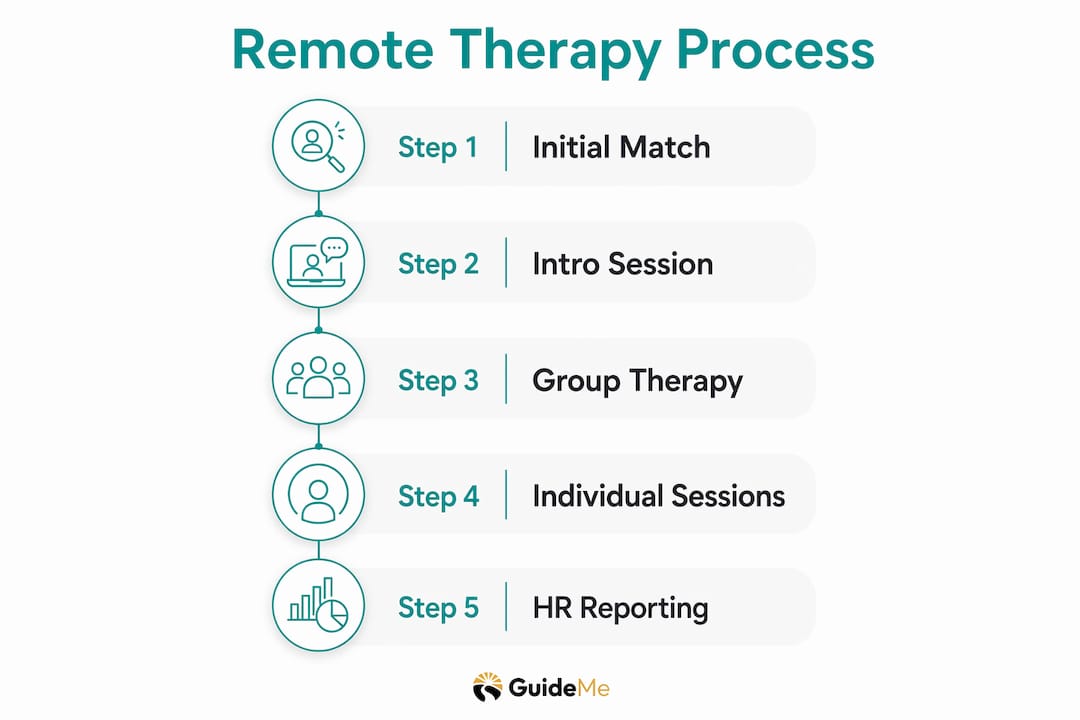
Operationally, the process involves:
- Scheduling and access: on-demand booking or fixed group slots, often managed through a dedicated platform or app
- HR integration: people and culture leads receive anonymised engagement data without accessing individual session content
- Navigator roles: some platforms assign a dedicated support person to help employees find the right therapist and session type from the outset
- Facilitated workshops: structured group formats covering topics such as stress management, psychological safety, or conflict resolution
- Self-care resources: digital libraries, mood trackers, and guided audio content available between sessions
Remote therapy has also grown because it enables practices that face-to-face settings cannot easily replicate, such as advanced and technology-augmented methods described in Cognitive Behavioral Therapy | Anxiety Therapy SD. Team-based cognitive behavioural therapy, for instance, can involve a licensed therapist working alongside a behavioural coach simultaneously, a model that is logistically difficult to run in a single consulting room.
What are the real benefits for organisations?
Accessibility is the most immediate gain. Geography, commuting time, and scheduling conflicts all disappear when support is delivered digitally, which means participation rates tend to be higher than with traditional employee assistance programmes. Telephone and digital interventions have long been recognised for overcoming geographic barriers that conventional therapy cannot address.
The financial case is also clear. Structured mental health access through platforms like Therify can reduce out-of-network utilisation costs by approximately £1,260 per participating employee, with 90% of employees reporting a more positive workplace perception. For UK organisations, this translates to measurable reductions in absenteeism and presenteeism costs, both of which the Health and Safety Executive consistently identifies as significant productivity drains.
Further benefits include:
- Faster access: platforms offering on-demand connections can link employees with a clinical professional within 24 hours
- Cultural impact: regular group sessions build psychological safety and shared language around mental health
- Data visibility: HR teams gain anonymised dashboards showing engagement trends without compromising individual confidentiality
- Reduced stigma: virtual attendance lowers the social visibility of seeking support, which encourages more employees to participate
Challenges and important considerations when implementing remote therapy
The biggest risk is inadequate clinical oversight. Practitioner vetting is non-negotiable: every therapist delivering remote sessions should hold a current licence, carry professional indemnity insurance, and adhere to a recognised data privacy framework such as the UK GDPR.
Other challenges organisations regularly encounter:
- Connectivity and device access: not every employee has a reliable broadband connection or a private space for video sessions
- Engagement resistance: some team members distrust digital platforms or feel sceptical about group therapy formats
- Confidentiality concerns: employees worry that HR can see their session content, even when the platform explicitly prevents this
- Platform fatigue: adding another app to an already crowded digital environment can reduce uptake if onboarding is poor
Pro Tip: Run a short, optional introductory session before the programme launches. Letting employees meet the facilitator, ask questions, and see the platform in a low-stakes setting consistently improves first-session attendance and reduces drop-off.
Who benefits most from remote team therapy?
The format suits a wide range of organisations, but certain contexts produce the strongest outcomes. Teams that are geographically dispersed or working hybrid schedules gain the most immediately, since the digital format removes the logistical friction that prevents consistent in-person attendance. Therapists supporting remote workplaces have noted that hybrid teams often experience a particular kind of disconnection that group sessions are well placed to address.
Organisations that benefit include:
- Fully remote or hybrid teams where in-person therapy is impractical
- High-growth companies scaling mental health support without proportionally scaling HR headcount
- Employees facing access barriers including those in rural areas, those with caring responsibilities, or those with mobility limitations
- HR and well-being leads who need measurable outcomes to justify mental health investment to senior leadership
- Sectors with high burnout risk such as healthcare, technology, financial services, and education
What to expect during a remote team therapy session
Most sessions follow a clear structure that participants can anticipate from the first meeting. The facilitator opens with a brief check-in, sets the agenda, and establishes ground rules around confidentiality and respectful communication. Discussion then moves through the session's theme, with the therapist guiding participation and managing any distress that arises.
Participants can expect:
- Session length: typically 45–90 minutes for group formats; 50 minutes for individual sessions within the same programme
- Platform tools: video conferencing with breakout rooms, in-session polls, and shared whiteboards for interactive exercises
- Privacy measures: end-to-end encrypted platforms, with clear policies on recording and data retention shared before the first session
- Asynchronous follow-up: reflection prompts, reading resources, or mood-check tools sent after each session
- Optional individual support: most programmes allow participants to book one-to-one sessions alongside group attendance
The combination of individual and group modalities within a single programme is one of the features that distinguishes well-designed remote therapy from a simple webinar series.
Expert recommendations for effective remote therapy delivery
Licensed clinicians and HR professionals who have implemented these programmes point to a consistent set of factors that separate effective delivery from well-intentioned but underperforming initiatives.
- Vet clinicians rigorously: confirm registration with the British Association for Counselling and Psychotherapy (BACP), the British Psychological Society (BPS), or the UK Council for Psychotherapy (UKCP) before any therapist delivers sessions
- Blend modalities: programmes combining group workshops, individual sessions, and asynchronous tools produce better engagement than single-format approaches
- Use AI-guided tools carefully: emerging technologies such as AI-assisted cognitive behavioural therapy and avatar-based anonymous groups can reduce stigma, but should supplement rather than replace licensed clinician contact
- Protect data rigorously: anonymised dashboards for HR, with navigator and data integration layers that preserve individual confidentiality, are the standard to insist on
- Measure continuously: collect session feedback, track engagement rates, and review outcomes quarterly to identify what is working and where to adjust
Legal and ethical considerations for remote team therapy in the UK
UK organisations commissioning remote therapy carry specific legal responsibilities. Under the UK GDPR and the Data Protection Act 2018, any platform processing employee mental health data is handling special category data, which requires explicit consent, a lawful basis for processing, and a Data Protection Impact Assessment before the programme launches.

Therapists must practise within their registered scope and hold valid professional indemnity insurance. The ethical guidelines published by the Human Givens Institute, alongside standards from the BACP and UKCP, all require that remote practitioners assess whether the digital format is clinically appropriate for each participant. Employees with acute risk presentations may need referral to face-to-face or crisis services rather than a group video session.
Employers also have a duty of care under the Health and Safety at Work Act 1974. Commissioning a remote therapy programme does not discharge that duty if the provision is clinically inadequate.
How to select and vet a remote therapy provider for teams
Start with clinical credentials. Any provider should be able to confirm that every therapist on their network holds current registration with the BACP, BPS, or UKCP, and that practitioners are supervised regularly. Ask for this in writing before signing a contract.
Beyond credentials, evaluate:
- Data security: confirm UK GDPR compliance, data residency within the UK or EEA, and clear policies on session recording
- Matching process: does the platform use a structured assessment to match employees with the right therapist, or is it self-directed browsing?
- HR reporting: what anonymised data does the platform provide, and how is individual confidentiality protected?
- Clinical range: can the provider support employees with varying levels of need, from mild stress to more complex presentations?
- Onboarding support: does the provider offer a dedicated navigator or account manager to support the launch?
Platforms that offer a structured therapy matching process from the outset tend to produce higher engagement and lower early drop-off rates.
Cost considerations and funding options in the UK
Pricing for remote team therapy programmes in the UK varies considerably by provider, group size, and the range of modalities included. Most providers offer per-employee-per-month pricing, with group session access, individual session allowances, and platform access bundled together. Smaller organisations sometimes access provision through their existing Employee Assistance Programme, though EAP session limits are often low.
UK funding routes worth exploring:
- NHS Talking Therapies: free at the point of use for eligible employees, though waiting times vary by region
- Occupational health budgets: many organisations already hold budget here that can be redirected toward structured remote therapy provision
- Health and wellbeing grants: Innovate UK and some sector-specific bodies periodically fund workplace mental health initiatives
- Private medical insurance: some PMI policies now include a mental health session allowance that covers remote delivery
The role of therapy in workplace culture is increasingly recognised by UK boards, and the business case for investment has strengthened as absenteeism data becomes easier to track through digital platforms.
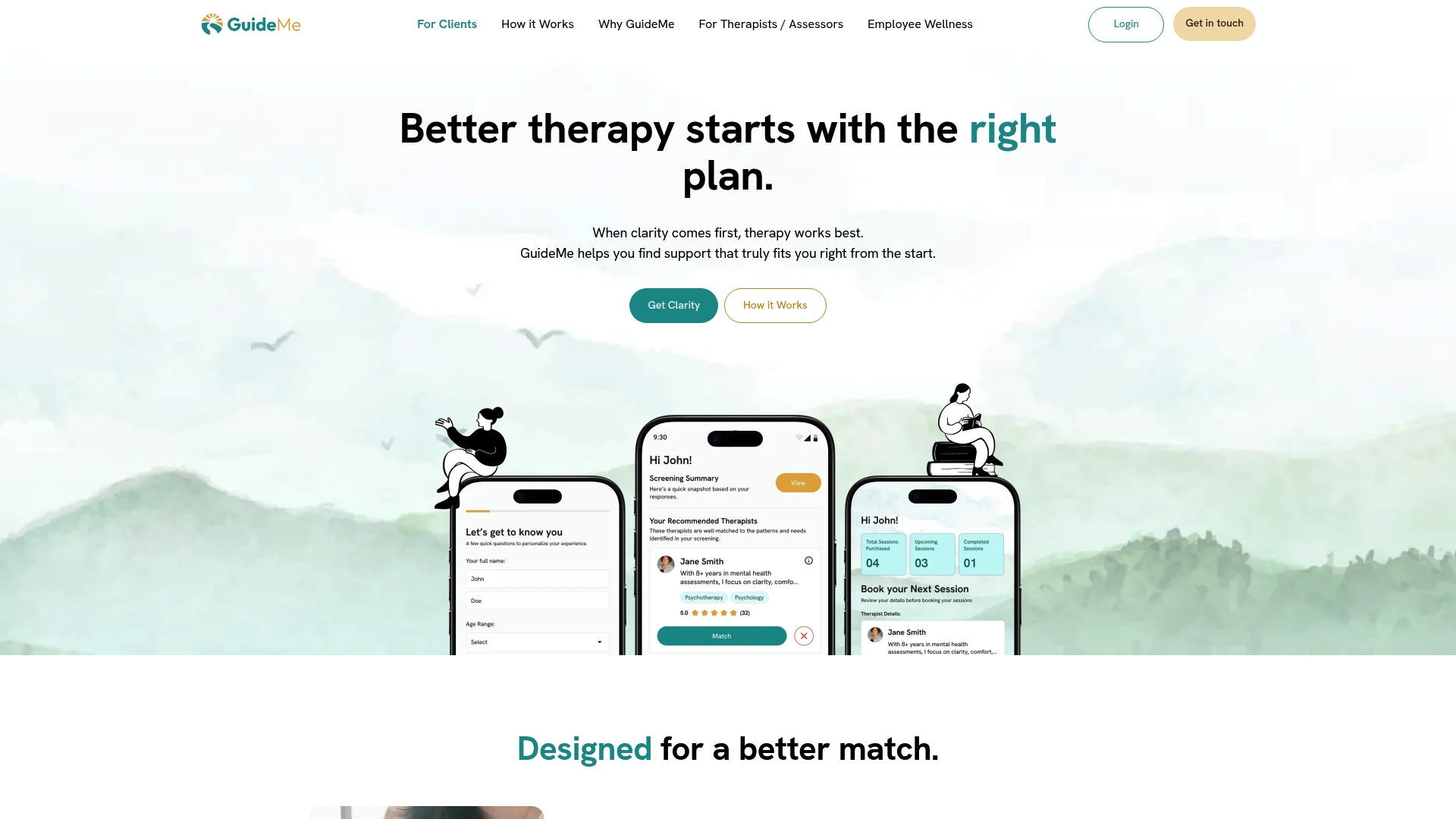
Finding the right provider for your team does not have to feel overwhelming. Guidemetherapy combines AI-powered therapist matching with human-led support, helping organisations connect employees with the right clinician from the very first session. Whether your team needs group workshops, individual sessions, or a blended programme, Guidemetherapy builds a plan around your people, not a generic template.
Key takeaways
Remote therapy for teams works best when licensed clinical oversight, structured matching, and anonymised HR reporting are built into the programme from the start.
| Point | Details |
|---|---|
| Clinical vetting is non-negotiable | Every therapist should hold current BACP, BPS, or UKCP registration before delivering sessions. |
| Blended modalities outperform single formats | Combining group sessions, individual therapy, and asynchronous tools drives higher engagement. |
| UK GDPR applies from day one | Mental health data is special category data; a Data Protection Impact Assessment is required before launch. |
| Cost savings are measurable | Platforms like Therify can reduce out-of-network utilisation costs by approximately £1,260 per participating employee. |
| Faster access improves outcomes | On-demand platforms can connect employees with a clinician within 24 hours, reducing the gap between need and support. |