

Directive therapy is a structured, therapist-led approach in which the clinician actively guides sessions, assigns specific tasks, and sets clear goals to change unhelpful patterns of behaviour or interaction. Unlike approaches that follow the client's lead, directive methods place the therapist in a more active role: assessing what is maintaining a problem, then prescribing targeted interventions to shift it. According to the SAGE Encyclopedia of Theory in Counselling and Psychotherapy, directive therapy refers specifically to therapist-led interventions designed to change behavioural interactions within a system, whether that is a family, a couple, or an individual's daily routines.
You would typically consider this approach when:
- You need short-term, focused help with a specific problem rather than open-ended exploration
- You are in or near crisis and need immediate structure and coping strategies
- Your goal is measurable behaviour change, such as reducing avoidance, building social skills, or managing anxiety symptoms
- You are working within a time-limited service, such as NHS talking therapies or a brief therapy contract
- A therapist has assessed that changing behaviour first is likely to open the door to deeper understanding later
Key takeaways
Directive therapy is a therapist-led, structured approach that assigns specific tasks to change the patterns maintaining a problem, and it is most effective when matched carefully to the presenting difficulty and delivered with genuine informed consent.
| Point | Details |
|---|---|
| What directive therapy is | A structured, therapist-led approach that assigns tasks to change behaviour or interaction patterns, not just to build insight. |
| When it works best | Short-term, specific problems such as anxiety, depression, phobias, and crisis stabilisation respond well to directive methods. |
| Key ethical safeguard | Informed consent for every directive is non-negotiable; check your therapist is registered with BACP, UKCP, HCPC, or BPS. |
| Directive versus non-directive | Non-directive approaches follow the client's lead; directive ones set the agenda. CBT sits between the two, structured but collaborative. |
| Finding a UK practitioner | Use BACP, UKCP, or HCPC directories and filter by specialism; Guidemetherapy matches you to a verified therapist suited to your approach. |
Table of Contents
- What is directive therapy and where did it come from?
- The core principles that define directive practice
- Common directive techniques with concrete examples
- Where is directive therapy typically used in the UK?
- How does directive therapy differ from non-directive approaches?
- What does the research evidence say?
- Advantages, disadvantages and when directive therapy may not be suitable
- Ethical safeguards and UK professional standards
- What to expect in a directive therapy session
- A directive therapy session in practice
- How to find a directive therapist in the UK
- When directive methods work best: an editorial perspective
- Finding the right directive therapist is easier with Guidemetherapy
- Sources
What is directive therapy and where did it come from?
The intellectual roots of directive psychotherapy stretch back to the mid-20th century work of Frederick C. Thorne, an American psychologist who argued that therapy should be as systematic and evidence-based as medicine. Thorne treated the therapist as an educator: someone who assesses a person's capacity for self-regulation and then selects techniques accordingly. His position was that passive, non-directive approaches were insufficient for many clients, particularly those who lacked the psychological resources to generate their own insight without structured support. His foundational paper on directive psychotherapy set out this assessment-driven, educative rationale in detail.
From Thorne's eclectic base, directive thinking fed into the strategic and systemic family therapy movements of the 1960s and 1970s. Jay Haley, working alongside figures such as Milton Erickson and later at the Philadelphia Child Guidance Clinic, developed a model in which the therapist deliberately designs tasks to disrupt the interaction sequences that maintain symptoms. Haley's descriptions of directive techniques showed how paradoxical assignments and specific behavioural prescriptions could interrupt entrenched relational cycles in ways that insight-focused conversation alone could not.
These strategic ideas eventually influenced brief therapy, solution-focused approaches, and the structured protocols of cognitive behavioural therapy (CBT). Understanding therapy modalities as a whole helps situate directive methods within the broader landscape of psychological treatment.
The core principles that define directive practice
Directive therapy is not a single school but a set of working principles that can be applied across different models. What unites them is the therapist's active, structured role.
Five principles consistently appear across directive models:
Therapist leadership. The clinician sets the agenda, structures sessions, and takes responsibility for the direction of treatment. This does not mean ignoring the client's priorities; it means the therapist actively shapes how those priorities are addressed.
Task assignment and between-session work. Directives are the engine of change. These are specific instructions, exercises, or behavioural experiments assigned for the client to carry out between sessions. The task is chosen because it targets the pattern maintaining the problem, not because it feels comfortable.

Targeting maintaining patterns. Rather than exploring the historical origins of a problem at length, directive therapists focus on what is keeping the problem alive right now. This might be an avoidance behaviour, a repeated interaction sequence in a family, or a cognitive habit that reinforces distress.
Time-limited, goal-oriented stance. Progress is measured against agreed goals, and treatment has a defined endpoint. This makes directive approaches well-suited to services with session limits and to clients who want to see concrete results.
Transparency and informed consent. A well-practised directive therapist explains the rationale for each task before assigning it. The client understands what the directive is intended to change and agrees to attempt it. Consent is not a one-off formality; it is revisited as tasks evolve.
Common directive techniques with concrete examples
Directive counselling techniques vary considerably depending on the model and the presenting problem, but several appear consistently across settings.
-
Behavioural activation. Used widely in depression treatment, this involves scheduling specific, achievable activities to break the withdrawal-low mood cycle. A therapist might direct a client to take a ten-minute walk each morning and record their mood before and after, not because the walk is a cure, but because it disrupts the inactivity that maintains low mood.
-
Exposure tasks. For anxiety and phobias, the therapist prescribes graded contact with feared situations. A client with social anxiety might be directed to initiate one brief conversation with a colleague each day, starting with the least threatening context and building systematically.
-
Prescribed interactions in family work. Drawing on Haley's strategic model, a therapist might direct family members to swap roles for a week: the parent who usually enforces rules steps back while the other takes the lead. The aim is to disrupt a rigid interaction pattern, not to assign blame.
-
Paradoxical directives. One of the more counterintuitive techniques, this involves prescribing the very symptom the client wants to eliminate. A client with insomnia might be told to try to stay awake rather than to sleep. By removing the performance pressure around sleep, the directive often reduces the anxiety that was perpetuating the problem. Haley's work on directive techniques describes how these paradoxical tasks are designed to disrupt symptomatic cycles within relational systems.
-
Role play and rehearsal. The therapist directs the client to practise a specific behaviour in session, such as assertively declining a request, before attempting it in real life. The in-session rehearsal provides feedback and builds confidence.
-
Homework and self-monitoring. Structured records, thought diaries, and behavioural logs are assigned between sessions. The data collected becomes the material for the next session's review.
A key point about how these techniques work: directive interventions change behaviour before they change understanding. The therapist assigns a task that alters the structure of a client's daily routine or interactions, and that behavioural shift often opens the door to new psychological insight.
Pro Tip: When a therapist assigns a directive, ask them to explain exactly what pattern it is intended to change. If they cannot give a clear answer, that is useful information about whether the approach is well-matched to your needs.
Where is directive therapy typically used in the UK?
Directive approaches are embedded in several care settings across the UK, often without being labelled as such.
Within NHS primary care, the Improving Access to Psychological Therapies (IAPT) programme, now operating under the NHS Talking Therapies banner, delivers structured, time-limited interventions for anxiety and depression. Many of these, including guided self-help, CBT, and behavioural activation, are directive in character. Sessions are typically six to twelve in number, goal-focused, and include between-session tasks.
Specialist services, including those for obsessive-compulsive disorder, post-traumatic stress, and eating disorders, use highly structured directive protocols such as exposure and response prevention or trauma-focused CBT. These are delivered by clinicians trained in specific manualised approaches.
Family and couple therapy services, both NHS and private, frequently draw on strategic and systemic directive methods. Therapists in these settings may assign specific interaction tasks between sessions, particularly when a family is stuck in a rigid pattern that conversation alone has not shifted.
Crisis teams and inpatient settings use directive approaches for immediate stabilisation: safety planning, grounding techniques, and structured daily routines are all directive in nature. The goal is not insight but containment and skill-building under pressure.
In private practice, directive methods are often integrated with other approaches. A therapist might use directive techniques for the first phase of treatment, then shift to more exploratory work once the presenting crisis has stabilised. Therapeutic approaches for executives and professionals in high-pressure roles often benefit from this structured, outcomes-focused model.
Access routes differ significantly. NHS Talking Therapies can be accessed via GP referral or self-referral through the NHS website. Private practitioners are found through professional directories such as those maintained by the British Association for Counselling and Psychotherapy (BACP) or the UK Council for Psychotherapy (UKCP). Fees in private practice are generally variable per session depending on location and practitioner experience.
How does directive therapy differ from non-directive approaches?
The clearest way to understand the distinction is to look at where control sits in the session.
| Dimension | Directive approaches | Non-directive / person-centred | Structured CBT |
|---|---|---|---|
| Therapist role | Active, prescriptive, agenda-setting | Facilitative, reflective, follows client | Collaborative but structured |
| Session structure | Therapist-led agenda | Client-led exploration | Shared agenda with protocol |
| Between-session tasks | Central, assigned by therapist | Rare or client-initiated | Standard, collaboratively agreed |
| Primary goal | Behaviour or interaction change | Self-understanding, self-acceptance | Symptom reduction via cognition and behaviour |
| Typical time frame | Short to medium term | Open-ended or medium term | Time-limited |
| Therapist stance on insight | Behaviour change precedes insight | Insight emerges from exploration | Insight and behaviour change together |
Is CBT directive? CBT sits in an interesting middle position. It is structured and goal-oriented, which aligns it with directive principles, but it is also explicitly collaborative: goals and homework are agreed jointly rather than prescribed by the therapist. Many CBT protocols are directive in their structure while being non-directive in their relational stance. The evidence review at DOI 10.1177/0004867420913118 groups structured CBT protocols with directive interventions when summarising short-term outcomes for common mental disorders.
Choosing between approaches. If you want to understand yourself more deeply and are not in immediate distress, a person-centred or psychodynamic approach may suit you better. If you have a specific, defined problem and want practical tools quickly, a directive approach is likely more efficient. Crisis situations almost always call for some degree of directive structure, at least initially. A guide to understanding therapy approaches can help you think through which model fits your situation.
What does the research evidence say?
The evidence base for directive methods is real but uneven, and it is worth understanding what the research actually shows rather than what advocates sometimes claim.
- Structured, directive interventions, including many CBT protocols, produce short-term symptom improvement for common mental disorders such as anxiety and depression. A recent review confirms this while noting significant heterogeneity across trials in terms of methods, populations, and outcome measures.
- A 2018 paper examining directive techniques within brief therapy models found variable effect sizes across populations, suggesting that the same technique does not work equally well for everyone.
- Evidence for paradoxical directives and strategic family therapy techniques is thinner and more mixed than for structured CBT or behavioural activation. Most studies in this area are older, smaller, and methodologically weaker by current standards.
- Long-term follow-up data is limited. Most trials measure outcomes at the end of treatment or at three to six months. Whether directive gains are maintained at one or two years is less well-established.
- The category of "directive therapy" is broad. Lumping together behavioural activation, paradoxical directives, and strategic family interventions under one label makes it difficult to draw firm conclusions about any single technique.
The honest summary: directive methods have a solid evidence base for specific, well-defined problems when the technique is matched carefully to the presenting difficulty. The evidence weakens when the approach is applied broadly or without clear rationale.
Advantages, disadvantages and when directive therapy may not be suitable
| Dimension | Advantages | Disadvantages / risks |
|---|---|---|
| Goal clarity | Clear, measurable targets make progress visible | Goals set by the therapist may not fully reflect the client's own priorities |
| Efficiency | Well-suited to time-limited services and specific problems | May feel rushed; underlying issues can be missed |
| Skill development | Builds concrete coping skills and behavioural repertoires | Skills may not generalise if the client does not understand the rationale |
| Crisis suitability | Provides immediate structure when distress is high | Directive stance can feel controlling if the client is already feeling powerless |
| Autonomy | Transparent rationale supports informed participation | Risk of dependency if the client defers to the therapist rather than building self-direction |
Contraindications and red flags. Directive therapy is not appropriate in every situation. Clients experiencing active psychosis need a clinical setting equipped to manage that level of distress before structured task work begins. People with complex trauma histories may find a highly directive stance retraumatising if it replicates past experiences of control or coercion. Severe personality difficulties, particularly those involving difficulties with trust and authority, generally require a longer stabilisation phase before directive techniques are introduced. And in any context, directive work without genuine informed consent is ethically indefensible.
Early intervention before problems become entrenched often makes directive approaches more effective and less risky, because the client has more psychological resources available to engage with tasks.
Ethical safeguards and UK professional standards
The power imbalance in directive therapy is real and worth taking seriously. The therapist is in an expert role, assigning tasks and evaluating whether the client has completed them. Without careful attention to consent and autonomy, this can tip into something that feels more like compliance than collaboration.
A checklist of what to expect from an ethically practised directive therapist in the UK:
- Informed consent at every stage. The therapist explains the rationale for each directive before assigning it. You are not expected to comply without understanding why.
- Registered with a recognised professional body. In the UK, look for registration with the Health and Care Professions Council (HCPC) for clinical or counselling psychologists, or accreditation with BACP, UKCP, or the British Psychological Society (BPS). These bodies have codes of ethics that include safeguarding responsibilities.
- Regular supervision. Qualified therapists in the UK are expected to receive ongoing clinical supervision. This is a safeguard for clients as well as practitioners.
- Clear record keeping and data protection. Therapists must comply with UK GDPR and maintain confidential records. Understanding confidentiality in therapy helps you know what your rights are.
- A clear exit plan. You should know from the outset how many sessions are planned, how progress will be reviewed, and what happens if the approach is not working.
- Legal compliance. UK therapists operate within a framework of legal and regulatory obligations that include safeguarding duties, particularly when working with children, young people, or vulnerable adults.
If you feel pressured to complete tasks you have not agreed to, or if a therapist dismisses your concerns about a directive, you can raise a complaint with the relevant professional body. BACP, UKCP, and HCPC all have formal complaints procedures.
What to expect in a directive therapy session
Knowing the shape of a session before you attend reduces anxiety and helps you get more from the work.
- Assessment phase (often sessions 1–2). The therapist gathers information about the presenting problem, its history, and what is currently maintaining it. They may use structured questionnaires. By the end of this phase, you should have agreed goals and a shared understanding of the approach.
- Directive selection. The therapist proposes a specific task or intervention based on the assessment. They explain what the directive is intended to change and why this particular task has been chosen for your situation.
- Task assignment. You agree to attempt the task between sessions. The therapist clarifies any questions and may role-play the task with you in session if it involves a new behaviour.
- Review and adaptation. The following session begins with a review of the task: what happened, what you noticed, and what the result suggests about the maintaining pattern. The directive is then adapted, extended, or replaced based on what the review reveals.
- Progress tracking. Many directive therapists use brief standardised measures, such as the PHQ-9 for depression or the GAD-7 for anxiety, at regular intervals. Defining and measuring progress is built into the model rather than left to subjective impression.
Questions to ask a prospective directive therapist:
- What specific pattern or behaviour will the directives target?
- How will you decide which tasks to assign, and will I have a say in that?
- What happens if I find a task too difficult or choose not to complete it?
- How will we know if the approach is working, and what is the plan if it is not?
- Are you registered with BACP, UKCP, HCPC, or BPS, and do you receive regular supervision?
A directive therapy session in practice
Consider an anonymised example to illustrate how this works in real life.
A woman in her early thirties sought help for social anxiety that had led her to decline most social invitations over the preceding two years. She described the pattern clearly: anticipatory dread, avoidance, short-term relief, and then increased isolation and self-criticism.
The therapist assessed that avoidance was the primary maintaining factor and proposed a graded exposure programme. The first directive was specific: attend one low-stakes social event of the client's choosing within the next fortnight, stay for at least twenty minutes, and record her anxiety level before, during, and after on a simple 0–10 scale.
The client agreed to the task after discussing her concerns about it. She attended a neighbour's informal gathering, stayed for thirty-five minutes, and recorded peak anxiety of 7 out of 10 on arrival, dropping to 4 by the time she left. The following session reviewed this data. The drop in anxiety during the event was used to challenge her prediction that anxiety would only increase. The next directive extended the exposure slightly.
Over several sessions, her avoidance reduced substantially and she resumed regular social contact. The measurable outcome included improvement in anxiety symptom scores. The insight that followed, that her anxiety was not as dangerous or permanent as she had believed, came after the behaviour changed, not before.
This vignette illustrates the mechanism but is not evidence on its own. Single cases are illustrative, not definitive, and outcomes vary considerably depending on the individual, the therapist's skill, and the fit between technique and problem.
How to find a directive therapist in the UK
Finding a suitably qualified practitioner takes a few deliberate steps. Here is a practical checklist.
- Identify what you need. Are you looking for individual CBT, strategic family therapy, or brief directive counselling? Knowing the model helps you search more precisely.
- Check professional registers. Search the BACP therapist directory, the UKCP register, or the HCPC register for registered practitioners. For psychologists specifically, the BPS has a Find a Psychologist directory.
- Filter by specialism. Most directories allow you to filter by presenting problem (anxiety, depression, relationship difficulties) and by therapeutic approach. Look for terms such as CBT, behavioural therapy, strategic therapy, brief therapy, or solution-focused therapy, as these are the most common directive models.
- Verify qualifications. A practitioner's profile should state their training, accreditation body, and registration number. You can verify registration directly on the BACP, UKCP, or HCPC websites.
- Ask about supervision. In a first contact or consultation, ask whether the therapist receives regular clinical supervision. This is a basic professional standard in the UK.
- Discuss the approach before committing. A reputable directive therapist will be able to explain their model clearly, describe what tasks or homework typically look like, and answer your questions about consent and progress review.
- Consider NHS routes. Self-refer to NHS Talking Therapies via your local service's website or ask your GP for a referral. Waiting times vary by area but the service is free at the point of access.
- Private practice fees. Expect to pay £50–£150 per session in private practice, with some therapists offering sliding-scale fees. Session length is typically fifty minutes.
When directive methods work best: an editorial perspective
There is a tendency in mental health writing to present directive and non-directive therapy as opposing camps, with advocates on each side arguing for their preferred model. The reality is more pragmatic and, frankly, more interesting.
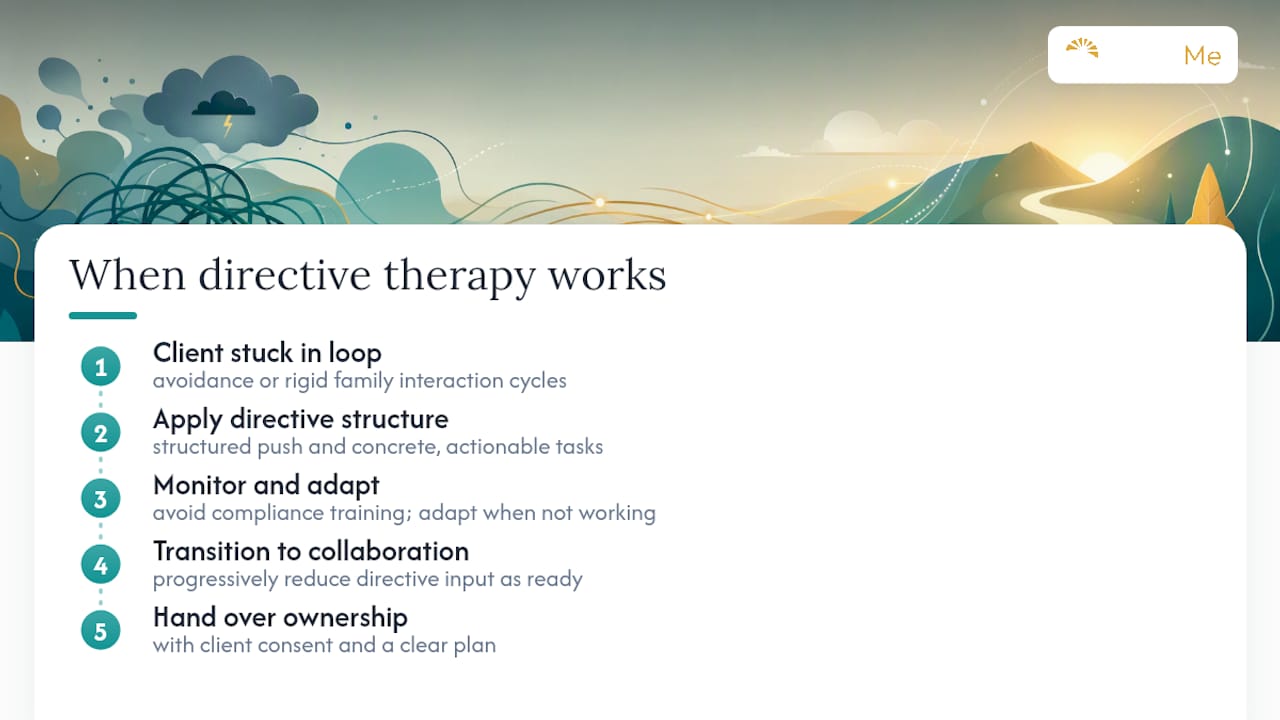
Directive methods are most useful when a client is stuck in a loop they cannot think their way out of. Insight, on its own, rarely breaks a well-established avoidance pattern or a rigid family interaction cycle. The person who knows perfectly well that their avoidance is making things worse but cannot stop avoiding needs a structured push, not more reflection. That is where directive work earns its place.
The risk, though, is that directive therapy can become a way of doing things to clients rather than with them. A therapist who assigns tasks without genuine consent, who does not adapt when a directive is not working, or who interprets non-completion as resistance rather than feedback, is not practising directive therapy well. They are practising compliance training. The distinction matters enormously for client welfare and for outcomes.
The most effective directive work I have observed, and the approach that the Psychology Today commentary on directive versus non-directive practice supports, is stage-sensitive: directive when structure is urgently needed, then progressively more collaborative as the client builds capacity and confidence. That transition is not automatic. It requires the therapist to notice when the client is ready to take more ownership and to hand that ownership over deliberately, rather than maintaining the expert role beyond its usefulness.
If you are considering directive therapy, the question to ask is not "is this approach evidence-based?" but "is this therapist using it thoughtfully, with my consent, and with a clear plan for what happens next?" Those are the conditions under which it works.
Finding the right directive therapist is easier with Guidemetherapy
Knowing that directive therapy might suit you is one thing. Finding a qualified practitioner who uses it well, matches your preferences, and is available in your area is another challenge entirely.
Guidemetherapy is a therapy navigation platform that takes the searching out of the process. It starts with an in-depth screening to understand your situation, then builds a personalised therapy plan and matches you with a therapist whose approach, qualifications, and availability fit your needs. The matching is both AI-assisted and human-led, which means the recommendations are specific rather than generic.

- Verified qualifications. Guidemetherapy checks that therapists on the platform hold recognised UK accreditations, so you do not have to cross-reference registers yourself.
- Matched to therapeutic style. If directive, structured approaches are what you need, the platform filters for practitioners who work that way.
- Support between sessions. Guidemetherapy offers ongoing support beyond the booking itself, so you are not left without guidance between appointments.
Start your therapy match and get a personalised plan that points you towards the right practitioner from the beginning.
Sources
The following sources underpin the claims in this article and are worth consulting directly if you want to read further or verify specific points.
- THEORETICAL FOUNDATIONS OF DIRECTIVE PSYCHOTHERAPY
- Techniques of directive therapy.
- Directive Therapy (SAGE Encyclopedia)
- To Be Directive or Non-Directive: That Is the Question
These sources vary in their level of technical detail. Academic papers and encyclopaedia entries are written for clinicians and researchers; the Psychology Today piece is accessible to general readers. Use them as a starting point, not a substitute for advice from a qualified therapist who knows your specific situation.
This article provides general information about directive therapy approaches and is not a substitute for professional clinical advice. If you are concerned about your mental health, consult a qualified therapist or your GP.