

Marriage counselling is a time-limited form of therapy that helps couples change repeating interaction patterns, improve communication, and repair trust where possible. If you are asking whether it can help you, the honest answer is: for most distressed couples, yes. Meta-analytic reviews indicate that roughly 60–80% of distressed couples show measurable benefit from behavioural and emotion-focused couples therapies.
Here is where to start right now:
- Check NHS or charity access first. Contact your GP for a referral, or reach out directly to a charity such as Relate for low-cost or free sessions.
- Book a private initial appointment if you need a shorter wait. Look for a therapist registered with the British Association for Counselling and Psychotherapy (BACP), the UK Council for Psychotherapy (UKCP), or the Health and Care Professions Council (HCPC).
- Use Guidemetherapy to get matched. Guidemetherapy's screening and personalised therapy plan can connect you with a qualified couples therapist without the guesswork of searching alone.
A typical course runs 8–20 sessions, and the first session usually lasts 60–90 minutes. Therapists registered with BACP, UKCP, or HCPC meet professional training and ethical standards, so checking registration is the single most important quality filter you have.
Key takeaways
Marriage counselling works best when both partners are willing to engage, the therapist is registered with BACP, UKCP, or HCPC, and the couple arrives with a shared goal rather than a list of grievances.
| Point | Details |
|---|---|
| Evidence of benefit | Roughly 60–80% of distressed couples show measurable benefit in trials; gains are smaller in routine practice. |
| Therapist registration | Always check BACP, UKCP, or HCPC registration before booking; this is the single most important quality filter. |
| First session logistics | The first session runs 60–90 minutes; follow-ups are 50–60 minutes, typically weekly or fortnightly. |
| Safety first | Couples counselling is not appropriate when domestic abuse or coercive control is present; contact specialist services first. |
| Guidemetherapy | Guidemetherapy's screening, personalised therapy plan, and AI-assisted matching connect you with a registered couples therapist suited to your needs. |
Table of Contents
- What is marriage counselling, and how does it differ from individual therapy?
- Who does couples counselling help, and is it right for you?
- What common issues can marriage counselling address?
- How does couples counselling work in practice?
- Which therapeutic approaches do couples therapists use?
- What does the research say about how effective couples therapy is?
- How do you access couples counselling in the UK, and what does it cost?
- How do you choose the right couples therapist in the UK?
- How to prepare for your first couples therapy session
- When counselling may not be enough and where to get urgent help
- How Guidemetherapy can help you start couples counselling
- An editorial perspective on what couples therapy actually requires
- Ready to find a couples therapist who fits?
- Sources
What is marriage counselling, and how does it differ from individual therapy?
Couples counselling, also called relationship counselling or couples therapy, treats the relationship itself as the primary client. The therapist is not there to adjudicate who is right. Their job is to observe how two people interact and help them shift patterns that are causing harm.
That distinction matters practically. In individual therapy, the focus is on one person's internal world: their history, thoughts, and feelings. In couples work, the therapist tracks the space between two people. What happens when one partner withdraws? What triggers the other's escalation? The interaction pattern is the problem, not either individual in isolation.
The therapist holds a neutral position throughout. They do not take sides, and they do not form a private alliance with one partner. This is sometimes called the "third client" model: the relationship itself is what is being treated, alongside each person's experience of it.
Most couples therapists draw on a blend of approaches rather than a single rigid method. The main ones you will encounter are Emotion-Focused Therapy (EFT), the Gottman Method, systemic therapy, and Cognitive Behavioural Therapy (CBT) for couples. Each is described in detail in the approaches section below. For a broader overview of how different counselling approaches are applied in practice, the Guidemetherapy blog covers the main modalities clearly.
Who does couples counselling help, and is it right for you?
Couples counselling tends to be most useful when two people are willing to attend, even reluctantly, and when the relationship is not in immediate physical danger. You do not need to be on the brink of separation. Many couples start therapy when they notice a pattern they cannot break on their own.
Signs that counselling may help include:
- The same argument keeps happening, with no resolution
- Trust has been damaged by infidelity, dishonesty, or a significant breach
- You feel more like housemates than partners
- A major life change (new baby, bereavement, redundancy, relocation) has created distance
- Parenting disagreements are affecting the relationship
- Sex or physical intimacy has become a source of tension or has stopped entirely
- One or both of you is considering separation but wants to explore options first
A note on safety. Couples counselling is not appropriate as a first step when there is domestic abuse, coercive control, or an immediate risk of harm. Joint sessions can be unsafe in these situations and may inadvertently give an abusive partner information to use against the other. If this applies to you, contact the National Domestic Abuse Helpline (0808 2000 247) or Women's Aid before pursuing couples therapy.
One partner being reluctant is common and does not automatically prevent progress. Some therapists will see one partner initially, and individual sessions can sometimes open the door to joint work later.
What common issues can marriage counselling address?
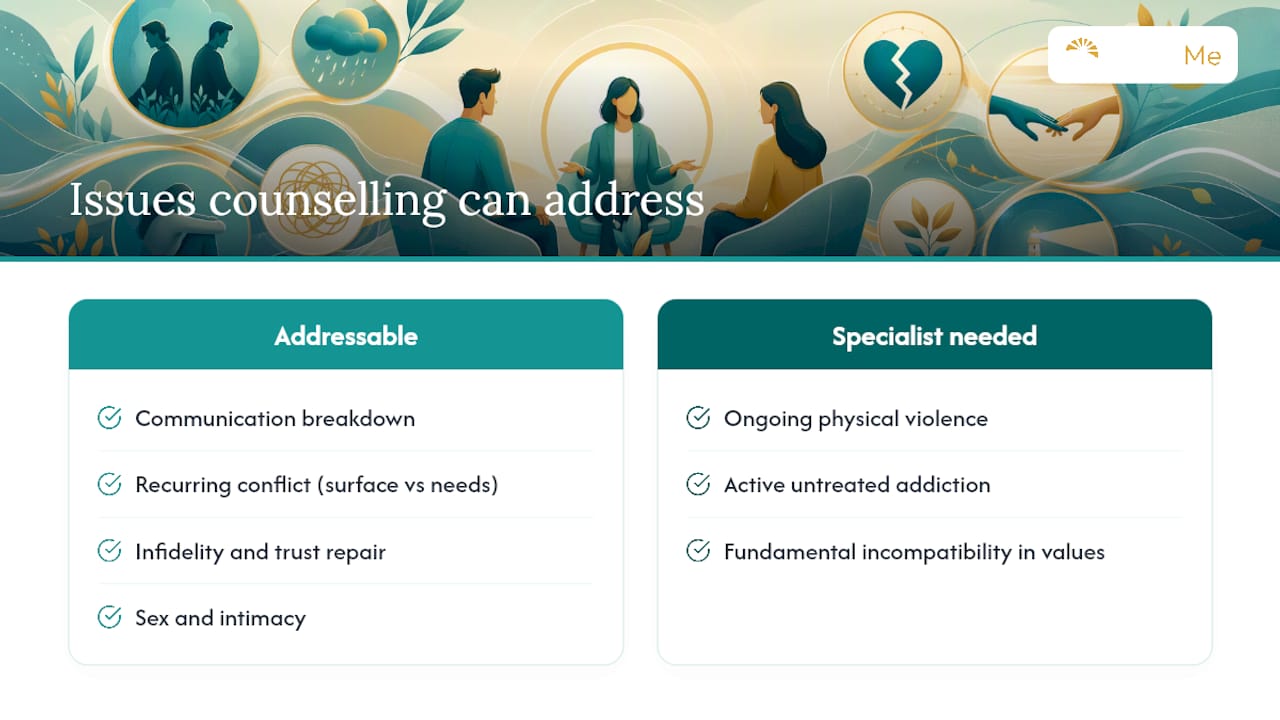
Couples therapy covers a wide range of relationship difficulties. The list below is not exhaustive, but it reflects what therapists most frequently work with.
Communication breakdown. This is the most common presenting issue. Therapy helps couples identify whether they are stuck in a pursue-withdraw cycle, a mutual escalation pattern, or simply talking past each other. The practical goal is to slow conversations down and introduce new ways of listening and responding.
Recurring conflict. Some arguments are about the surface topic (money, chores, in-laws) and some are about underlying unmet needs. A therapist helps couples distinguish between the two, which changes how they fight.
Infidelity and trust repair. Recovering from an affair is possible, though it takes time and genuine commitment from both partners. Therapy provides a structured space to process the betrayal, understand what led to it, and decide whether repair is possible.
Sex and intimacy. Desire discrepancy, loss of physical connection, and sexual difficulties after illness or childbirth are all areas couples therapy can address, sometimes alongside specialist psychosexual therapy.
Parenting and blended-family conflict. Disagreements about discipline, step-parenting roles, and co-parenting after separation are common and respond well to structured therapeutic work.
Grief, illness, and major transitions. Bereavement, serious illness, and significant life changes can pull couples apart. Therapy provides a space to grieve together rather than in parallel.
Financial arguments. Money disputes are rarely just about money. Therapy helps couples understand the values and anxieties driving their financial conflicts.
Counselling is less likely to resolve situations involving ongoing physical violence, active untreated addiction, or a fundamental incompatibility in core values. In those cases, specialist support (addiction services, domestic abuse programmes, or individual therapy) is usually the more appropriate starting point.
How does couples counselling work in practice?
The first session typically runs 60–90 minutes. Follow-up sessions are usually 50–60 minutes, meeting weekly or fortnightly. A typical course lasts 8–20 sessions, though some couples complete focused work in fewer, and others continue longer. Clinical practice literature describes the first session as a joint assessment covering each partner's background, the history of the relationship, and an early set of shared goals.
Here is what usually happens across the opening phase of therapy:
- Assessment (session 1). The therapist gathers background on the relationship, each partner's history, and the main concerns. They may ask about the relationship's strengths as well as its difficulties. Expect questions about how you met, what has changed, and what you are hoping for.
- Goal-setting (sessions 1–2). The therapist works with both partners to agree a shared focus. This is not a list of complaints; it is a jointly held statement of what you both want to be different. Good practice guidance emphasises transparent contracting, including clear discussion of confidentiality, session boundaries, and how progress will be reviewed.
- Intervention phase (sessions 3 onwards). The therapist introduces techniques specific to their approach: identifying emotional triggers, practising new communication patterns, or working through a specific event. Homework between sessions is common.
- Review. Most therapists build in a mid-course review to assess progress and adjust the focus if needed.
Formats available in the UK:
- In-person sessions at a therapist's consulting room
- Video or phone sessions, which are now widely available and offer practical advantages for couples with busy schedules or limited local provision
- Couples workshops or retreats, offered by some charities and private providers for intensive short-course work
- Single-session or check-up appointments for couples who want to address one specific issue
At the first session, the therapist will also cover paperwork: a therapy agreement, data protection information, and their confidentiality policy. Understanding how confidentiality works in therapy before you attend reduces anxiety and helps you engage more openly from the start.
Which therapeutic approaches do couples therapists use?
Most UK couples therapists work integratively, drawing on more than one approach depending on what the couple needs. The four most established methods are described below.
| Approach | Core focus | Best suited to | Typical technique |
|---|---|---|---|
| Emotion-Focused Therapy (EFT) | Attachment needs and emotional cycles | Couples with emotional distance or recurring pursue-withdraw patterns | Identifying and expressing underlying attachment fears rather than surface complaints |
| Gottman Method | Friendship, conflict management, and shared meaning | Couples wanting structured, skills-based work | The "Four Horsemen" framework to identify destructive communication habits |
| Systemic therapy | Relationship patterns in wider family and social context | Couples where family-of-origin dynamics or cultural context are prominent | Circular questioning to reveal how each partner's behaviour influences the other |
| CBT for couples | Unhelpful thought patterns and behaviours | Couples with specific behavioural conflicts or anxiety-driven patterns | Identifying cognitive distortions that fuel conflict and practising alternative responses |
A few practical points worth knowing:
- EFT has a strong evidence base, particularly for emotionally withdrawn or avoidant patterns.
- The Gottman Method is widely taught in the UK and is often used alongside other approaches rather than as a standalone method.
- Systemic therapy is the dominant training tradition in many NHS and charity settings.
- CBT for couples is useful when one or both partners has an anxiety or mood difficulty that is feeding relationship problems.
Many therapists describe themselves as "pluralistic" or "integrative," which simply means they adapt their approach to the couple rather than applying one method rigidly. This is generally a strength, not a weakness.
What does the research say about how effective couples therapy is?
Meta-analytic reviews show that roughly 60–80% of distressed couples report measurable benefit from behavioural and emotion-focused couples therapies. That is a meaningful signal. The caveat is equally important: effects tend to be smaller in routine clinical practice than in controlled trials, and gains diminish for roughly half of couples after treatment ends.
Systematic reviews confirm reliable effects in trials but note that generalisability and long-term maintenance of gains require more research. Randomised and controlled studies also show that individual differences and comorbidities, such as depression, trauma history, or active addiction, moderate outcomes significantly.
What predicts a better result? BACP guidance identifies the therapeutic relationship itself as one of the most reliable predictors of positive outcomes across modalities. Empathy, collaboration, and clear contracting matter more than strict adherence to any single method. Commitment from both partners, early attendance consistency, and lower severity of problems at the start also predict better outcomes. For a deeper look at what evidence-based therapy actually means in practice, the Guidemetherapy blog explains the research framework clearly.
Pro Tip: Set a specific, shared goal before your first session. Couples who arrive with a jointly agreed focus ("we want to argue less about parenting decisions") tend to make faster progress than those who arrive with a general sense that "things aren't working." Specific goals give the therapist something concrete to work with from session one.
Doing homework between sessions, practising new communication patterns in real situations, and attending consistently all increase the likelihood of lasting change. Therapy is not a passive process.
How do you access couples counselling in the UK, and what does it cost?
Access in the UK runs across three main routes: NHS, charity, and private. Each has different wait times, costs, and availability.
NHS. Most NHS Talking Therapies services (formerly IAPT) focus on individual mental health conditions rather than relationship work. Some areas do offer couples-specific provision, but this is variable. Your GP can advise on what is available locally and make a referral. Waiting times for NHS couples therapy can be several months in many areas.
Charity and low-cost options. Relate is the UK's largest relationship support charity and offers counselling on a sliding scale based on income, as well as free telephone and online resources. Other charities, including some faith-based organisations offering Christian marriage counselling, provide low-cost or free sessions. Local counselling services and community organisations may also offer subsidised couples work.
Private therapy. Private couples therapy in the UK typically costs between £60 and £150 per session, with significant variation by location (London rates tend to be higher) and therapist experience. Wait times are usually shorter than NHS or charity routes, often days rather than months.
Key access points to know:
- BACP's therapist directory (bacp.co.uk) lets you search by location, specialism, and fee range
- UKCP's find-a-therapist tool (psychotherapy.org.uk) lists registered psychotherapists
- Psychology Today's UK directory lists private practitioners with profile information
- Relate (relate.org.uk) for charity-sector relationship counselling
- Your GP for NHS referral or signposting to local services
Meta-analytic evidence supports the effectiveness of both NHS-delivered and private couples therapy, though access and quality vary. If cost is a barrier, it is worth asking any private therapist whether they offer a reduced fee, as many do.
Urgent needs. If you or your partner is in crisis, do not wait for a therapy appointment. Contact the Samaritans (116 123), your GP, or NHS 111 for immediate support.
How do you choose the right couples therapist in the UK?
Choosing well at the start saves time and reduces the risk of a poor experience. Work through this checklist before booking.
- Check registration. Confirm the therapist is registered with BACP, UKCP, or HCPC. Registration means they meet minimum training standards, hold professional indemnity insurance, and are bound by a code of ethics. This is non-negotiable. Therapist qualifications vary considerably, so checking the register directly takes less than two minutes and is worth doing.
- Confirm couples-specific training. General counselling training does not automatically include couples work. Ask whether the therapist has specific postgraduate training or supervised experience in couples therapy (EFT, Gottman, systemic, or similar).
- Check experience with your specific issue. A therapist who works mainly with anxiety may not have deep experience with infidelity repair or sexual difficulties. Ask directly.
- Ask about their safeguarding policy. Any registered therapist should have a clear policy on what happens if safeguarding concerns arise. If they cannot explain it, that is a concern.
- Confirm practical logistics. Session length, fees, cancellation policy, and how they handle missed sessions should all be transparent before you start.
Questions to ask on a discovery call:
- What is your approach to couples work, and how do you adapt it to different situations?
- How do you handle confidentiality when one partner discloses something privately?
- Do you have experience working with LGBT+ couples, or with couples from specific cultural or religious backgrounds?
- How do you review progress, and how will we know when therapy is complete?
- What happens if one of us wants to stop and the other does not?
Red flags to watch for:
- The therapist appears to take one partner's side consistently
- They encourage one partner to share information privately that is then used in joint sessions
- Fees or qualifications are not clearly stated upfront
- There is no mention of a review point or an end to therapy
- They dismiss concerns about safety or minimise descriptions of controlling behaviour
Therapy boundaries and the role of trust in therapy are both worth understanding before you start, so you know what good practice looks like from the inside.
How to prepare for your first couples therapy session
The first session tends to feel exposing. That is normal. A little preparation makes it easier to use the time well.
Before you go:
- Agree a short, joint statement of what you both hope to get from therapy. It does not need to be detailed. "We want to communicate better when we disagree" is enough.
- If it helps, bring brief notes on the main issues you want to raise. But do not prepare a "case" against your partner. The therapist is not a judge.
- For online sessions, find a private space where neither of you will be overheard. Headphones help.
During the session:
The therapist will lead. Your job is to be honest, not to perform. The first session structure typically covers background, the relationship's history, and early goals. You will not be expected to resolve anything in session one.
After the session:
Many couples feel emotionally raw after an intense first appointment. Practitioner accounts recommend giving yourselves time to process rather than launching into a heavy conversation the same evening. Go for a walk, watch something light, or simply acknowledge that it was a lot. The 5-5-5 rule is a regulation heuristic some therapists suggest: when a disagreement feels intense, each partner rates it on a scale of 1–5 for how important it will feel in five minutes, five months, and five years. This helps triage emotional intensity and decide whether a conversation needs to happen right now or can wait. It is a regulation tool, not a repair method, and it does not address the underlying issue.
When counselling may not be enough and where to get urgent help
Couples counselling is not the right first step when there is an immediate safety risk. This is a firm boundary, not a caveat.
Situations that need specialist support before or instead of couples therapy:
- Domestic abuse or coercive control. Joint sessions can be unsafe and may give an abusive partner information or leverage. Contact the National Domestic Abuse Helpline (0808 2000 247) or Women's Aid (womensaid.org.uk) first.
- Active addiction. Couples therapy is significantly less effective when one partner has an untreated substance dependency. Specialist addiction services (such as Turning Point or Change Grow Live) are the more appropriate starting point.
- Suicidal ideation or acute mental health crisis. Contact the Samaritans (116 123), NHS 111, or your GP urgently. A Crisis Team referral may be needed before couples work can begin.
- Serious trauma. Where one or both partners has unprocessed trauma, individual trauma-focused therapy (such as EMDR or trauma-focused CBT) may need to run alongside or before couples work.
Individual therapy and couples therapy are not mutually exclusive. Many couples find that one or both partners working individually alongside joint sessions produces better results, particularly where personal history is affecting the relationship. Randomised studies confirm that comorbidities moderate couples therapy outcomes, which is why stepped or combined care is sometimes the more appropriate plan.
This article provides general information and is not a substitute for professional advice. If you have concerns about your safety or mental health, please contact a qualified professional or emergency service.
How Guidemetherapy can help you start couples counselling
Finding the right couples therapist is harder than it should be. Searching directories, reading profiles, and making cold calls takes time and energy that most people do not have when they are already struggling. Guidemetherapy is designed to remove that friction.
Here is how the platform works:
- In-depth screening. You complete a structured questionnaire that covers your relationship concerns, therapy history, preferences, and practical needs (location, budget, availability).
- Personalised therapy plan. Based on your screening, Guidemetherapy generates a therapy plan that identifies the most relevant approaches and the type of therapist likely to suit your situation.
- AI-assisted and human-led matching. The platform combines AI-powered analysis with human oversight to match you with a qualified couples therapist from its network of registered practitioners.
- Booking support. Once matched, you can book directly through the platform without navigating multiple directories or making speculative calls.
- Between-session resources. Guidemetherapy provides ongoing support between appointments, including tools and guidance to help you apply what you are working on in therapy.
The next step is straightforward: visit Guidemetherapy and complete the short matching questionnaire to get your personalised therapy plan and therapist match.
An editorial perspective on what couples therapy actually requires
The research on couples therapy is genuinely encouraging, but there is a gap between what the headline figures suggest and what most couples actually experience. Routine practice is messier.
What the evidence consistently shows is that the quality of the therapeutic relationship matters more than the specific method a therapist uses. A skilled, empathic therapist using an integrative approach will usually outperform a rigid adherent to any single branded method. This means the most important thing you can do is not to find a Gottman-certified therapist or an EFT specialist, but to find someone you both feel genuinely safe with.
The second thing most couples underestimate is their own role. Therapy is not something that happens to you. The couples who make lasting gains are the ones who practise new patterns between sessions, who tolerate the discomfort of being honest in the room, and who stay consistent even when sessions feel unproductive. Commitment to the process is not a soft variable. It is the variable.
Finally, there is a tendency to treat couples therapy as a last resort. Couples who start earlier, when patterns are less entrenched, tend to do better. If you have been thinking about it for six months, that is probably already later than ideal.
Ready to find a couples therapist who fits?
Searching for a therapist when your relationship is under strain is genuinely difficult. Guidemetherapy was built to make that process clearer and faster, so you spend less time searching and more time in the room with someone who can actually help.
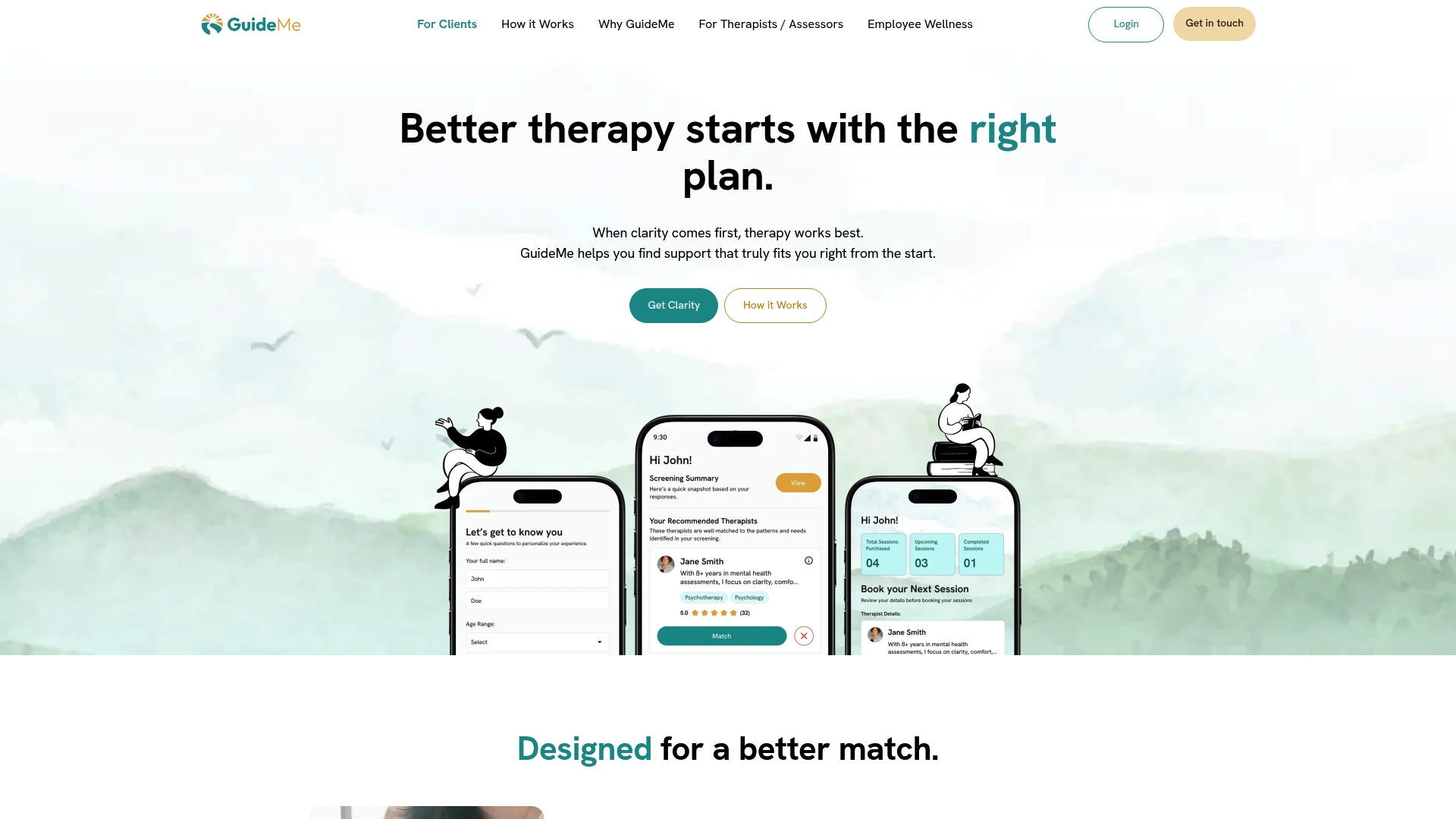
Complete the short matching questionnaire at Guidemetherapy and receive a personalised therapy plan within minutes. The platform's human-led, AI-assisted matching connects you with a registered couples therapist suited to your specific concerns, budget, and availability. No lengthy directory searches, no cold calls. Just a clearer path to the right support.
Sources
The following sources are cited in this article or provide reliable further reading for couples considering therapy in the UK.
- Interventions for Couples | Annual Reviews
- What works in counselling and psychotherapy relationships
- Ncbi
- Pmc
- Ncbi
- Pubmed
- The 5-5-5 Rule for Couples: What It Is, Where It Came From, and How to Use It — Daniel Dashnaw